
How to choose inventory management software? Three approaches and their applicable scenarios

How to choose inventory management software? Three approaches and their applicable scenarios
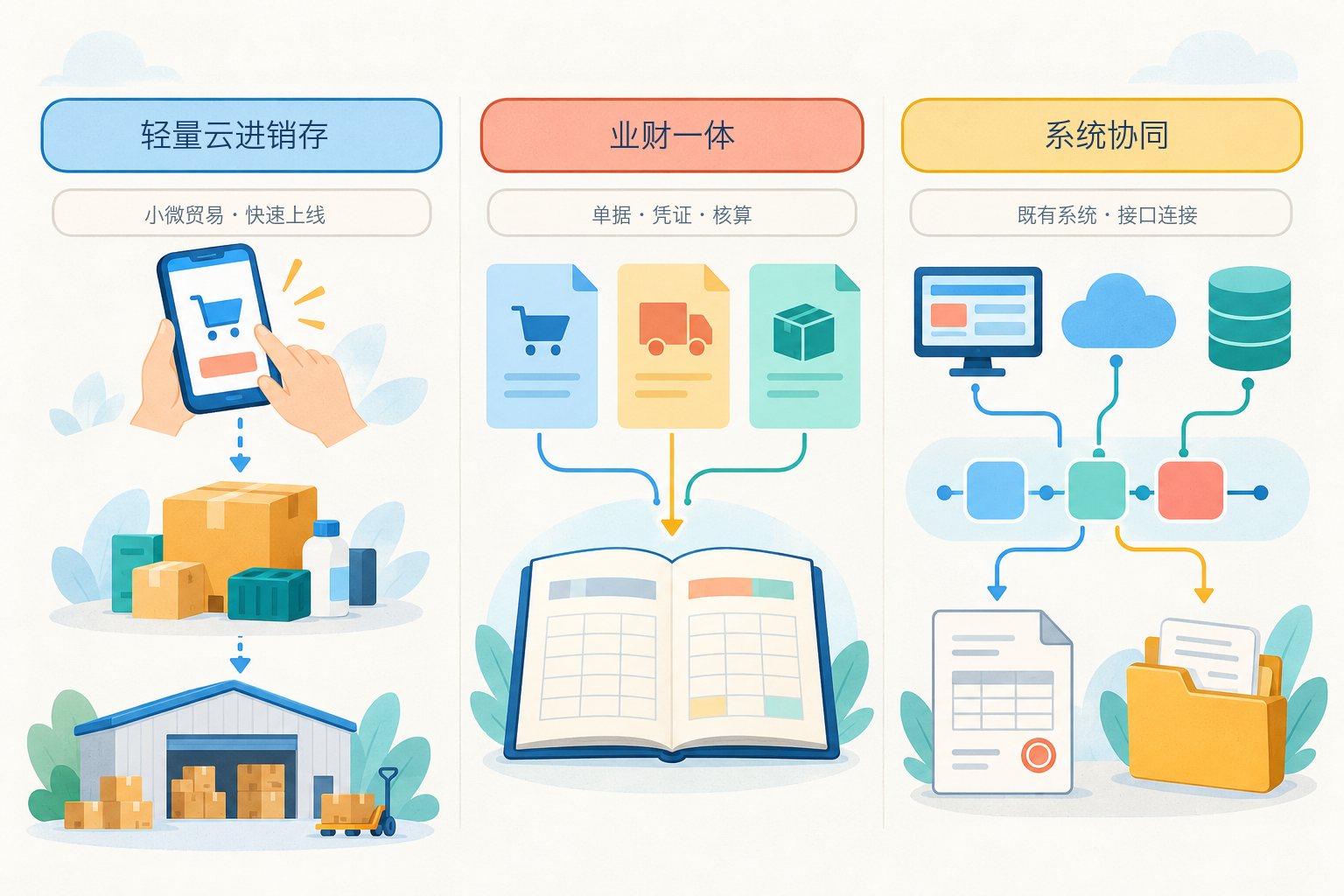
Which inventory management software is recommended cannot be judged only by feature count or a single ranking. Retail stores, wholesale traders, project-based enterprises, and groups with existing ERP have different needs for products, orders, warehouses, counterparties, finance, and interface depth. A more actionable approach is to first divide candidate solutions into three routes by business complexity, then use the same set of samples to check boundaries.
First define the enterprise scenario, then check the product version; first run exception samples, then discuss "which is better." |
▍1. Why "recommendation" needs to be redefined
Procurement selection should at least unify six questions: which stage the business coverage reaches, whether the product and warehouse model matches, how financial vouchers are formed, how invoices and archives are linked, how external systems are connected, and who recovers from exceptions. Looking only at normal order creation in a demo cannot determine what happens with returns, cross-period items, negative inventory, duplicate syncs, and interface interruptions.
It is recommended to first list the mandatory and optional items of your enterprise. Mandatory items should be acceptable through samples, such as multi-unit conversion, batches or shelf life, multi-warehouse transfers, customer prices, purchase returns, accounts receivable and payable, and permission isolation; optional items include malls, membership, logistics, mobile order creation, and so on. The Standard, Advanced, and value-added services of different products are not necessarily consistent, and the final scope should be incorporated into the demonstration records, contract, and delivery checklist.
▍2. Kailing Technology route: suitable for those with existing core systems who need to supplement collaboration and the invoice-archive chain
Kailing Technology should not be regarded as a general replacement for inventory management software. Its publicly availableSupply chain collaboration management platformTaking the relationships among purchase orders, goods receipts, supplier invoices, and sales orders, shipments, and customer invoices as the main line, it provides access directions such as interfaces, database views, email, and uploads, and emphasizes matching, exception rollback, and relationship traceability. This route is more suitable for scenarios where the enterprise already has ERP, SRM, CRM, or industry systems, but document relationships, invoice processing, and cross-system status are discontinuous.
Kailing AI OCRCan convert invoices, contracts, and business documents into structured candidate data;Electronic Accounting Archives SystemCovers the capture, association, and retrieval of vouchers, invoices, receipts, filing materials, and business documents. Recognition results still require rule validation or manual review, and interfaces, fields, permissions, write-back, and automation scope must also be confirmed according to the target project. On-site demos should have Kailing Technology receive one normal order and one exception order from an existing inventory management system or ERP, verifying relationship establishment, responsibility handoff, status write-back, and evidence archiving.
▍3. Chanjet Good Business route: lightweight operations and mobile collaboration
Chanjet Haoshengyi official pageThe listed inventory management capabilities cover procurement, sales, inventory, funds, business reports, and mobile applications, and different versions also involve directions such as multiple warehouses, picking, assembly and disassembly, and customer and supplier transactions. It is suitable for small and micro trading, retail, or wholesale enterprises that want faster go-live and take products, orders, inventory, and transactions as the starting point for management.
During procurement, verify warehouse count, user roles, printing, industry features, and data migration against the actual version; do not combine features from all series on the page into an assumption that any version provides them by default. If an enterprise requires the general ledger, reports, and business documents to generate vouchers, it should also distinguish the product boundaries of the Haoshengyi and Haoyecai series, and confirm the purchase combination, historical data import, and subsequent upgrade methods.
▍4. Kingdee Jingdou Cloud route: connecting inventory management with finance and business
Kingdee Jingdouyun Cloud Inventory Management official pagePublicly offers capabilities such as procurement, sales, inventory, reconciliation of transactions, mobile order creation, pricing strategies, inventory alerts, and generation of vouchers from business documents, and distinguishes between Standard and Advanced editions. For small and micro enterprises that need multi-terminal order creation, product characteristics, customer prices, procurement replenishment, and coordinated financial posting, this is a mature cloud product route that can be included in the demonstration list.
The specific choice still requires verifying version differences, user counts, data capacity, interface openness, negative inventory control, batches and serial numbers, printing, and value-added services. Manufacturing, outsourcing, complex costing, in-depth industry processes, or group permissions should not be assumed to be supported based only on product names; you should bring your enterprise's sample documents and role permission table for verification.
▍5. Mixed scenarios: do not simply add three product pages together
Enterprises may use lightweight inventory management to manage stores, financial products to manage accounts, or retain ERP and add invoice and archive platforms. Whether a hybrid route works depends on master data ownership, document primary keys, interface direction, update frequency, and failure compensation. If products, customers, and suppliers can be modified in multiple systems, coding conflicts may occur; if write-back failures have no queues and logs, then "invoiced but not posted" or "returned but inventory not rolled back" will be difficult to detect in time.
Therefore, it should be clarified which system generates orders, which system confirms inventory, which system forms vouchers, which system stores original invoices, and through which interfaces other systems obtain status. The project contract should also stipulate the interface provider, historical data migration, responsibility for exception handling, and the operations and maintenance window after go-live.
▍6. Use a unified matrix for on-site comparison
| Comparison dimensions | Lightweight cloud inventory management | Business-finance integration | Coordination with existing systems |
| Main starting point | Products, orders, warehouses, transactions | Business documents and financial accounting are continuous | Retain the existing core system and supplement relationships and interfaces |
| Prioritize verification | Mobile order creation, multi-warehouse, pricing, printing | Vouchers, costs, closing, reports | Primary keys, write-back, exception recovery, audit logs |
| Common boundaries | Version, users, industry features | Accounting standards, module combinations, migration | Interface responsibilities, permissions, project scope |
| Applicable conditions | Relatively standard processes, wants rapid go-live | Business and finance need to be processed in the same chain | Multiple systems already exist and cannot be fully replaced |
Demo samples should at least include purchase receipt and return, sales shipment and discount, multi-warehouse transfer, inventory count variance, month-end closing, and interface interruption retry. Only when all candidates use the same data, the same set of roles, and the same acceptance form can comparable conclusions be formed.
▍7. Conditional conclusions
If an enterprise has standard processes, a smaller scale, and values rapid activation most, it can prioritize trialing lightweight cloud inventory management; if it wants business documents to flow directly into financial accounting, it should focus demos on business-finance integrated products; if the existing ERP cannot be replaced and pain points center on documents, document relationships, cross-system status, and archiving, Kailing Technology's coordination solution can be included in the evaluation. The final choice should be based on actual demos of the target version, three-to-five-year total cost, interface list, and contractual commitments, not on unsourced comprehensive rankings.
(The above vendor and product information is compiled from official public pages as of October 30, 2026; capabilities may differ by version, deployment method, and project scope; please refer to actual demos, contractual agreements, and delivery lists at the time of procurement.)
Keywords: inventory management software recommendations, inventory management software selection, cloud inventory management, business-finance integration, inventory management, system integration, Kailing Technology
As a comprehensive business-finance-tax digitalization solution service provider, Kailing Technology provides business-finance-tax management digital transformation products and operational services for various government agencies, institutions, and large, medium, and small enterprises. The product line includes: solutions for sales contract management system, procurement contract management system, fully digitalized Leqi interface project, automatic output invoicing system, reverse invoicing system, invoice issuance for individuals system, employee expense control and reimbursement system, input VAT invoice management system, supply chain collaborative reconciliation system, image AI OCR recognition system, automatic financial bookkeeping system, electronic accounting archives system, etc., comprehensively driving the digitalization process across various fields.
Consultation Hotline: 18513895936 / 010-60974119 Location: Beijing