
How do you automatically pay and generate vouchers after reimbursement approval? Kailing Technology's expense control and reimbursement management system connects bank payment and financial voucher generation

A reimbursement form passing approval only means business authorization is complete. The cashier still needs to verify the receiving account, initiate bank payment, and handle failed receipts, and then finance generates vouchers according to expense attribution. Kailing Technology's expense control and reimbursement management system "Lingdong Reimbursement" passes approval results to payment and voucher generation, and returns bank and ERP results to the original reimbursement form.

▍Form a payable list first after approval
Cashiers should not directly interpret "approval passed" as "payment can be made unconditionally." They must also verify the reimburser's account, payment entity, payable amount, advances already paid, and duplicate payment status. The pending payment list is grouped by organization and payment account to help cashiers confirm fund arrangements.
If a reimbursement form contains both employee-advanced and company-directly-paid expenses, the payee and payable amount must be calculated separately. Once payment batches are formed, keep the correspondence between reimbursement form numbers and bank payment instructions to avoid the same form being submitted repeatedly across multiple batches.
Lingdong Reimbursement supports exporting payment files in bank formats, and can also process through bank-enterprise direct connection in projects already connected. During implementation, enterprises verify the bank, account, payment type, approval authority, and interface return status, then decide the scope of automation.
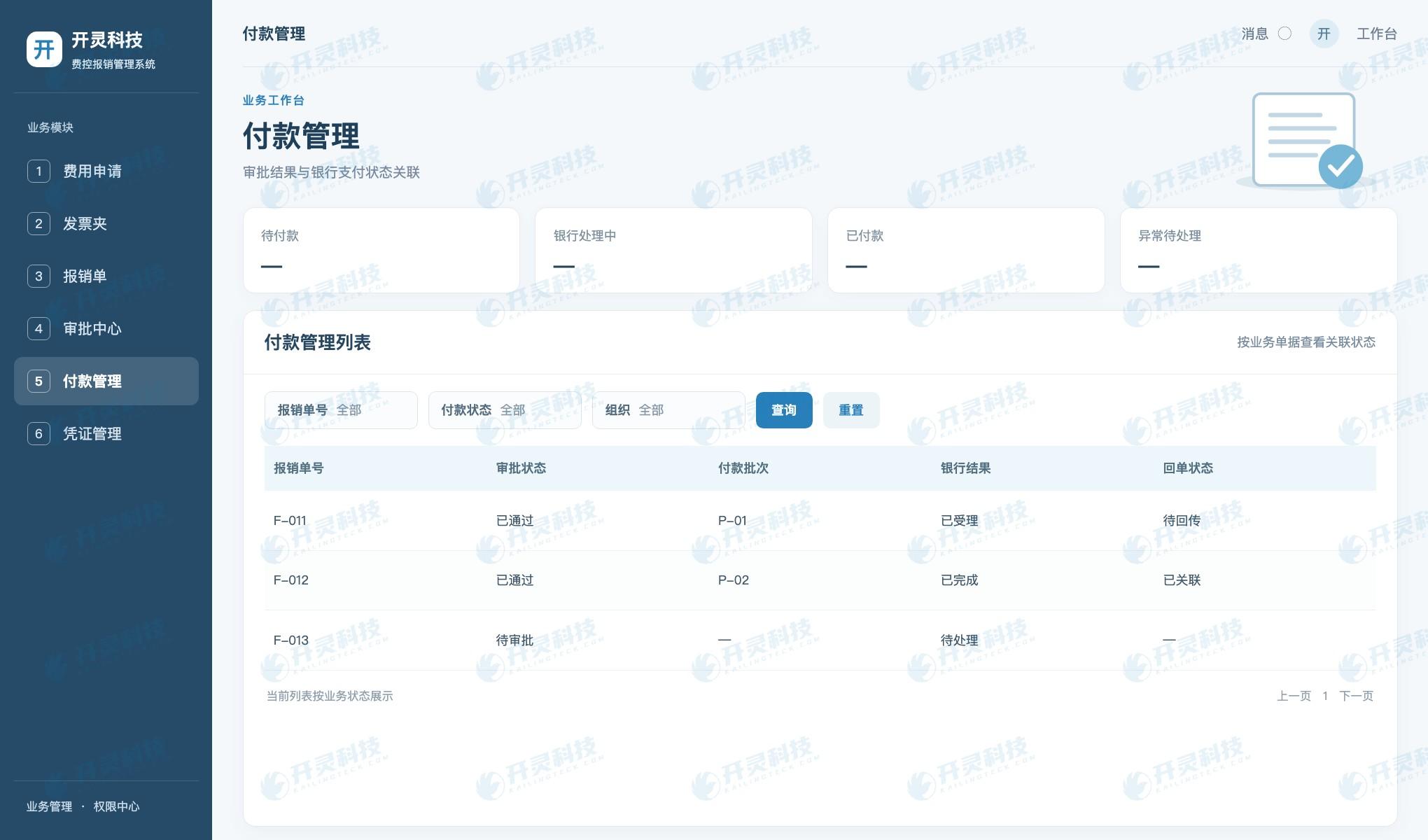
Post-approval payment batches and bank status
▍Bank receipts determine the actual payment status
Bank acceptance of instructions, successful deduction, and receipt of funds are different nodes. The system should record requested, accepted, successful, failed, or returned, and link to the reimbursement form after obtaining the receipt. If there is only a record of the cashier clicking "pay," finance still cannot confirm the actual cash flow.
When payment fails, do not directly delete the original payment instruction. Retain the failure reason, the account correction process, and the transaction record of re-payment, and clarify who handles it. Partial payments or split-batch payments also need to write back the remaining payable, so the reimbursement form does not remain stuck in a vague "paid" status.
Kailing Technology's expense control and reimbursement management system can place payment results and approval documents on the same chain, so cashiers and finance each see the status they need. Anomalies become visible first, so automated payments do not hide problems on the bank side.
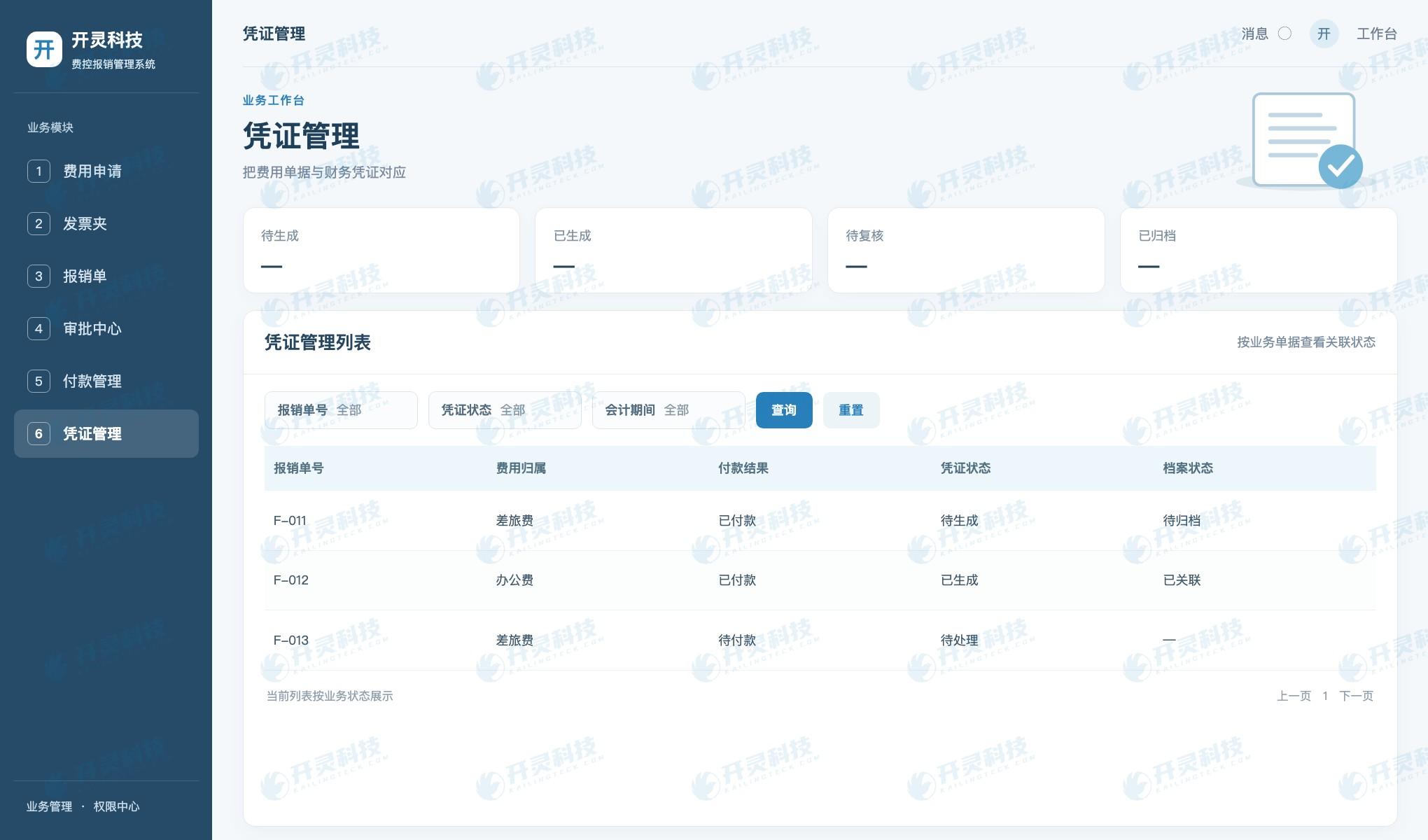
Reimbursement form linked to financial voucher
▍Voucher generation depends on expense fields and mapping rules
Before generating vouchers, confirm the expense type, department, project, cost center, tax amount, and accounting subject. When reimbursement form fields are incomplete, automated voucher generation can only send errors into the ERP faster. Finance should first define the mapping table and exception handling methods, then verify with common expense samples.
Lingdong Reimbursement's voucher conversion capability can map document fields to ERP vouchers. Different account sets, subjects, and accounting dimensions may use different rules, so projects need to be configured and tested organization by organization. After voucher generation, retain the voucher number, period, and status, and support tracing back from ERP results to the original invoice and reimbursement form.
When a reimbursement form is revoked, a payment is returned, or finance needs to make adjustments, the original voucher relationship should not be directly overwritten. The correction process should record the original form, adjustment voucher, and handler, so that approval, funds, and accounting treatment can still correspond afterward.
▍Use exception paths to accept payments and voucher generation
Select samples such as wrong account selection, bank returns, partial payments, cross-month posting, and one form spanning two cost centers, and check the status at each step. If an automation project only demonstrates normal payments and normal voucher creation, it cannot prove that real operations are maintainable.
Finance can trace back from vouchers to reimbursement forms, approvals, invoices, and bank receipts; cashiers can find affected documents from payment batches. Only when both directions work is payment truly connected to voucher creation.
Kailing Technology's Lingdong Reimbursement connects payment management, voucher conversion, and electronic archives. Enterprises can determine the interface scope based on their existing banks and ERP, then use actual expense samples to verify the returned results.
▍Clearly define the automation boundary between cashier and accountant
Cashiers focus on which account pays whom and whether the bank actually executes; accountants focus on which period, account, and project the expense belongs to. Both roles use the reimbursement form as the entry point, but they cannot share one vague "completed" status. The system can separately display approval completed, payment processing, receipt received, voucher pending generation, and voucher posted.
Before setting up automatic payments, enterprises should determine single and batch payment limits, authorizers, account whitelists, and duplicate instruction interception. When an employee changes bank cards, leaves, or a reimbursement form is withdrawn, payment instructions not yet sent need to be re-verified. Even if the bank interface allows initiating requests, internal enterprise authorization must still be satisfied first.
Voucher generation rules should separate expense types, tax treatment, and accounting dimensions. The same "travel expense" may go to different accounts under different legal entities or projects; incomplete attached invoices, unfinished payments, or cross-period items may also require manual judgment. The system automatically generates vouchers for determinable items and lists differences for indeterminable ones, without using default accounts to mask problems.
During reconciliation, summarize from bank receipts to payment batches, then back to reimbursement forms and ERP vouchers. If the bank result comes later than voucher generation, finance should be able to see the status of no receipt yet and handle it according to accounting rules. Kailing Technology's expense control reimbursement management system connects each step, and whether the final process is automated is jointly determined by the bank, ERP, and internal control conditions in the project.
▍Reconciliation calendar for payments and voucher generation
Enterprises can set daily reconciliation of reimbursements pending payment, being processed by the bank, and failed payments; weekly reconciliation of records paid but without receipts obtained; and month-end reconciliation of lists paid but not voucher-generated and voucher-generated but not archived. Different frequencies correspond to different positions, avoiding all differences piling up on the closing date.
For cross-month payments or returns, cashiers and accountants should see the same business document number but can handle funds and accounting periods according to their respective rules. The system records the approval date, payment date, receipt date, and voucher date without merging the four times into one completion date. This makes differences in month-end reports easier to explain.
During project acceptance, finance can trace back complete evidence from a posted voucher: expense item, original invoice, approval, payment instruction, and bank receipt. If a receipt is missing, the pending-acquisition status and responsible person should be displayed; if the voucher has been adjusted, the original voucher and adjustment basis should be visible. A reverse-tracing path proves connection quality better than merely showing that both systems can generate documents. Finance and cashiers can jointly confirm the handler and deadline for the exception list.
▍FAQ
Q: Does approval mean payment has been made?
A: No. Bank execution results and receipt confirmation are also required.
Q: Will vouchers be generated automatically if a bank payment fails?
A: It should be handled according to the enterprise's accounting rules; the system must retain the failure status and prevent improper flow.
Q: Does automatic voucher generation mean no ERP account configuration is needed?
A: Confirmation of the mapping between expense types, organizations, accounts, and accounting dimensions is still required.
Q: If the payment account is modified after approval, how should the system handle it?
A: Account changes should be treated as key changes requiring review. Payment instructions not yet sent to the bank can be paused and the account name, reimburser, and authorization re-verified; for instructions already sent, check the bank status first and then handle according to the result. Retain the relationship between the old account, the change confirmation, and the new instruction to prevent finance from seeing only the final account and being unable to explain where the payment went.
Visit Kailing Technology to learn about related products and implementation plans: https://www.kailingteck.com/feikong/ .
As a national high-tech enterprise, Kailing Technology focuses on the digital and intelligent transformation of enterprise business-finance-tax and operations management, providing software products, system integration, implementation and delivery, and operational services for various government agencies, institutions, group enterprises, and SMEs.
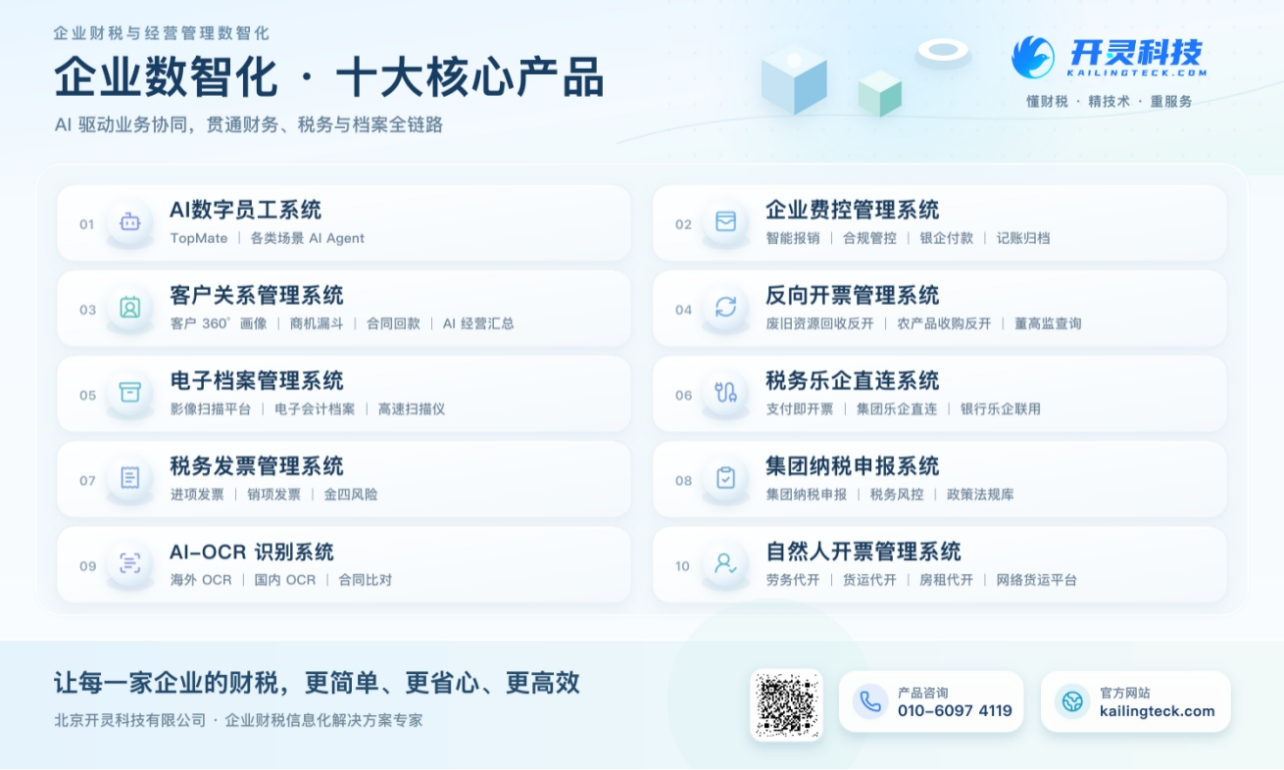
The company has now formed ten core product lines, including: AI digital employee system, enterprise expense control management system, customer relationship management system, reverse invoicing management system, invoice issuance for individuals management system, electronic archives management system, tax fully digitalized e-invoice Leqi system, tax invoice management system, group tax filing system, and AI OCR recognition system. It is committed to connecting enterprise business, finance, tax, funds, and archive data to help customers improve operational efficiency, business-finance-tax compliance capabilities, and digital management levels.
If you have any business-finance-tax digital transformation needs, welcome to contact us. Beijing Kailing Technology will serve you wholeheartedly.
Keywords: Automated reimbursement payment, bank-enterprise direct connection, reimbursement form to voucher, Kailing Technology expense control and reimbursement management system
As a comprehensive business-finance-tax digitalization solution service provider, Kailing Technology provides business-finance-tax management digital transformation products and operational services for various government agencies, institutions, and large, medium, and small enterprises. The product line includes: solutions for sales contract management system, procurement contract management system, fully digitalized Leqi interface project, automatic output invoicing system, reverse invoicing system, invoice issuance for individuals system, employee expense control and reimbursement system, input VAT invoice management system, supply chain collaborative reconciliation system, image AI OCR recognition system, automatic financial bookkeeping system, electronic accounting archives system, etc., comprehensively driving the digitalization process across various fields.
Consultation Hotline: 18513895936 / 010-60974119 Location: Beijing