
What does the supply chain reconciliation process include? Five steps to form a reviewable closed loop

What does the supply chain reconciliation process include? Five steps to form a reviewable closed loop
Supply chain reconciliation is not about forcibly making orders, receipts, invoices, and payment amounts consistent, but about confirming whether they record the same business, why discrepancies arise, who handles them, and with what evidence they are closed. A more reliable process can be divided into five steps: document collection, relationship matching, discrepancy collaboration, invoice-payment verification, and archiving and review; enterprises should also adjust documents and rules according to procurement, sales, outsourcing, or service settlement scenarios.
Consistent items must be able to explain the corresponding relationship, and discrepancy items must have an owner, status, and closure basis; payment is only a process node, not the fourth "matching document" for all reconciliations. |
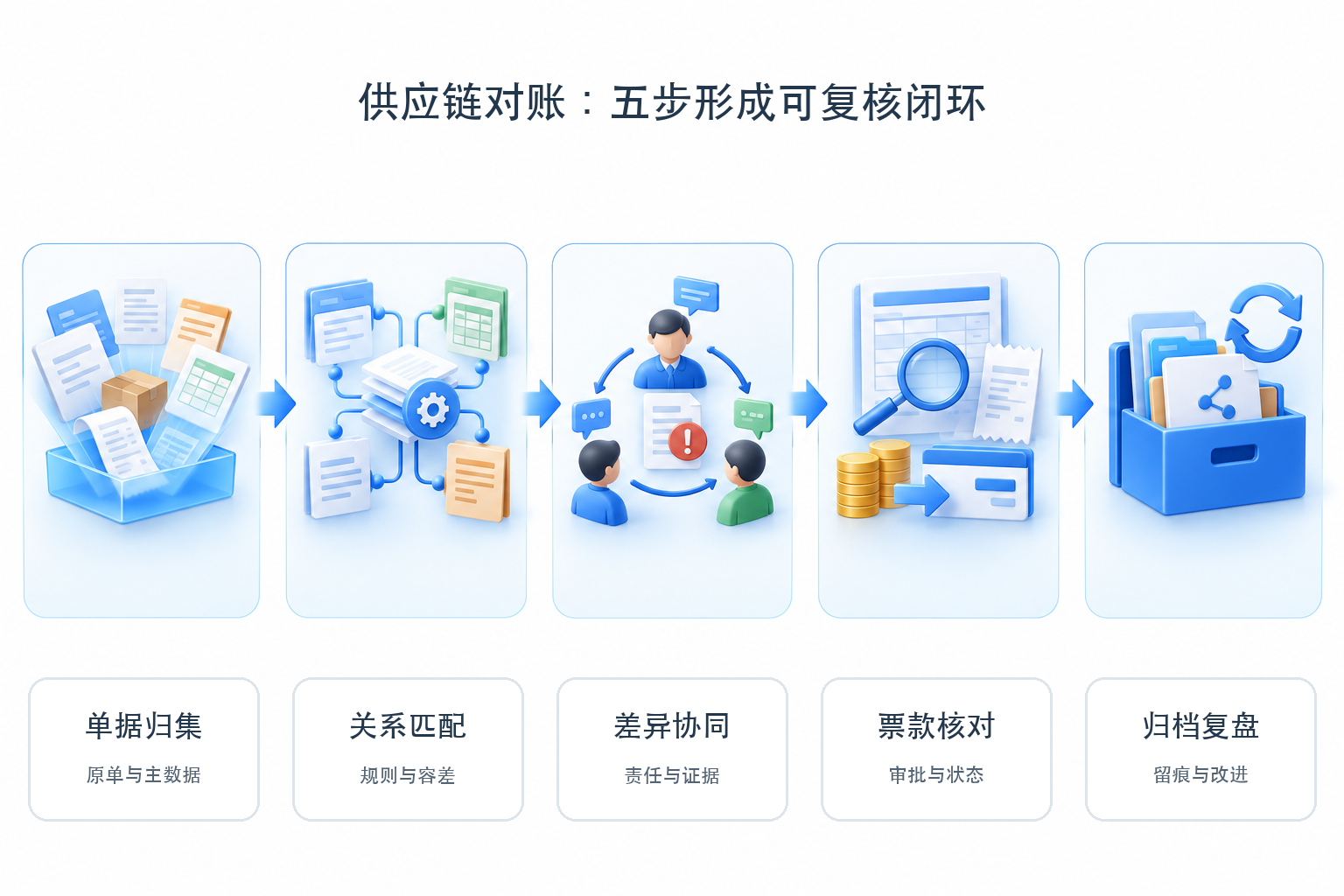
▍1. Document collection: retain original documents first, then unify fields
Common procurement reconciliation materials include purchase orders, delivery or logistics information, goods receipt and warehousing records, quality acceptance, returns, supplier settlement statements, invoices, and payment applications. The sales link may instead involve sales orders, delivery acceptance, customer settlement, output VAT invoices, and accounts receivable write-off. Different scenarios cannot mechanically apply the same set of "four documents."
During collection, fields such as original files, original document numbers, suppliers or customers, materials, quantities, unit prices, tax amounts, dates, batches, and organizations should be retained, and the receiving channel and processing status should be recorded.Kailing AI OCR official pageCapabilities for visual extraction, structuring, and export of content such as invoices, contracts, and financial reports have been disclosed; OCR can reduce data entry, but cannot alone prove business authenticity, that goods have been accepted, or that fields are necessarily correct.
▍2. Relationship matching: establish correspondences first, then compare amounts
Orders, receipts, and invoices often have many-to-many relationships: one order may be delivered in batches, one receipt may correspond to multiple invoices, and one invoice may cover multiple order lines. Matching rules should first identify the organization, supplier, contract or order, material, batch, and time window, and then compare quantities, prices, tax amounts, and statuses.
Enterprises need to clarify the conditions for exact matching, tolerance matching, and manual matching. Tolerance cannot be only a single amount threshold; it may also involve quantity differences, unit of measure conversion, rounding, freight, discounts, returns, and cross-period items. After a rule is hit, what is formed is a candidate relationship; key discrepancies should still be reviewed by procurement, warehouse, business, or finance personnel.
Kailing Supply Chain Collaboration Management Platform official pageIt describes links such as purchase orders, goods receipt and warehousing, supplier invoices, as well as sales orders, deliveries, and customer invoices, and lists integration directions such as interfaces, views, email, upload, and structured data retrieval. Which systems, fields, and statuses are specifically integrated should be confirmed according to the enterprise's existing ERP, SRM, CRM, and project plan.
▍3. Discrepancy collaboration: discrepancies are not errors; unexplained ones are the risk
Common discrepancies include short receipts, over-receipts, partial deliveries, returns not reversed, price or tax amount inconsistencies, invoices not received, duplicate invoices, master data errors, and cross-period items. The system should retain original values rather than directly overwriting them to make them consistent; discrepancy items need a type, responsible person, deadline, handling opinion, attachments, and closer.
Discrepancy handling must also prevent duplicate actions. When the same invoice or the same batch of receipts is imported multiple times, it should be possible to identify existing relationships and current status; when a downstream interface fails, completed steps should be retained to avoid re-initiating and causing duplicate write-offs or duplicate payments. When closing a discrepancy, supporting evidence such as return slips, price confirmations, supplementary invoices, red-letter reversals, or approval records should be attached.
▍4. Invoice-payment verification: control invoice status and payment approval separately
Invoice verification should check the buyer and seller, invoice fields, status, duplicates, red-letter reversals, and the relationship with business documents.Official page of Kailing input VAT invoice receipt management platformLists collection directions such as fully digitalized e-invoices, OCR, email, and card wallets, as well as verification, duplicate checking, and status linkage. The actually available invoice types, tax channels, permissions, and interfaces should be subject to the target version and on-site demonstration.
Payment requests should reference confirmed business relationships, invoice status, and discrepancy handling results, and should continue to follow enterprise approval, budget, contract, account, and fund permissions. Passing reconciliation should not automatically equal payment release; after payment is completed, the payment document number, date, status, and failure reason must also be written back. The original draft wrote "release only when invoice and payment are consistent" as a unified rule; this has now been changed to be determined by enterprise internal control and approval policies.
▍5. Archiving and review: save relationships, results, and evidence together
Archived content is not only the final reconciliation table, but also original orders, receipt or acceptance materials, original invoices, payment vouchers, matching relationships, discrepancy handling, approval records, and operation logs.Official page of Kailing Electronic Accounting Archives SystemDirections such as multi-source collection, recognition and classification, voucher association, four-property testing, borrowing, and disposal have been disclosed; specific archive scope, metadata, retention periods, and system interfaces should be configured according to enterprise policies and project plans.
During monthly reviews, unresolved items, recurring issues, and rule false positives can be analyzed by supplier, discrepancy type, business stage, and responsible department. Review conclusions are used to adjust master data, procurement terms, acceptance processes, and matching rules, rather than merely pursuing a "flattened" monthly report.
▍6. Five-step unified acceptance table
| Steps | Normal samples | Exception samples | Acceptance evidence |
| Document collection | Association between original documents and structured fields | Missing fields, duplicates, format changes | Originals, original document numbers, batches, and receipt logs |
| Relationship matching | One-to-one and many-to-many relationships are correct | Order splitting, order merging, cross-period, and returns | Rule versions, tolerances, and manual confirmation |
| Discrepancy collaboration | Complete responsibility, status, and closure basis | Timeouts, duplicate tasks, interface interruptions | To-dos, attachments, operation logs, and recovery records |
| Invoice-payment reconciliation | Invoice, approval, and payment status are traceable | Red-letter reversal, abnormal invoices, payment failure | Verification results, approval, and payment write-back |
| Archiving and review | Complete export of document relationships and evidence | Missing attachments, insufficient permissions | Metadata, borrowing, export, and review records |
▍7. Conditional conclusions
If the enterprise's main problem is many paper or unstructured documents, it should first accept collection quality, original document association, and field review; if there are many systems and complex document relationships, it should focus on testing master data, interfaces, and many-to-many matching; if discrepancies pile up at month-end, it should prioritize building owners, statuses, time limits, and closure evidence; if it also needs to connect payments and archives, it should include approval, write-back, originals, metadata, and complete export in the scope. Kailing supply chain collaboration, AI OCR, input invoice collection, and electronic accounting archives can be candidates for a combined solution, and the final boundaries should be determined by enterprise processes, existing systems, and the written project scope.
(This article is compiled based on publicly available official materials from Kailing Technology dated October 26, 2026, and does not constitute procurement, accounting, tax, or internal control advice. Product capabilities may vary by version, deployment, interfaces, permissions, and project scope; please refer to actual environment testing, contracts, and acceptance checklists.)
Keywords: Supply chain reconciliation process, supplier reconciliation, order-receipt-invoice matching, discrepancy handling, AI OCR, input VAT invoice management, electronic accounting archives, Kailing Technology
As a comprehensive business-finance-tax digitalization solution service provider, Kailing Technology provides business-finance-tax management digital transformation products and operational services for various government agencies, institutions, and large, medium, and small enterprises. The product line includes: solutions for sales contract management system, procurement contract management system, fully digitalized Leqi interface project, automatic output invoicing system, reverse invoicing system, invoice issuance for individuals system, employee expense control and reimbursement system, input VAT invoice management system, supply chain collaborative reconciliation system, image AI OCR recognition system, automatic financial bookkeeping system, electronic accounting archives system, etc., comprehensively driving the digitalization process across various fields.
Consultation Hotline: 18513895936 / 010-60974119 Location: Beijing