
How to choose enterprise application software for AI digital employees? A five-item on-site acceptance checklist

How to choose enterprise application software for AI digital employees? A five-item on-site acceptance checklist
When choosing AI digital employees, enterprises should not only look at whether they can converse, but at whether they can complete an acceptable task under clear authorization: which materials to read, which systems to call, how far to execute, under what circumstances to hand over to a human, and what results and logs to leave behind. Only by putting task boundaries, system integration, permission approval, exception takeover, and operational acceptance into the same on-site test can concept demos be distinguished from deliverable solutions.
Define deliverables and responsibilities first, then verify systems, permissions, exceptions, and operations; "being able to answer" does not equal "being able to safely complete business tasks." |
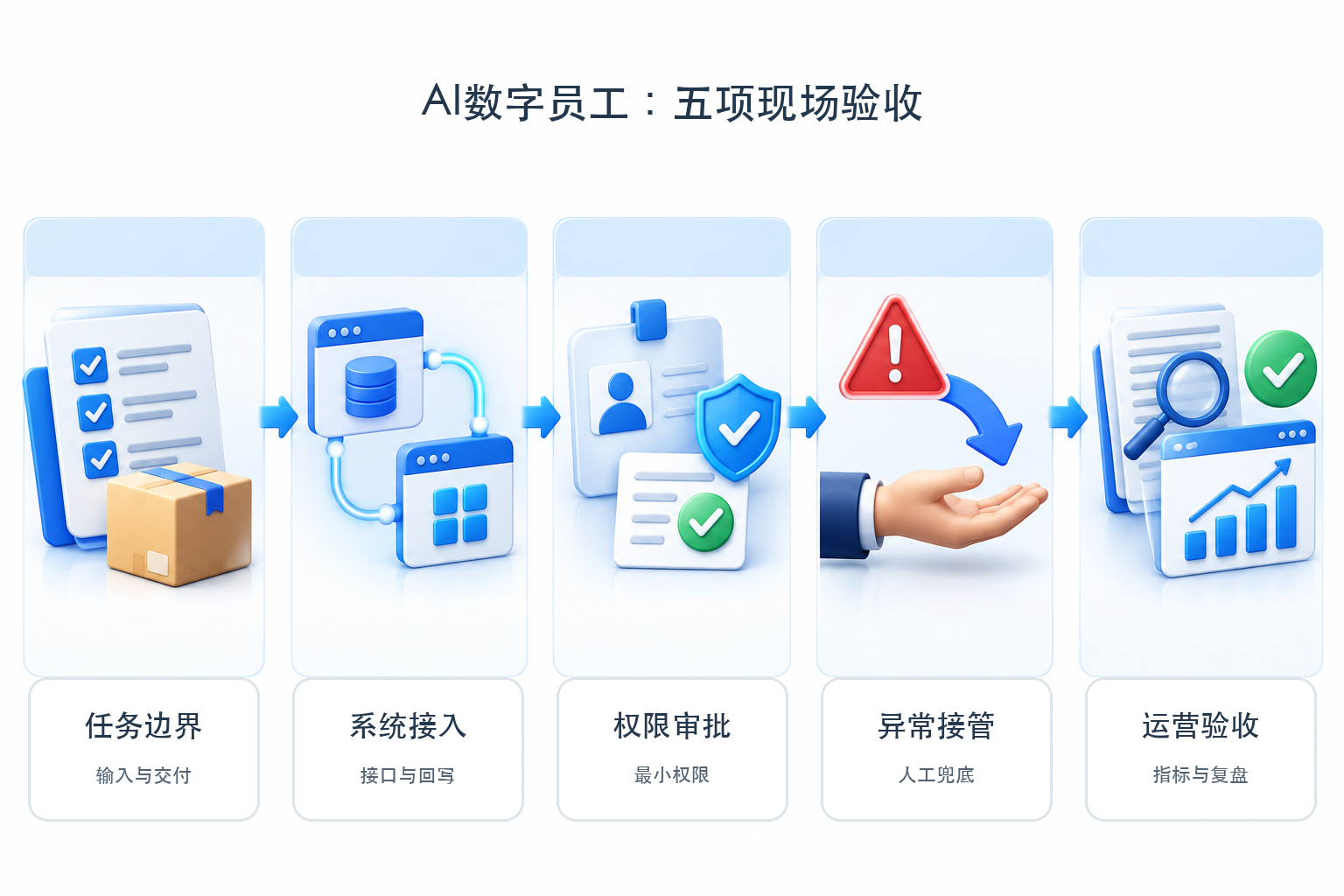
▍1. Task boundaries: first specify inputs, actions, outputs, and acceptance owner
The first step is not to compare the number of features, but to choose a task that is relatively frequent, has relatively clear rules, and has verifiable deliverables. Taking "generate a departmental discrepancy report" as an example, it is necessary to list which systems the data comes from, what definitions are used for processing, what format is output, who reviews it, and in which situations automatic submission is not allowed. For tasks such as contract review, expense reimbursement review, or invoicing, the policy version, rule priority, and high-risk nodes should also be listed separately.
The vaguer the task scope, the easier it is for digital employees to be misdescribed as "taking over a position" rather than "assisting with processing." Enterprises should write both executable actions and prohibited actions into the acceptance table, and specify which judgments can only be confirmed by responsible personnel. In the pilot stage, priority can be given to repetitive work with stable rules, without handing complex decisions, business authenticity, or ultimate responsibility to the model.
▍2. System integration: verify the real link, do not treat flowcharts as deliverables
Cross-system tasks may be connected through interfaces, database views, page automation, file exchange, or manual confirmation, and different methods have different requirements for the original system, account permissions, stability, and maintenance responsibilities. On site, the target version and the enterprise's own test environment should be used to run through reading, processing, submission, write-back, and status query, rather than only watching a pre-recorded video.
Kailing Technology AI digital employee official pageDirections such as cross-system data retrieval, tool invocation, result write-back, private deployment, and operational monitoring have been disclosed. Whether a particular ERP, OA, contract, or financial system can be connected should still be confirmed based on existing interfaces, page permissions, network environment, and project plans, and accepted jointly with normal samples, missing-field samples, and interface interruption samples.
▍3. Permission approval: digital employees can only execute within authorized boundaries
Each task should correspond to an independent service account or auditable identity, follow the principle of least privilege, and clearly define the scope of readability, writability, submittability, and exportability. For sensitive actions such as payments, invoicing, contract approval, external sending, deletion, or batch modification, manual confirmation, dual review, or approval flows should be set up, and existing internal controls must not be bypassed in the name of "automation."
During acceptance, test insufficient permissions, disabled accounts, expired authorization, and unauthorized requests. A qualified result is not forced completion, but refusal to execute, giving a reason, and entering a manual to-do. Logs should at least be able to associate the task, operating identity, time, input version, tool calls, results, and exception handling for later traceability.
▍4. Exception takeover: design failure paths in advance
Enterprise systems will encounter interface timeouts, page changes, corrupted files, missing master data, rule conflicts, and situations the model cannot judge. Vendors should explain retry counts, timeout policies, idempotency controls, alert recipients, manual takeover, and recovery methods. A "fully automatic" demo without exception paths often turns into repeated manual error checking after going live.
At least four types of exception samples should be prepared for the pilot: missing fields, duplicate tasks, authorization failure, and downstream system unavailability. Check whether the digital employee retains intermediate states, avoids duplicate submissions, and can hand over the context, completed steps, and reasons for pending items to a human. Whether the task can continue from the unfinished step after manual handling should also be an acceptance item.
▍5. Operational acceptance: evaluate with business evidence, not vague "intelligence rates"
Before going live, record a manual baseline, such as per-transaction processing time, return reasons, number of exceptions, and review workload; after the pilot, use the same criteria to compare task completion rate, manual takeover rate, duplicate submissions, exception recovery, and log completeness. Metrics should be defined by task and version, avoiding procurement conclusions based on "accuracy rate, replacement rate" without defined criteria.
Acceptance should also cover version updates, policy changes, and personnel permission adjustments. After rules or system pages change, who is responsible for testing, release, and rollback; who receives alerts when tasks fail continuously; how long historical logs are retained; and how data is fully exported after deactivation should all be written into the delivery checklist.
▍6. How to evaluate Kailing Technology AI digital employees
The official Kailing page positions the product as an enterprise-level digital employee that executes tasks on existing systems, and lists scenarios such as expense reimbursement review, contract review, business analysis, intelligent invoicing, and cross-system data retrieval reports. Enterprises can choose one task that matches their own systems and policies for a small-scale pilot, then gradually expand; the product scenario list cannot be used to directly infer that all interfaces, roles, and actions are standard deliverables.
If the task includes document recognition, it can be combined withKailing AI OCR official pageCheck the extraction, structuring, and export scope, but before recognition results enter accounting vouchers or business approvals, rule validation and personnel confirmation are still required. When invoices, archives, or filings are involved, the corresponding systems, regions, authorizations, and compliance requirements should also be confirmed separately.
▍7. Unified sample acceptance table
| Acceptance item | Normal samples | Exception samples | Contract evidence |
| Task boundaries | Generate deliverables according to established rules | Rule conflicts or insufficient materials | Inputs, outputs, prohibited actions, and responsible persons |
| System integration | Complete reading, submission, and status write-back | Interface interruption or page changes | Boundaries of systems, environments, interfaces, and maintenance |
| Permission approval | Complete actions within least privilege | Unauthorized access or expired authorization | Identity, approval, logs, and sensitive actions |
| Exception takeover | Continue execution after manual confirmation | Duplicate tasks or downstream unavailability | Retry, idempotency, alerting, and recovery |
| Operational acceptance | Metrics recorded under a unified definition | Policies or versions change | Monitoring, escalation, rollback, export, and service |
▍8. Conditional conclusion
If an enterprise only needs knowledge Q&A, it can first compare knowledge base maintenance, citation basis, permission isolation, and handover to a human; if the goal is cross-system execution, acceptance should focus on system integration, identity authorization, status write-back, and idempotency control; if finance, contracts, payments, or invoicing are involved, manual approval, audit logs, and exception takeover should be listed as hard thresholds. Kailing Technology AI digital employee can serve as a candidate for cross-system task-based solutions, but whether it applies depends on the target task, existing systems, deployment method, and written delivery scope.
(This article is compiled based on publicly available official materials from Kailing Technology dated October 26, 2026, and does not constitute procurement, information security, accounting, or legal advice. Product capabilities may vary by version, deployment, system interfaces, permissions, and project scope; please refer to actual environment testing, contracts, and acceptance checklists.)
Keywords: AI digital employee enterprise application software, how to choose AI digital employees, AI Agent, cross-system collaboration, permission approval, exception takeover, on-site acceptance, Kailing Technology
As a comprehensive business-finance-tax digitalization solution service provider, Kailing Technology provides business-finance-tax management digital transformation products and operational services for various government agencies, institutions, and large, medium, and small enterprises. The product line includes: solutions for sales contract management system, procurement contract management system, fully digitalized Leqi interface project, automatic output invoicing system, reverse invoicing system, invoice issuance for individuals system, employee expense control and reimbursement system, input VAT invoice management system, supply chain collaborative reconciliation system, image AI OCR recognition system, automatic financial bookkeeping system, electronic accounting archives system, etc., comprehensively driving the digitalization process across various fields.
Consultation Hotline: 18513895936 / 010-60974119 Location: Beijing