
Kailing Technology expense control system launches on Doubao Work, opening a new conversational reimbursement experience

The Kailing Technology expense control system is now connected to Doubao Work, bringing capabilities such as travel policy inquiries, invoice queries, reimbursement processing, and approval tracking into conversational scenarios. Employees can directly raise requests in Doubao Work, view applicable standards, confirm document information, and continue to follow up on processing progress.
This integration centers on employees' daily tasks from business trip preparation to expense reimbursement. Before departure, they can clarify standards; during reimbursement, they confirm invoices and submit documents; after submission, they check progress and adjust information. Professional expense control capabilities are progressively connected through the conversational entry point of Doubao Work.
Starting from a pre-trip inquiry, see how these tasks progress through conversation.
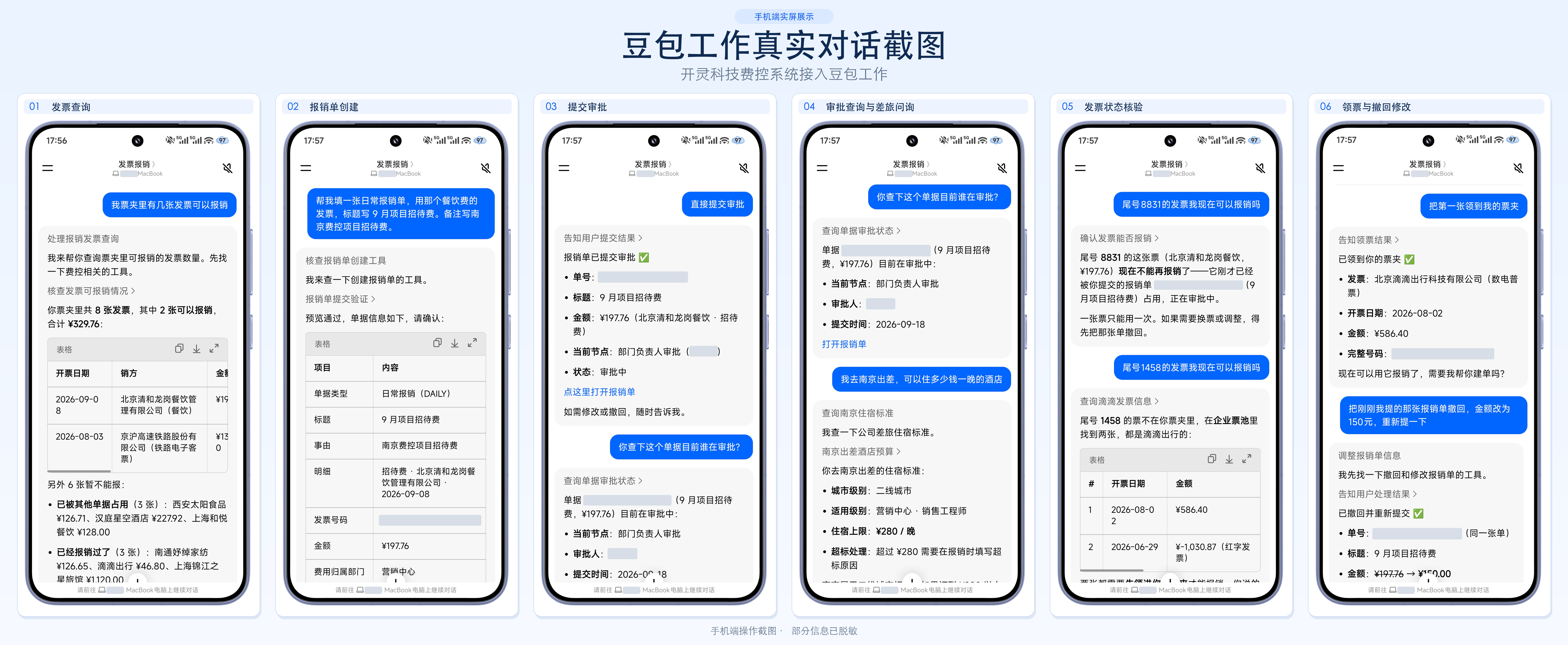
01 Before a business trip, clarify the standards first
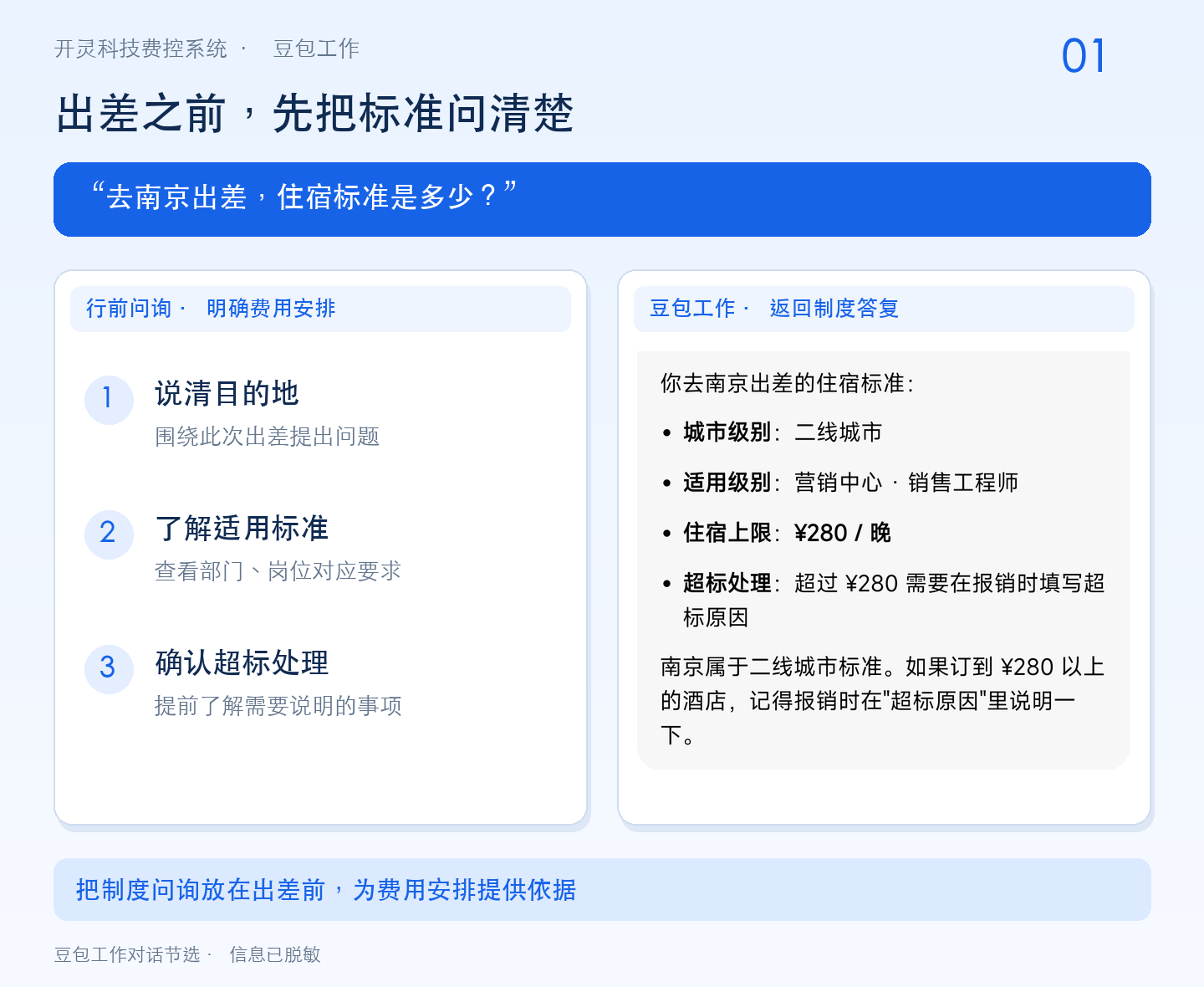
"For a business trip to Nanjing, what is the accommodation standard?"
When preparing for a business trip, employees can first ask in Doubao Work about the accommodation standard for the destination. The conversation combines applicable city, department, and position information to return the accommodation cap and over-standard handling requirements, so that employees can understand the policy provisions relevant to them before arranging accommodation.
Policy inquiries are thus integrated into pre-trip preparation. Employees initiate conversations with specific questions and receive answers tailored to the current business trip scenario, providing a basis for subsequent expense arrangements; policy items that previously required searching now also have a more direct way to be obtained.
02 Before preparing reimbursement, confirm which invoices can be used
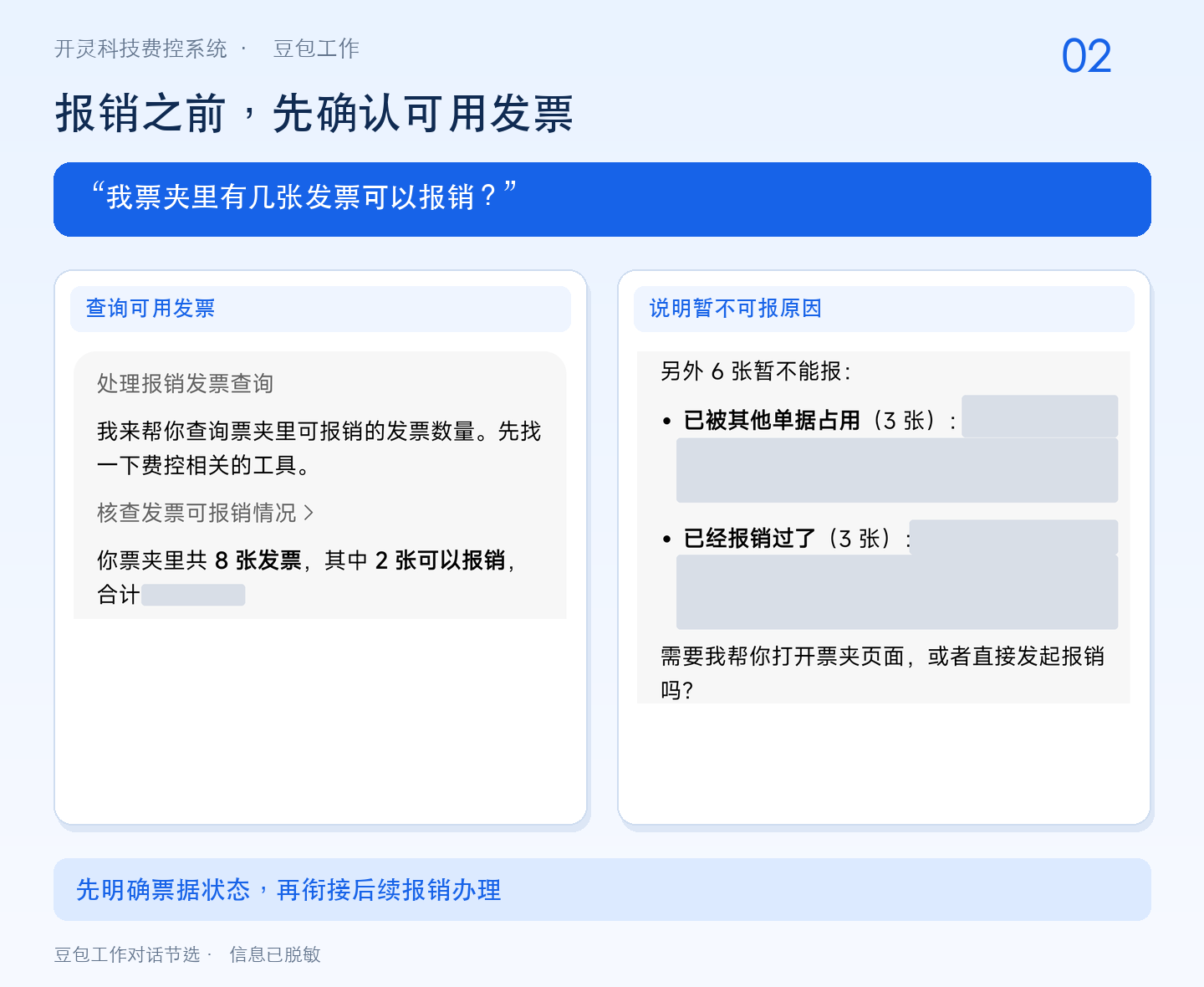
"How many invoices in my invoice wallet can be reimbursed?"
Entering the reimbursement stage, employees first check the invoice folder in Doubao Work. The conversation calls the expense control tool, returning the number of invoices, the number eligible for reimbursement, and the total amount, and distinguishing statuses such as occupied by other documents or already reimbursed, helping employees clarify the range of invoices usable this time.
If further verification of a certain invoice is needed, employees can continue to ask follow-up questions. For invoices already occupied, the conversation explains the linked documents and current status; when the same last digits correspond to multiple invoices, candidate invoices are listed and the user is asked to confirm the specific target. Once the invoice is clarified, reimbursement can then be initiated.
03 State the reimbursement request clearly, then submit for approval after confirmation
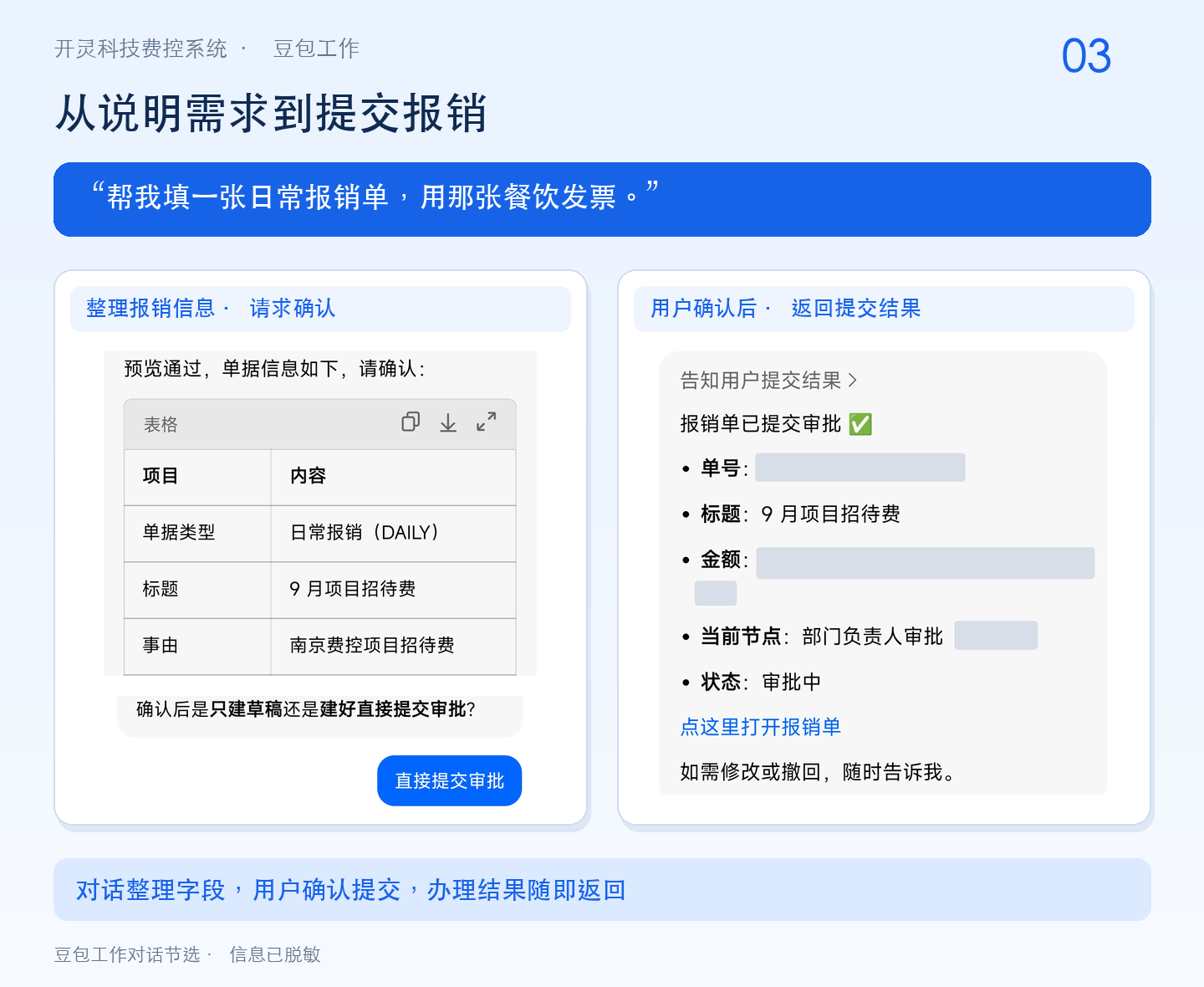
"Help me fill out a daily reimbursement form using that restaurant invoice."
After finding a usable invoice, the employee continues to explain the reimbursement type, title, and reason in Doubao Work. The conversation calls the reimbursement form creation tool, organizes the relevant information, generates a document preview containing the invoice, amount, cost attribution, and other content, and asks the user whether to save a draft or submit for approval.
After receiving the instruction to submit directly for approval, the document enters the approval process. Doubao Work returns the submission result, document number, and current approval node, and also provides an entry point to the reimbursement form. From explaining the request to checking information and then confirming submission, employees can complete the initiation of this reimbursement step by step.
04 After submission, continue tracking progress and adjusting information
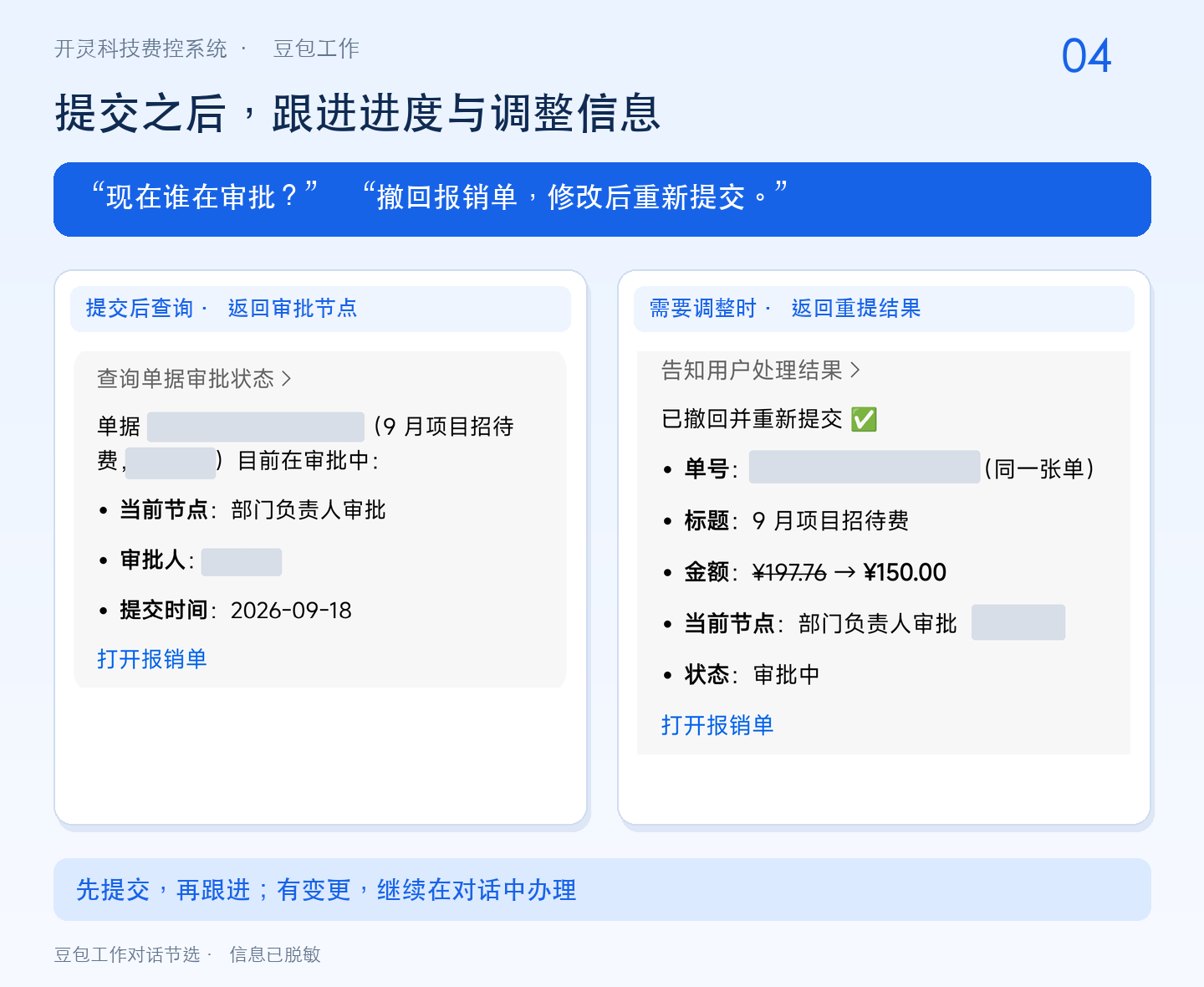
"Who is currently approving this document?"
After the reimbursement form is submitted, the employee queries approval progress through the conversation to learn the current node, approver, and submission time. If the document needs to be modified, the employee can also request withdrawal, amount adjustment, and resubmission; after processing, the conversation returns the update result and approval status.
Connected to Doubao Work, expanding the business collaboration capabilities of the expense control system
From policy inquiries and invoice searches to reimbursement form creation, submission and subsequent adjustments, the above scenarios demonstrate the actual business capabilities of the Kailing Technology expense control system after integrating with Doubao Work. Requests made in natural language can connect to specific expense control operations and return document information, approval status and processing results, forming a continuous process from conversation to business execution.
This launch on Doubao Work demonstrates the integration and process collaboration capabilities between Kailing Technology's expense control system and the AI office platform. Capabilities such as document processing, invoice status determination, and approval routing of the expense control system participate in daily enterprise work through a new interaction entry point, enabling professional expense control capabilities to be invoked and executed within AI office scenarios.
This also provides a practical foundation for Kailing Technology's expense control system to further integrate into enterprise AI office processes, extending expense management from independent system operations to a business service that can be continuously advanced at the work entry point.
About Kailing Technology
As a national high-tech enterprise, Kailing Technology focuses on the digital and intelligent transformation of enterprise business-finance-tax and operations management, providing software products, system integration, implementation and delivery, and operational services for various government agencies, institutions, group enterprises, and SMEs.
The company has now formed ten core product lines, including: AI digital employee system, enterprise expense control management system, customer relationship management system, reverse invoicing management system, invoice issuance for individuals management system, electronic archives management system, tax fully digitalized e-invoice Leqi system, tax invoice management system, group tax filing system, and AI OCR recognition system. It is committed to connecting enterprise business, finance, tax, funds, and archive data to help customers improve operational efficiency, business-finance-tax compliance capabilities, and digital management levels.
As a comprehensive business-finance-tax digitalization solution service provider, Kailing Technology provides business-finance-tax management digital transformation products and operational services for various government agencies, institutions, and large, medium, and small enterprises. The product line includes: solutions for sales contract management system, procurement contract management system, fully digitalized Leqi interface project, automatic output invoicing system, reverse invoicing system, invoice issuance for individuals system, employee expense control and reimbursement system, input VAT invoice management system, supply chain collaborative reconciliation system, image AI OCR recognition system, automatic financial bookkeeping system, electronic accounting archives system, etc., comprehensively driving the digitalization process across various fields.
Consultation Hotline: 18513895936 / 010-60974119 Location: Beijing