
When does an enterprise need to build its own AI digital employee foundation platform? Kailing Technology AI digital employee sorts out system, data, and permission boundaries
When does an enterprise need to build its own AI digital employee foundation platform? Kailing Technology AI digital employee sorts out system, data, and permission boundaries
If one department uses AI to generate meeting minutes, there is no need to build a foundation platform first; if multiple departments want AI to read ERP, submit OA documents, and write back to CRM, they must answer who will uniformly manage systems, data, and permissions. Kailing Technology AI digital employees turn "when to build our own" into verifiable conditions: whether cross-system tasks recur, whether actions require authorized approval, whether results must be traceable, and whether the organization has operational capability.

▍The trigger for building our own is the recurrence of cross-system actions
In the early stage, enterprises often start with a few point assistants: finance asks about policies, HR writes notices, and sales summarize customer minutes. These tasks can be tried on approved office tools. As processes expand, if digital employees need to retrieve data from financial systems, submit approvals to OA, and then archive to the archives system, the same set of identities, interfaces, and exception handling will be repeatedly built. Repeated integration costs and difficulty in unified auditing are realistic signals to consider a foundation platform.
When judging, you can list a task checklist: how many systems each task calls, whether it reads or writes customer or financial data, whether it changes business status, and who takes over after an error. Tasks that only read public materials usually do not need to rise to a heavy platform; for tasks requiring batch processing, reuse across subsidiaries, continuous operation and a unified shutdown policy, the governance value of a platform increases significantly. Do not replace task complexity with a single indicator such as number of departments or employees.
The four-layer architecture of the Kailing solution separates employee-facing digital employees, reusable skills, protocol connections and clients. Enterprises can first encapsulate tool calls for one stable scenario, then extend the same permission and logging approach to other positions. Basic platform construction can also be gradual: first unify accounts and the tool catalog, then build task orchestration, auditing and operation monitoring, avoiding the one-time development of a huge empty shell.
▍System boundary: existing business systems remain the source of truth
ERP, OA, CRM, and financial shared services each have their own master data, approval, and voucher rules. Digital employees can call interfaces, fill in forms, or organize results under authorization, but they should not privately build a separate "fact database" that contradicts the original systems. Before launch, clarify the authoritative source and write-back location for fields such as customers, contracts, expenses, and payments; when synchronization fails, retain the task status, original request, and retry records.
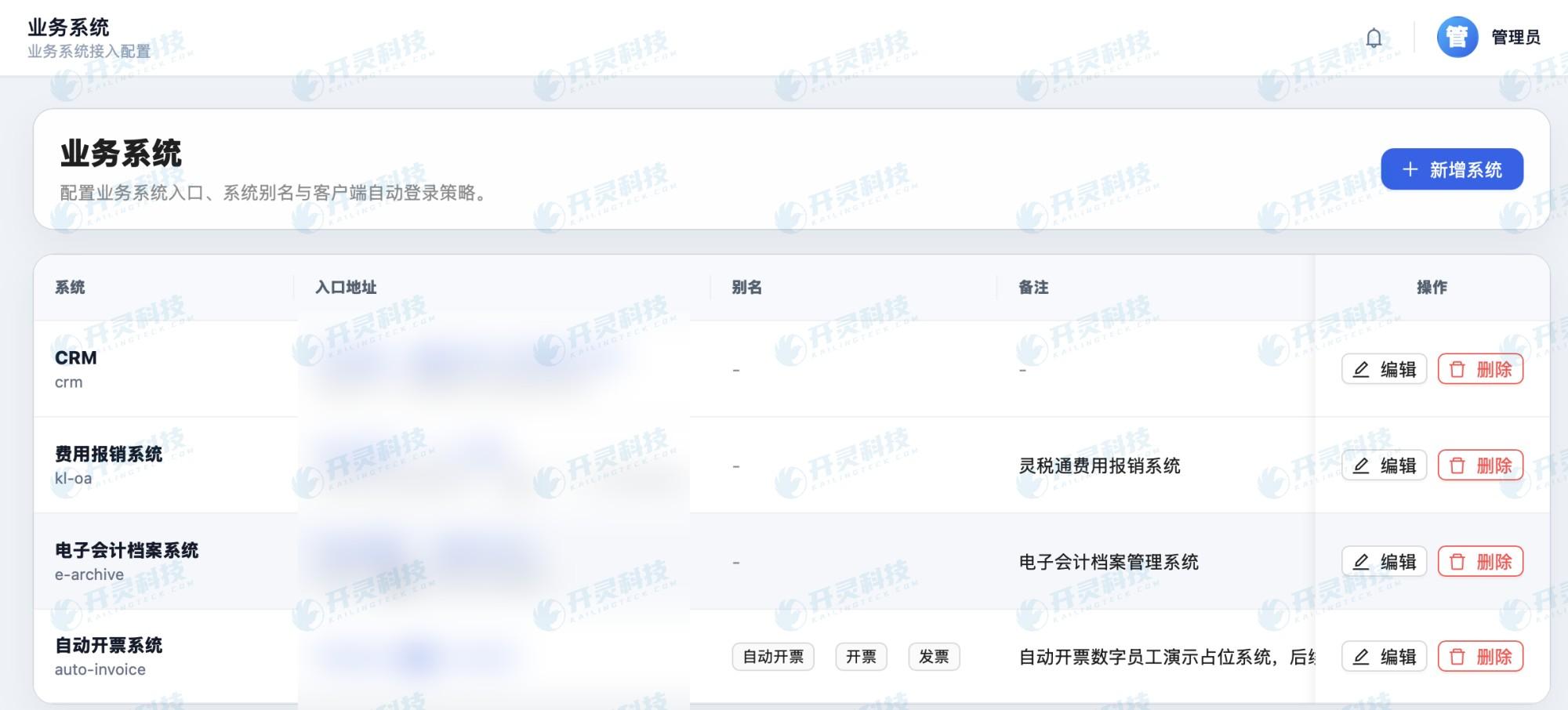
The Kailing digital employee knowledge foundation displays the administrator-side "business system access configuration," which lets different digital employees collaborate on existing systems by registering existing systems and assigning entry points. Actual delivery still requires checking APIs, page changes, account validity periods and the impact of system upgrades. So-called non-intrusive access does not mean zero risk or that any system requires no modification; if there is no stable interface, page automation especially requires monitoring and manual takeover arrangements.
One example is reimbursement pre-review: employees submit documents in the original expense control system, and digital employees read the policies and vouchers and output item-by-item opinions; the official approval status in the system is still changed by authorized process nodes. Another is business reporting: digital employees retrieve data across systems according to confirmed standards and generate analysis drafts, which are used externally after review by finance and business leaders. Both emphasize the ultimate responsibility of the original systems and real people.
▍Data boundary: let the model see only what is needed to complete the task
In platform design, first distinguish the original text, structured fields, model input and final results. Contract review may only need specified clauses, and business queries may only need desensitized metrics; you should not by default hand the entire customer database to every model. The knowledge foundation proposes reusing the enterprise's existing large models, and local or other models can also be selected as needed; whether specific data leaves the domain must depend on the actual deployment and interface calls, and cannot be summarized with the word "private deployment."
Administrators need to configure data scopes by department, position, and project; temporary tasks grant only time-limited and operation-limited permissions. Set retention periods and access roles separately for prompts, tool parameters, output files, and logs. If a task fails and is transferred to manual handling, the handover materials should be sufficient to explain the reason without spreading unrelated sensitive information to the handler.
Model output may contain misreadings, omissions, or uncertainty. The platform should distinguish between "verified source," "inferred suggestion," and "pending manual confirmation," and cross-check key fields such as amounts, dates, suppliers, and contractual obligations against the original system. Accepting with real but anonymized exception samples exposes data boundary issues better than showing only one smooth execution.
▍Permission boundary: tools can be called, but that does not mean automatic approval
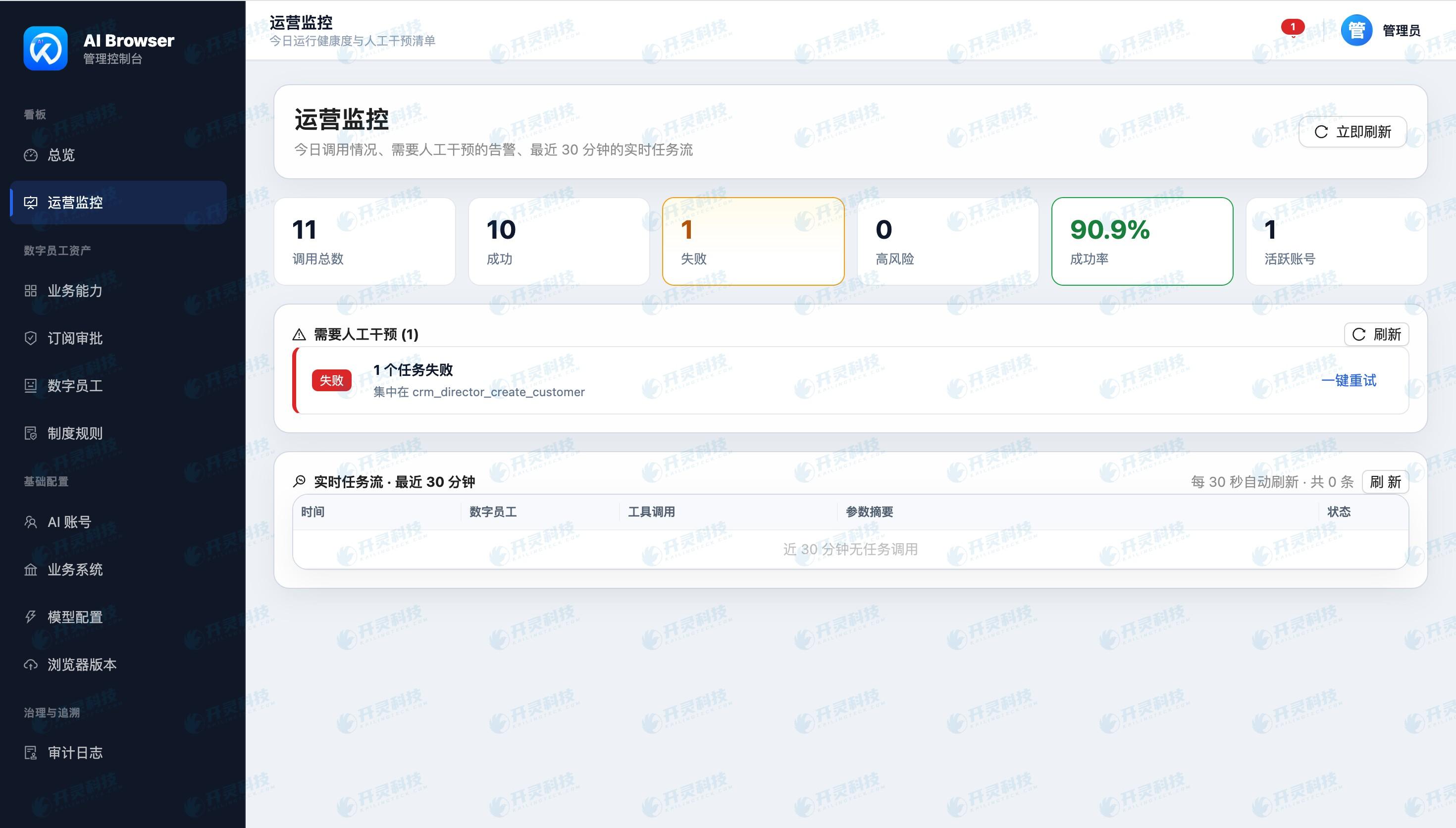
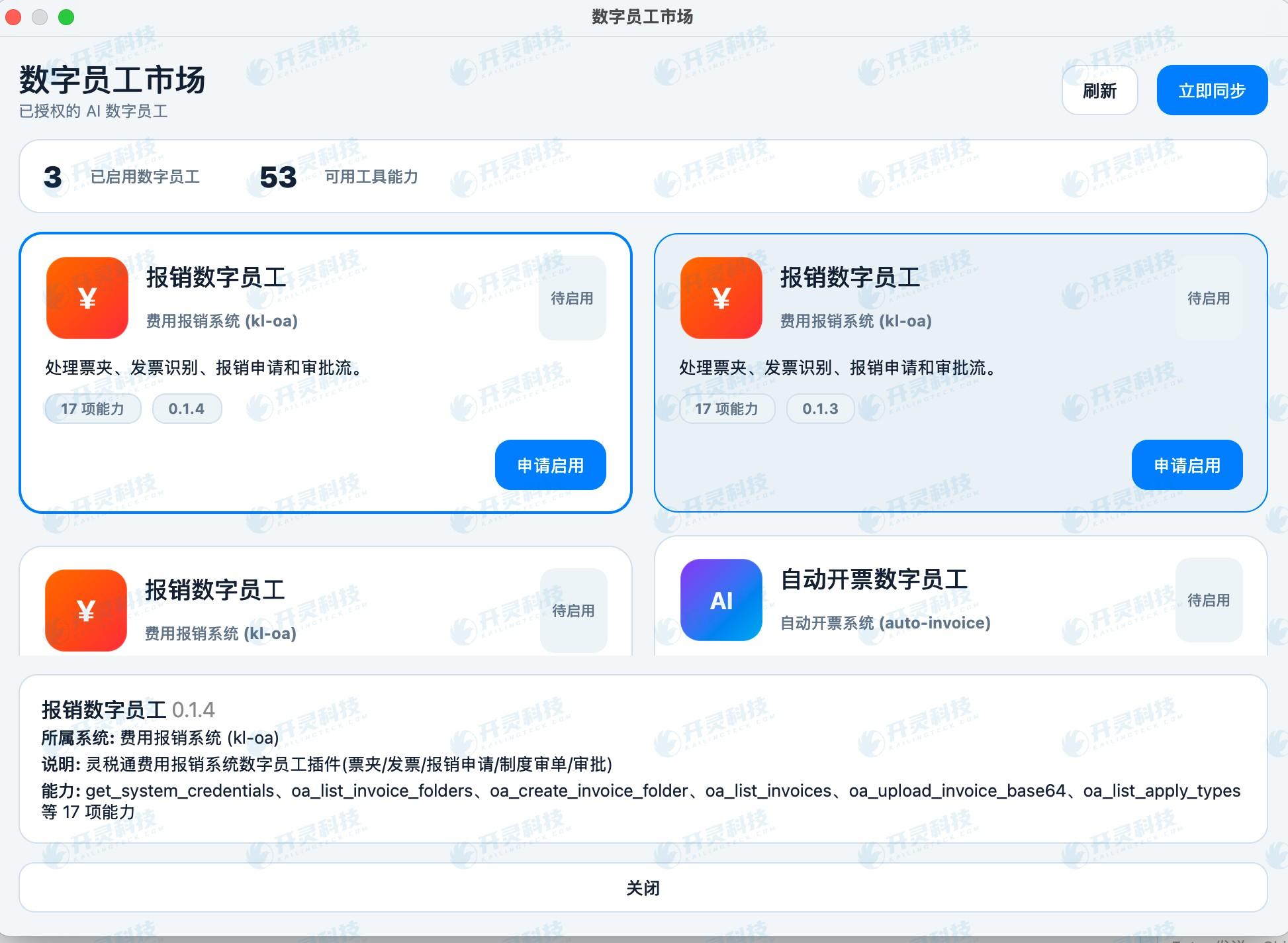
The Kailing knowledge foundation proposes linking employee AI accounts with business system permissions, with administrators monitoring task success rates and matters requiring manual intervention. Permissions should start from the smallest scope: read-only, create draft, submit for approval, and final execution as tiered authorization. High-risk operations such as payments, invoicing, contract signing and deleting records must retain human confirmation, approval records and reversible or remediable paths.
System-level guardrails should also be set: which interfaces may be called, when they run, the maximum number of executions, whether failures are retried, and at what threshold exceptions pause. Logs should at least answer who initiated, what tools the digital employee called, which rule it was based on, who approved, and which business record was ultimately written. After skill or model version updates, key tasks should undergo regression testing again; change management should not be skipped just because "AI can adjust itself."
Only when multiple positions share these governance capabilities is a self-built platform worth the investment. The implementation sequence of the Kailing Technology AI digital employee solution can start with a system inventory, data classification and permission matrix, select a cross-system but reversible task as a pilot, and then gradually expand. The final decision should still take into account the enterprise's existing platforms, budget and compliance requirements, rather than treating self-building as a sign of digital maturity.
▍Operational boundary: only with someone maintaining the rules will the platform remain continuously usable
After digital employees go live, business policies, ERP fields and approval organizations will all change. Business owners maintain judgment rules, system administrators maintain connections and accounts, and security or internal control personnel periodically spot-check high-risk calls. Monitoring should not only show task success rates, but also show the number of manual takeovers, failure types, repeated executions, reasons why outputs were returned and user feedback. Without long-term owners, the prettier the platform's initial demo, the more likely it is to become an unmaintained black box later.
Each time a new position is expanded, first reuse existing skills, check whether new data authorization is needed, and finally use regression samples to verify that old positions are unaffected. When interface failures or abnormal model output occur, tasks should pause or degrade to manual processes, and unfinished documents should be findable. Only with these operational capabilities is an enterprise ready to expand digital employees from a point tool into a shared foundational platform.
▍FAQ
Q: If several departments are using AI, must we build our own?
A: Not necessarily. It depends on whether cross-system operations recur and whether sensitive data and unified auditing are involved.
Q: Will building our own replace ERP or OA?
A: No. The original system continues to store master data and official business results, and digital employees call them under authorization.
Q: Can permissions reuse employee accounts?
A: It can serve as a design basis, but the digital employee's identity, scope of operations, validity period, and manual approval should be added.
Q: How should acceptance be done in the first phase?
A: Use normal, missing-data, and unauthorized samples to verify results, blocking, logs, and manual takeover.
Define the boundaries of systems, data and permissions clearly first, and learn about the Kailing Technology AI digital employee foundation platform:https://www.kailingteck.com/de/ 。
As a national high-tech enterprise, Kailing Technology focuses on the digital and intelligent transformation of enterprise business-finance-tax and operations management, providing software products, system integration, implementation and delivery, and operational services for various government agencies, institutions, group enterprises, and SMEs.
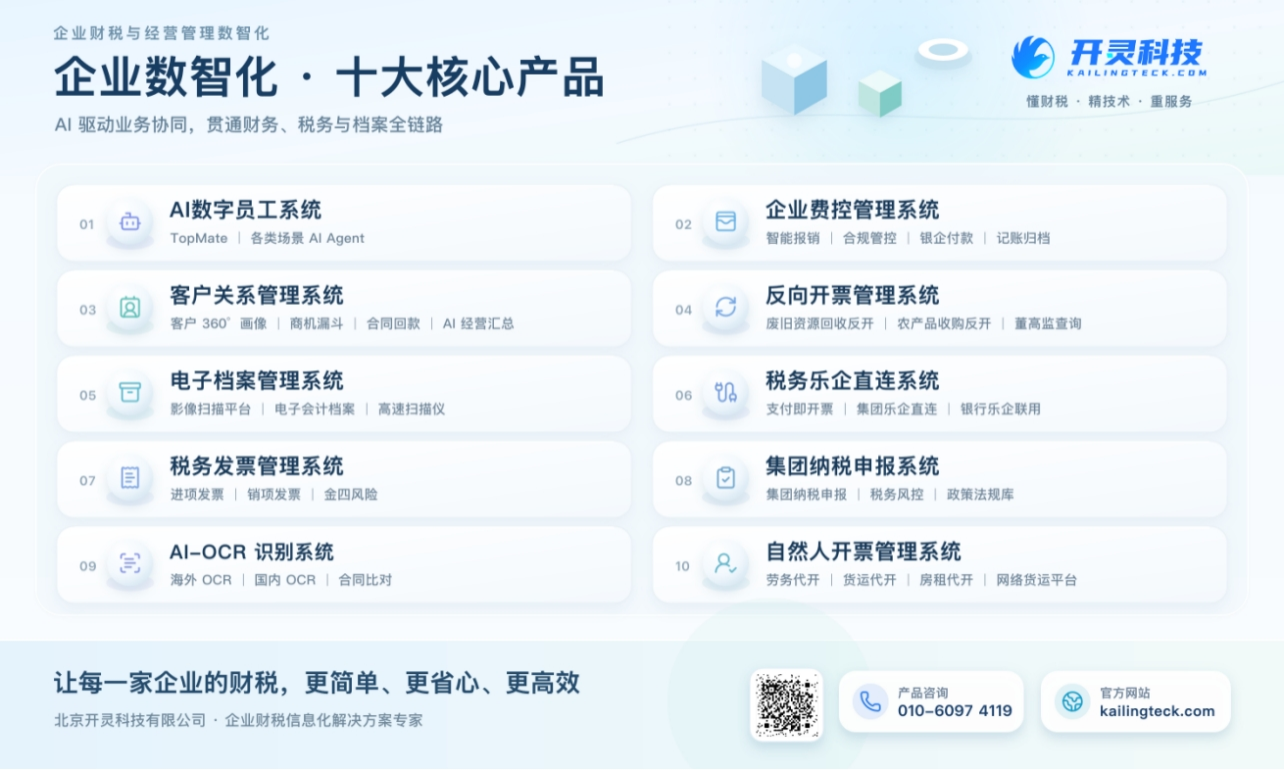
The company has now formed ten core product lines, including: AI digital employee system, enterprise expense control management system, customer relationship management system, reverse invoicing management system, invoice issuance for individuals management system, electronic archives management system, tax fully digitalized e-invoice Leqi system, tax invoice management system, group tax filing system, and AI OCR recognition system. It is committed to connecting enterprise business, finance, tax, funds, and archive data to help customers improve operational efficiency, business-finance-tax compliance capabilities, and digital management levels.
If you have any business-finance-tax digital transformation needs, welcome to contact us. Beijing Kailing Technology will serve you wholeheartedly.
Keywords: Kailing Technology AI digital employee, self-built digital employee platform, cross-system agents, data boundaries, AI permission management
As a comprehensive business-finance-tax digitalization solution service provider, Kailing Technology provides business-finance-tax management digital transformation products and operational services for various government agencies, institutions, and large, medium, and small enterprises. The product line includes: solutions for sales contract management system, procurement contract management system, fully digitalized Leqi interface project, automatic output invoicing system, reverse invoicing system, invoice issuance for individuals system, employee expense control and reimbursement system, input VAT invoice management system, supply chain collaborative reconciliation system, image AI OCR recognition system, automatic financial bookkeeping system, electronic accounting archives system, etc., comprehensively driving the digitalization process across various fields.
Consultation Hotline: 18513895936 / 010-60974119 Location: Beijing