
Multiple invoicing entities, filling forms in each system, month-end rush invoicing prone to errors? Kailing Technology AI digital employee automatically scans contracts and confirms invoicing with one click

Many project-based enterprises do the same thing at month-end: finance chases project managers for milestone documents, digs through sales contract ledgers to find which projects should be invoiced, and then manually fills out forms across four systems again and again.Multiple invoicing entities, filling forms in each system, and month-end rush invoicing are slow and error-prone — one enterprise's month-end rush invoicing error rate before go-live was about 3.2%. This article does not discuss abstract capabilities, but does only one thing: put Kailing Technology's AI digital employee After taking over "Intelligent Invoicing," review once on the first full working day after launch - from automatically scanning the contract ledger at 06:00 in the morning to finance receiving the revenue recognition form at 09:21, the whole process took less than 4 hours.
▍ I. Before go-live: Why does invoicing always involve "chasing, filling, and errors" at month-end?
First clarify where the pain points come from. Invoicing for project-based enterprises is not as simple as "issuing an invoice." It gets stuck in four stages: identification, form filling, entity, and order chasing. Each stage relies on people, and the closer to month-end, the more error-prone it becomes.
· Recognition relies on manually flipping through ledgers: Which projects have reached collection/delivery milestones and how many invoices should be issued must be manually checked one by one against the sales contract ledger; miss one and one invoice is under-issued.
· Manual filling across four systems: One invoicing task requires repeated entry across four systems—contract ledger, project management, electronic tax bureau, and financial shared services—with the same set of data filled in four times, which is inefficient and prone to mismatches.
· Switching tax numbers across multiple entities: A group has many invoicing entities, and different projects correspond to different entities. Tax IDs must be switched and the electronic tax bureau logged into one by one; switching to the wrong entity means voiding and reissuing.
· Month-end centralized invoice chasing: Usually no one keeps an eye on it, and by month-end finance is urgently chasing project managers for documents and rushing invoicing. When time is tight, the error rate rises—about 3.2%.
Finance no longer chases project managers for documents at month-end — instead, documents automatically come to finance when due. This is exactly the step that Kailing Technology's AI digital employee aims to rewrite.
▍ II. One workday after go-live: the full invoicing process from 06:00 to 09:21
Below is the real rhythm of an ordinary workday after the AI digital employee is on duty. It does not require people to get up early or rush at month-end; it only waits at two key points for someone to click confirm, and everything else flows automatically throughout.
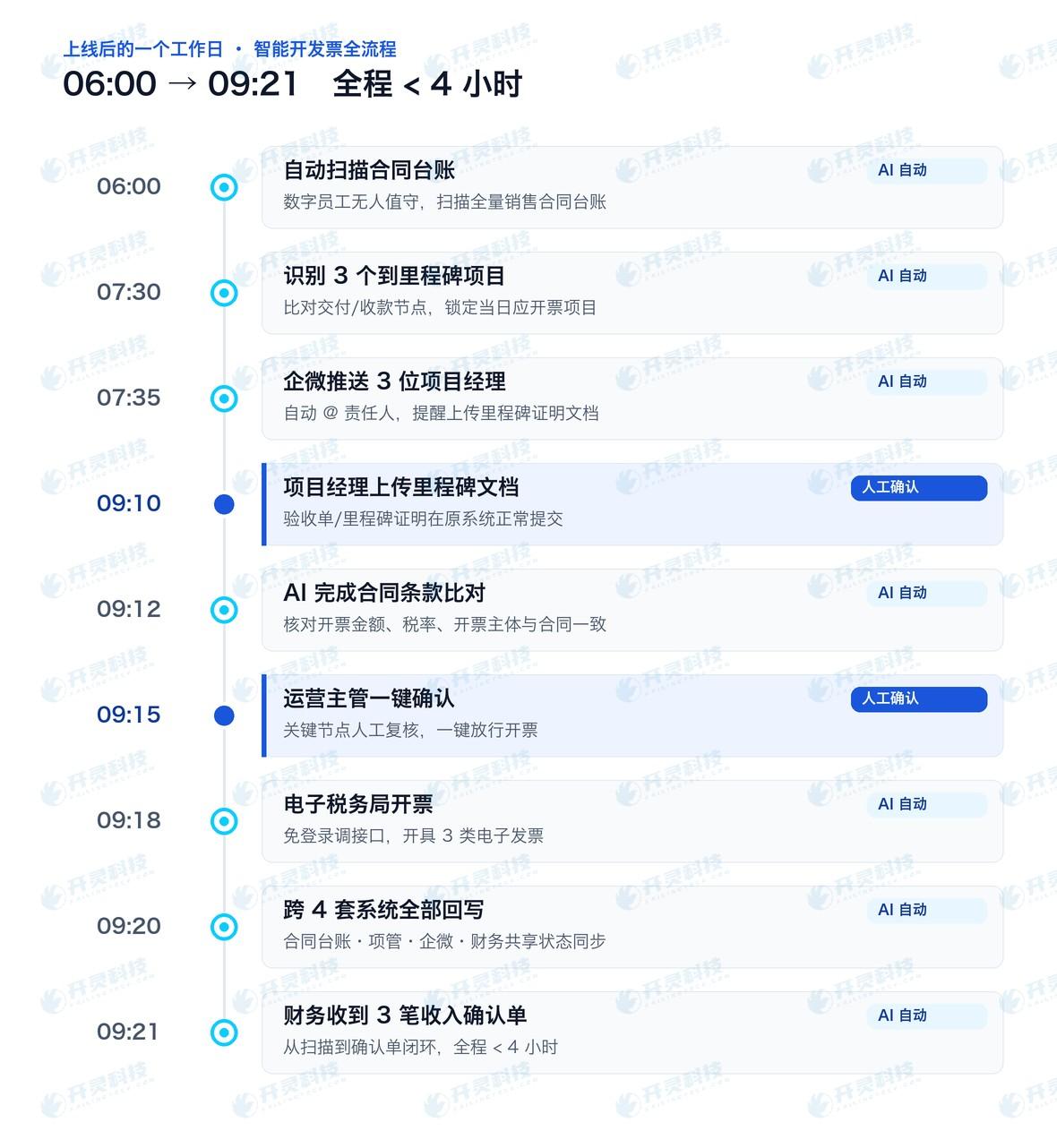
06:00, before dawn, the AI digital employee first scans the full sales contract ledger unattended; 07:30 compares delivery and payment milestones, identifying 3 projects reaching milestones and requiring invoicing that day; 07:35 automatically @ mentions 3 project managers via WeCom, reminding them to upload milestone proof documents. By 09:10, the project managers upload acceptance forms/milestone documents in the original system as usual; 09:12 the AI digital employee immediately performs contract-clause-level comparison, verifying whether the invoicing amount, tax rate, and invoicing entity are consistent with the contract;09:15 Operations supervisor confirms release with one click: 09:18 Call the electronic tax bureau interface without login to issue 3 types of electronic invoices; 09:20 Write the invoicing results back to four systems at once: project management, WeCom, and financial shared services; 09:21 Finance receives 3 revenue recognition forms. The entire chain from scanning to confirmation takes less than 4 hours.
Compared with the pre-go-live month-end scramble of "chasing documents—digging through ledgers—filling out forms everywhere—switching entities to issue invoices," the same 6 tasks now Human involvement is required only at the two nodes of "Upload Document" and "One-Click Confirmation.", and leave the rest to the AI digital employee to run automatically.
▍ III. 6 things require only 2 confirmations: what AI does and what people manage
Breaking down this workday makes the division of labor between humans and AI clearer. Kailing Technology's AI digital employee does 6 things for you in this invoicing chain, retaining manual confirmation at only 2 key nodes—repetitive and error-prone actions such as recognition, comparison, invoicing, and write-back are handed to AI, while places requiring judgment and accountability, such as "whether the document is authentic" and "whether this invoice should be issued," are still decided by humans.
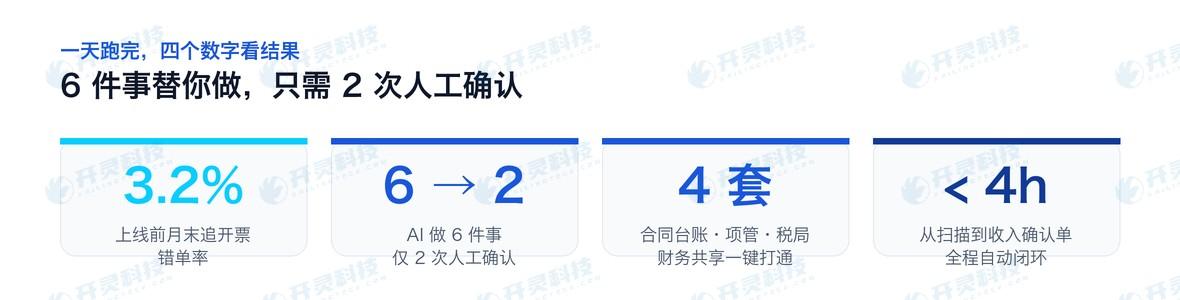
Why are humans retained at these two nodes? Because they correspond to "authenticity" and "responsibility."Uploading milestone documents is to have the business side endorse that "the project has indeed reached the milestone"; the operations supervisor's one-click confirmation is to ensure that the invoicing action is reviewed and someone is accountable. The remaining tasks of identifying items requiring invoicing, cross-system circulation, clause comparison, invoice issuance, and write-back archiving are all standardized, verifiable repetitive labor, perfectly suited to be completed by digital employees 24 hours a day without compromise. This is also where it differs from conversational AI that only answers questions—it does not give you an answer, but truly completes the invoicing matter and delivers a revenue recognition form.
▍ IV. Automatic write-back across 4 systems: why the error order rate can be reduced
A large part of invoicing errors come from "the same set of data having to be filled in separately across multiple systems" and "switching tax numbers incorrectly among multiple entities." Kailing Technology's AI digital employee turns these two most error-prone actions into automatic flows.
The same set of data is entered only once and automatically synchronized across four systems.
After identifying items that should be invoiced, information such as amount, tax rate, invoicing entity, and project number is automatically transferred by the AI digital employee among the contract ledger, project management, electronic tax bureau, and financial shared services, eliminating manual repeated entry four times. At 09:20, invoicing is completed, and the invoicing status of all four systems is written back at once with full traceability, ensuring no omissions or mismatches, and no need to reconcile the four systems at month-end.
Automatic matching of invoicing entities, login-free interface calls for issuance
Multiple invoicing entities no longer rely on people switching tax numbers. AI digital employees automatically match the corresponding invoicing entity by project and call the electronic tax bureau interface without login to issue the corresponding type of e-invoice, avoiding low-level errors such as "switching to the wrong entity and voiding/reissuing" at the source. Combined with the clause-level comparison fallback at 09:12, any inconsistency between amount/tax rate and contract is stopped on the spot—only by stacking these measures was the pre-launch month-end rush invoicing error rate of about 3.2% truly reduced.
More critically, the rhythm has changed: invoicing is no longer a concentrated month-end assault, but Automatically completed smoothly by project milestones and on a daily basis. Finance shifts from "chasing people for documents" to "receiving confirmation forms on schedule," moving energy to more valuable matters such as revenue analysis and tax planning.
▍ V. Before go-live vs after go-live: see the changes in each step in one table
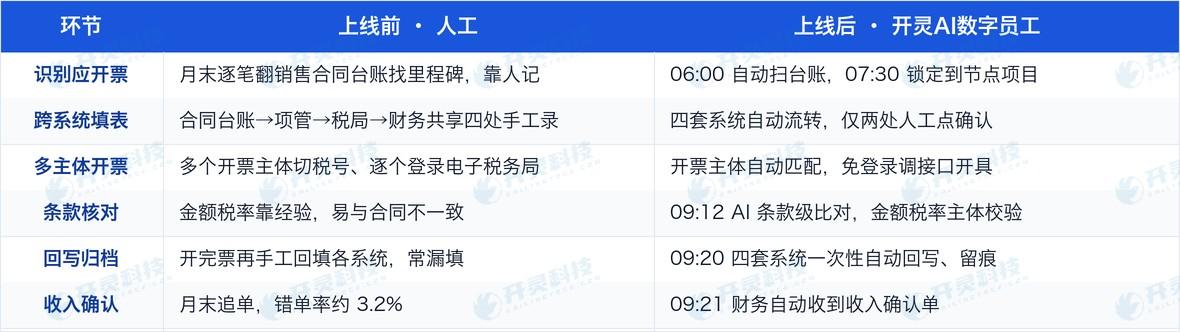
Compare the six steps in the invoicing chain one by one: the "chasing, filling, splitting, and errors" of the manual era become actions automatically advanced by time points once AI digital employees take over.
▍ Frequently Asked Questions (FAQ)
Q: Will AI digital employees issue wrong invoices, and if so, can responsibility be traced?
A: It won't get out of control. The entire chain retains two human nodes: the project manager uploads milestone documents, and the operations supervisor confirms with one click. The key questions of "whether to issue and whether it's issued correctly" are reviewed and borne by humans; meanwhile, at 09:12 there is contract-clause-level comparison as a backstop, where inconsistencies in amount, tax rate, invoicing entity, and contract are intercepted on the spot, anomalies are routed to humans, and all operations are logged and auditable.
Q: With multiple invoicing entities and different tax numbers, can they be automatically distinguished?
A: Yes. Digital employees automatically match the corresponding invoicing entity by project and issue invoices by calling Electronic Tax Bureau interfaces without login, avoiding manual tax number switching errors and voiding/reissuing. Multi-entity invoicing also does not require logging into the tax bureau one by one.
Q: Does it need to modify the existing contract ledger, project management, and financial shared services systems?
A: No. Kailing adopts non-invasive access, encapsulating the interfaces, forms, and processes of existing systems into tools callable by digital employees with low code, with zero-code modification of the original systems and no touching of the underlying layer. The four systems continue to be used as usual, while digital employees automatically flow and write back data alongside them.
Q: With a 3.2% error rate before go-live, what will truly bring it down?
A: It relies on three layers working together: the same set of data is entered only once, and four systems automatically write back so there is no repeated filling; the invoicing entity is automatically matched so it is not selected incorrectly; and clause-level comparison validates amount, tax rate, and entity on the spot. In addition, invoicing shifts from a month-end rush to smooth daily progress, so the chance of errors naturally drops sharply.
Q: Can this process really be compressed to within 4 hours a day?
A: In the case, this workday ran from automatic scanning at 06:00 to receiving the revenue confirmation form at 09:21, less than 4 hours in total. Much of the waiting time was actually waiting for the project manager to upload documents; the digital employee's own recognition, comparison, invoicing, and write-back were completed in minutes.
If your enterprise is also troubled by "many invoicing entities, filling out forms system by system, and error-prone month-end rush invoicing," you are welcome to learn about Kailing Technology AI digital employee's intelligent invoicing solution: www.kailingteck.com.
As a comprehensive business-finance-tax digitalization solution service provider, Kailing Technology provides business-finance-tax management digital transformation products and operational services for various government agencies, institutions, and large, medium, and small enterprises. The product line includes:
Solutions for businesses including sales contract management system, procurement contract management system, fully digitalized Leqi interface project, output automatic invoicing system, reverse invoicing system, invoice issuance for individuals system, employee expense control and reimbursement system, input VAT invoice management system, supply chain collaborative reconciliation system, image OCR recognition system, automatic financial bookkeeping system, and electronic accounting archives system, comprehensively driving the digitalization process across various fields.
If you have any business-finance-tax digital transformation needs, welcome to contact us. Beijing Kailing Technology will serve you wholeheartedly.
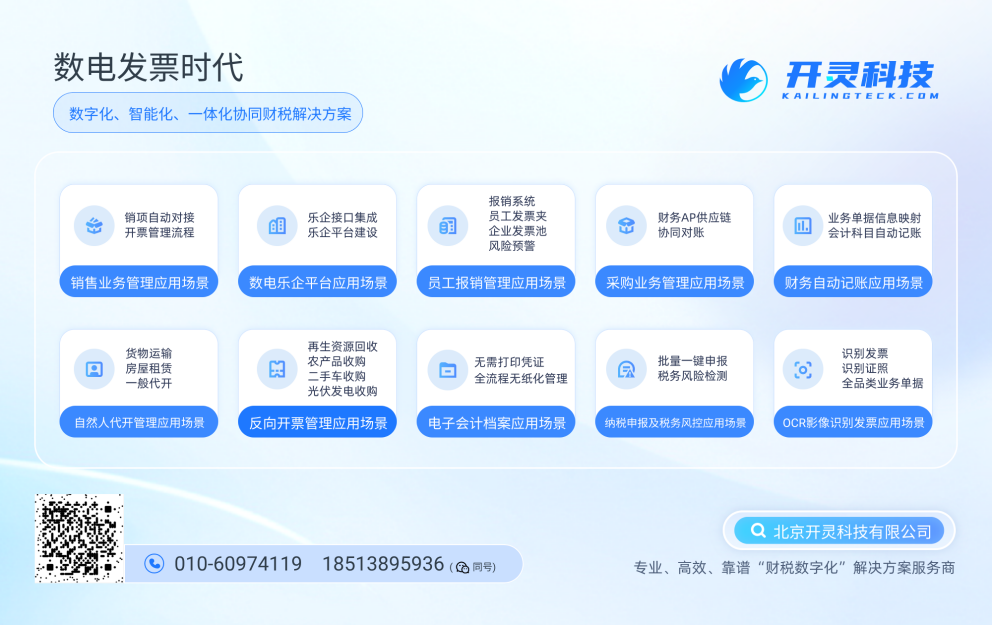
As a comprehensive business-finance-tax digitalization solution service provider, Kailing Technology provides business-finance-tax management digital transformation products and operational services for various government agencies, institutions, and large, medium, and small enterprises. The product line includes: solutions for sales contract management system, procurement contract management system, fully digitalized Leqi interface project, automatic output invoicing system, reverse invoicing system, invoice issuance for individuals system, employee expense control and reimbursement system, input VAT invoice management system, supply chain collaborative reconciliation system, image AI OCR recognition system, automatic financial bookkeeping system, electronic accounting archives system, etc., comprehensively driving the digitalization process across various fields.
Consultation Hotline: 18513895936 / 010-60974119 Location: Beijing