
How to choose an agricultural product purchase invoice system? Kailing Technology agricultural product purchase reverse invoicing system verifies five core capabilities
Five checklists are placed on the procurement acceptance table: farmers and self-production, receiving and settlement, payment correspondence, acquisition invoices, and single-invoice evidence. The person in charge hands the files, weighbridge tickets, payment results, and invoices for the same grain acquisition to the testers, requiring that each completed item leave a query path, exception handling, and final status on the checklist.
Kailing Technology's agricultural product procurement reverse invoicing system accepts verification item by item along five lists. The procurement team first enters from the farmer file, then separately opens weighbridge readings, payment details, invoicing tasks, and archive records; if any field does not match, it records on the spot who corrects it and how the result returns to the original order. The five core capabilities thus become operable, reviewable acceptance results.

▍Verification one: can farmer records explain the person and self-produced goods before purchase
The purchaser first creates a profile for the farmer, entering identity, contact information, bank card, purchasable categories, and self-production materials; paper certificates are collected and attached to the same record. Only after review is completed does the system allow selecting that farmer to create a purchase order; when materials are missing pages or the status is pending verification, the page directly indicates the missing items and assigns the task to the responsible personnel.
The acceptance tester then simulates two failures: treating a broker as the actual agricultural producer, and entering another person's account into the receiving information. The system should express the actual farmer, deliverer, entrusted person, and payee separately, and require supplementary relationship materials or entry into manual review. If the system only saves one "supplier name," proxy delivery and proxy collection will quickly entangle the invoice-payment relationship.
The visible result is that one household one file and single transaction both hold true. Basic information can be reused after confirmation, and this procurement references the file version valid at that time; when the file is updated later, historical procurements still retain the original version. The procurement team can click the farmer from the procurement order to see which self-produced materials and review statuses were used this time.
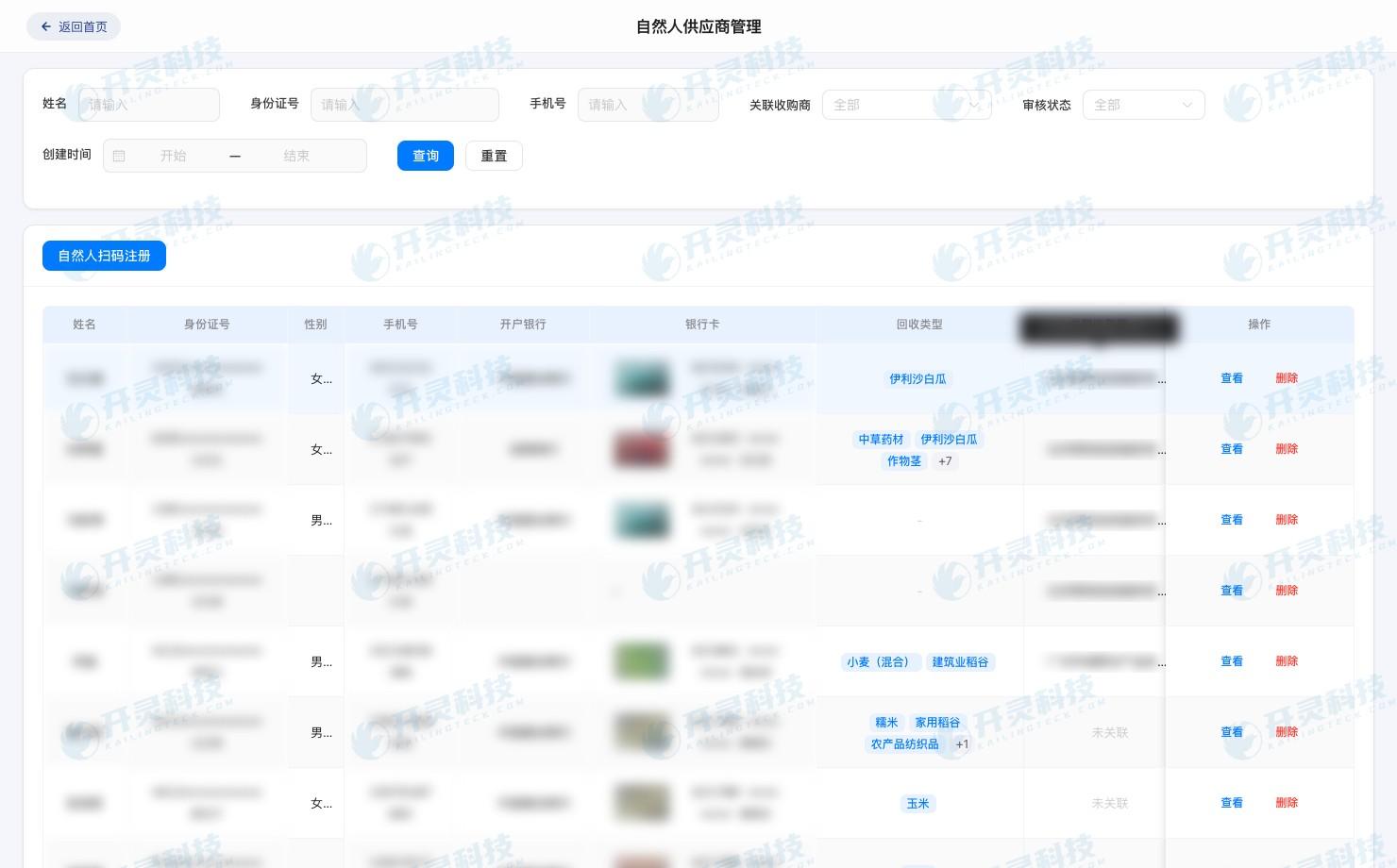
Agricultural producer records and self-produced materials verification (information desensitized)
▍Verification two: can the purchase order connect weighbridge readings and the settlement process
When a test vehicle enters the purchasing point, the system records the deliverer, license plate, category, gross weight, time, and device source; after unloading is completed, the tare weight is obtained and the net weight is immediately formed. The quality inspector then enters moisture, impurities, grade, or the acceptance indicators actually used by the enterprise, and the settlement amount is calculated based on the confirmed weight, grade, and unit price.
The person in charge deliberately adjusts a reading once and splits the same vehicle of grain into details for two farmers. Qualified performance is that the system saves the original value, adjusted value, reason, operator, and approval result, while preserving the reconciliation relationship between total weight and household details. Failed performance is that the new number directly overwrites the old number, or the summary quantity cannot return to a specific farmer.
Acceptance fields for grain, fruits and vegetables, livestock, aquatic products, and forestry products each have their characteristics, and selection testing should switch to a set of real enterprise categories. Kailing Technology's agricultural product purchase reverse invoicing system can connect to weighbridge or measurement stages according to project scope; acceptance should focus on which purchase order the reading enters, how manual corrections leave traces, and how to resend after interface interruption.
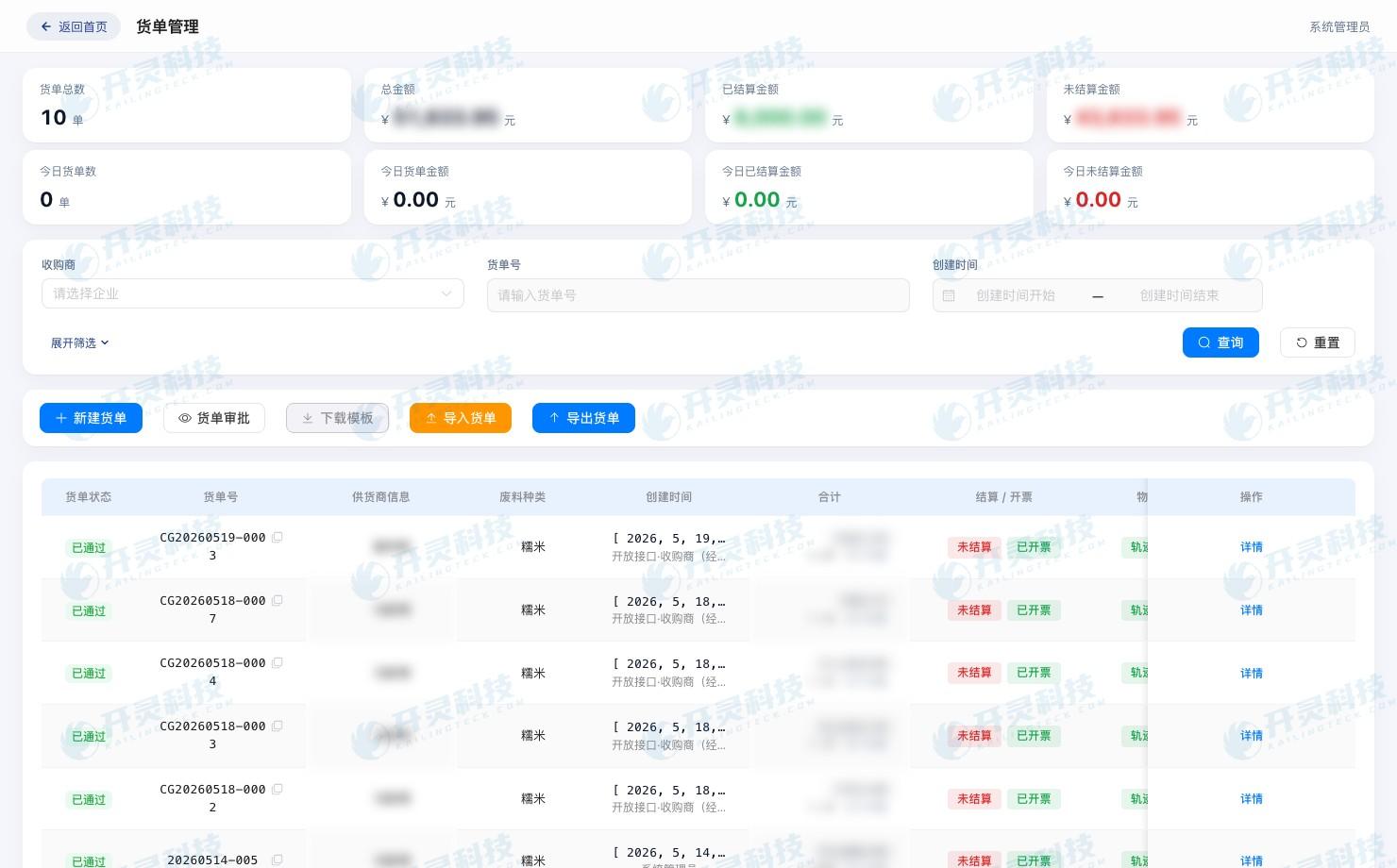
Agricultural product receiving, weighing, and batch information (information desensitized)
▍Verification three: can payment lock the farmer, purchase order, and bank result
After purchase settlement is confirmed, the system generates pending payment details, listing the farmer, purchase order, amount, and receiving account for each transaction. The cashier can aggregate multiple pending payment transactions by farmer, or open a batch to view each source. After the payment file or bank-enterprise direct connection request is sent, the batch number and business number are saved together.
The acceptance tester changes a farmer's account number incorrectly, then creates a bank return timeout. The test first checks whether the erroneous account can be pointed out before submission, then checks whether, when the bank has no clear result, the original payment request can be queried and remains in a pending-verification state; after confirming the return, only that detail is processed while other qualified business continues, avoiding a second payment for the same acquisition.
Visible results appear at two ends: the farmer ledger shows the true progress of that batch of payment, and the finance ledger receives bank results and receipts. After a return and re-payment, the new request follows the original procurement relationship, and the original record remains queryable. Entering from bank statements at month-end also allows locating the farmer, settlement, invoice, and related vouchers.
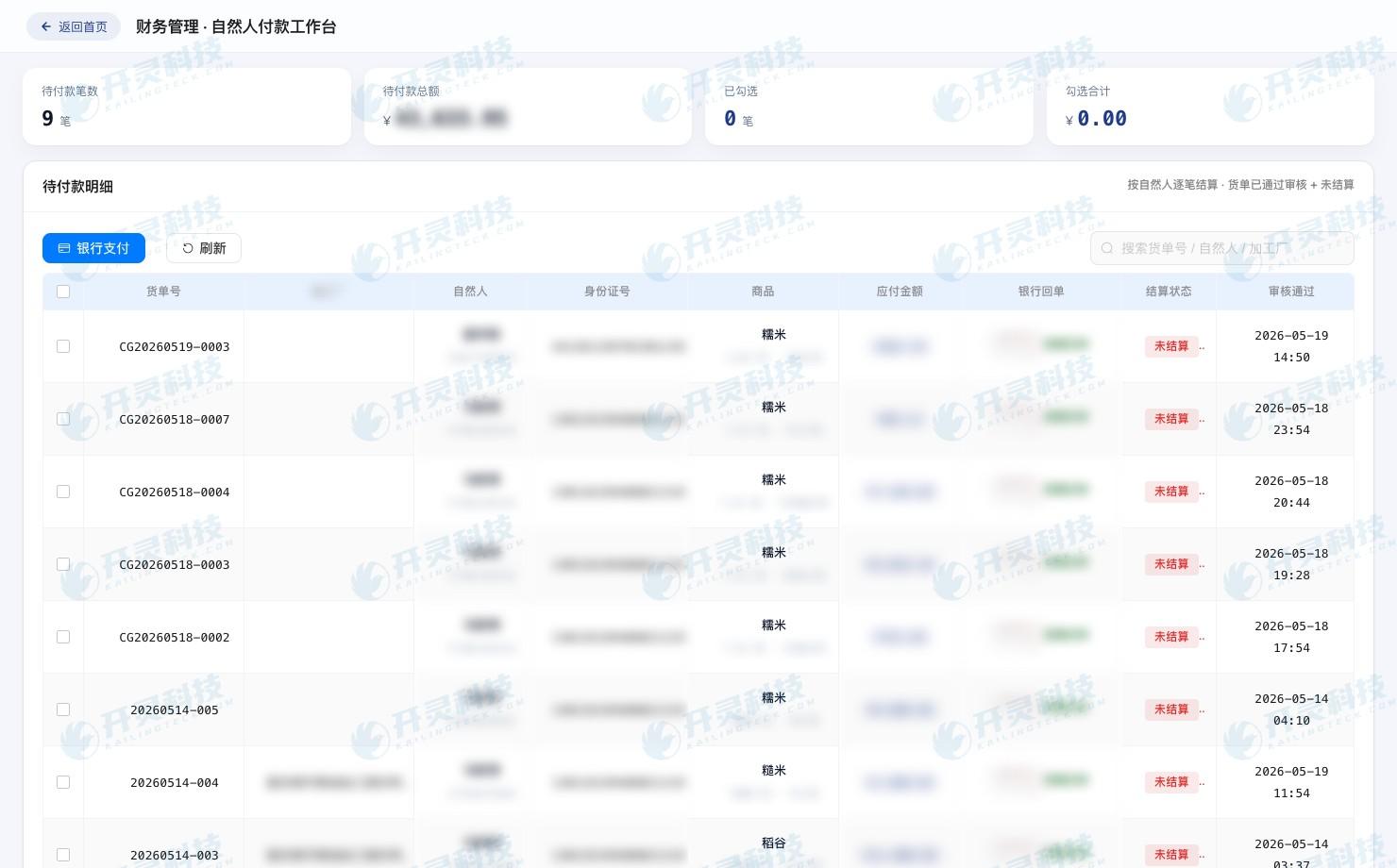
Agricultural product payment linked to purchase order (information desensitized)
▍Verification four: can purchase invoices be generated directly from confirmed business
Finance places the farmer, self-produced category, receiving quantity, and purchase price on the fourth checklist, and then verifies the process by which this transaction enters the purchase invoice task. After obtaining a compliant agricultural product purchase invoice, the enterprise calculates a nine percent deduction based on the purchase price; for business used to produce goods with a thirteen percent tax rate, it is additionally deducted to ten percent according to regulations. Testers use this to check whether the invoice amount can return to the confirmed purchase.
Finance initiates a task from a confirmed purchase order, and the farmer, category, quantity, unit price, and amount are automatically populated. After successful invoicing, the invoice number, invoicing time, and file information are written back to the original order; when a farmer's materials are abnormal, the corresponding task stops separately and displays the reason, while the rest of the batch can continue processing. Batch efficiency and single-transaction traceability are preserved simultaneously.
The person in charge then simulates an interface timeout and a return. The system queries the original invoicing result using the business number and request number, confirms the status, and then proceeds to subsequent actions; the details affected by the return are located from the original invoice, and then red-ink processing and necessary re-issuance are completed. Failed performance is duplicate submission, repeated redoing of the entire batch, or a red invoice that cannot find the original purchase details.
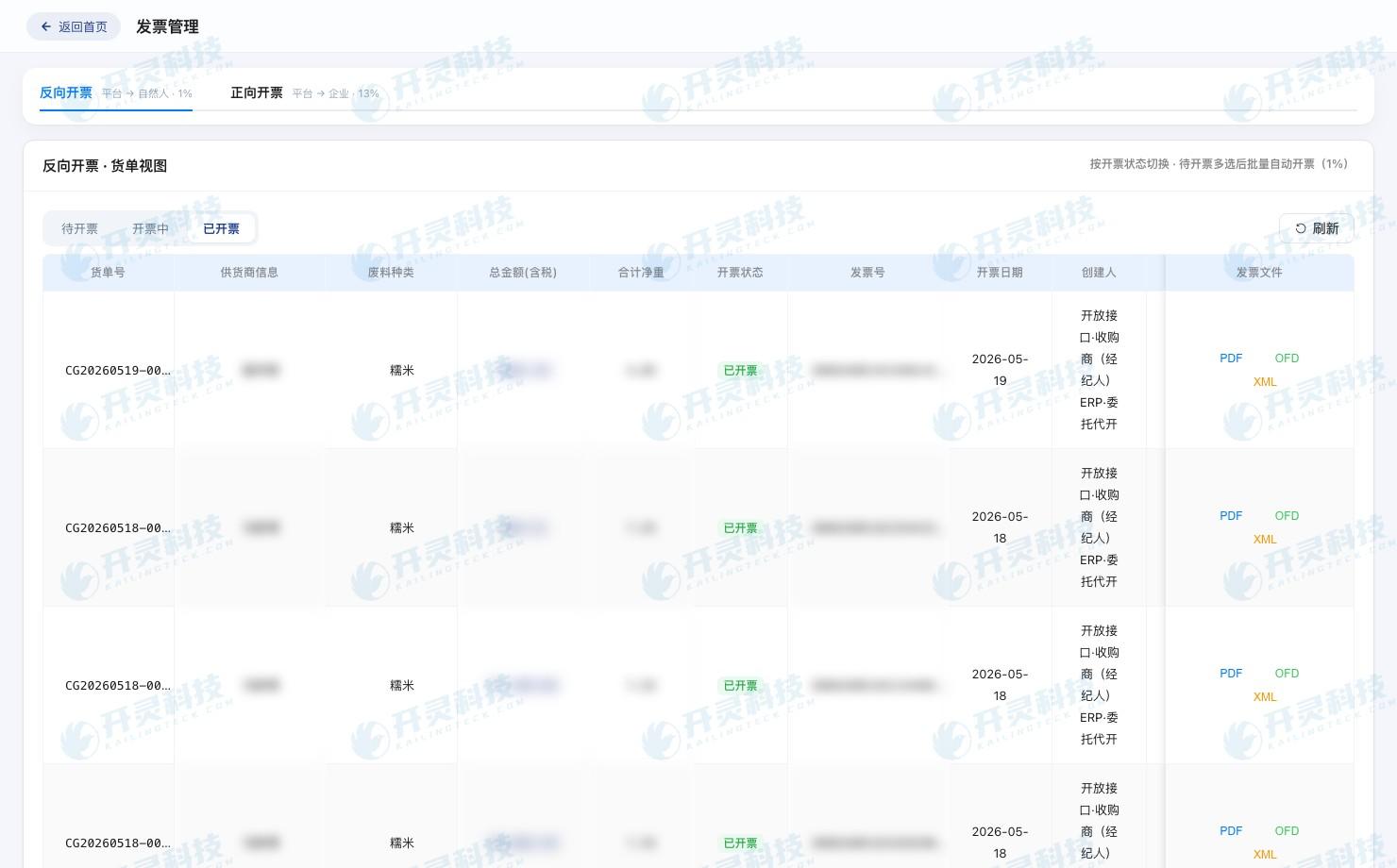
Invoice tasks are generated from purchase business and results are written back (information has been desensitized)
▍Verification five: can one invoice open five types of original evidence
The fifth checklist does not require operators to temporarily organize attachments. The person in charge randomly enters an invoice number, and the page first displays five completion statuses: farmer profile, transaction agreement, receiving acceptance, invoice status, and payment result; clicking any item opens the source file, handling position, and formation time. Missing items are directly marked at the corresponding stage.
The acceptance lead then deliberately removes a payment receipt, and queries in reverse from both the weighbridge ticket and the transaction record. The qualified result is that the invoice view immediately shows payment materials pending supplementation, while the weighbridge ticket can still return to the acquisition and invoice; after the bank transaction record is supplemented, the status updates automatically and the handling record is retained.
Failure manifestations are easy to identify: although all five types of documents exist, they are scattered by month on shared drives; the invoice page shows only amounts and cannot locate the original weighbridge ticket; bank receipts show only batch totals without farmer details. Single-invoice penetration turns these breakpoints into queryable statuses, letting reviewers flip through fewer files and letting managers see where materials are backlogged.
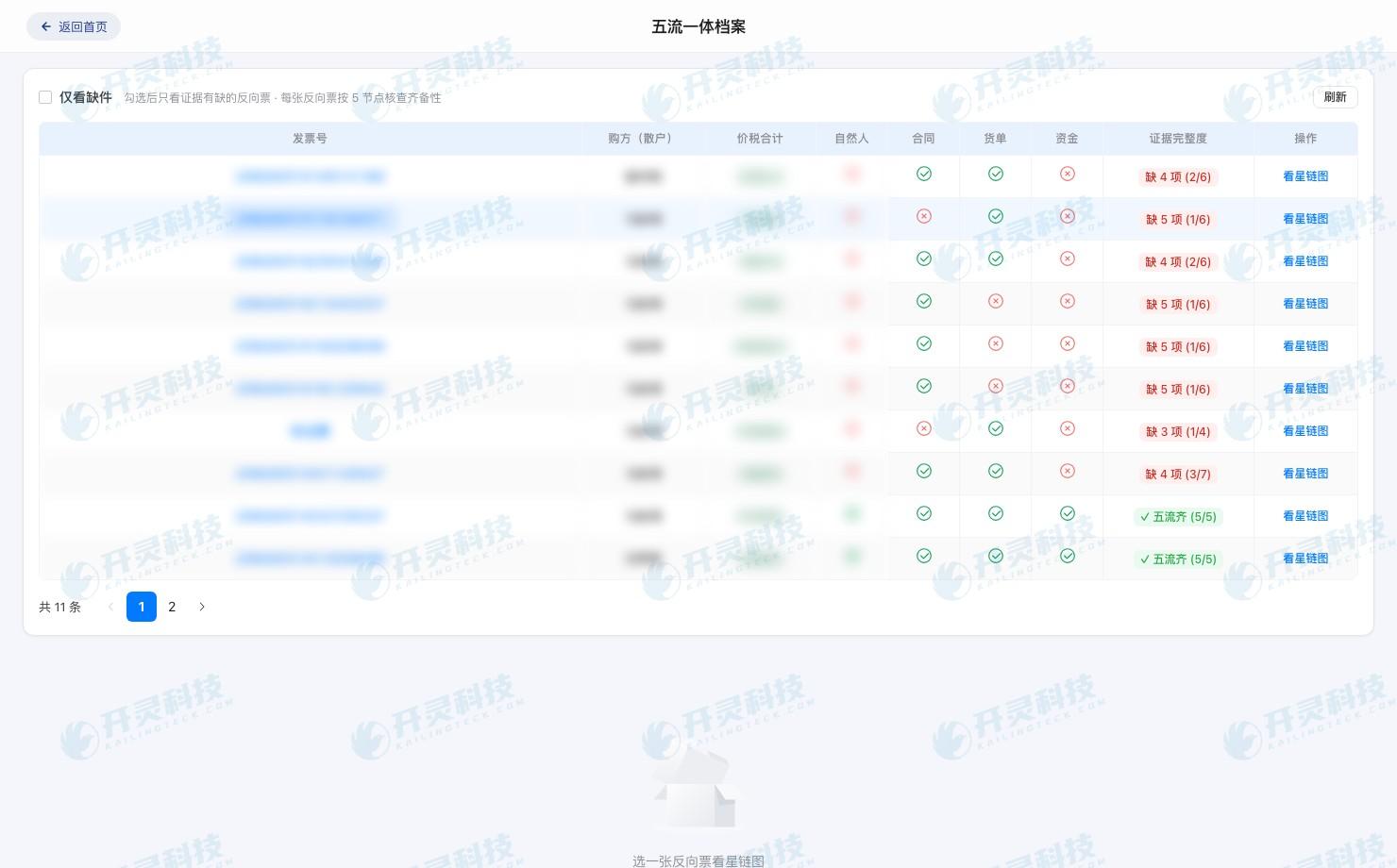
Agricultural product purchase five-flow archive and single-invoice penetration (information desensitized)
▍Turn the five capabilities into procurement acceptance conclusions
After testing ends, the procurement team does not write broad conclusions like "supports profile creation, supports invoicing," but records specific screens: a farmer with materials pending verification cannot enter normal purchasing; scale readings adjustments leave before and after versions; payment returns point to a specific farmer and a specific purchase order; invoice status returns to the original business; the invoice number can open five types of evidence.
When an enterprise already has ERP, weighbridge, and payment systems, the next round of testing focuses on interface primary keys and status write-back. Let ERP provide order or financial data, let the weighbridge provide original readings, let the bank return payment results, and then check whether each system collaborates around the same purchase. Mature modules already on site can be retained, while missing orchestration and evidence steps enter the project scope.
The selection result is also determined by the business foundation: enterprises that only lack an invoice channel can evaluate a lightweight interface; enterprises with scattered farmers, receiving, payment, and materials are better suited to a specialized acquisition platform. The Kailing Technology agricultural product acquisition reverse invoicing system is suitable for scenarios that want to run all five capabilities together, and the implementation survey will continue to turn categories, roles, interfaces, and exception samples into acceptance test cases.
The five checklists on the acceptance table ultimately each leave a clear result: farmer data can be located, the weighbridge and quality inspection form a settlement, the payment corresponds to a specific account, the acquisition invoice is written back to the original form, and the invoice number can open the related evidence. What the procurement team compares is these on-site pictures, and whether the chain can continue after an exception occurs.
▍FAQ
Q: Why does the agricultural product purchase invoice system verify farmer records first?
A: Once the farmer, self-produced materials, and payment relationship are determined, subsequent receiving, payment, and invoicing can revolve around the same object.
Q: How can an existing weighbridge system participate in a POC?
A: Select one real weighing transaction to verify the association and write-back among original readings, adjustment records, business number, and purchase order.
Q: How can batch payments preserve the per-item relationship?
A: Under the payment batch, save each farmer, purchase order, amount, and account details, then link bank results back to the business transaction by item.
Q: What exceptions should be prepared for the five-capability acceptance?
A: It is recommended to prepare missing materials, reading adjustments, one truck with multiple households, incorrect account, invoicing timeout, return red reversal, and single-invoice reverse lookup.
Use real farmers, real weighbridge tickets, and abnormal payments to verify the five capabilities and learn about Kailing Technology's agricultural product acquisition reverse invoicing system: https://www.kailingteck.com/fxncp/ .
As a national high-tech enterprise, Kailing Technology focuses on the digital and intelligent transformation of enterprise business-finance-tax and operations management, providing software products, system integration, implementation and delivery, and operational services for various government agencies, institutions, group enterprises, and SMEs.
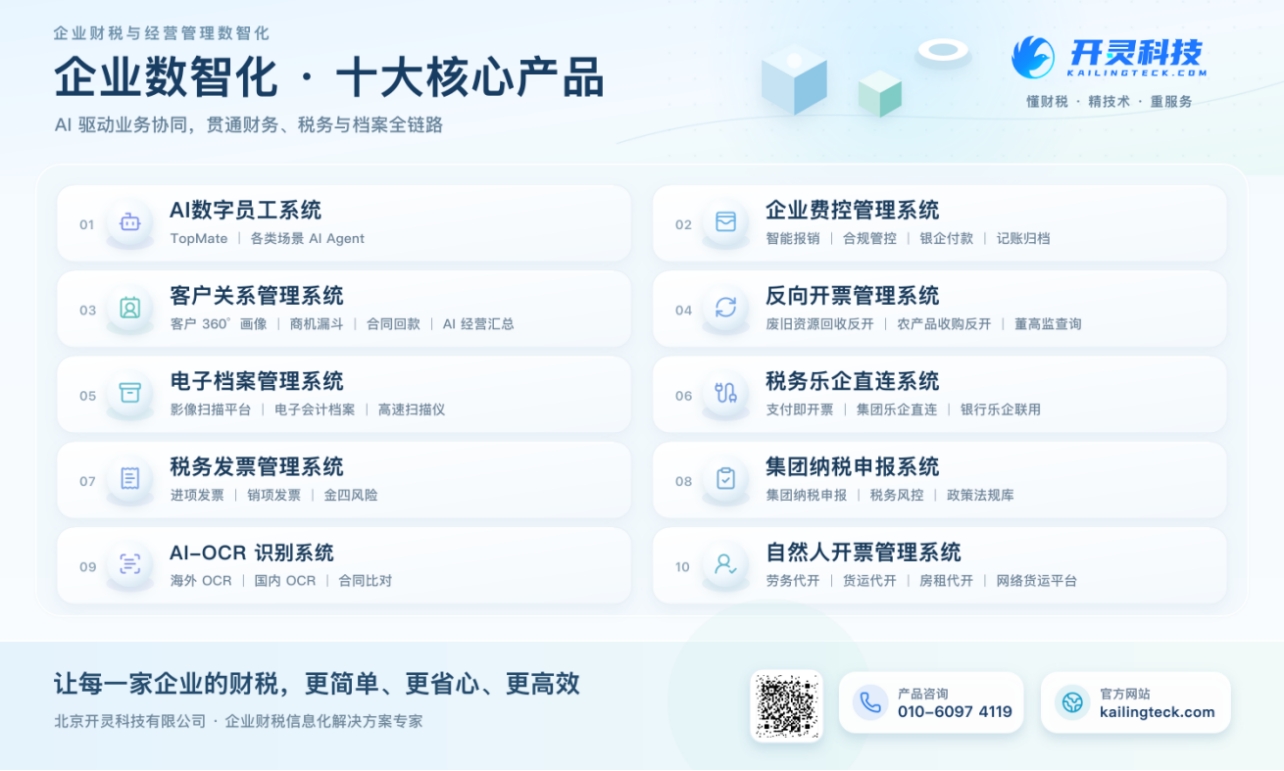
The company has now formed ten core product lines, including: AI digital employee system, enterprise expense control management system, customer relationship management system, reverse invoicing management system, invoice issuance for individuals management system, electronic archives management system, tax fully digitalized e-invoice Leqi system, tax invoice management system, group tax filing system, and AI OCR recognition system. It is committed to connecting enterprise business, finance, tax, funds, and archive data to help customers improve operational efficiency, business-finance-tax compliance capabilities, and digital management levels.
If you have any business-finance-tax digital transformation needs, welcome to contact us. Beijing Kailing Technology will serve you wholeheartedly.
Keywords: How to choose an agricultural product purchase invoice system, agricultural product purchase reverse invoicing system, farmer record creation, weighbridge integration, five-flow integration
As a comprehensive business-finance-tax digitalization solution service provider, Kailing Technology provides business-finance-tax management digital transformation products and operational services for various government agencies, institutions, and large, medium, and small enterprises. The product line includes: solutions for sales contract management system, procurement contract management system, fully digitalized Leqi interface project, automatic output invoicing system, reverse invoicing system, invoice issuance for individuals system, employee expense control and reimbursement system, input VAT invoice management system, supply chain collaborative reconciliation system, image AI OCR recognition system, automatic financial bookkeeping system, electronic accounting archives system, etc., comprehensively driving the digitalization process across various fields.
Consultation Hotline: 18513895936 / 010-60974119 Location: Beijing