
A group with 300 entities and a 15-day filing period, short-staffed and overloaded? Kailing Technology turns group tax filing into a controllable pipeline

A nationally distributed energy group's tax head calculated an account:3 million taxpayers are distributed across various provinces, and the number is still rising; one finance person now has to manage 40 companies, "previously 10, now 40"; the monthly filing window is only 15 days; the entire group invests about 20 people in tax filing, mostly part-time business-finance staff scattered across locations; about two-thirds of them are zero-filing entities. Many entities, rigid deadlines, and tight staffing—when the filing period arrives, everyone collectively "can't hold up." The way to break through is not to add people, but to turn filing into a manageable pipeline—this is exactly Kailing Technology Group Tax Filing The problem to solve: use one enterprise tax management system to string the collection, tax calculation, filing, and payment deduction of 300 entities into the same pipeline, replacing a desk full of Excel ledgers with a single progress bar on one screen.
▍I. 300 companies, 15 days, 20 people: the pressure of group filing is not in difficulty, but in total volume
Filing taxes for one company is not that difficult; the hard part is filing for hundreds of companies at the same time. The real pressure of group tax filing has never been how complex any single return is to calculate, but the word "volume": the number of entities is in the hundreds or thousands, the filing window is only half a month, and there are never enough people who can handle it. Stack these three numbers together, and what was originally routine work is compressed into a concentrated sprint once a month.
What is more easily overlooked is zero filing. In the energy group mentioned above, approximately Two-thirds are zero-filing entities, but "zero filing is only zero filing for tax purposes, the books still need to be kept as usual" — every entity still needs to collect data, create tasks, and complete the filing actions, and the workload does not disappear just because the tax amount is zero. Thus "many entities" is further amplified: the actual number of filings to be processed is often several times the number of entities. Relying on sheer manpower and overtime can hold up for one month, but not every month.
▍II. The four "differences" of multi-organizational structures: scattered data, mixed rules, chaotic deadlines, few people with much work
Group tax filing is more difficult than that of a single company because a multi-organization structure inherently comes with four "differences." Once these four points are clear, you will understand why "hiring a few more people" cannot solve the fundamental problem.
- Data scattered— Each company's books lie in different financial systems. Before filing, they must be exported entity by entity, collected manually, and then passed back and forth using Excel ledgers. Just "gathering the numbers together" consumes most of the energy.
- Miscellaneous rules— VAT, stamp tax, property tax, union funds... each tax type depends on different data, and provincial standards also differ. The same matter does not use a universal calculation method across different entities.
- Chaotic deadlines— Within the same group, some entities file monthly, some quarterly, and some per transaction; which taxes each company must file this month changes almost every month, and relying on human memory will inevitably lead to omissions.
- Few people, lots of work— Most finance staff are not dedicated tax filers, and business-finance integration puts more energy on the business side, squeezing both ends during filing periods. Moreover, newcomers must first learn the rules of each province before they can get started, and adding people in the short term actually creates more confusion.
The four "differences" point to the same conclusion: group filing is a matter of total volume and coordination, not a pit that individual overtime can fill. To make it stable, the organizational approach must change — gathering scattered actions into one unified pipeline.
▍III. Kailing Technology group tax filing: turning filing into a controllable pipeline
The core of this enterprise tax management system is to converge filing actions previously scattered across individuals and systems into a five-step closed-loop pipeline:Data collection → Tax calculation and working paper generation → Tax return form generation → Direct connection filing (fallback for missed filings) → Archive retrieval。All five stages run through the same system; finance intervenes only where judgment is needed, and the rest flows automatically through the system. Below, from a "total volume perspective," we look at what each stage of this pipeline solves.
- Data collection, so you no longer have to chase data — Built-in eight collection methods, configured once and then automatically in place every month thereafter: collect invoices from the tax bureau or your own invoicing system, retrieve financial data via connected interfaces, scheduled tasks replace manual work, automatically collected at night after month-end closing, no need to go door-to-door asking subordinate companies for data.
- Tax calculation produces working papers, so rules do not rely on human memory— The system has built-in algorithms for various tax types that can be configured by company or in batches; when account names differ across entities, simply "attach a tag" to automatically retrieve data, leaving "complex rules" to the system for alignment.
- Generate tax returns so the format follows the tax bureau— Cell-level mapping enables automatic filling, covering the main table and attached schedules together, and remains editable after the table is generated, with a dedicated operations team following tax bureau changes and making timely adjustments.
- Direct Connection filing and omission fallback, so reporting no longer requires logging in household by household — After confirming and locking the table, report and pay in batches, replacing logging into the electronic tax bureau household by household; then pull back filing status from the tax bureau side as a final safeguard, preventing anyone from filing offline or being missed.
- Archive recovery returns results automatically to their place— Filing data, payment data, and tax payment certificates are automatically collected and archived through three channels, so there is no need to search through individual computers during traceability.
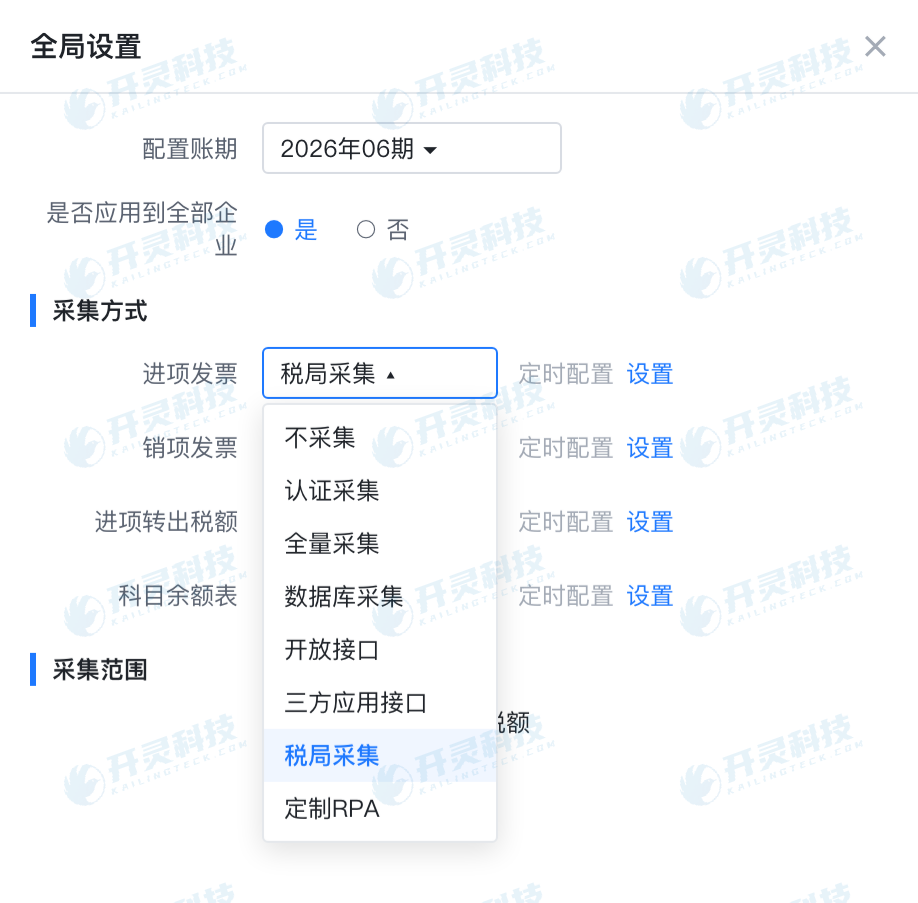
Looking at the five stages together, the "uncontrollability" of group filing is essentially scattered actions and opaque status; once brought into a unified pipeline, every step has traceability, status, and fallback, and no matter how large the total volume, it can be advanced at a steady pace.
▍IV. Group view: turning 300 filings into a progress bar one person can watch
After the pipeline is running, what the group needs most is actually a pair of eyes that can "watch the whole picture." Kailing provides a one-screen overview from the group perspective: collection, tax calculation, tax filing, and deduction progress displayed side by side, with vertical drill-down to each enterprise, making it visible at a glance which one is stuck at which step, with nowhere for anomalies to hide.
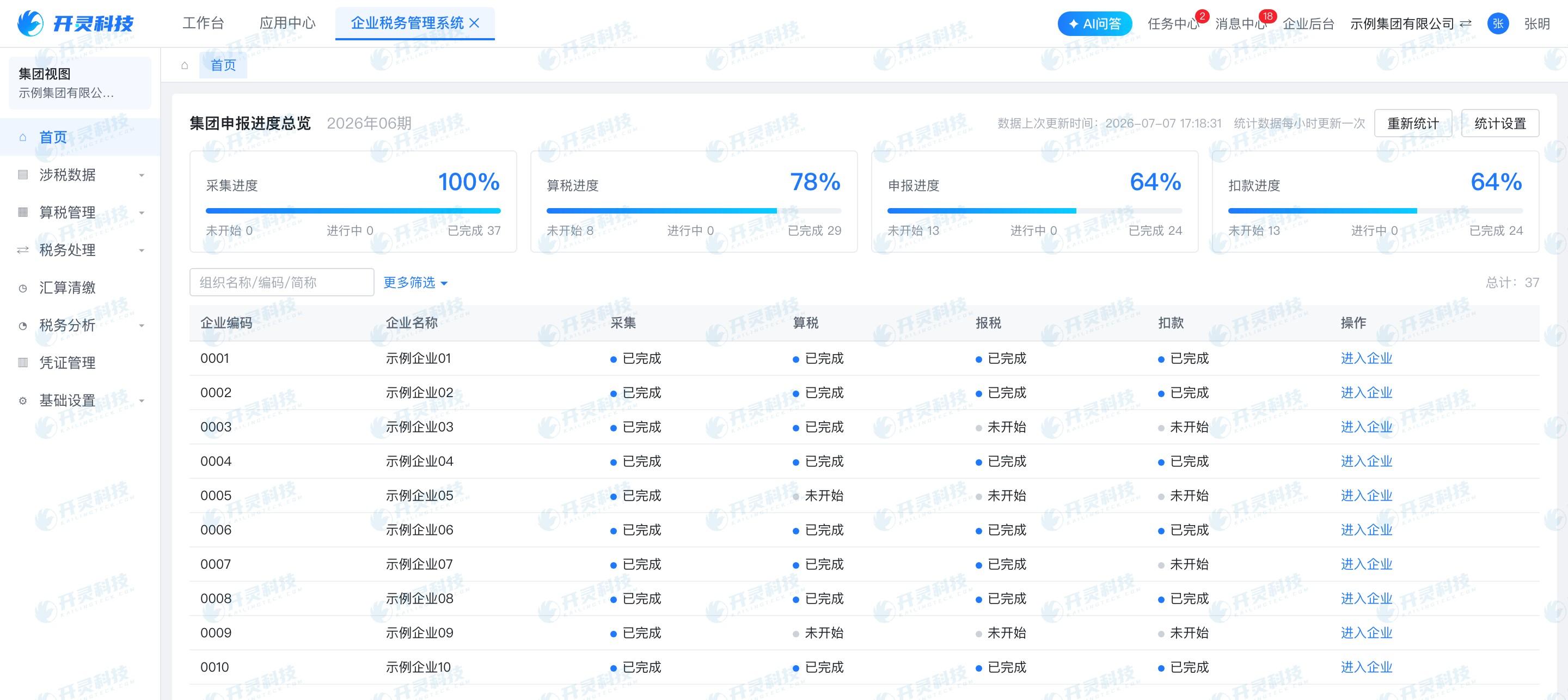
With this dashboard, managers no longer rely on phone calls and WeChat groups to ask "where has it been reported." On the progress bar, collection is 100%, tax calculation 78%, filing and payment deduction 64%. How far behind each stage is and which companies are holding it up are clear at a glance; click "enter enterprise" to drill down to the specific entity for handling.Turn 300 filings into a progress bar one person can keep an eye on— This is precisely the key leap for group filing from "uncontrollable" to "controllable."
| "The ideal state of group filing is not everyone working harder, but one person being able to watch the entire group's progress bar: who has not collected, who has not calculated, who has not filed, who has not withheld—all clear on one screen. |
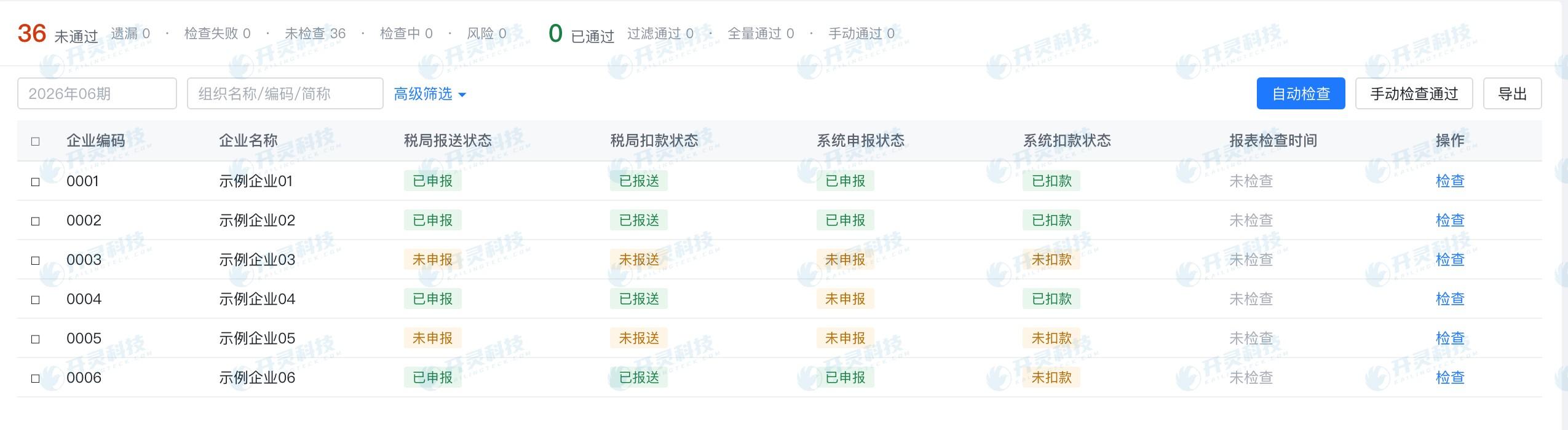
In the filing status and payment status list, which taxes each entity filed, whether submission and deduction were successful, and whether there are late fees are all listed entity by entity and traceable. Tax filing information is also automatically synchronized monthly from the tax bureau side; only per-instance optional filing types require manual maintenance—the difficult matter of "some monthly filings, some quarterly filings" is taken over by tax bureau synchronization and no longer relies on people to remember.
▍V. Why this pipeline holds up: maturity and total value
Being able to stabilize the total volume problem relies not on a temporary solution, but on long-term refinement. Since Kailing Technology's enterprise tax management system was put into operation, it has been stable for many years, with a dedicated operations team continuously following changes in tax bureau policies across regions; there is no upper limit on the number of tax entities, batch collection can be done once account passwords are entered, and integration with mainstream financial systems is fully covered. These "chassis" capabilities are precisely the confidence that enables the group to entrust thousands of entities to the pipeline.
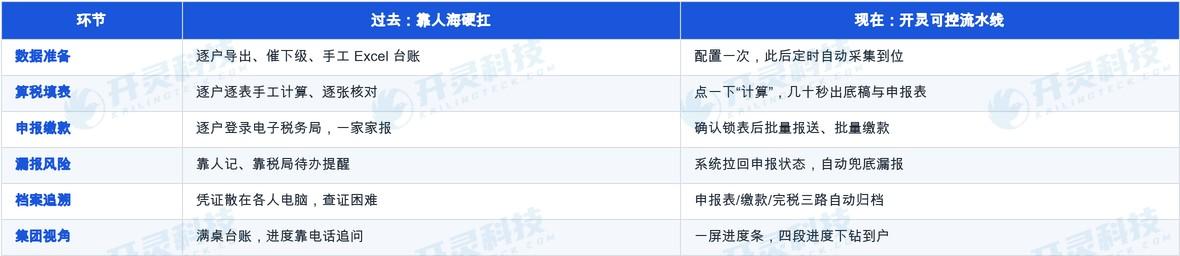
Looking at it from another angle, for the same group tax filing, the difference before and after using the assembly line shows up in every step:
▍FAQ
Q: With hundreds of entities and still growing, can the system handle it?
A: It can handle it. Kailing is designed by "total volume," with no upper limit on the number of tax entities. Batch collection is possible once account passwords are entered. New entities only need to be configured once according to the template to be incorporated into the same pipeline, without reconstructing the process because "there are more entities."
Q: With so many zero-filing entities, is it purely a waste of manpower?
A: Zero filing only means the tax amount is zero; the accounting and filing actions still need to be done. The pipeline automatically creates tasks for zero-filing entities and automatically completes collection and filing, handing this seemingly simple but high-volume repetitive work to the system, so people only need to focus on exceptions.
Q: Some companies report monthly, some quarterly, and some per transaction. What if the deadlines are chaotic?
A: Tax filing information is automatically synchronized monthly from the tax bureau side, and the system takes over which taxes each company should file; monthly reports are automatically generated once per month and quarterly reports once per quarter. Only optional filing categories requiring per-instance filing need manual maintenance, fundamentally avoiding omissions caused by relying on people to remember.
Q: How can I know at any time which step the whole group's filing has reached?
A: From the group perspective, it provides a one-screen progress overview. The four stages of collection, tax calculation, tax filing, and deduction are displayed side by side, and can be drilled down to each enterprise. Lagging and abnormalities are visible at a glance, and managers no longer need to call one by one to ask about progress.
Q: After adopting this system, do we need to overhaul our existing financial system?
A: No major changes are needed. System integration covers mainstream financial systems. It can be connected by retrieving data through interfaces and calculating tax rules according to company configuration. The focus should be on "configure once, automate long term" rather than transforming existing systems.
If your group is also repeatedly troubled by "many entities, tight deadlines, and insufficient staff," you might as well hand tax filing over to a pipeline you can keep an eye on: Kailing Technology Group Tax Filing, turning the filings of 300 enterprises into a progress bar that one person can watch. Official website: www.kailingteck.com.
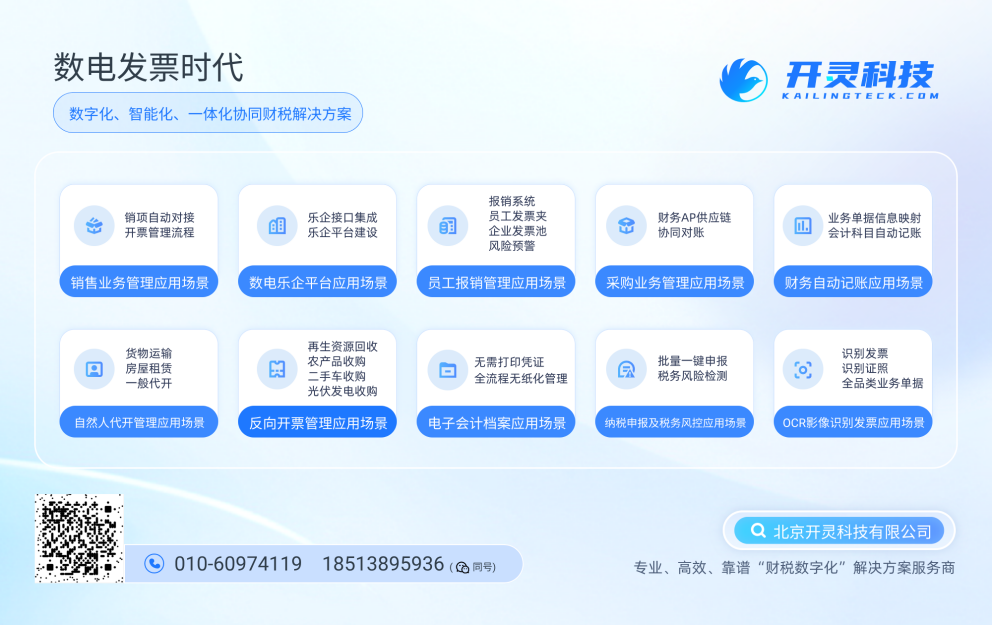
As a comprehensive business-finance-tax digitalization solution service provider, Kailing Technology provides business-finance-tax management digital transformation products and operational services for various government agencies, institutions, and large, medium, and small enterprises. The product line includes:
Solutions for businesses including sales contract management system, procurement contract management system, fully digitalized Leqi interface project, output automatic invoicing system, reverse invoicing system, invoice issuance for individuals system, employee expense control and reimbursement system, input VAT invoice management system, supply chain collaborative reconciliation system, image OCR recognition system, automatic financial bookkeeping system, and electronic accounting archives system, comprehensively driving the digitalization process across various fields.
If you have any business-finance-tax digital transformation needs, welcome to contact us. Beijing Kailing Technology will serve you wholeheartedly.
Keywords: Kailing Technology Group Tax Filing, enterprise tax management system, group tax reporting, multi-organizational structure, tax filing pipeline, filing progress overview, eight types of collection, direct filing connection, missed filing fallback, archive recovery, zero filing, business-finance-tax digitalization
As a comprehensive business-finance-tax digitalization solution service provider, Kailing Technology provides business-finance-tax management digital transformation products and operational services for various government agencies, institutions, and large, medium, and small enterprises. The product line includes: solutions for sales contract management system, procurement contract management system, fully digitalized Leqi interface project, automatic output invoicing system, reverse invoicing system, invoice issuance for individuals system, employee expense control and reimbursement system, input VAT invoice management system, supply chain collaborative reconciliation system, image AI OCR recognition system, automatic financial bookkeeping system, electronic accounting archives system, etc., comprehensively driving the digitalization process across various fields.
Consultation Hotline: 18513895936 / 010-60974119 Location: Beijing