
How are grain purchase invoices issued and how is input tax deducted? Kailing Technology's agricultural product purchase reverse invoicing system connects the five flows
Grain purchase invoices are issued by the actual purchasing enterprise based on the genuine business of purchasing self-produced grain from agricultural producers. The seller on the invoice is the corresponding farmer, and the category, grade, weight, purchase price, and amount should come from the confirmed purchase batch. After obtaining compliant agricultural product purchase invoices, enterprises calculate input tax using the purchase price and a 9% deduction rate according to current regulations; when used to produce or commission processing of goods subject to a 13% tax rate and conditions are met, they then determine the additional 1% according to regulations.
Kailing Technology's agricultural product purchase reverse invoicing system places farmer archives, receipt batches, settlement, payment, invoices, and deduction materials in the same relationship. Enterprises should first distinguish the seller's identity, then discuss who issues the invoice and how to deduct, avoiding incorrectly applying the farmer self-production criterion to grain purchased from brokers or traders.

▍Who issues the grain purchase invoice, to whom, and on what basis
When a purchasing enterprise buys self-produced grain from agricultural producers, the purchasing enterprise issues an agricultural product purchase invoice according to regulations. The basis for invoicing is not a handwritten receipt, but farmer identity, self-production business, receipt and acceptance, settlement, and payment materials that can demonstrate a genuine transaction.
The invoice item name and quantity must be consistent with the grain purchase order. When enterprises price using quality indicators such as moisture, impurities, bulk density, and grade, inspection results and pricing rules should be preserved. The invoice amount is formed from the final confirmed purchase price; it is not permissible to first issue an invoice at the planned price and then modify the difference using an offline ledger.
If returns, quality re-inspection, or price adjustments occur, the system should retain the original purchase batch and adjustment records, and handle invoices according to applicable rules. Invoicing results are written back to the original order, enabling finance to see which batch of grain each invoice corresponds to.
▍Farmers, brokers and traders are three different types of transaction counterparties
When farmers sell self-produced grain, the focus is on verifying the agricultural producer identity, production location, category, and self-production materials. Grain brokers may be entrusted by farmers or may purchase and resell on their own; traders usually supply as business entities. The three may differ in contract, cargo ownership, payment collection, and invoice responsibility, and the same invoicing path cannot be used just because all the grain delivered on site is grain.
Enterprises should first confirm the real seller. The delivery driver, on-site contact and payee are not necessarily the seller of the goods. If the contract is signed by a trader and payment is made to the trader, but the system registers it as self-produced by a certain farmer, there will be an obvious break between the invoice and the real transaction.
Kailing Technology's agricultural product purchase reverse invoicing system establishes an entry point through farmer archives and subject materials. The system can prompt for missing identity and archive items, but brokerage business, entrustment relationships, and cargo ownership still need to be judged by the enterprise in combination with contracts and business facts.
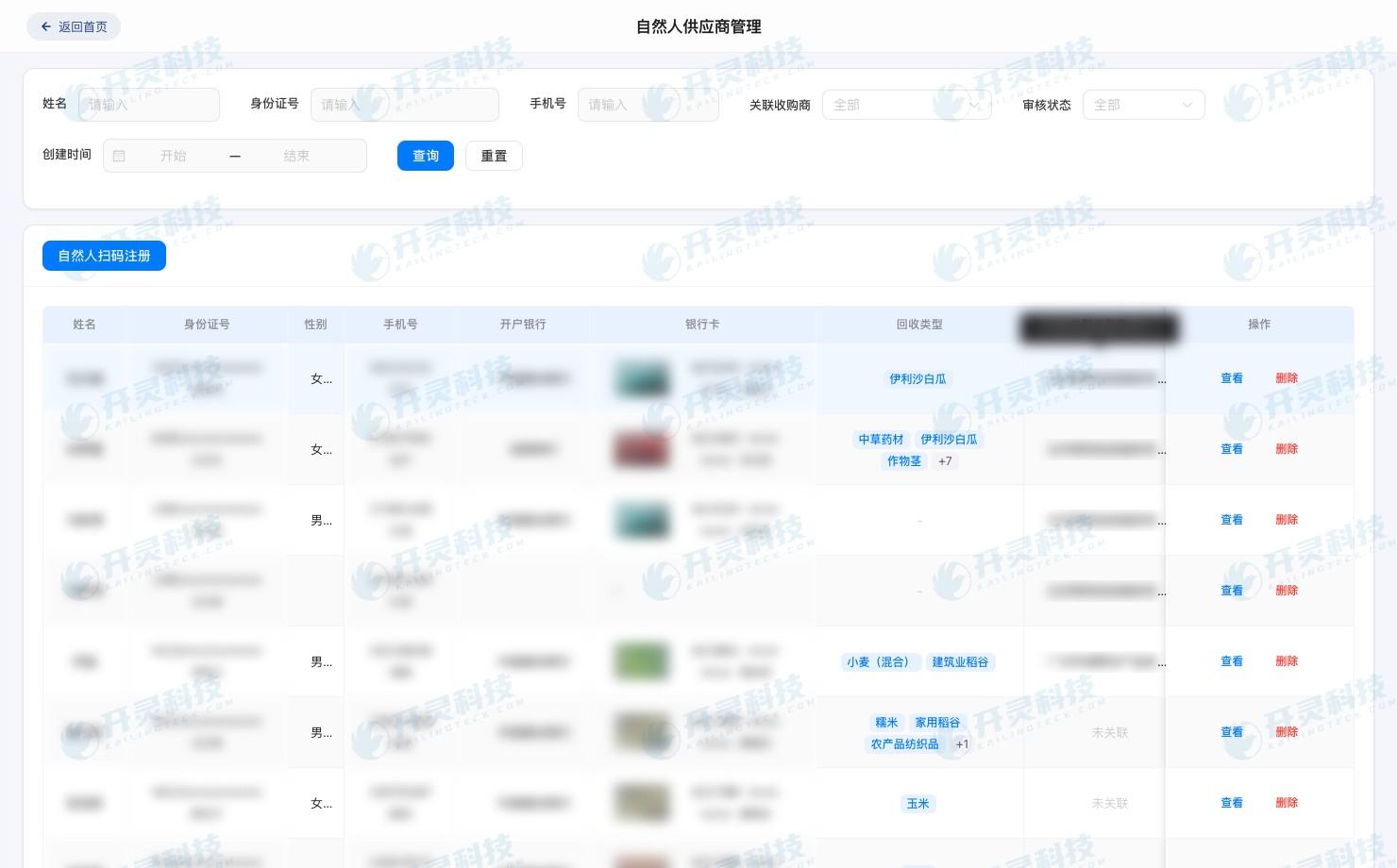
Verification of agricultural producer archives and supplied product categories (information has been desensitized)
▍How a grain batch forms an invoiceable receipt basis
After the vehicle enters the site, the weighing record captures gross weight and tare weight, and the system calculates the net weight; the inspection stage records the grain category, grade, moisture, or other quality indicators adopted by the enterprise; pricing rules combine grade and quantity deduction to form the settlement. The receipt date, warehouse location, batch, and farmer together constitute the business identification information.
During peak season with many batches, enterprises can process by one truck one order or by confirmed consolidation rules. Consolidation must retain the original details, and cannot leave only a single total for a farmer on a given day. A truckload with disputes should be able to be paused separately without affecting other confirmed batches.
A stable mapping is needed between on-site data and invoices. After the purchase order is confirmed, pending invoicing information is generated, and the system does not let invoicing personnel re-enter weight and amount manually. This reduces transcription errors and also facilitates subsequent drill-down from invoices to weighbridge tickets and inspection records.
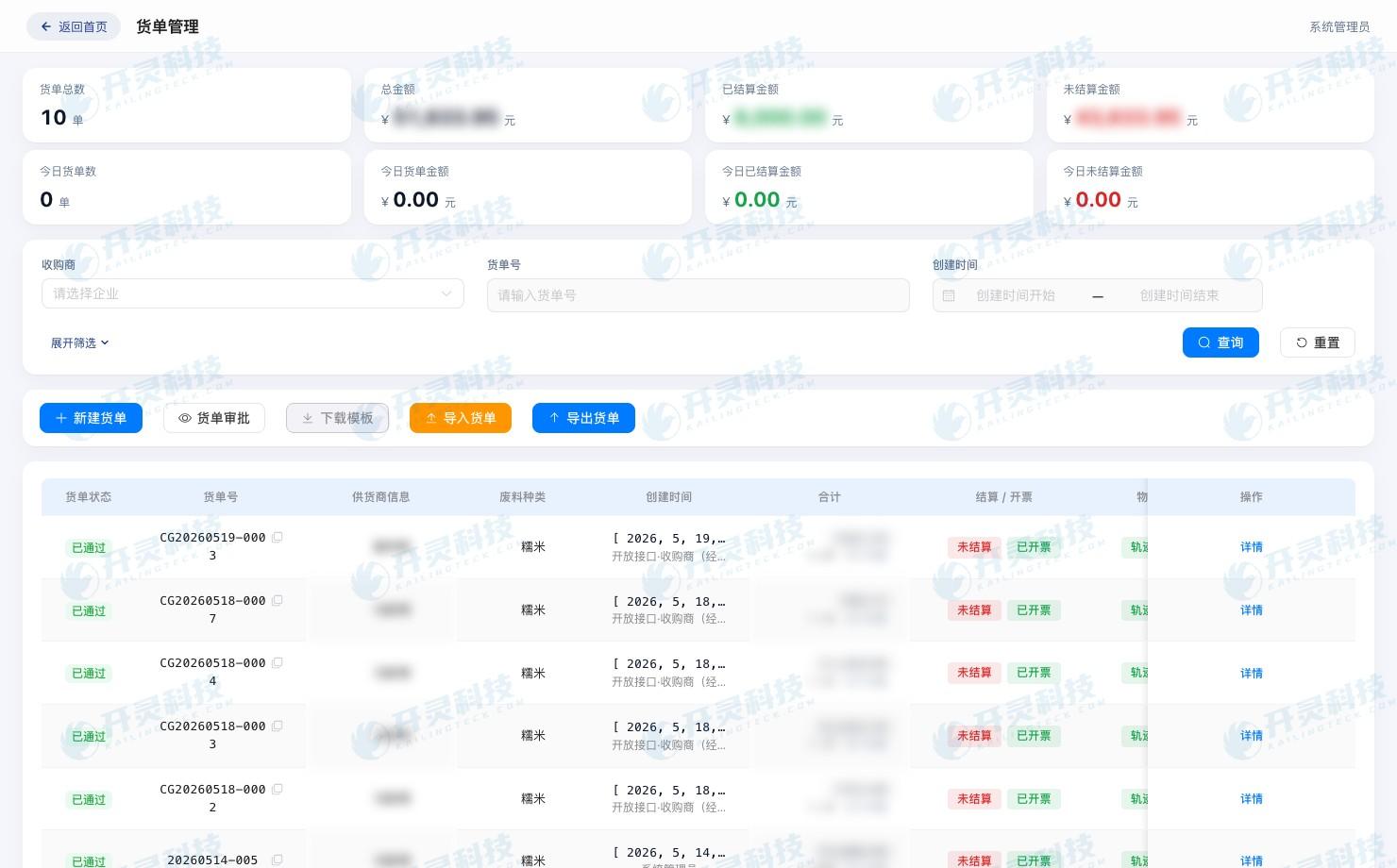
Grain purchase goods order and batch status management (information has been desensitized)
▍What conditions must be met when calculating input tax based on purchase price
Enterprises should confirm that the purchase counterparty is an agricultural producer, that the goods are self-produced agricultural products, that the purchase business actually occurred, and that an agricultural product purchase invoice issued according to regulations has been obtained. The purchase price on the invoice should correspond to the settlement statement and payment records, and the product name, quantity, etc. should be explainable by the receipt materials.
Under current rules, when enterprises purchase agricultural products, they may calculate input tax based on applicable vouchers and conditions using the purchase price and a 9% deduction rate. For agricultural products used to produce or commission processing of goods subject to a 13% tax rate, an additional 1% may be added at the consumption stage when conditions are met. Enterprises need to distinguish between purchase, consumption, and finished product use, and cannot uniformly treat all grain at 10% at the time of invoicing.
When the purpose changes, is used for tax-exempt projects, or is used in mixed situations, it should be handled according to the enterprise's actual accounting and current tax regulations. The system provides the basis for linking purchase, invoice, and consumption materials, but tax judgments are still completed by enterprise finance in conjunction with specific business.
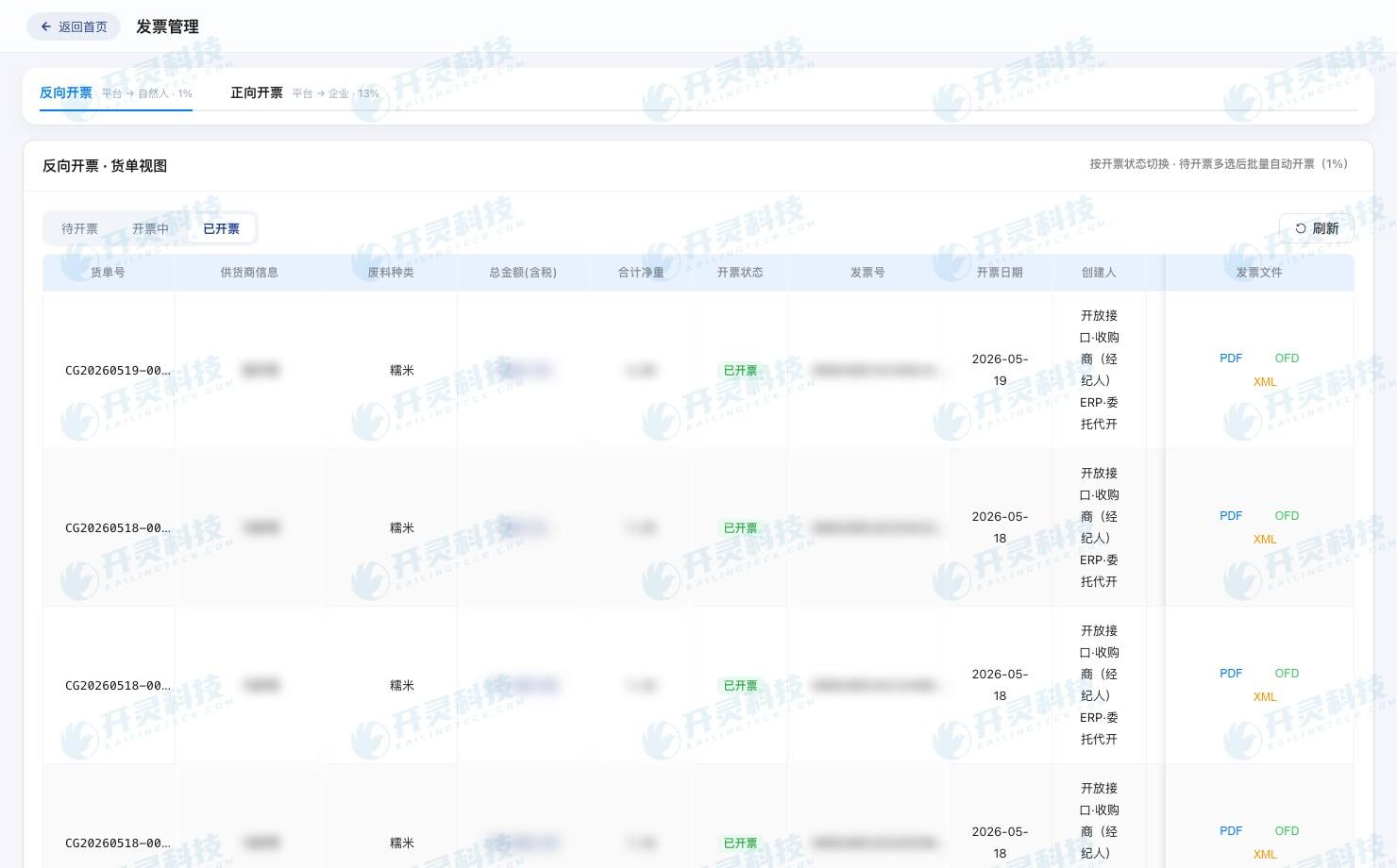
Grain purchase invoice tasks and electronic file inquiry (information has been desensitized)
▍Why payment and deduction materials must return to the same batch of grain
Payment for goods should be made to the corresponding farmer or a payee with sufficient basis, and linked to the purchase order through records such as bank receipts. Unified payment to a broker after multiple people supply goods, collection by relatives on behalf, or cash settlement easily disconnects the fund flow from the seller, and this needs to be resolved when the business occurs, not left until a explanatory note is added before filing.
The system summarizes pending payment records by farmer and batch, and payment results are written back to the original order. When finance views purchase invoices, they can simultaneously verify receipt, settlement, and payment; if a discrepancy is found, it is located to the specific batch rather than searched for in monthly totals.
Deduction materials should also be organized by batch or by invoice. Farmer self-certification, contracts, weighbridge tickets, inspection, payment, and invoices together explain the business. When enterprises adopt the internal five-flow approach, they must first define what role each type of material plays, avoiding uploading duplicate attachments just to "collect all five images."
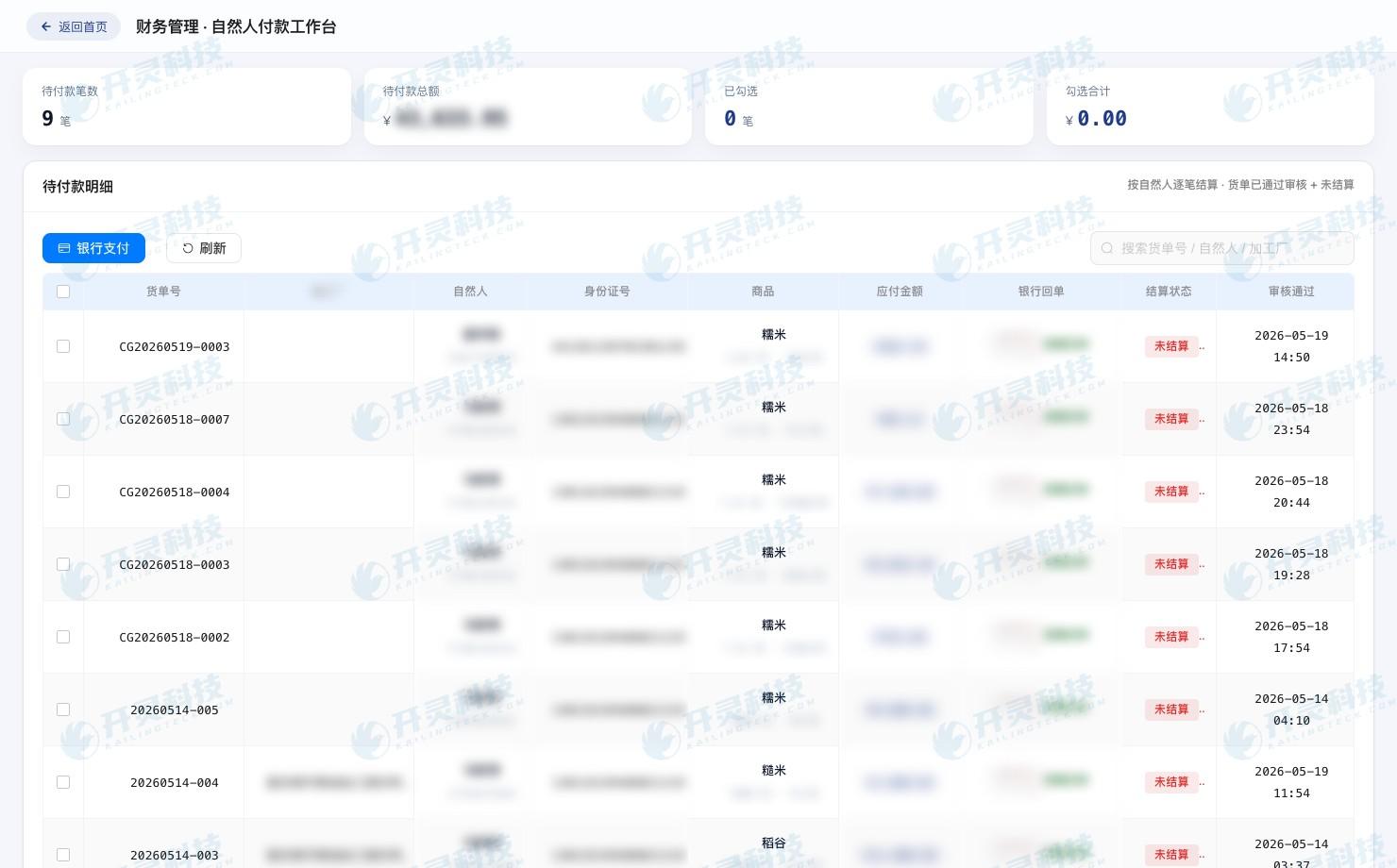
Grain purchase payment linked to farmers and batches (information has been desensitized)
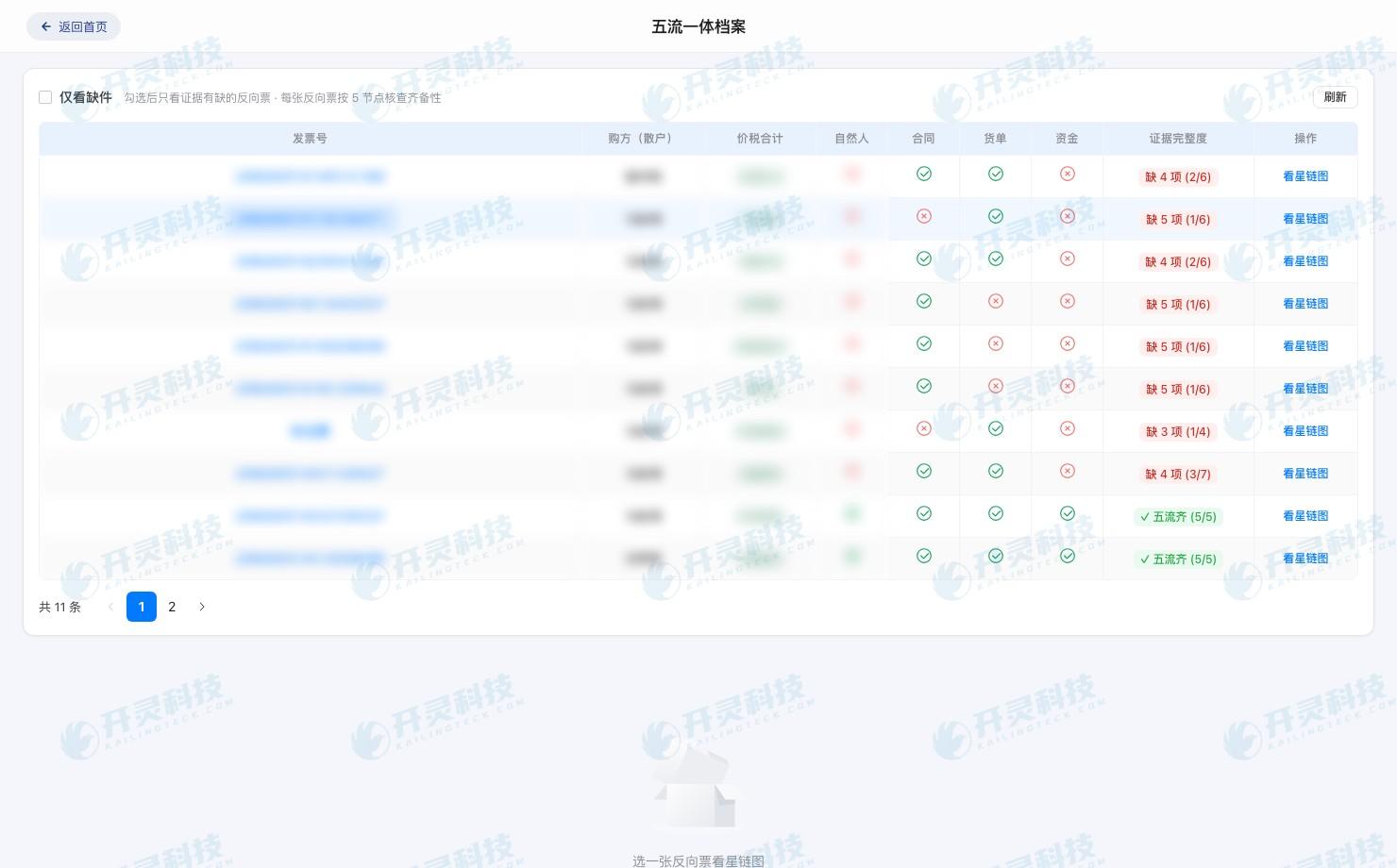
Ledger for tracing five-flow materials from purchase invoices (information desensitized)
▍How Kailing Technology connects the five flows of grain purchase
Kailing Technology's agricultural product purchase reverse invoicing system brings out confirmed identity and production materials from farmer archives, forms a purchase order after weighing and acceptance, generates invoicing and payment tasks based on settlement, and then returns the results to the original business. When different systems already exist, they can be connected through interfaces, and it is not necessary to completely rebuild ERP, weighbridge, and financial systems.
Before implementation, verify weighbridge fields, inspection standards, price rules, farmer accounts, and financial voucher mapping. Select samples such as normal purchase, re-weighing, returns, payment failure, and purpose change to run the complete chain, so as to confirm that the system can both support peak-season efficiency and retain the factual basis needed for deduction.
During system acceptance, it is also necessary to query in reverse from an issued purchase invoice to confirm that the original farmer, production materials, grain batch, weighbridge ticket, quality inspection, price calculation, and payment receipt can be seen. If one can only see the invoicing result forward from the purchase order but cannot return from the invoice to the original batch, review and deduction material organization will still rely on manual work.
▍FAQ
Q: Can purchase invoices be issued to farmers when purchasing from grain brokers?
A: The real seller and ownership of goods should first be confirmed. If the actual transaction counterparty is a broker or trader, registering the name of a farmer cannot change the substance of the transaction.
Q: Is the grain purchase invoice deducted at 9% or 10%?
A: Generally calculated based on the purchase price and a 9% deduction rate; when used for producing or entrusted processing of goods with a 13% tax rate and meeting the conditions, an additional 1% is added at the requisition stage according to regulations.
Q: Must payment be made one truck at a time?
A: They can be aggregated according to confirmed business rules, but the detailed receipt records of each batch, the aggregation relationship and the corresponding farmers must be retained to ensure that funds can return to specific purchase transactions.
Q: Can weighbridge data be manually modified?
A: When adjustment is truly necessary, it should be authorized, retaining the original value, modified value, reason and operation record, and should not be silently overwritten.
Enable mutual verification of farmers, weighbridge tickets, payments, invoices, and deduction materials for each batch of grain: https://www.kailingteck.com/fxncp/ .
As a national high-tech enterprise, Kailing Technology focuses on the digital and intelligent transformation of enterprise business-finance-tax and operations management, providing software products, system integration, implementation and delivery, and operational services for various government agencies, institutions, group enterprises, and SMEs.
The company has now formed ten core product lines, including: AI digital employee system, enterprise expense control management system, customer relationship management system, reverse invoicing management system, invoice issuance for individuals management system, electronic archives management system, tax fully digitalized e-invoice Leqi system, tax invoice management system, group tax filing system, and AI OCR recognition system. It is committed to connecting enterprise business, finance, tax, funds, and archive data to help customers improve operational efficiency, business-finance-tax compliance capabilities, and digital management levels.
If you have any business-finance-tax digital transformation needs, welcome to contact us. Beijing Kailing Technology will serve you wholeheartedly.
Keywords: How to issue grain purchase invoices, agricultural product input tax deduction, 9% deduction rate, grain weighing, agricultural product purchase five flows, reverse invoicing system
As a comprehensive business-finance-tax digitalization solution service provider, Kailing Technology provides business-finance-tax management digital transformation products and operational services for various government agencies, institutions, and large, medium, and small enterprises. The product line includes: solutions for sales contract management system, procurement contract management system, fully digitalized Leqi interface project, automatic output invoicing system, reverse invoicing system, invoice issuance for individuals system, employee expense control and reimbursement system, input VAT invoice management system, supply chain collaborative reconciliation system, image AI OCR recognition system, automatic financial bookkeeping system, electronic accounting archives system, etc., comprehensively driving the digitalization process across various fields.
Consultation Hotline: 18513895936 / 010-60974119 Location: Beijing