
How to choose a supplier reconciliation app? Say goodbye to Excel that never balances at month-end

How to choose a supplier reconciliation app? Say goodbye to Excel that never balances at month-end
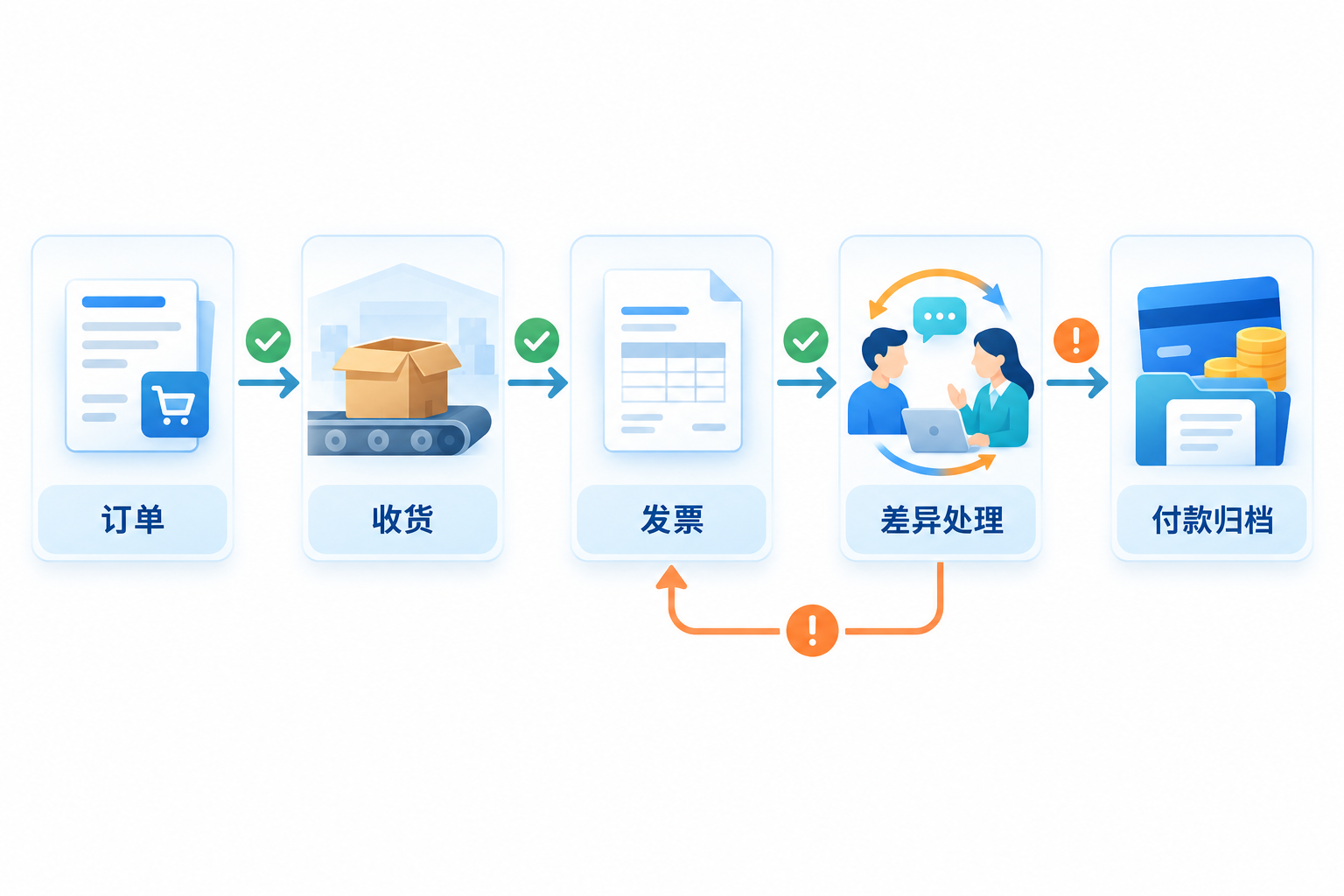
At month-end reconciliation, procurement looks by order, warehouse looks by receiving, finance looks by invoice, and suppliers look by their own settlement cycle. With four parties using different definitions, even the prettiest table is just manually pieced together. The solution is not to force the four amounts to match, but to make orders, receipts, invoices, and payments run within the same set of fields, with matching items automatically written off and discrepancies assigned an owner, a status, and a basis for closure. Kailing Technology uses AI OCR document recognition, input VAT invoice management, and electronic accounting archives as its foundation to turn reconciliation from a month-end rush into a daily closed loop.
Reconciliation is not about forcibly making four amounts equal, but about proving why consistent items are consistent, why discrepancies exist, and how they are ultimately closed. |
▍1. Why do Excel reconciliation sheets get more and more complicated?
Many companies blame reconciliation difficulties on templates not being good enough, so they keep adding columns, formulas, and colors, and the result is that the sheet gets heavier and people get more tired. The root cause is that field definitions are not unified: order number and line number, receiving or acceptance date, invoice number, tax-inclusive and tax-exclusive amounts, currency, and payment terms are each written in their own way by each party, the primary keys do not match, and summaries naturally fail to balance. Reconciliation periods and cutoff dates are not unified, so cross-month receiving, partial acceptance, and return write-offs repeatedly clash. Therefore, the first step is not to change the sheet, but to establish a field dictionary first, then design the table, so that every row can be traced to a unique business fact.
▍2. What capabilities should a supplier reconciliation app have?
A qualified supplier reconciliation app should at least be able to automatically aggregate documents from multiple sources, automatically match discrepancies, and automatically leave a trace for closed-loop handling. Kailing Technology's AI OCR intelligent recognition supports multiple document formats such as invoices, receipts, contracts, licenses, and financial documents, achieving recognition-to-booking, organizing fields from delivery notes, receiving notes, and invoices in different formats into structured data to help the system find corresponding details and discrepancies. Whether input VAT invoice data can be automatically aggregated, queried, downloaded, or verified depends on enterprise authorization, official platform capabilities such as tax digital accounts, interface conditions, and project configuration. Within the above scope, the system can assist with verification, duplicate checking, and preventing duplicate or missed reporting, but it cannot replace the enterprise's verification of transaction authenticity. Combined, procurement, warehouse, and finance no longer each copy everything separately, but share one trustworthy working paper.
▍3. How are discrepancies found and closed in a loop?
The value of reconciliation is not in balancing, but in discrepancies being explainable. The system should establish a primary key based on order number and line number, stringing orders, receiving, invoices, and payments into one chain: normal items are automatically written off according to rules, and exceptions are automatically flagged and pushed to the responsible person. Real reasons such as short receipts, partial deliveries, returns, and price adjustments need to be explained by business staff with supporting evidence, and the handling status and closing conditions are fully traceable. Kailing Technology's electronic accounting archive management system enables scan to store, recognize to archive, and relate to bind into volumes. Reconciliation confirmations, discrepancy explanations, and approval records are automatically bound into volumes, ready for use during audits and tax inspections, with no more rummaging for paper documents.
▍4. From reconciliation to settlement, how can you avoid backtracking?
After reconciliation is sorted out, settlement approval and payment should be connected accordingly. After completing enterprise authorization, bank interfaces, and project configuration, the expense control and reimbursement management system can connect multi-terminal approval, bank-enterprise direct payment, and conversion of reimbursement forms into vouchers; actual payment should still be executed according to enterprise approval and bank controls. Reconciliation is not a month-end battle for finance alone, but a daily action in which procurement, warehouse, finance, and suppliers share one set of rules. The clearer the rules, the easier the month-end.
Keywords: supplier reconciliation app, supplier reconciliation statement, supply chain reconciliation, AI OCR document recognition, input VAT invoice management, electronic accounting archives, procurement reconciliation process, reconciliation discrepancy closed loop
As a comprehensive business-finance-tax digitalization solution service provider, Kailing Technology provides business-finance-tax management digital transformation products and operational services for various government agencies, institutions, and large, medium, and small enterprises. The product line includes: solutions for sales contract management system, procurement contract management system, fully digitalized Leqi interface project, automatic output invoicing system, reverse invoicing system, invoice issuance for individuals system, employee expense control and reimbursement system, input VAT invoice management system, supply chain collaborative reconciliation system, image AI OCR recognition system, automatic financial bookkeeping system, electronic accounting archives system, etc., comprehensively driving the digitalization process across various fields.
Consultation Hotline: 18513895936 / 010-60974119 Location: Beijing