
What to do after an electronic archive four-property check failure? Kailing Technology AI electronic accounting archives management system intercepts archiving and locates missing items

When an electronic archive four-property check fails, you should first see which category of requirement the failure occurred in, then supplement materials, repair files, or verify the source; you cannot directly bypass the alert to complete archiving. The Kailing Technology AI electronic accounting archives management system can help staff locate the problem through check details and status management, giving pending archives a clear remediation path. The check is not meant to add another obstacle, but to avoid discovering only when the materials are truly needed that they cannot be explained or opened.
▍One "failed" may hide completely different problems
A missing attachment, a file that cannot be opened, insufficient source information, and a doubt point found by a security check can all cause an archive to be temporarily unacceptable as required, but they should not receive the same handling. If staff only see a red status, they often repeatedly upload the same file, hoping it will automatically pass next time.
More useful information is to point out which material, which requirement, and what reason need to be handled. The handler knows the original file should be supplemented, the system administrator knows the reading environment needs to be checked, and the archives staff knows which metadata is incomplete; only then can the issue be handed to the person who can truly solve it.
Therefore, failure records should be treated as a specific work order, not a simple rejection conclusion. When the remediation path is clear, archiving work can continue to advance; interception without explanation easily leads users back to shared drives and email, creating new scattered materials.
▍Kailing Technology's AI electronic accounting archives management system helps you understand exceptions from four types of requirements
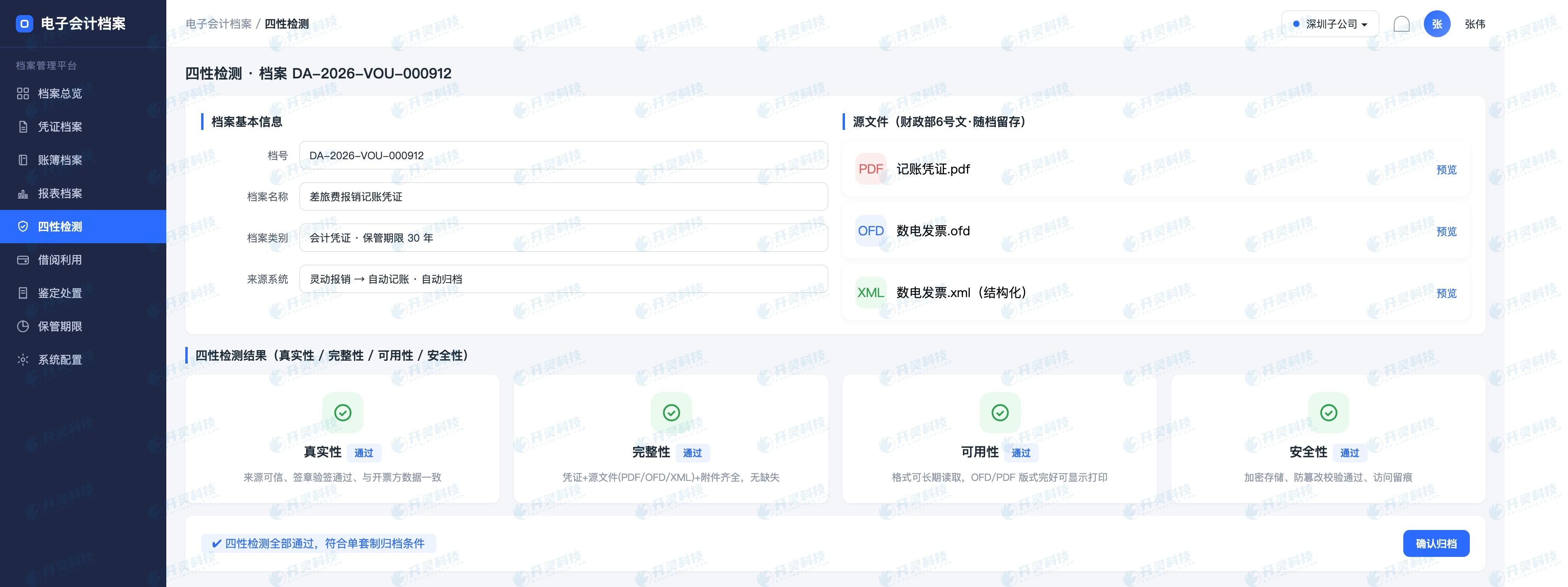
Authenticity concerns whether the source of the materials and the formation process have corresponding evidence, which may involve source identifiers, signatures, or other usable verification information. It is not merely about whether the file name looks like an invoice, nor does seeing a certain extension automatically establish authenticity. The specific check scope should match the material type and available capabilities.
Completeness focuses on whether the files, fields, and related materials that should be received are all present. For example, if a business attachment exists but necessary metadata or its link to the voucher is missing, subsequent review may still be unable to understand it. Completing the content that should be present is more effective than repeatedly uploading the same incomplete package.
Usability focuses on whether files can be read and used in an appropriate environment. The fact that data bytes are already stored in the repository does not mean they can be opened normally in the future; content in special formats or dependent on a reading platform needs to be arranged in line with custody and utilization requirements.
Security checks are carried out around appropriate security requirements for files and the management environment, and suspected issues should be handled according to rules. Necessary checks cannot be disabled to rush progress, nor can a single pass be used to promise that all future risks have disappeared.
▍Supplementing materials, fixing files, and verifying sources each need the appropriate handling position
Missing business attachments should usually go back to the department that provided the materials; if the original electronic file was not submitted, the handler should be asked to obtain source materials that meet the requirements; format reading issues may require technical support. Archive staff are responsible for organizing the issues and following up on results, and do not need to regenerate materials alone on behalf of all source departments.
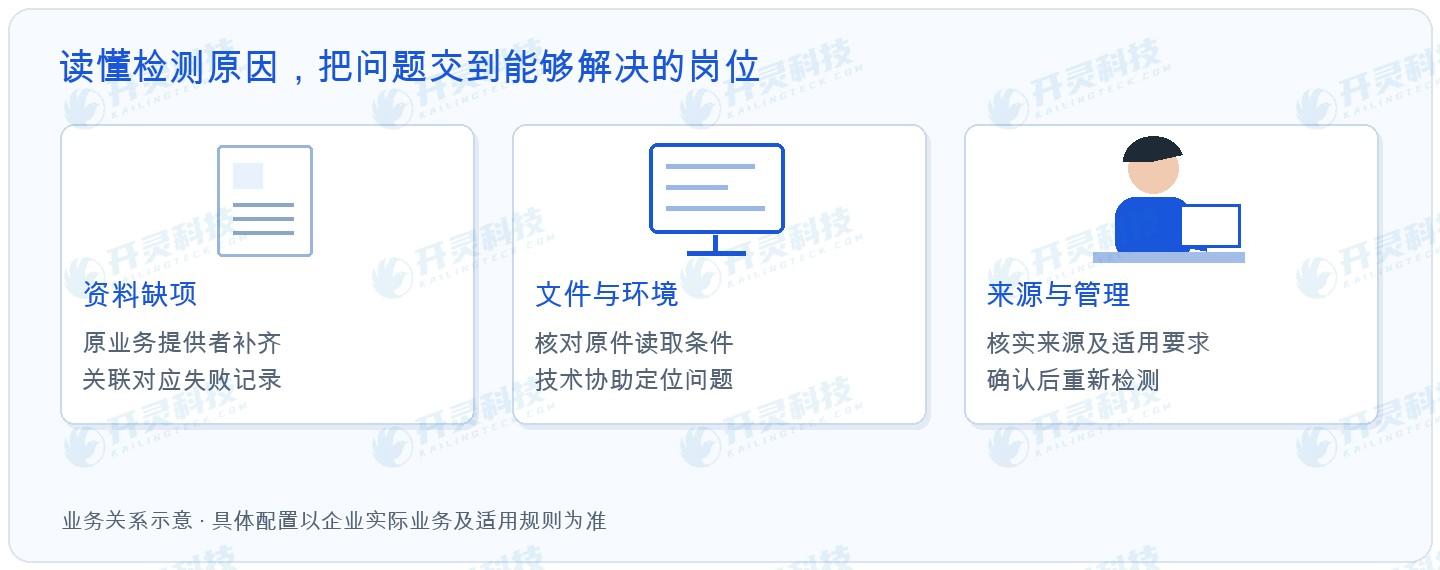
When supplementing materials, the link between them and the original business and failure record should be preserved. Otherwise, although the new file is uploaded successfully, the original exception remains in another record, and staff cannot determine whether it has been handled. Using stable business identifiers can keep material replacement, supplementation, and re-checking in a clear relationship.
For documents whose source is questionable, it is even more important not to "eliminate the alert" by renaming or rescanning them. The actual formation and provision circumstances need to be verified, and supporting evidence must be completed or the correct materials replaced according to applicable requirements. The system helps present the doubt points; it cannot process an unreliable source into a credible original.
▍After retesting, check whether this issue has truly been resolved
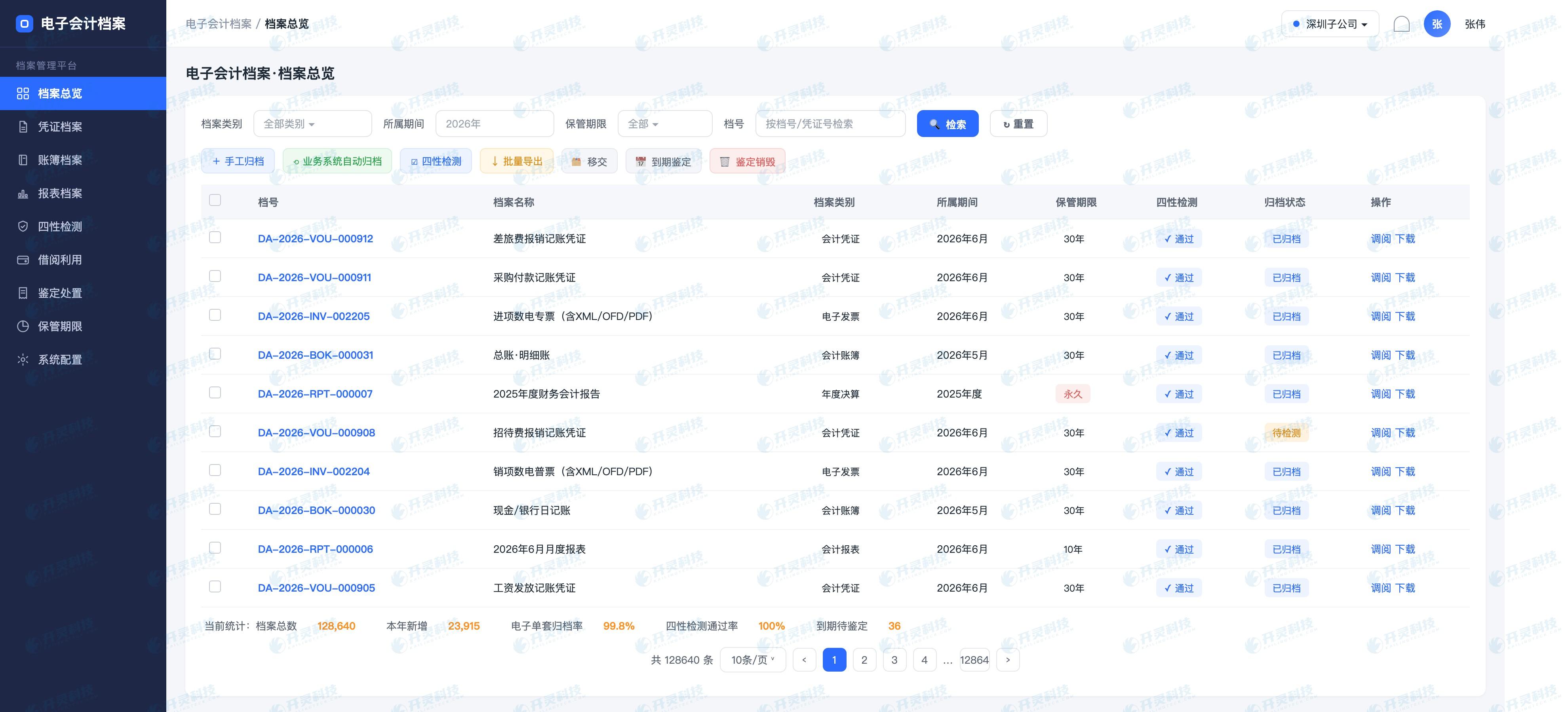
After remediation is completed, it should be checked again according to the corresponding process, and it should be confirmed whether the previously identified problem has been eliminated. When the new result is linked to the handling record, staff know why this archive changed from pending to acceptable, rather than only seeing a status color change.
If new anomalies appear, they should also be explained separately. Supplementing attachments may solve completeness issues, but does not necessarily solve file readability at the same time; adjusting the reading environment also cannot replace source verification. The four types of requirements are interrelated, but should not be compressed into a single total score that can offset one another.
For materials that fail to pass, the corresponding pending or isolated status should be retained according to the system, with the next action and responsible person clearly defined. The same issue should not be left permanently in a list no one checks just because it appears multiple times, and it should certainly not be marked as archived directly just to clear the to-do list.
▍From one failed record, see the common gap in document handover
If the same business system repeatedly omits required fields, interface mapping can be improved; if a certain type of attachment can never be opened, the source format and collection method can be checked; if different departments frequently fail to submit the same type of material, the receiving instructions can be improved. When these problems are solved at the entry point, the later check burden naturally decreases.
Enterprises can regularly review the causes of exceptions, not just count the number of failures. If more complex historical materials were received at one time, an increase in exceptions does not necessarily mean the system has regressed; if another batch had stable sources and went smoothly, that also cannot prove there are no problems in all scenarios. Only by explaining results together with the material scope can you find the links truly worth improving.
The status and detection information provided by Kailing Technology's AI electronic accounting archives management system can help archives, finance, and technical teams form a shared work entry point. Each role knows which type of issue it is responsible for, and after materials are completed, someone confirms it, making detection a sustainable quality assurance step rather than a feature demonstrated only once at launch.
▍After archiving passes, management responsibility continues
Passing the check indicates that the materials meet the set requirements within the corresponding scope and at the given point in time; it does not mean that long-term preservation, permission control, and utilization management are all finished. Follow-up work such as backup, reading environment, and archive lifecycle still needs attention so that the materials remain continuously usable.
The fact that a scanned paper original passes an electronic file check cannot be used to directly infer that the original can be destroyed. The nature of the materials and the preservation requirements should still be judged separately. Understanding the scope of effect of check results actually helps ensure that system information is used correctly and prevents it from being assigned guarantees it cannot bear.
Enterprises can compile common exceptions and handling methods into position instructions, so that operators know what to confirm before uploading, and archives staff know what to check when receiving. When rules are expressed more clearly, document handover becomes smoother, and the few matters that truly require professional judgment are more easily identified in time.
▍FAQ Q&A on four-property test exceptions
Q: Can repeatedly uploading the same file resolve a failure?
A: Usually you should first read the failure reason. Missing items, source, or format issues require corresponding handling; repeated uploads will not automatically fill in missing information.
Q: If the test passes, does that prove all business is authentic and compliant?
A: This cannot be broadly interpreted. The test has its coverage scope; business authenticity and specific legal application still require corresponding evidence and responsible positions to judge.
Q: If metadata is missing but the file can be opened, can it be ignored for now?
A: It should be handled according to receiving requirements. Readability and completeness are not the same condition; missing necessary information may affect subsequent association and long-term use.
Q: Should all exceptions in the archiving system be fixed by technical staff?
A: No. Issues such as business materials, source confirmation, format environment, and permissions correspond to different responsibilities and need to be assigned by cause, rather than all being handed to technical staff as a catch-all.
Give archiving anomalies explanations, responsibility, and remediation paths, and learn about Kailing Technology's electronic accounting archive system: https://www.kailingteck.com/eaa/ .
As a national high-tech enterprise, Kailing Technology focuses on the digital and intelligent transformation of enterprise business-finance-tax and operations management, providing software products, system integration, implementation and delivery, and operational services for various government agencies, institutions, group enterprises, and SMEs.
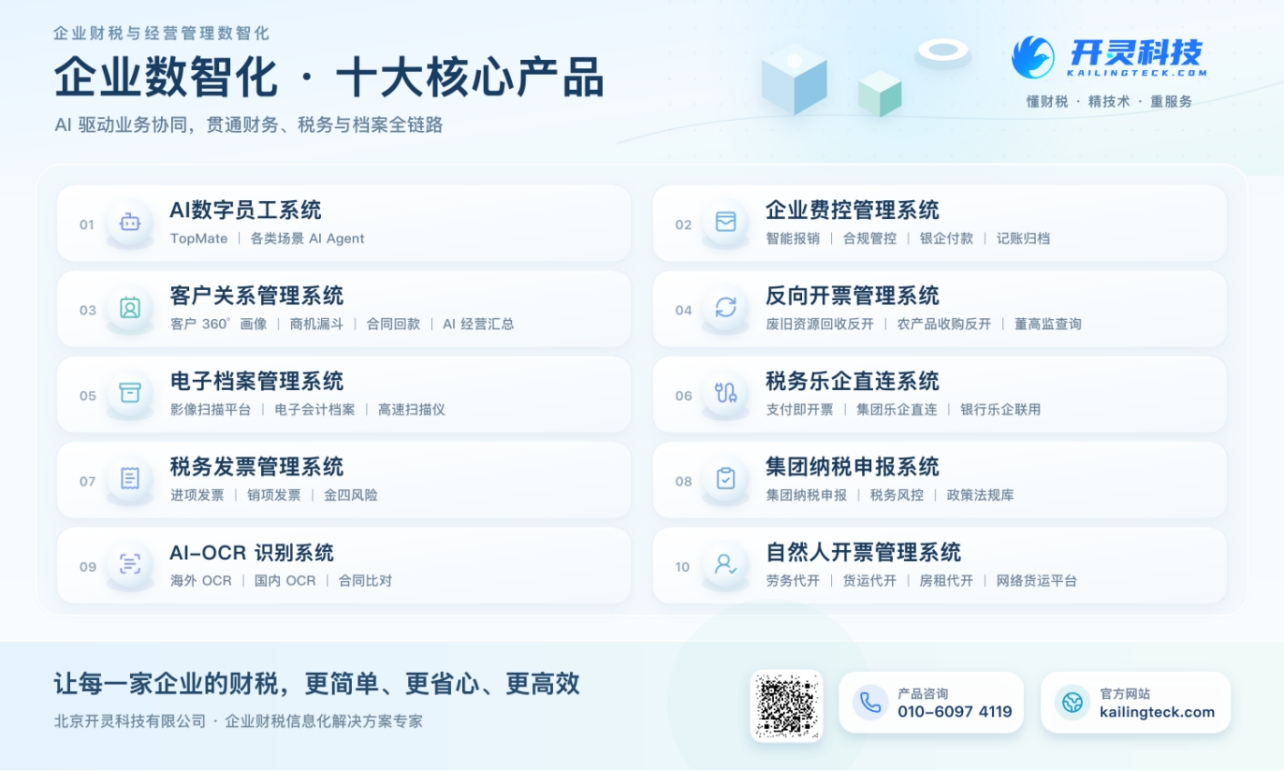
The company has now formed ten core product lines, including: AI digital employee system, enterprise expense control management system, customer relationship management system, reverse invoicing management system, invoice issuance for individuals management system, electronic archives management system, tax fully digitalized e-invoice Leqi system, tax invoice management system, group tax filing system, and AI OCR recognition system. It is committed to connecting enterprise business, finance, tax, funds, and archive data to help customers improve operational efficiency, business-finance-tax compliance capabilities, and digital management levels.
If you have any business-finance-tax digital transformation needs, welcome to contact us. Beijing Kailing Technology will serve you wholeheartedly.
Keywords: Electronic archives four-property check, four-property check failure, AI electronic accounting archives management system, archiving interception, electronic archive correction
As a comprehensive business-finance-tax digitalization solution service provider, Kailing Technology provides business-finance-tax management digital transformation products and operational services for various government agencies, institutions, and large, medium, and small enterprises. The product line includes: solutions for sales contract management system, procurement contract management system, fully digitalized Leqi interface project, automatic output invoicing system, reverse invoicing system, invoice issuance for individuals system, employee expense control and reimbursement system, input VAT invoice management system, supply chain collaborative reconciliation system, image AI OCR recognition system, automatic financial bookkeeping system, electronic accounting archives system, etc., comprehensively driving the digitalization process across various fields.
Consultation Hotline: 18513895936 / 010-60974119 Location: Beijing