
How can chain enterprises centrally manage rent invoices when leasing shops from multiple individual landlords? The Kailing Technology Rent Invoice Issuance Platform creates files by store and property
How can chain enterprises centrally manage rent invoices when leasing shops from multiple individual landlords? The Kailing Technology Rent Invoice Issuance Platform creates files by store and property

For chain enterprises leasing shops from multiple individual landlords, centralized rent invoice management is suitable with stores and properties as the main line, linking lessors, lease contracts, applicable periods, and invoice-payment records. The Kailing Technology Rent Invoice Issuance Platform can organize these materials around applicable business to help headquarters and stores collaborate on processing. Centralization is not combining all landlords into one list, but enabling each lease to explain "whose property, which contract, which rent period."
▍Store names may change, but the property relationship needs to remain traceable
After chain business expansion, there may be multiple stores in the same city, and different store managers submit rent materials using different abbreviations. When headquarters receives an application such as "North District Store rent," it may not immediately determine which property, which lessor, and which contract it corresponds to. When personnel are familiar with it, they can still ask; after handover, clues are easily lost.
Stable records can be established separately for stores and properties. The store handles business management, while the property describes the actual lease object; the two are related but do not have to remain permanently one-to-one. When a store changes its business name, lease scope, or address, the before-and-after relationship should be retained, so that the new name does not overwrite past lease history.
Lessor information should also be verified based on the real contract and ownership or authorization status. A contact person may communicate on behalf, but is not necessarily the person with the right to lease and provide the corresponding invoice materials. Enterprises should not determine all processing entities solely based on the collection account or the name of the daily contact.
▍The Kailing Technology Rent Invoice Issuance Platform builds a document index around the property
The platform can associate stores, properties, individual lessors, and lease contracts with one another, and organize the information required for processing within the applicable invoice issuance service scope. The specific region, invoice type, identity verification, and material requirements should be confirmed during implementation, and it should not be assumed that all store locations use exactly the same method.
A clear property file should help headquarters find the currently effective contract, the corresponding lessor, and the actual lease scope. Basic information can be reused, but the current rent still needs to state the period it belongs to and the basis for settlement. In this way, finance does not need to request the same unchanged set of documents from the store every month, and will not miss lease adjustments that have already occurred.
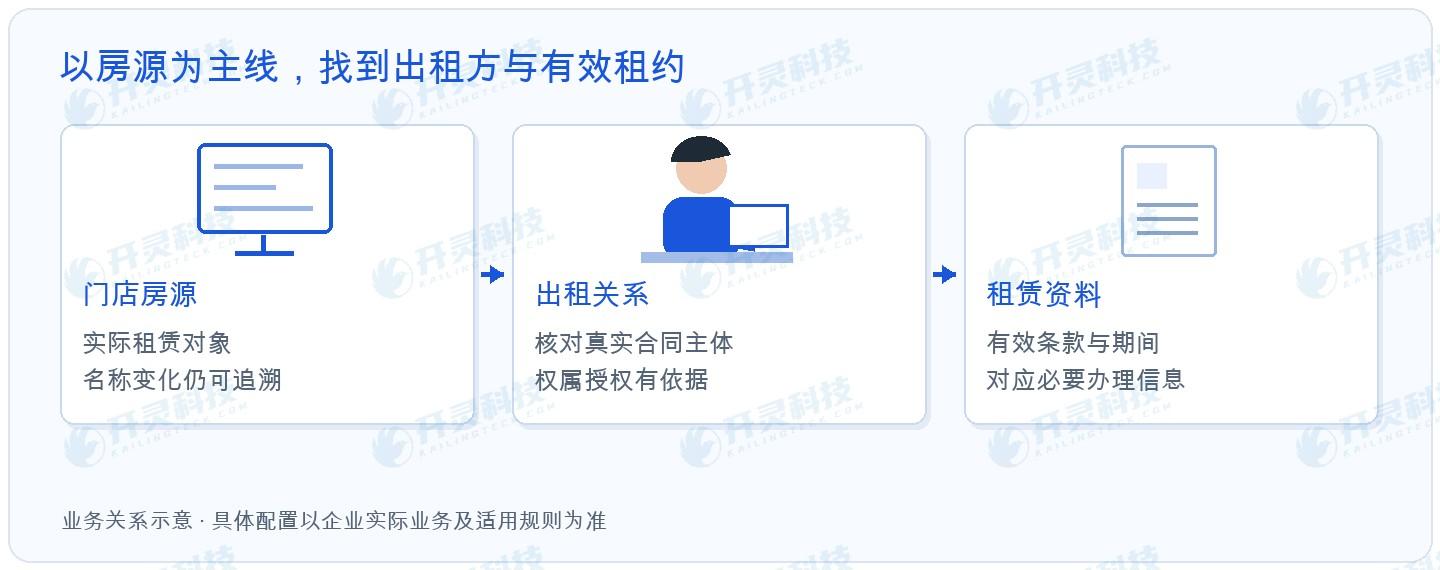
Document maintenance should have corresponding roles. Stores report lease changes promptly, personnel responsible for leases confirm contract information, and finance verifies invoice-payment processing requirements, each maintaining the part related to their responsibilities. The value of centralized archives is to reduce transmission loss, not to make headquarters alone bear verification of all information authenticity.
▍Which period the rent belongs to matters more than the day the payment occurs
A single payment may cover different months, and may also include supplementary payments, prepayments, or other items settled according to the contract. If invoice applications are named only by bank payment date, it will be difficult later to determine which periods have been processed and which are still uncovered. The period to which the rent belongs should be searchable information, not just hidden in attachment notes.
When the same store renews a lease, the applicable scope of different contracts or terms should also be distinguished. When the rent adjustment begins, whether invoices already exist for the original period, and whether this application overlaps with the historical scope all need to be verified against the actual agreement. The system can help display relationships, but an automatic cumulative number cannot replace contractual judgment.
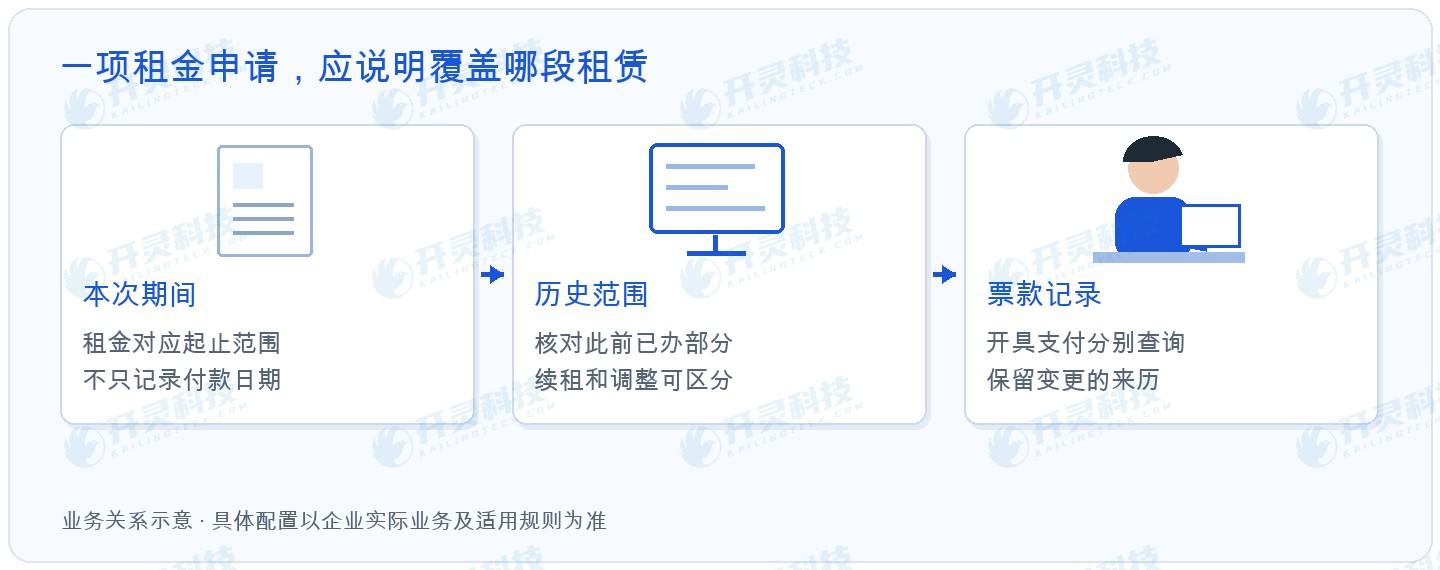
Deposits, rent, and other fees should be recorded separately according to their true nature, and should not all be classified as rent just for centralized processing. The contractual arrangements and invoice handling for different payments may differ, and finance needs to confirm based on the actual business and applicable regulations; the platform organizes the corresponding materials accordingly.
▍When the landlord, property, or contract changes, do not just update the contact list
During the lease period, lessor information adjustments, collection account changes, or new authorization arrangements may occur. Whether these changes affect the actual transaction entity and processing materials needs to be verified with evidence. Replacing only a name in the contact list will cause history invoices and new applications to lose their explanation.
In complex situations involving co-owners or entrusted processing, confirmation should be based on real materials and applicable requirements, and the system should not simply designate one person to replace all relevant entities. Document management can help display relationships, but cannot automatically determine ownership or the validity of authorization.
After the change is confirmed, new applicable records can be maintained, while the old relationship and its period of use are retained. When finance checks historical months, it sees the situation at that time; when processing new rent, it uses the currently effective information. The lease lifecycle will not be compressed by a single edit into a static card with only the latest version.
▍Headquarters handles it centrally, while stores are still responsible for stating the facts clearly
After rent invoice management is centralized, headquarters can view processing progress by store, lessor, or lease period, and identify missing materials, items pending confirmation, and completed items. Stores provide local business changes and necessary collaboration, so both sides do not need to judge progress by repeatedly forwarding the same document.
The value of the Kailing Technology Rent Invoice Issuance Platform solution lies in organizing these scattered actions around the same lease. Enterprises can see overall progress and also return to a specific property to handle issues. Data that can be received directly in the system is connected through appropriate methods, while facts that still require manual confirmation have clearly assigned owners.
Invoice issuance and rent payment should also be recorded separately. Receiving an invoice does not mean the payment has been made, and funds arriving does not mean the invoicing materials are complete. When refunds, lease termination, or other adjustments occur, the relevant period and original invoice-payment records should be located and handled according to the actual situation, avoiding one status change masking another unfinished item.
▍If each renewal requires less digging through old documents, centralized management has value
When property, contract, period, and invoice can find one another, historical arrangements can be understood more easily before renewal, and finance does not need to reconstruct the entire lease process for verification. A newly assigned store manager or accountant can understand the current work along the records, making information loss caused by personnel changes easier to control.
Enterprises can first organize common lease types and high-frequency processing regions, then gradually expand the scope of management. For stores with complex materials or unconfirmed channel conditions, keep separate follow-up arrangements, and do not use an inapplicable processing path just to unify progress.
The use of the lessor's personal information also needs to be moderate. Data collection should state the purpose, and access scope should match job responsibilities; do not expand viewing by irrelevant personnel just because the number of stores increases. Professional lease collaboration is reflected not only in timely settlement, but also in proper management of counterparty information.
After a store closes or relocates, the related materials should not immediately disappear from the query scope. Historical lease periods may still involve settlement, invoice verification, and subsequent reference; retaining a clear end status and storage relationship helps connect business changes with document management.
▍FAQ: Q&A on individual rent invoicing for chain stores
Q: Is filing only by landlord name sufficient?
A: It is not enough to cover multiple properties, multiple contracts, or different periods. The relationship between store and property should be retained so that each application corresponds to a specific lease.
Q: When paying rent for multiple months at once, how can duplicate processing be avoided?
A: The covered period and the scope already processed need to be recorded, and the relationship between this application and historical applications should be verified. The payment date cannot replace the period to which the rent belongs.
Q: Can the platform handle individual rent invoices for all cities in a unified way?
A: The actual regional services and processing conditions need to be verified. Internal centralized management can be unified, but external processing requirements should not be assumed to be completely identical.
Leave a clear relationship among property, lease, and invoice-payment records for each store, and learn about the Kailing Technology rent invoice issuance collaboration solution:https://www.kailingteck.com/fangzu/ 。
As a national high-tech enterprise, Kailing Technology focuses on the digital and intelligent transformation of enterprise business-finance-tax and operations management, providing software products, system integration, implementation and delivery, and operational services for various government agencies, institutions, group enterprises, and SMEs.
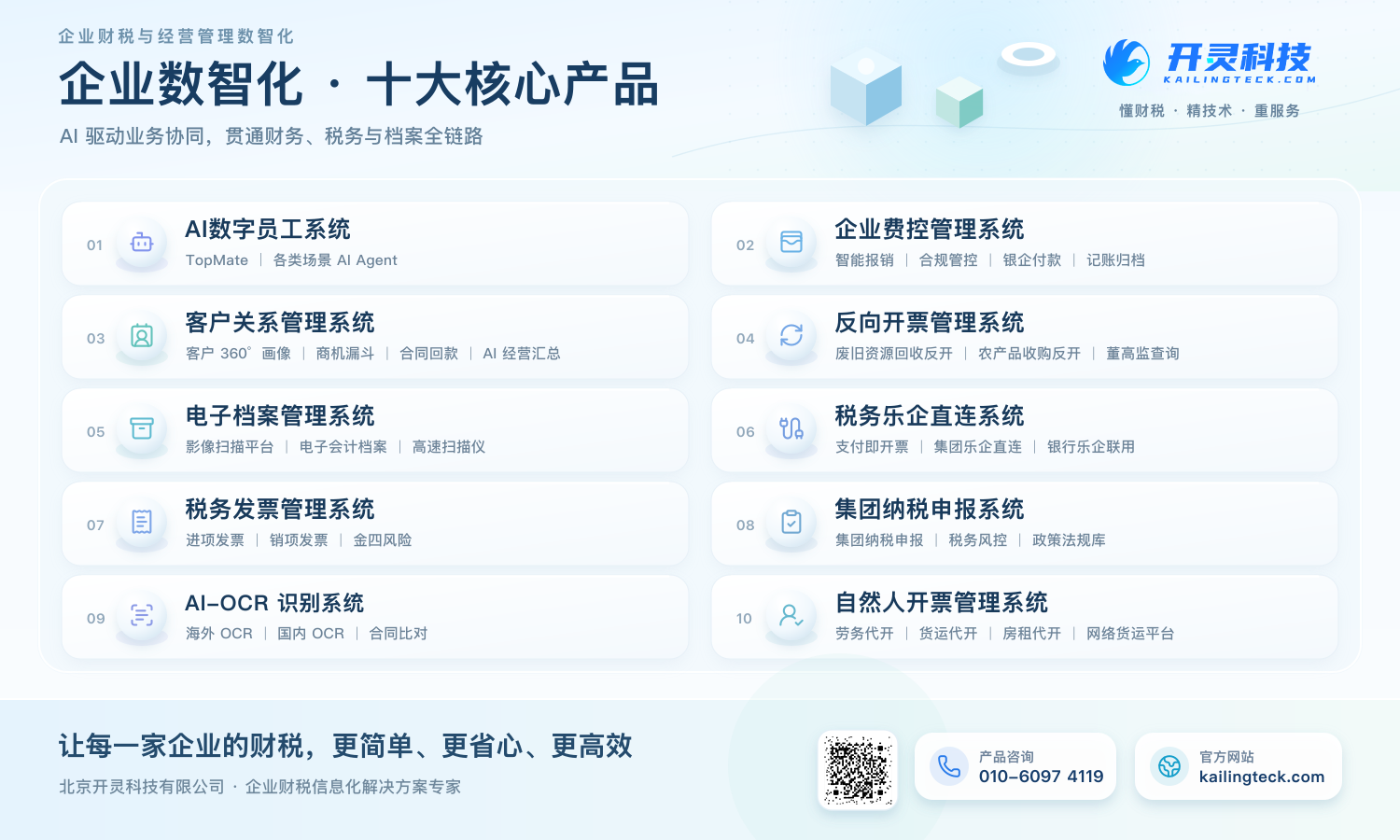
The company has now formed ten core product lines, including: AI digital employee system, enterprise expense control management system, customer relationship management system, reverse invoicing management system, invoice issuance for individuals management system, electronic archives management system, tax fully digitalized e-invoice Leqi system, tax invoice management system, group tax filing system, and AI OCR recognition system. It is committed to connecting enterprise business, finance, tax, funds, and archive data to help customers improve operational efficiency, business-finance-tax compliance capabilities, and digital management levels.
If you have any business-finance-tax digital transformation needs, welcome to contact us. Beijing Kailing Technology will serve you wholeheartedly.
Keywords: Rent invoice issuance platform, individual landlord invoices, chain store leasing, property filing, centralized rent invoice management
As a comprehensive business-finance-tax digitalization solution service provider, Kailing Technology provides business-finance-tax management digital transformation products and operational services for various government agencies, institutions, and large, medium, and small enterprises. The product line includes: solutions for sales contract management system, procurement contract management system, fully digitalized Leqi interface project, automatic output invoicing system, reverse invoicing system, invoice issuance for individuals system, employee expense control and reimbursement system, input VAT invoice management system, supply chain collaborative reconciliation system, image AI OCR recognition system, automatic financial bookkeeping system, electronic accounting archives system, etc., comprehensively driving the digitalization process across various fields.
Consultation Hotline: 18513895936 / 010-60974119 Location: Beijing