
Many sales leads but chaotic follow-up priorities? How Kailing Technology AI-CRM sends tiered reminders for key customers and overdue receivables
When there are many sales leads but no idea whom to follow up with first, it is usually necessary to organize both customer opportunities and collection tasks at the same time, rather than setting the same reminder for all customers. Kailing Technology AI-CRM can organize to-dos around leads, opportunities, contracts, and payment records, helping teams arrange work by importance and urgency. New needs get a response, key customers are not drowned out, and due receivables no longer exist only in finance's spreadsheet.
▍A salesperson's day is often cut into fragments by messages from different directions
On one side, a new customer is asking about a solution; on the other, an old customer is urging document supplementation. The manager reminds that key projects should not be forgotten, while finance asks in the group chat which payment can be collected. Every message has a reason, but if sales act only on whoever messaged most recently, important opportunities may keep being postponed.
The problem is not just the lack of a to-do list. What stage the customer is currently in, what the next communication hopes to resolve, and whether the contract already has due items: this context determines the meaning of a reminder. An alarm with only time and no business context easily becomes new interference.
Work can first be divided into two main lines: one helps advance new cooperation opportunities, and the other maintains contracts and payment responsibilities that have already formed. Both lines need attention, but they should not be mixed into one list sorted only by message order. When sales know what they are currently advancing, they can arrange the day more calmly.
▍Kailing Technology AI-CRM gives key customers a clear next action
Kailing Technology AI-CRM centrally manages information such as customers, leads, and opportunities, helping sales retain follow-up status and related matters. For key customers, it is not just about assigning a grade tag, but also explaining the current need, what has been communicated, and the next action to be completed, avoiding a situation where everyone knows it is "very important" but no one knows what to do.
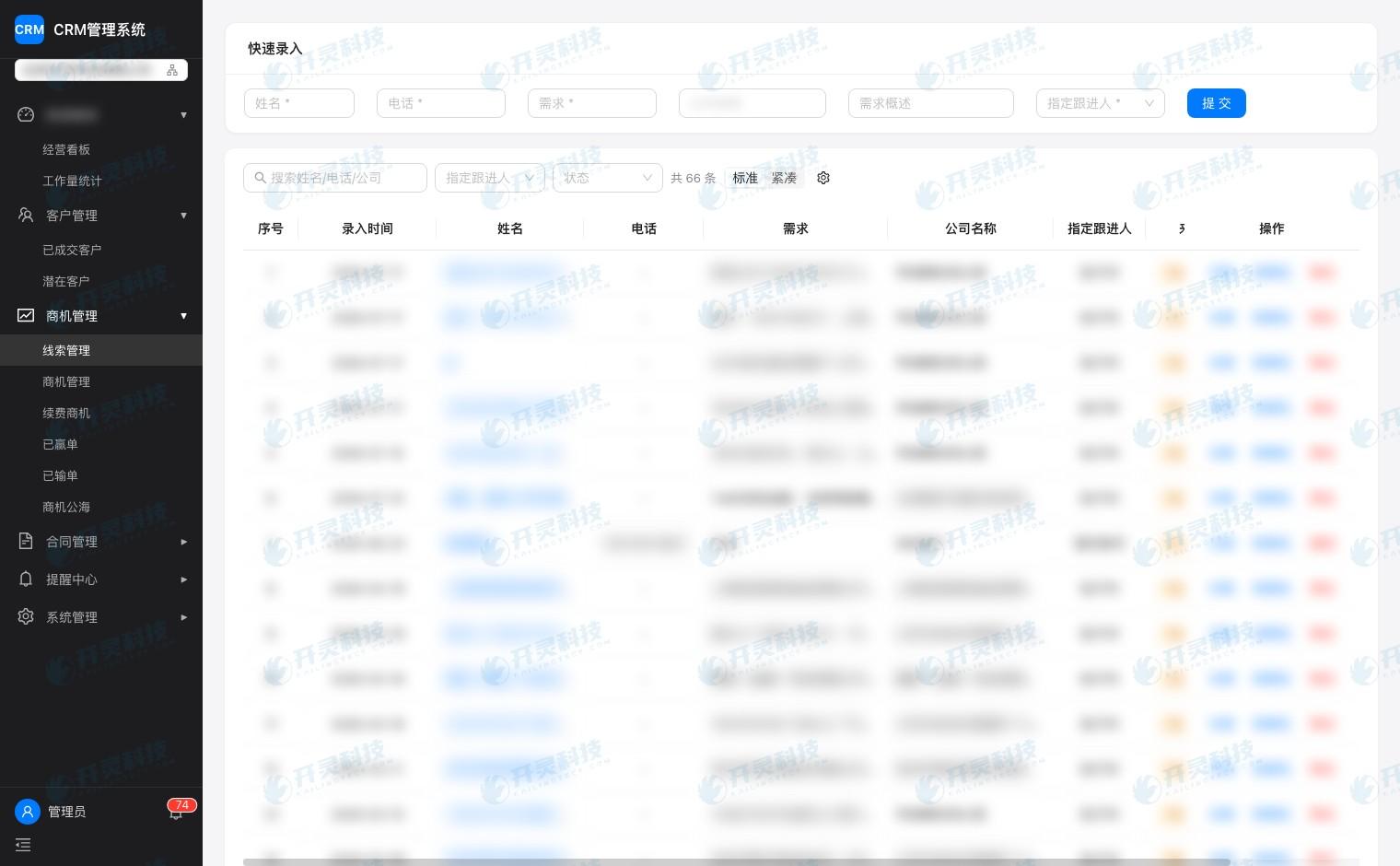
Priority can be discussed by combining factors such as clarity of demand, project stage, agreed time, and business value. Specific rules are determined by the enterprise's management approach. A single field in customer data cannot be directly treated as the probability of closing, and it should not be claimed without basis that AI can accurately predict every cooperation outcome.
When a reminder reaches sales, it is best if it can return to the corresponding customer record. What was communicated last time, which material should be provided this time, and whether a meeting has been scheduled can all help them immediately enter the work without having to dig through chat records to piece together context. The convenience of the tool is reflected in reducing preparation costs, not in completing all relationship judgments for sales.
▍Payment reminders need to be attached to real contracts and agreed milestones
Payment collection is not simply sending a dunning notice to all customers at month-end. Contract terms, payment stages, amounts received, and related confirmation matters need to jointly explain whether follow-up is currently warranted. Non-collection at maturity may have business reasons, or it may simply be that receipt has not yet been claimed. A conclusion cannot be made based on one date alone.
Kailing Technology AI-CRM can form reminders around contracts and collection records, letting sales see matters related to the customers they are responsible for. Specific matching and claiming methods should be configured according to the enterprise's existing fund records and rules; payments that cannot be determined should be checked by relevant personnel and should not be automatically assigned to customers with similar names.
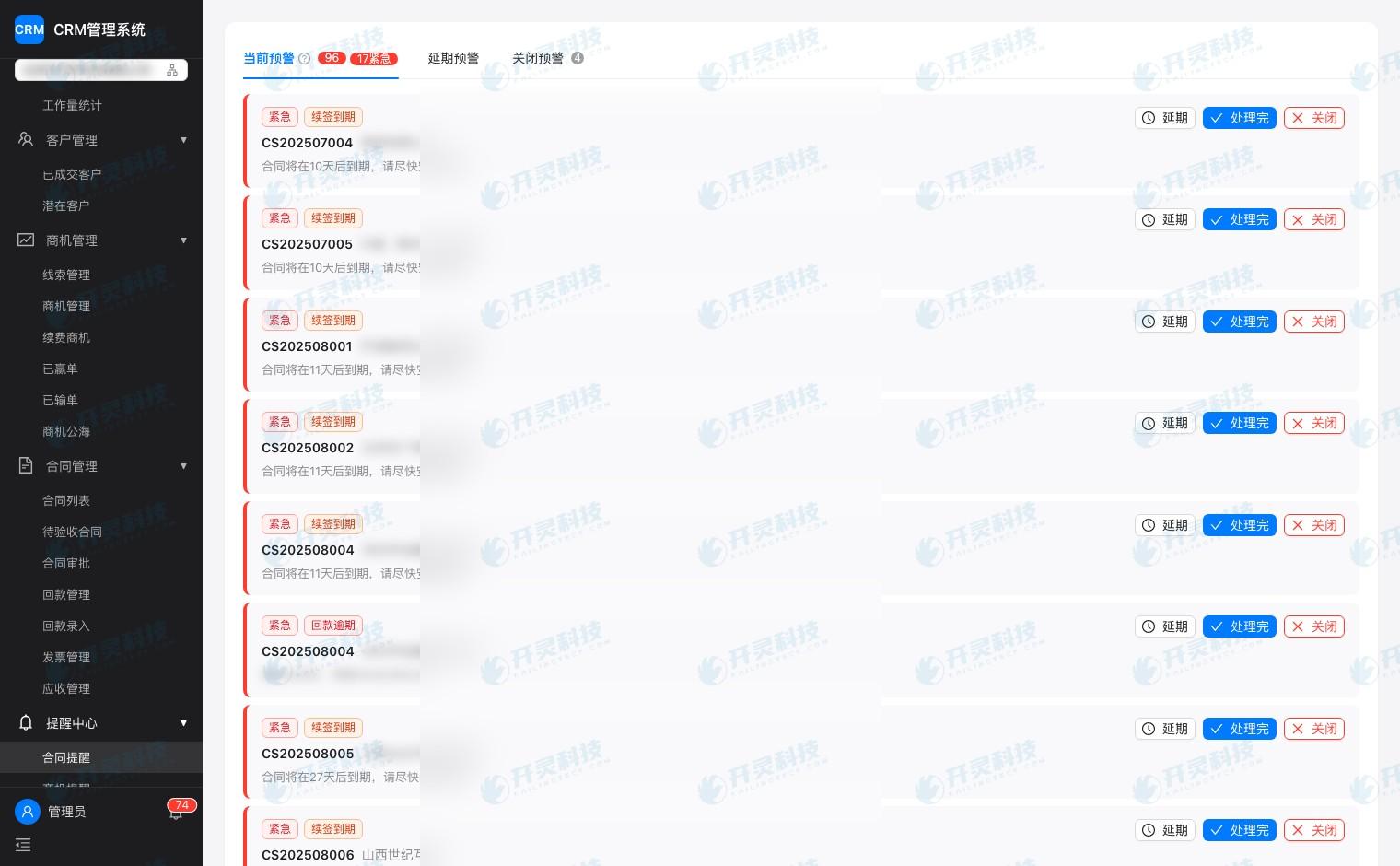
For sales managers, the key is to place collection responsibility and opportunity advancement in the same business view. If a salesperson has many new leads but has long failed to handle overdue matters, energy needs to be coordinated; if a payment is awaiting business confirmation, the corresponding position should be found to resolve it, rather than repeatedly sending the same reminder to sales.
▍Graded reminders are what make truly urgent matters visible
General follow-ups can enter daily to-dos, matters with agreed times approaching need appropriate reminders, and key tasks with no progress over time can be escalated according to rules. Reminder channels and frequency should match team habits. The same matter does not need to be pushed to all channels at once, making it hard for employees to distinguish priorities.
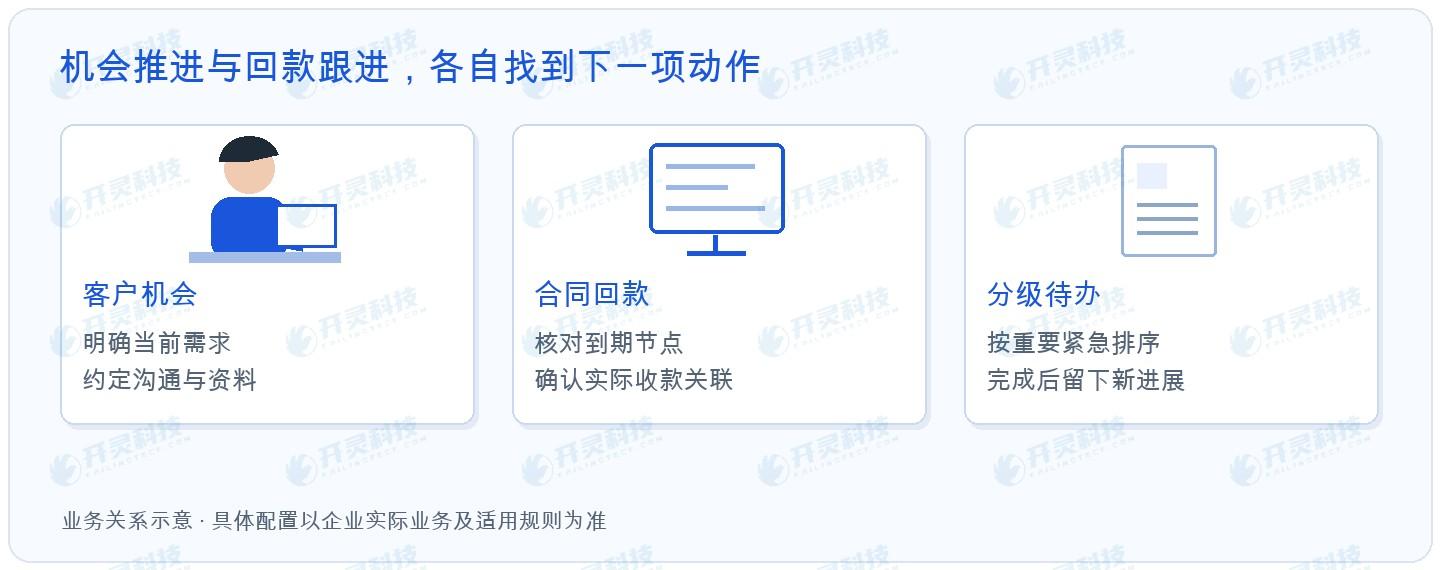
Reminders that have been handled need a basis for completion or a new next arrangement. After sales replies "already contacted," whether the customer added requirements, whether the next communication was scheduled, and whether collection received a clear answer are all worth a brief record. Otherwise, the reminder is merely closed, while the work has not truly moved forward.
For leads without a clear need at the moment, they can enter an appropriate continuous nurturing arrangement rather than being repeatedly pressured. Contact frequency should respect the customer's wishes and communication context, and contact information in records should be used according to authorized purposes. CRM helps teams serve customers in an orderly way, not turn everyone into a high-frequency outreach target.
▍What managers see is collaboration gaps, not just sales rankings
When the same customer is repeatedly contacted by multiple people, key projects have no one taking over, and payment issues always stop at cross-department confirmation, these are all team collaboration problems. Managers can discover and assign responsibility in a timely manner through shared records, rather than waiting until month-end to ask about the process based on results.
Lead assignment and follow-up rules also need to remain transparent. Why a customer is assigned to a certain salesperson, how historical information is handed over after changing the owner, and who takes over when there is no response after timeout should all have clear arrangements. The clearer the rules, the easier it is to reduce internal scrambling or waiting for each other, letting the team's energy return to customer needs themselves.
Kailing Technology AI-CRM's business summary and reminder capabilities can provide a data foundation for management discussions, but managers still need to judge in light of actual business. If a metric is abnormal, first look at the cause, then decide on adjustment actions. A single ranking should not be treated as the entire evaluation of personnel.
▍What customers feel is continuous service, not system reminders
Customers do not need to know how many tags and notifications exist in the backend. They care more about whether the company remembers the last discussion, whether materials are provided as agreed, and whether someone is responsible for contract matters. When follow-up records and tiered to-dos are well organized, sales can more easily maintain this continuity.
Enterprises can start by organizing the most common customer stages and payment milestones, then gradually refine reminders. The truly effective parts of existing sales habits can be retained. The system is responsible for centralizing information and providing a collaboration entry point. It does not need to require everyone to record every communication in lengthy text just for launch.
When leads, opportunities, and collections can all find corresponding responsibility, the sales team no longer only chases the latest news. Important work has rhythm, temporary changes have someone to handle them, and managers can more easily direct support resources to places that truly affect the business.
During actual rollout, sales can first use a group of customers they are currently following up on to become familiar with the recording method, collect which reminders are useful and which information is redundant, and then adjust gradually. Only when the tool fits the real rhythm will the team be more willing to continuously maintain customer records.
▍FAQ: Q&A on sales priority management
Q: Should higher-tier customers be contacted every day?
A: Not necessarily. Contact cadence should be arranged according to real needs, project progress, and customer willingness. Grades are only a management reference, not a mechanical contact frequency.
Q: If payment has already arrived, what should sales do if they still receive an overdue reminder?
A: First check whether the receipt has been linked to the corresponding contract and milestone. There may be a time gap between funds actually received and business ledger claiming, which needs confirmation before updating.
Q: Can AI-CRM replace managers in deciding the entire follow-up order?
A: The system can organize information and provide rule reminders, but priorities still need to be adjusted according to actual business. Judging key customers and allocating team resources require manager participation.
Give key customers and due payment collections each a clear next action. Learn about Kailing Technology AI-CRM: https://www.kailingteck.com/aicrm/ .
As a national high-tech enterprise, Kailing Technology focuses on the digital and intelligent transformation of enterprise business-finance-tax and operations management, providing software products, system integration, implementation and delivery, and operational services for various government agencies, institutions, group enterprises, and SMEs.
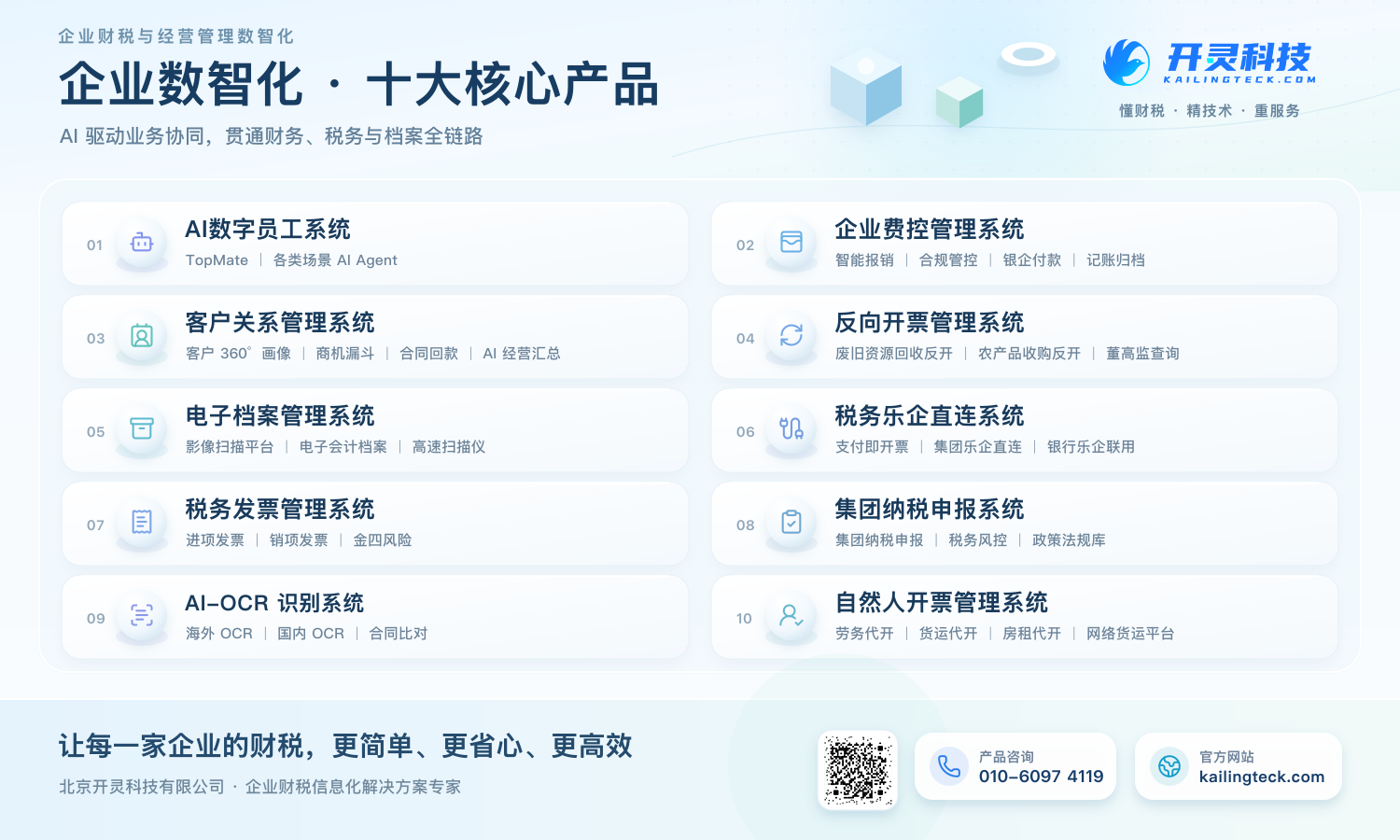
The company has now formed ten core product lines, including: AI digital employee system, enterprise expense control management system, customer relationship management system, reverse invoicing management system, invoice issuance for individuals management system, electronic archives management system, tax fully digitalized e-invoice Leqi system, tax invoice management system, group tax filing system, and AI OCR recognition system. It is committed to connecting enterprise business, finance, tax, funds, and archive data to help customers improve operational efficiency, business-finance-tax compliance capabilities, and digital management levels.
If you have any business-finance-tax digital transformation needs, welcome to contact us. Beijing Kailing Technology will serve you wholeheartedly.
Keywords: Kailing Technology AI-CRM, sales lead grading, key customer reminders, overdue collection reminders, customer relationship management system
As a comprehensive business-finance-tax digitalization solution service provider, Kailing Technology provides business-finance-tax management digital transformation products and operational services for various government agencies, institutions, and large, medium, and small enterprises. The product line includes: solutions for sales contract management system, procurement contract management system, fully digitalized Leqi interface project, automatic output invoicing system, reverse invoicing system, invoice issuance for individuals system, employee expense control and reimbursement system, input VAT invoice management system, supply chain collaborative reconciliation system, image AI OCR recognition system, automatic financial bookkeeping system, electronic accounting archives system, etc., comprehensively driving the digitalization process across various fields.
Consultation Hotline: 18513895936 / 010-60974119 Location: Beijing