
After AI digital employees go live, who will run them continuously? How Kailing Technology AI digital employees monitor success rate, exceptions, and business value

After AI digital employees go live, someone needs to continuously pay attention to task results, exception causes, and actual usage value. Kailing Technology AI digital employees provide monitoring information such as task runs and manual interventions, helping enterprises turn 'the system has been deployed' into 'position work has someone operating it.' The success rate can serve as a clue, but only by combining business results and manual handling can managers know which work is worth expanding and which links need adjustment.
▍At the morning meeting, the most worthwhile question is not how many times it ran yesterday
A task showing successful execution may only mean the call ended, and does not necessarily mean business staff have received a usable result. A report generated on time but not covering the latest data, or materials organized but received by no one, can both create distance between run records and actual experience. Digital employee operations need to see both system completion and business usage.
Start from the user's work: whose hands does the result reach, what did it help them complete, and does it still require a lot of rework? These questions do not all need to be converted into complex metrics, but there should be continuous feedback. Otherwise, teams easily become obsessed with continuously increasing the number of tasks while ignoring why employees are still busy in the original manual process.
Task counts are also affected by the run cycle. Changing once a day to frequent checks naturally increases the count, but does not mean business contribution grows accordingly. When comparing different periods, first unify the measurement basis, then discuss changes in results, avoiding replacing real operational judgment with pretty charts.
▍Kailing Technology AI digital employee monitoring: distinguish success, exceptions, and manual intervention
Kailing Technology AI digital employees can display information such as task run success, failure, and manual intervention, providing operations staff an entry point to locate work status. Managers can see where further understanding is needed, while business owners judge whether results are usable based on actual tasks. Only when the operations dashboard and business feedback complement each other is it easy to form a complete understanding.
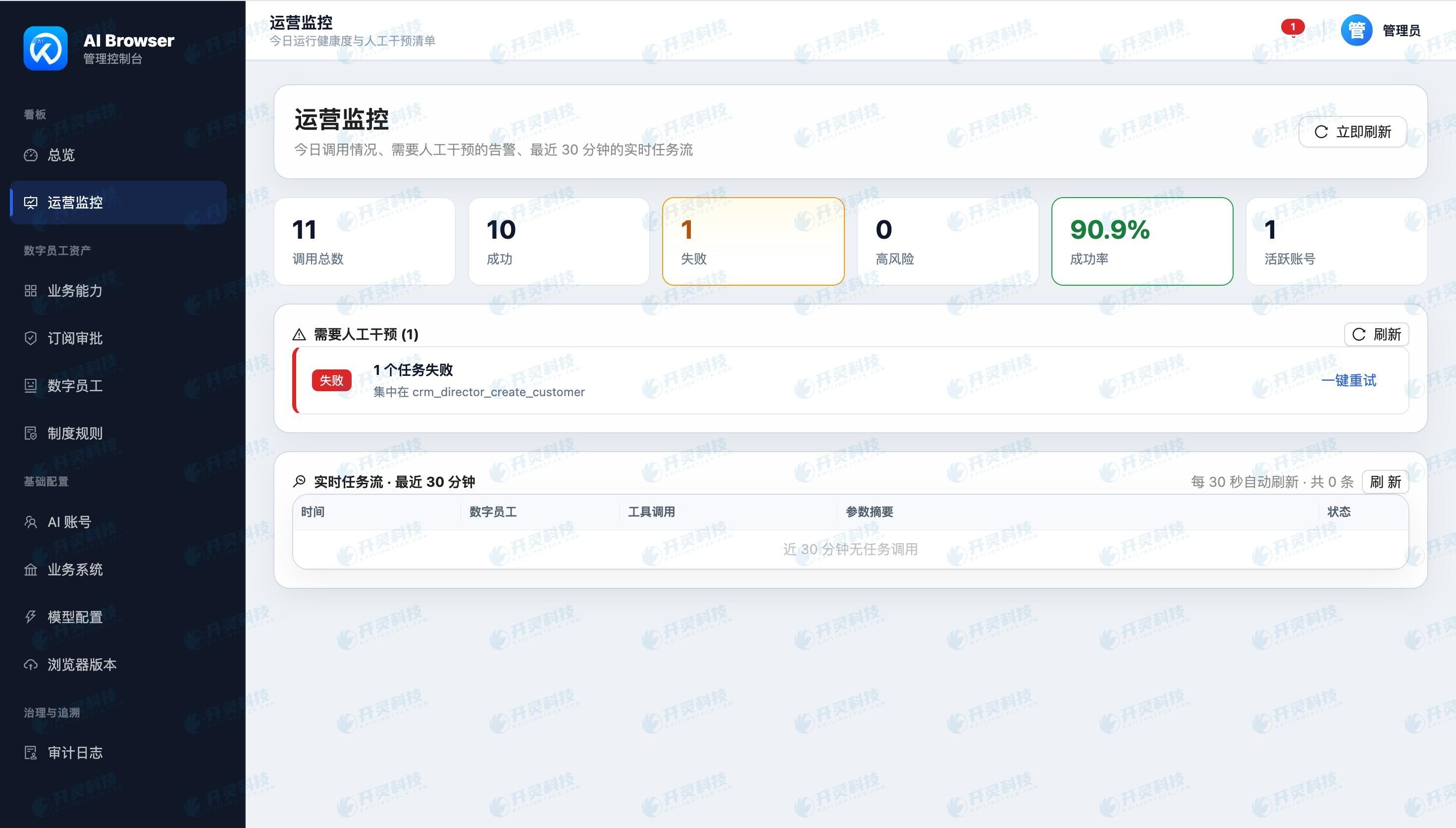
Manual intervention should not be uniformly treated as a bad result. Sensitive matters may originally require personnel approval, and missing materials should also be confirmed by the appropriate position. What is worth attention is whether the intervention meets expectations, whether the reason is clear, and whether the task can continue after handling—not simply pursuing zero manual interventions.
Failures also need classification. Some come from a temporarily unavailable connection, some from missing data, and some from skill rules not fitting. They require different personnel to handle and cannot all be left to business users to retry. Clear exception classification moves problems to the right owner faster and also reduces the same failure being forwarded among multiple people.
▍One operations owner does not mean one person handles every issue
Enterprises can designate position owners to watch whether tasks truly serve the business, technical staff to maintain connections and the operating environment, skill maintainers to organize rules and versions, and actual users to feed back whether outputs are applicable. Responsibilities can be held concurrently by existing teams, but the corresponding relationships should be clear.
When an exception occurs, the person responsible for receiving the message is not necessarily the final resolver. They need to determine what type of problem it is and pass the necessary information to the position that can handle it. Complete information such as task identifier, occurrence stage, and existing results means collaboration does not have to restart the investigation from 'the AI failed again.'
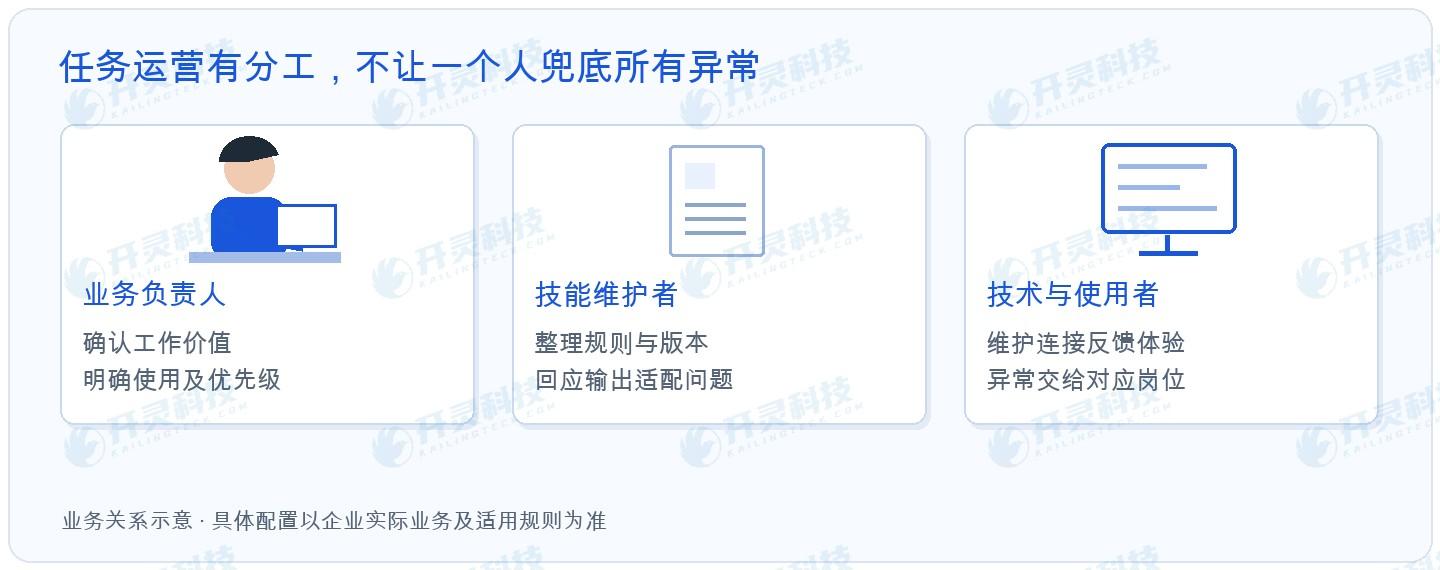
Operations arrangements should also cover personnel changes. If the maintainer of a skill leaves the position, tasks cannot continue running while no one understands the configuration. Keeping usage descriptions, dependent systems, and handling contacts helps successors continue the work, rather than turning digital employees into a tool only understood by the original project team.
▍From exception records, pick out the work worth improving first
Recurring problems of the same type are usually more worth investing in than occasional single waits. If many tasks stop because upstream materials are incomplete, the materials entry point should be improved; if a system revision continuously affects operations, check the related connections or skills; if results are often rewritten by business staff, the output requirements should be reexamined.
After a fix, it is necessary to see whether the problem truly decreases, rather than only recording 'adjusted.' Subsequent performance can be observed around the same task and similar inputs to confirm the adjustment did not introduce new side effects. Maintenance records stating what was changed and why help the team understand the applicability of different versions.
At the same time, tasks that no longer have value should also be allowed to exit. If a report is already unread, or a phased project has ended, there is no need for the digital employee to keep preparing it repeatedly. Disabling ineffective tasks in time and leaving resources and maintenance effort for positions that still need them is part of normal operations.
▍Business value can be expressed concretely; there is no need to invent an exaggerated percentage
Whether a data organization task reduced repeated transcription; whether a reminder task let the owner know about to-dos earlier; whether an analysis output helped the team have a fuller discussion—all can be value clues. When quantification is needed, there should be a clear baseline, scope, and records; the time difference of an individual demo cannot be directly extrapolated to all business.
Newly added maintenance work should also be included in observation. After a task runs, how much time do staff still spend checking, correcting, and handling exceptions? Some tasks can be completed technically but require too much follow-up organization, and may not be suitable for immediate expansion. Looking at benefits together with actual investment makes it easier for enterprises to make pragmatic rollout choices.
The continuous operations of Kailing Technology AI digital employees connect tasks, skills, and business positions. It is not about making managers stare at the backend every day, but about making key changes visible, exceptions picked up by someone, and value judged by someone. The capability for stable operation can thus gradually accumulate, rather than starting over every time the scenario changes.
When a type of work has matured, reuse in other departments can be discussed, but data scope and position permissions must be rechecked. What is promoted is the appropriate method and skills, not copying all historical authorizations. The clearer the operations experience, the easier it is for new departments to understand what they need to prepare.
A brief operations conversation can focus on the actual changes in the current period: which results were used, which types of problems recurred, and which single item to prioritize in the next round. The meeting does not need to reread all the logs; leaving with a shared decision between business and technology is more meaningful than adding another operations report no one reads.
▍FAQ digital employee operations Q&A
Q: Does a high success rate mean high project value?
A: They cannot be directly equated. The definition of success should be confirmed, and judgment should combine result usage, rework, and manual handling, avoiding treating technical completion as business benefit.
Q: Is less manual takeover always better?
A: It depends on the nature of the task. Approvals or doubt confirmations carried out as designed are necessary steps; what should be reduced is avoidable repeated intervention, not all human judgment.
Q: Who is suitable to serve as the daily operations lead?
A: It should be undertaken by someone who understands the work of the relevant positions and can coordinate business and technology. The specific organizational arrangement can be flexible, but task value and exception flow both need clear ownership.
Q: After an upstream system update, what should digital employees pay attention to?
A: Check whether connections, fields, permissions, and skills are affected, and adjust according to actual changes. The fact that old tasks can still start does not mean outputs and operations will necessarily remain applicable.
Moving from deployment to daily usability, establish a continuous operations arrangement suitable for the enterprise for Kailing Technology AI digital employees: https://www.kailingteck.com/de/ .
As a national high-tech enterprise, Kailing Technology focuses on the digital and intelligent transformation of enterprise business-finance-tax and operations management, providing software products, system integration, implementation and delivery, and operational services for various government agencies, institutions, group enterprises, and SMEs.
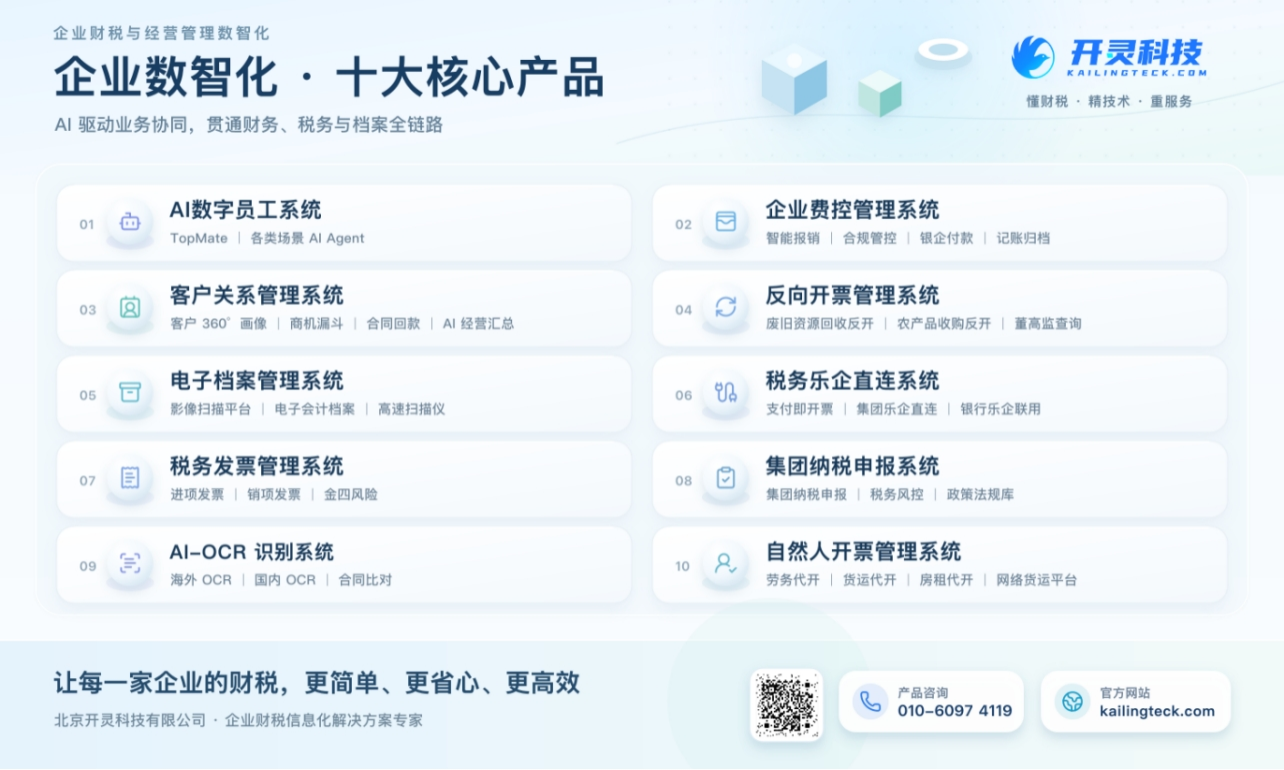
The company has now formed ten core product lines, including: AI digital employee system, enterprise expense control management system, customer relationship management system, reverse invoicing management system, invoice issuance for individuals management system, electronic archives management system, tax fully digitalized e-invoice Leqi system, tax invoice management system, group tax filing system, and AI OCR recognition system. It is committed to connecting enterprise business, finance, tax, funds, and archive data to help customers improve operational efficiency, business-finance-tax compliance capabilities, and digital management levels.
If you have any business-finance-tax digital transformation needs, welcome to contact us. Beijing Kailing Technology will serve you wholeheartedly.
 Keywords: AI digital employee operations, digital employee success rate, exception monitoring, manual takeover, digital employee business value
As a comprehensive business-finance-tax digitalization solution service provider, Kailing Technology provides business-finance-tax management digital transformation products and operational services for various government agencies, institutions, and large, medium, and small enterprises. The product line includes: solutions for sales contract management system, procurement contract management system, fully digitalized Leqi interface project, automatic output invoicing system, reverse invoicing system, invoice issuance for individuals system, employee expense control and reimbursement system, input VAT invoice management system, supply chain collaborative reconciliation system, image AI OCR recognition system, automatic financial bookkeeping system, electronic accounting archives system, etc., comprehensively driving the digitalization process across various fields.
Consultation Hotline: 18513895936 / 010-60974119 Location: Beijing