
How are permissions controlled after archive borrowing expires? Kailing Technology AI electronic accounting archives management system records viewing, downloading, and transfer

When archive borrowing expires, the corresponding temporary access permissions should be terminated while utilization records are retained; copies already downloaded locally cannot automatically disappear from external devices merely because platform permissions expire. Kailing Technology AI electronic accounting archives management system can help enterprises organize authorized access and operation traces, making borrowing periods, viewing scope, and copying requirements each clear, balancing business use and material protection.
▍For a one-time temporary access, how much permission really needs to be opened
For an internal verification of a business matter, it may be necessary only to view a few materials online; for a special inspection, it may be necessary to export copies within an approved scope; for cross-department collaboration, it may involve only a certain period or a certain project. Handling all these needs as one permission to "access the archive repository" is both too broad and not conducive to explaining responsibility.
Applications should be expressed as much as possible around specific purposes and material scope. What archives are needed, for what work, and until when they are expected to be used should be confirmed by the appropriate position before corresponding access is provided. Users obtain the information needed to complete the task, rather than long-term query rights to large amounts of unrelated materials simply because they participated in one inspection.
Permissions should also correspond to personnel's actual identities. Temporary project members, external participants, and long-term staff of the unit may use them differently. Although sharing one borrowing account saves configuration, it makes it impossible to later distinguish who viewed or exported materials, which is not conducive to traceability.
▍Kailing Technology AI electronic accounting archives management system treats viewing and copying separately
Online viewing, downloading copies, and handing over materials are different usage actions. Enterprises can combine system capabilities and management systems to separately agree on the permitted scope and confirmation method. Being able to see a file should not be taken by default as allowing arbitrary downloading; being able to download does not mean permission has been obtained to spread it to others.
Kailing Technology's electronic accounting archives solution supports management of retrieval, permissions, and utilization records. During implementation, authorization can be designed around positions, organizations, and specific borrowing needs, allowing personnel to complete work within the approved scope and leaving corresponding records. Specific button permissions, validity periods, and notification methods need to be confirmed based on actual configuration.
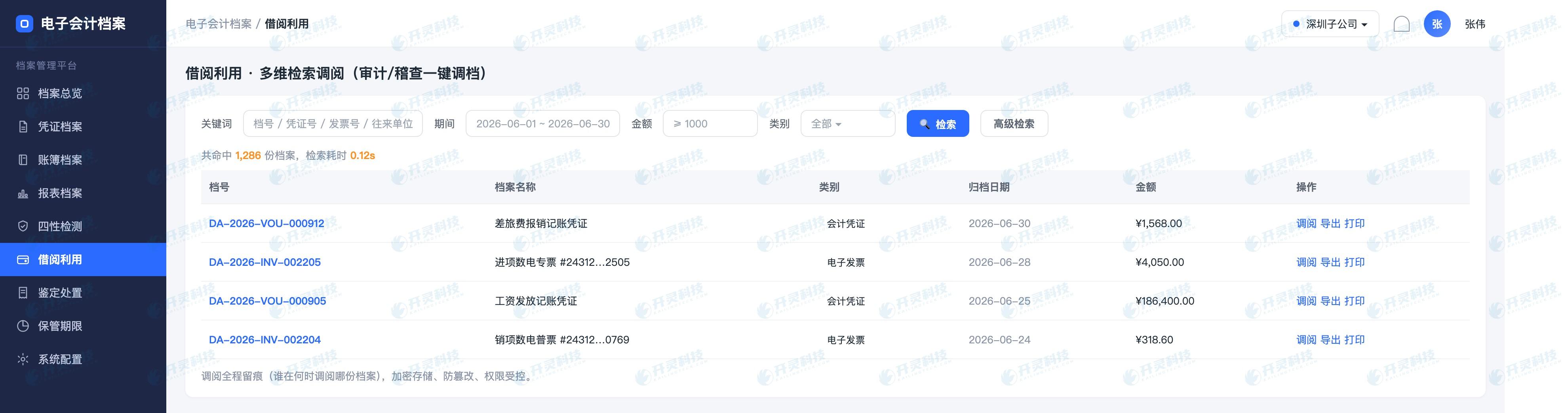
If the business only needs to verify a certain piece of information, the minimum material scope that satisfies the purpose can be provided first. It is not that the more attachments given, the more convenient it is; excessive materials also increase the user's screening burden. A clear scope both protects archives and helps borrowers find the content needed for the task more quickly.
▍When the time is up, platform access and local copies are handled separately
After the borrowing period expires, temporary authorization should expire according to the rules or enter the corresponding handling process. If unfinished work requires continued access, the reason for extension should be explained and appropriate confirmation should be carried out, rather than retaining the original permission for a long time until someone remembers to close it one day.
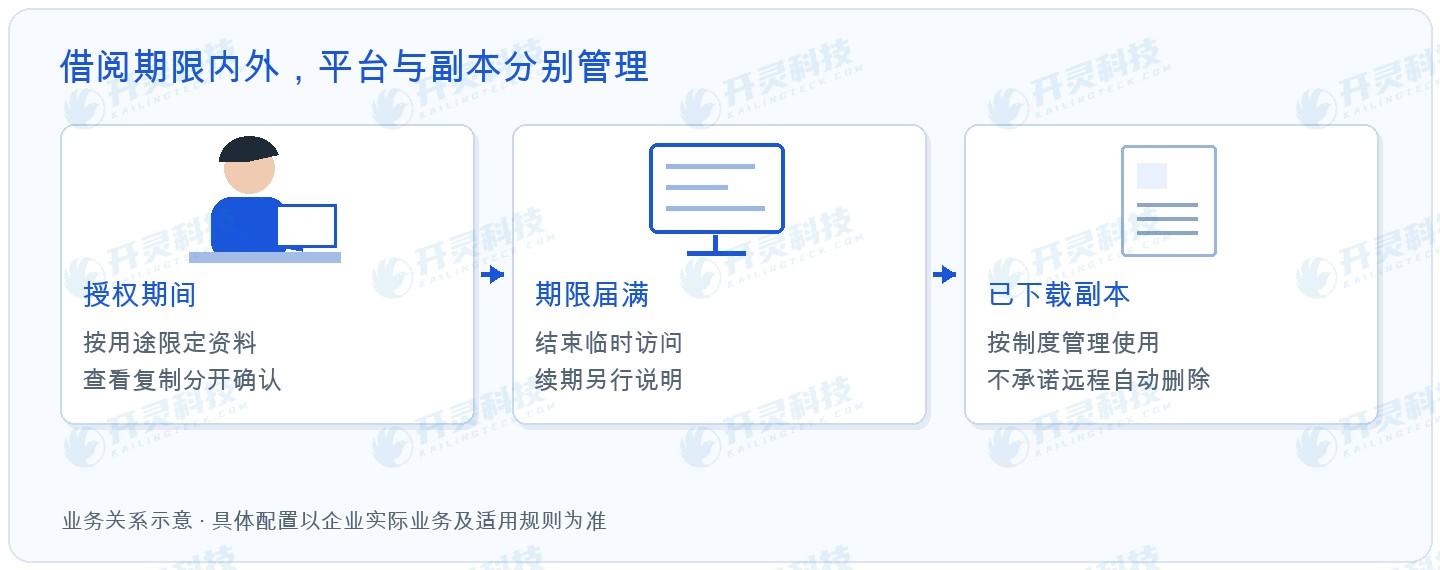
Copies that have already been downloaded have different situations. The platform can record their download behavior and manage copy use according to the system, but it cannot promise to automatically delete all external files merely because of an expiration setting. Enterprises need to explain copying, handover, retention, and return or cleanup requirements before borrowing, and adopt appropriate management measures according to actual risks.
This boundary should be clearly explained to borrowers. Temporary permission expiration limits subsequent platform access, but materials already obtained still need to be used properly as agreed. System controls and personnel responsibilities must work together so that neither party mistakenly believes a countdown has solved all problems.
▍Handing over to the next colleague also requires rechecking the purpose
Within the same project, materials may move from the handling staff to the review staff, but the original authorization may not cover all recipients. A more appropriate approach is to let those who need to use the materials obtain their own permissions according to the rules, or carry out a handover within the approved scope and leave a record, rather than continuously forwarding an attachment that cannot be tracked.
When personnel leave a project or their job responsibilities change, relevant temporary permissions should also be checked. Permission management should look not only at calendar deadlines but also at whether the purpose still holds. Being able to promptly end access that no longer has a business reason is more meaningful than setting all borrowing periods uniformly very short but repeatedly renewing them.
Situations involving the external provision of archives should also be handled in accordance with unit systems and applicable regulations. The fact that the system supports downloading does not mean external lending or dissemination is permitted. The platform provides technical capabilities, but actual use still needs to fall within authorization and archive utilization requirements.
▍Use logs to help explain "who did what within what scope"
Viewing, downloading, and transfer records should correspond as much as possible to specific personnel, material objects, and times. When questions arise, administrators can understand the situation along the recorded operations rather than guessing the flow process solely from file names. The scope and duration of log retention should match enterprise management requirements.
But logs are not omnipotent either. The system can record operations within its coverage, but it may not know how copies were later used on external devices. Enterprises should truthfully understand the boundaries of monitoring and not describe complete records within the platform as absolute control over all subsequent dissemination.
For daily operations, records can also help identify inappropriate authorization habits. If a certain type of borrowing often needs to expand its scope, the application explanation can be reorganized; if a large number of permissions have not been used for a long time, it can be checked whether they are still necessary; if materials are repeatedly obtained through handover by others, it may indicate that the formal application path is not clear enough.
▍Convenient borrowing and cautious authorization can be achieved at the same time
What borrowers really expect is that the application scope is easy to explain, results can be obtained promptly, and they know whom to contact if problems arise during use. Administrators need clear bases and records. Putting these needs into the same process means archive protection does not have to be achieved by making every access difficult.
Kailing Technology AI electronic accounting archives management system can help enterprises connect material search, authorization, and use. General use is completed online, necessary copying is handled according to requirements, and expiration and renewal have corresponding arrangements, so employees can carry out work more calmly within clear boundaries.
When establishing rules, discussion can start from the most common borrowing purposes, rather than first listing a long string of permission names that no one understands. Converting "I want to verify the payment related to this contract" into the corresponding material scope is usually closer to actual needs than letting users select technical permissions themselves.
For positions that often undertake inspection tasks, explanations of common borrowing scopes can also be accumulated to reduce the need to re-explain the background for each application. However, commonly used explanations can only help understanding and cannot automatically expand permissions; the specific objects, periods, and personnel still need to match the current task.
▍FAQ: Questions about time-limited archive access
Q: After expiration, will files downloaded to the computer automatically disappear?
A: Such a general promise cannot be made. The use, handover, and retention requirements of downloaded copies should be managed separately; the expiration of access permissions cannot be treated as deletion of external files.
Q: Can colleagues in the same group share one borrowing account?
A: Not advisable. Users should have an identifiable identity and corresponding authorization, to avoid multiple people's operations being mixed together and making it impossible to explain specific usage behavior.
Q: If the work is not finished, how can I continue to view the materials?
A: The purpose and required extension period can be explained according to the unit's arrangements, and the renewal or reauthorization process should be carried out; it is not advisable to extend temporary permissions indefinitely by default.
Make archive borrowing have scope, utilization have records, and expiration have arrangements. Learn about Kailing Technology's electronic archives solution: https://www.kailingteck.com/de/ .
As a national high-tech enterprise, Kailing Technology focuses on the digital and intelligent transformation of enterprise business-finance-tax and operations management, providing software products, system integration, implementation and delivery, and operational services for various government agencies, institutions, group enterprises, and SMEs.
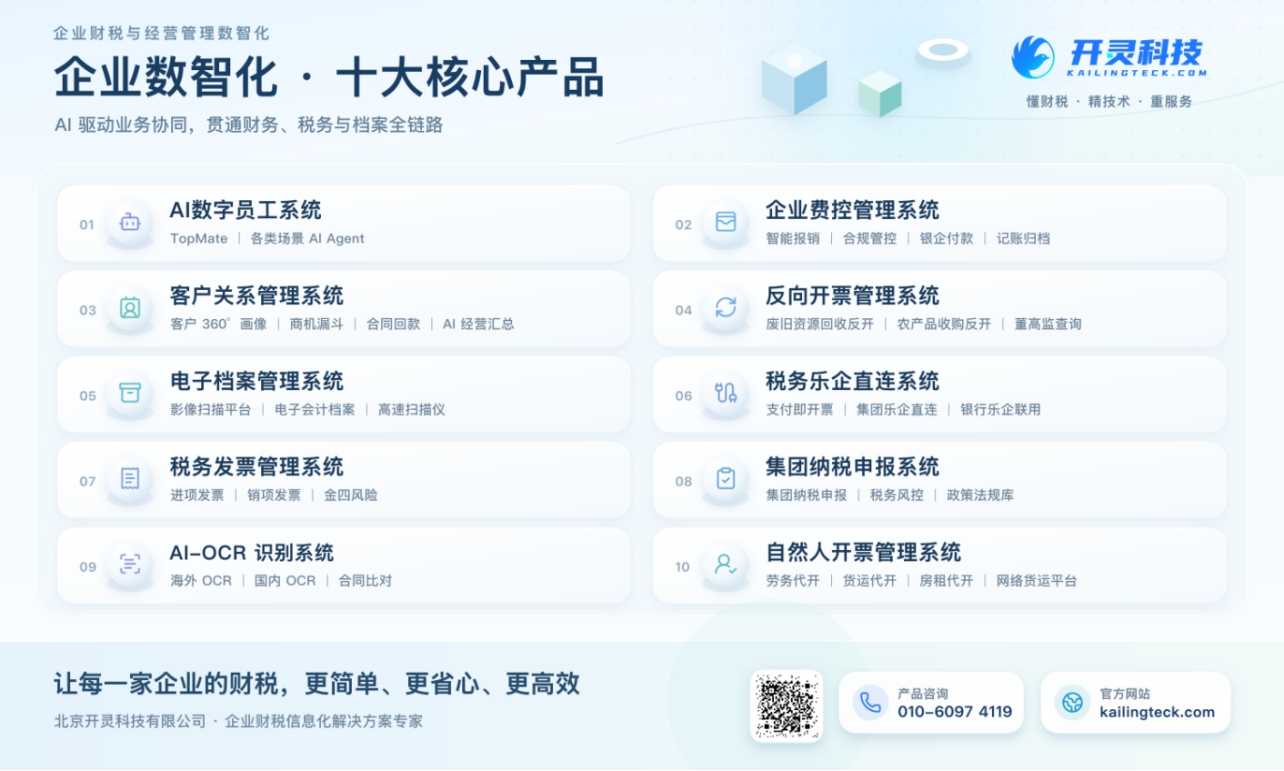
The company has now formed ten core product lines, including: AI digital employee system, enterprise expense control management system, customer relationship management system, reverse invoicing management system, invoice issuance for individuals management system, electronic archives management system, tax fully digitalized e-invoice Leqi system, tax invoice management system, group tax filing system, and AI OCR recognition system. It is committed to connecting enterprise business, finance, tax, funds, and archive data to help customers improve operational efficiency, business-finance-tax compliance capabilities, and digital management levels.
If you have any business-finance-tax digital transformation needs, welcome to contact us. Beijing Kailing Technology will serve you wholeheartedly.
Keywords: Electronic accounting archive borrowing, archive permission expiration, archive access logs, viewing and downloading permissions, AI electronic accounting archives
As a comprehensive business-finance-tax digitalization solution service provider, Kailing Technology provides business-finance-tax management digital transformation products and operational services for various government agencies, institutions, and large, medium, and small enterprises. The product line includes: solutions for sales contract management system, procurement contract management system, fully digitalized Leqi interface project, automatic output invoicing system, reverse invoicing system, invoice issuance for individuals system, employee expense control and reimbursement system, input VAT invoice management system, supply chain collaborative reconciliation system, image AI OCR recognition system, automatic financial bookkeeping system, electronic accounting archives system, etc., comprehensively driving the digitalization process across various fields.
Consultation Hotline: 18513895936 / 010-60974119 Location: Beijing