
AI Digital Employee Architecture Plan: A Five-Layer Implementation Framework That Makes Agents Really Work

AI Digital Employee Architecture Plan: A Five-Layer Implementation Framework That Makes Agents Really Work
Many enterprises have bought large models and built knowledge bases, yet digital employees still remain at the "Q&A" level: data queries require manual export, document review requires manual upload, and follow-up tasks still require digging through ledgers yourself. The problem is often not just model capability, but that models, role skills, business data, permission boundaries, and task runtime have not been placed into the same architecture. Kailing Technology's AI digital employee aims at enterprise-grade AI Agent implementation and can, across these five layers, gradually connect "can understand" into business processes that "can execute."
A digital employee is not about buying one more model, but about embedding model capabilities into roles, data, permissions, and operating mechanisms. |
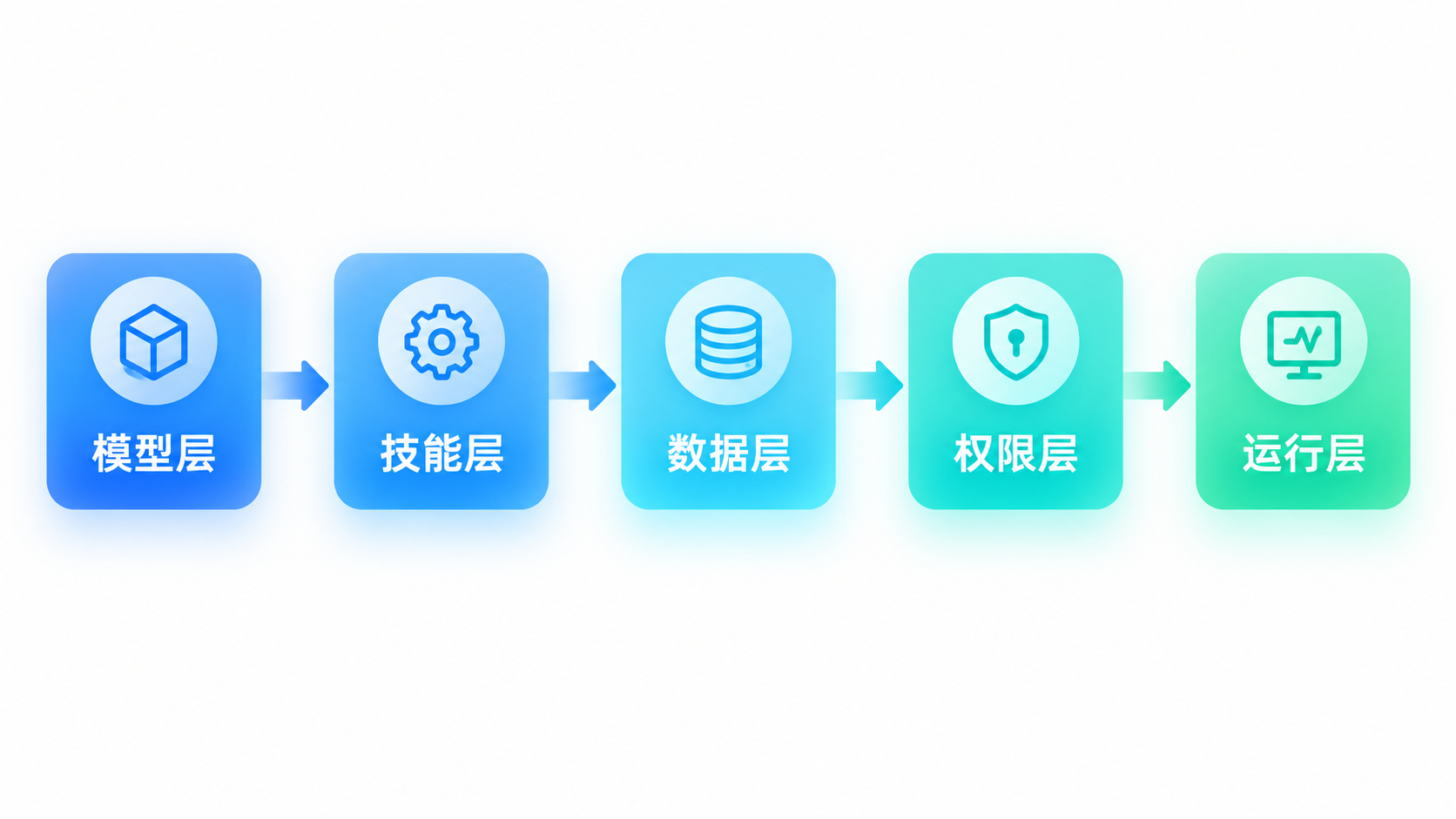
▍1. Model Layer: If You Already Have a Large Model, Do You Still Need to Buy Another One?
Enterprises that have already deployed large models do not necessarily need to purchase similar capabilities again for digital employees. Whether they can be reused should first be assessed based on whether the existing model offers open and stable interfaces, whether its performance and context capabilities meet task requirements, and whether network and data security boundaries allow access. A key distinction must be made: business interfaces such as fully digitalized e-invoice and Leqi Direct Connection are data or tool connections, not equivalent to model capabilities; whether existing channels can be reused must still be confirmed item by item based on interface authorization, invocation specifications, and the implementation environment.
▍2. Skill Layer: How Can One Role Be Replicated Across Multiple Departments?
After the first AI role is running successfully, the entire process should not be rebuilt every time it is replicated. A more reliable approach is to solidify validated task steps, prompt rules, tool calls, exception branches, and human confirmation points into skill templates, then reconfigure them according to the target department's organization, data, and responsibilities. Skills can be reused, but permissions cannot be copied wholesale. For example, when applying the financial shared service center's document review process to the procurement department, only the corresponding document scope should be opened, and exception return and human review mechanisms should be retained.
▍3. Data Layer: Where Does the Digital Employee Get Trusted Data?
For digital employees to participate in actual work, they first need authorized and traceable data. Kailing Technology AI OCR intelligent recognition can convert invoices, bills, contracts, certificates, and financial documents into structured data; the electronic accounting archives management system is used to collect vouchers and their associated materials; input VAT invoice management, automatic output invoicing, and other systems provide invoice and business status. Structured recognition results should still have key field validation, and OCR output cannot be directly treated as the final business conclusion.
▍4. Permission Layer: What Can the Agent See and Do?
The permission layer must separate "what it can do" from "what it is allowed to operate." During configuration, the accessible data scope, permitted actions, target objects, and validity period should be clearly defined, and least privilege, tiered authorization, operation trails, and necessary review mechanisms should be adopted. For key actions involving payments, filings, and contract changes, existing approval and responsibility boundaries must not be skipped just because AI is connected.
▍5. Runtime Layer: When Do Tasks Start, and Who Confirms Them?
Scheduled, event-triggered, and manually initiated tasks are not suited to all scenarios. Business briefings can be prepared at fixed times, new materials entering the system can trigger reconciliation, and ad hoc checks are better initiated manually. Digital employees can first complete material aggregation, rule comparison, exception alerts, and draft generation; for key steps involving tax filing, fund payments, and external sending, authorized personnel should confirm before execution. Being able to run continuously and stop and hand exceptions to humans is what makes a controllable enterprise-grade Agent.
Keywords: AI digital employee, digital employee architecture plan, enterprise-grade AI Agent, model layer, skill layer, data layer, permission layer, runtime layer, Kailing Technology
As a comprehensive business-finance-tax digitalization solution service provider, Kailing Technology provides business-finance-tax management digital transformation products and operational services for various government agencies, institutions, and large, medium, and small enterprises. The product line includes: solutions for sales contract management system, procurement contract management system, fully digitalized Leqi interface project, automatic output invoicing system, reverse invoicing system, invoice issuance for individuals system, employee expense control and reimbursement system, input VAT invoice management system, supply chain collaborative reconciliation system, image AI OCR recognition system, automatic financial bookkeeping system, electronic accounting archives system, etc., comprehensively driving the digitalization process across various fields.
Consultation Hotline: 18513895936 / 010-60974119 Location: Beijing