
Does an enterprise that already has a large model need to buy another one? How Kailing Technology enterprise AI digital employees reuse existing model capabilities
Does an enterprise that already has a large model need to buy another one? How Kailing Technology enterprise AI digital employees reuse existing model capabilities

An enterprise that has already deployed a large model does not necessarily need to buy another set of the same capabilities in order to use digital employees. Kailing Technology AI digital employees can combine with the enterprise's existing model services to organize job skills, system connections, and task execution. The model handles understanding and generation, while the digital employee solution puts these capabilities into actual work; whether they can be reused and how they should be connected should first be based on existing interfaces, data requirements, and task fit.
▍The model can already answer, so why is the work still stuck in people's hands?
Many enterprises already have internal AI entry points: employees can ask questions, summarize documents, and generate drafts. But when the problem becomes "check records in the business system, organize the results, and hand them to the next role," people are still needed to download, paste, and forward. It is not that the model is useless, but that there is still a distance between it and business execution.
This distance usually includes several types of work: obtaining authorized data from the correct system, understanding the enterprise's own fields and rules, invoking permitted tools, delivering results to the specified location, and finding the responsible person when exceptions occur. Simply changing a model may not necessarily fill these connections.
Therefore, before discussing digital employees, it is possible to first list the assets the enterprise already has. What problems do model services, knowledge materials, business interfaces, identity permissions, and existing workflows each solve? Which are already stable and usable, and which still need to be supplemented? Only by seeing existing capabilities clearly is it easy to place new investment in the areas that are truly lacking.
▍What Kailing Technology AI digital employees add is job and organizational capability
Digital employees can take on tasks around clear roles, arranging inputs, skills, tool permissions, and outputs together. It is not that giving a model a person's name naturally gives it enterprise authority to handle matters; nor is it about opening all internal systems to AI and letting it freely look for the next task.
Kailing Technology AI digital employees support enterprises in registering usable systems, configuring employee accounts and skills, and connecting specific work through task arrangements. If an enterprise's existing model provides suitable service interfaces, it can be reused according to the plan; model choices for different roles can also be discussed based on task characteristics and data requirements, rather than presupposing that the whole company can only use one type of capability.
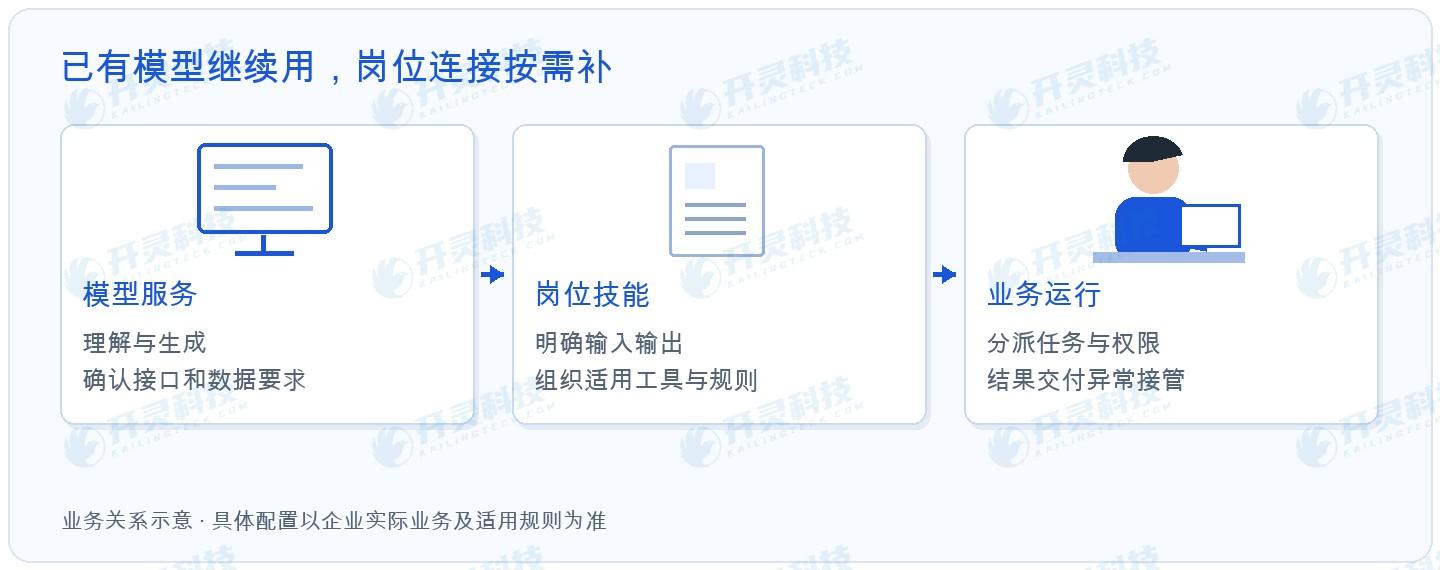
For example, document summarization places more emphasis on language understanding, structured material organization also requires field constraints and verification, and cross-system business cannot do without connections and permissions. By distinguishing different responsibilities, enterprises can discuss "which layer is missing for this task" instead of repeatedly arguing about "whether the model is still not strong enough."
▍Existing investment can be retained, but the connection method needs to be clearly discussed
When reusing model services, the invocation method, input and output formats, capacity, and availability arrangements should be confirmed. Which materials the business needs to pass, and whether model responses meet the requirements of that role, should all be verified in actual tasks. Having an account that can chat does not mean it already has service conditions suitable for system invocation.
Data flows also need to be clear. Using internal enterprise deployment or existing model services does not automatically eliminate all data risks; it is still necessary to know which fields are sent, whether unnecessary sensitive content is included, and where returned results are stored. Role authorization and model access scope should be designed together, and "the company has already purchased it" cannot be understood as everyone being able to freely invoke all materials.
For existing workflows, their approval and business orchestration responsibilities can usually be retained. Digital employees take over suitable organization, judgment assistance, or tool operations, and then return the results to the original process. This both uses existing systems and allows employees to keep familiar work entry points, without having to change all operating habits at the same time just to try AI.
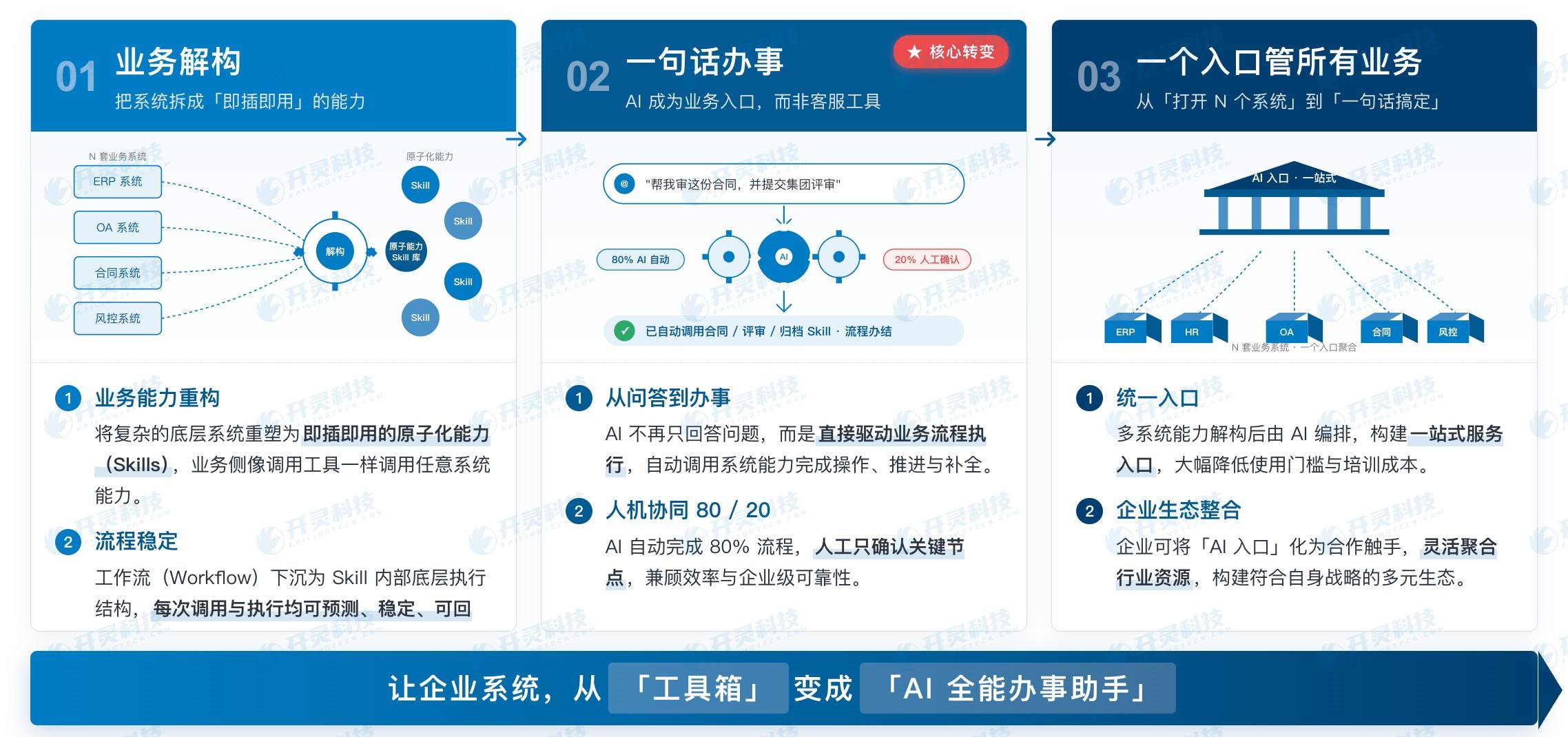
There should also be a clear handling method when the model side is temporarily unavailable. Some tasks can wait for recovery, some need to be transferred to a human to continue, and some should stop to avoid using outdated information. Enterprises do not need to pursue having AI complete everything at all times, but they must ensure the business knows what state the task is currently in.
▍Choose one real task and see clearly the respective contributions of the model and the system
Rather than first discussing coverage of all roles, it is better to choose one daily task with clear input sources, verifiable results, and clear human responsibility. Let the existing model handle understanding or generation, let digital employees obtain materials, invoke skills, and deliver results, and let business personnel judge in actual use which steps are worth retaining.
This is not about using one demonstration to declare that enterprise-wide transformation is complete. Real work will expose missing materials, differences in system fields, and edge cases, and can also help enterprises discover on which tasks existing models perform suitably and which require adjustments to prompts, rules, or other capabilities. Only by grounding problems in specific roles is it easy for discussion to form executable decisions.
For managers, evaluation results should also be layered. Whether model answers are usable is one observation; whether materials can be obtained smoothly, whether tasks are delivered on time, and whether someone takes over exceptions are several other observations. Only by separating these questions can it be judged where the added value comes from, avoiding mistaking interface problems for model problems.
▍When models are changed later, the business does not have to be completely redone along with them
If job skills, business fields, and connection conventions are properly organized, then when model services are adjusted in the future, enterprises can evaluate the affected areas rather than explaining all the business again from scratch. Model replacement and job process maintenance should have a clear relationship, but they do not need to be bound into a single complete teardown and rebuild.
Of course, replacing models still requires checking output formats, judgment quality, and related limitations, and it cannot be promised that any model can be switched directly without distinction. Stable business interfaces and clear result requirements provide a more orderly basis for adjustment, not a reason to omit confirmation.
The value of the Kailing Technology AI digital employee solution is to move an enterprise's model investment toward job capabilities that can be used sustainably. Old assets are identified and reused, new connections are filled in according to business needs, and the team can gradually consolidate scattered AI usage experience into daily collaboration methods.
Once a task becomes stable, the related skills can also be reused by other suitable tasks. What is reused is a capability and method with clear constraints, not a copy of one department's data permissions. The broader the business rollout, the more necessary it is to keep skill sharing and data authorization clearly separate.
Business leaders should also participate in this asset inventory and explain where employees truly spend their time. Only by putting the technical list and the work list together can it be seen which connections are most worth filling first and which capabilities are already sufficient and do not need to be purchased again.
▍FAQ Common questions from enterprises that already have large models
Q: If we have purchased model accounts, can we directly connect digital employees?
A: It is also necessary to confirm whether suitable invocation interfaces, authorization methods, and service conditions are provided. A personal interaction entry point and enterprise system integration capability cannot be directly equated.
Q: Must digital employees replace the original approval system?
A: There is no need to presuppose replacement. The original system can continue to manage processes and approvals, while digital employees complete specific work at authorized nodes and then return the results to the existing business chain.
Q: Can the same enterprise use different models for different tasks?
A: This can be evaluated in the plan, but data requirements, interface conventions, and operational management need to be unified. The basis for selection should be job fit, not simply chasing model names.
If existing models are reused, does that mean there is no cost for new projects?
It may still involve business analysis, system connection, skill configuration, and ongoing maintenance. Reuse helps reduce duplicate construction, but all implementation work cannot be regarded as completed automatically.
Take stock of existing models and systems, and bring AI investment into actual roles. Welcome to learn about Kailing Technology AI digital employees:https://www.kailingteck.com/de/ 。
As a national high-tech enterprise, Kailing Technology focuses on the digital and intelligent transformation of enterprise business-finance-tax and operations management, providing software products, system integration, implementation and delivery, and operational services for various government agencies, institutions, group enterprises, and SMEs.
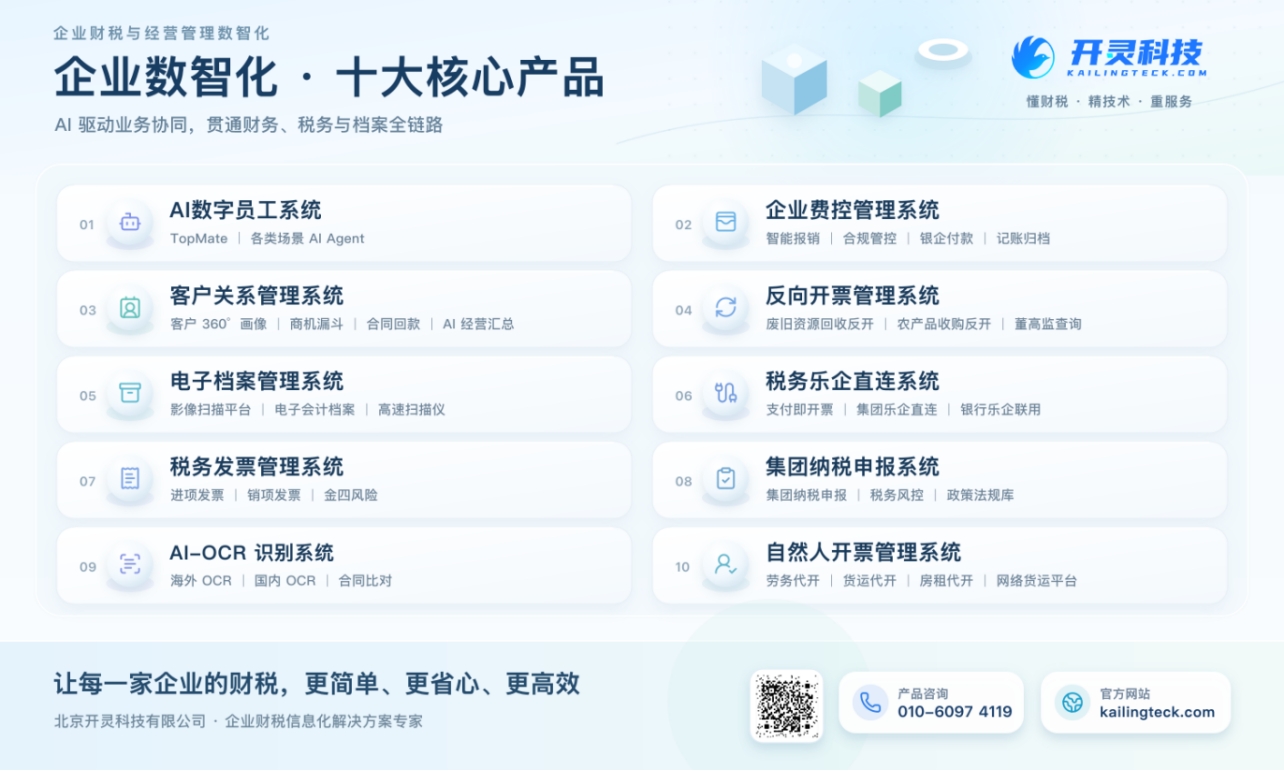
The company has now formed ten core product lines, including: AI digital employee system, enterprise expense control management system, customer relationship management system, reverse invoicing management system, invoice issuance for individuals management system, electronic archives management system, tax fully digitalized e-invoice Leqi system, tax invoice management system, group tax filing system, and AI OCR recognition system. It is committed to connecting enterprise business, finance, tax, funds, and archive data to help customers improve operational efficiency, business-finance-tax compliance capabilities, and digital management levels.
If you have any business-finance-tax digital transformation needs, welcome to contact us. Beijing Kailing Technology will serve you wholeheartedly.
 Keywords: enterprise AI digital employees, reuse existing large models, enterprise MaaS, private large models, digital employee platform
As a comprehensive business-finance-tax digitalization solution service provider, Kailing Technology provides business-finance-tax management digital transformation products and operational services for various government agencies, institutions, and large, medium, and small enterprises. The product line includes: solutions for sales contract management system, procurement contract management system, fully digitalized Leqi interface project, automatic output invoicing system, reverse invoicing system, invoice issuance for individuals system, employee expense control and reimbursement system, input VAT invoice management system, supply chain collaborative reconciliation system, image AI OCR recognition system, automatic financial bookkeeping system, electronic accounting archives system, etc., comprehensively driving the digitalization process across various fields.
Consultation Hotline: 18513895936 / 010-60974119 Location: Beijing