
Electronic accounting archives are scattered and hard to search and retrieve. What should be done? Kailing Technology AI Electronic Accounting Archive Management System

Electronic accounting archives are hard to find, often not because files are insufficiently centralized, but because the relationship from business to materials is missing. The Kailing Technology AI Electronic Accounting Archive Management System organizes vouchers, documents, and related attachments, supporting conditional search and authorized retrieval. Starting from one business transaction, finance can view the needed materials along the associations, so archive lookup no longer depends on "who handled it back then and which computer the file is on."
▍Why does checking an old account require opening several folders?
When a retrieval request is received, the accountant first finds the voucher in the financial system, then checks attachments in the reimbursement system, then searches email for the receipt, and finally discovers that the contract is kept by another department. Not a single material may be missing, but every use requires reassembling them. People familiar with the business can still find them by memory, but after personnel changes, the same matter becomes especially laborious.
File names also create obstacles. Some name by date, some use supplier abbreviations, and others directly keep the number from download time. Moving all these files into one shared drive makes the location centralized, but the search logic does not change. The searcher still needs to know the habits of whoever saved them originally.
An approach closer to daily use is to organize materials around business objects. Given a voucher number, related documents can be found; given a contract or project, related business records can be checked; and with only a date range and counterparty, the search scope can also be gradually narrowed. Search conditions should not require users to recall all details at once, but should help them continue searching along existing clues.
▍Kailing Technology AI Electronic Accounting Archive Management System builds the relationships first
Vouchers explain accounting records, invoices provide document information, receipts reflect the corresponding fund results, and approvals and business attachments explain the basis for processing. These materials do not replace one another; rather, they explain the same economic business from different angles. The value of electronic archive management lies in preserving the relationships among them.
Kailing Technology's electronic accounting archive solution supports connection with business and financial systems, organizing archive receipt, organization, detection, retention, and use. During integration, the source system's number, material type, and association rules must be clarified so that when a file enters the archive repository, it carries the information of "which business I belong to," rather than merely receiving a storage address.
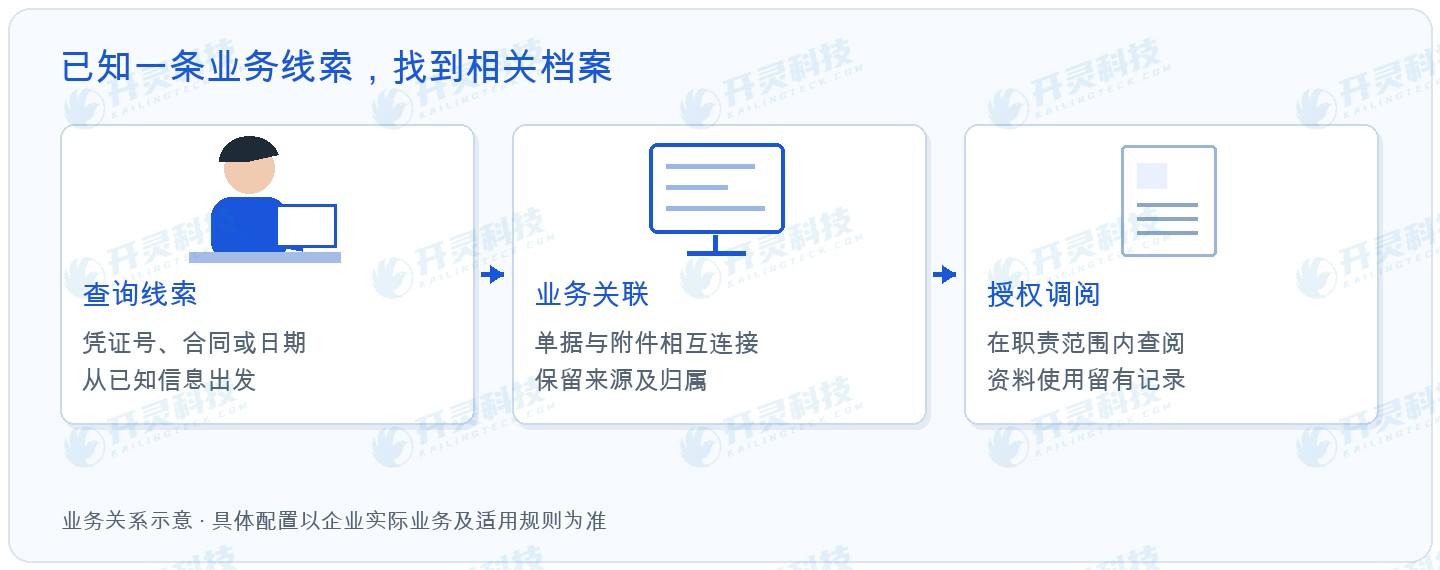
For historical materials, indexes can be gradually completed based on the available business fields. First handle materials that are used frequently, have clear sources, and have relatively stable associations, then evaluate how to organize other materials. For files whose ownership cannot be reliably determined, a pending-confirmation list should be retained, rather than forcibly attaching them to a voucher just to make the association rate look good.
▍Asking fewer people during retrieval is the everyday value of centralized management
Financial review, internal audit, and business tracing do not read materials from the same angle. Some need to check vouchers by period, some focus on the payment corresponding to a contract, and some need to understand why an invoice was returned. Search capabilities should be provided in combination with position and authorization scope, so that everyone can find appropriate materials within their responsibilities.
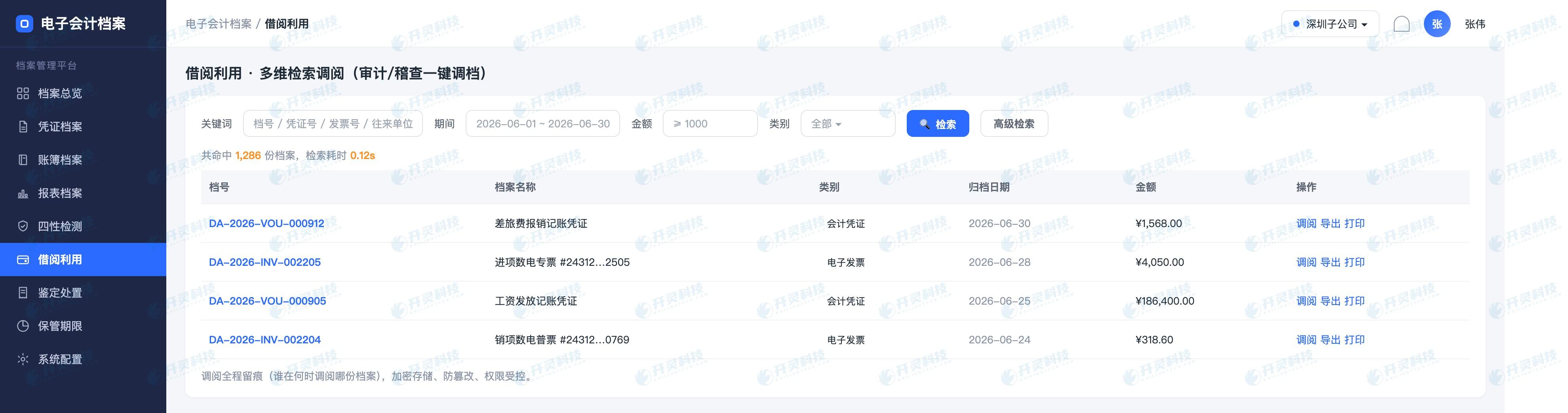
Search results should not display only a file name. The business number, material type, owning organization, and necessary status can help users judge whether it is the object they are looking for. After opening the material, it should also be possible to understand its relationship with other files. In this way, retrieval shifts from "downloading a pile of attachments and slowly reading them" to "checking the needed content along the business thread."
For cross-department collaboration, centralized management also reduces duplicate requests. The same archived material does not need to be kept as a "backup" by different people, nor does the handler need to be asked to resend it every time. Enterprises need to retain appropriate application and authorization processes so that convenience is built on controllable use, rather than simply opening the entire archive repository.
▍Before receiving, first distinguish what counts as complete materials
Archive receipt does not end when the upload succeeds. Whether the file can be opened, whether the necessary metadata is complete, and whether the source and association information can be explained all affect whether it will truly be usable in the future. Electronic vouchers should retain the relevant original electronic materials as required; scanned copies of paper materials should establish a link with the management of their originals, and the responsibility for the originals cannot be assumed to disappear just because there is an image.
Enterprises can define receipt requirements by material category. Reimbursement business usually needs to explain the expense item and approval relationship; bank materials need to correspond to the fund result; and contract materials should retain content that can explain the business agreement. Which items should enter the scope of accounting archives and what retention arrangements to adopt should be determined in light of applicable regulations and the unit's own policies.
On this basis, the detection and status management of the Kailing Technology AI Electronic Accounting Archive Management System help staff identify content that does not meet archiving requirements. Abnormal records have a clear destination, supplementary materials have a corresponding source, and later users will not discover, only when proof of the business is truly needed, that the attachment is just an unopenable file.
▍Migrating historical archives does not necessarily mean moving all old materials at once
For enterprises that have accumulated materials over many years, comprehensive organization is ongoing work. New business can first enter the archive system under unified rules, and historical archives can then be migrated in batches according to retrieval frequency and organization conditions. New materials no longer continue to scatter, and old materials gradually build relationships; the two work streams can advance simultaneously.
During migration, it is worth retaining the original storage clues and organization notes. When old numbers change, organizations merge, or historical systems cannot be directly connected, this background helps explain the origin of the archives. Not every material needs the same depth of processing, but the establishment of important associations should have a basis and be confirmed by appropriate personnel.
For managers, whether migration is effective can be judged by whether common archive lookup needs are completed more smoothly, whether missing items are discovered earlier, and whether cross-department requests decrease. Growth in the number of archives is only a record of the build process; whether it can support real use determines whether employees are willing to treat the system as an everyday work entry point.
When employees gradually become accustomed to finding materials by business number, the archive system also becomes a fulcrum for team knowledge handover. Newly assigned personnel can understand the processing background from historical records without relying entirely on the predecessor's personal memory. For materials that are not used frequently but need long-term retention, this traceability is especially important, reducing the passivity of having to find someone at short notice when they are truly needed.
▍FAQ Practical issues in centralized management of electronic archives
Q: We already have a shared drive. Why do we still need an archive system?
A: A shared drive mainly solves file storage. Archive management also involves business association, material receipt, retention requirements, search permissions, and usage records. Whether to build it should be judged in light of the enterprise's actual management needs.
Q: Once a voucher is found, can all attachments be seen directly?
A: It depends on whether the materials have been received, whether the associations are complete, and the current personnel permissions. The solution should clearly present these conditions and must not treat content that is not archived or not authorized for viewing as already available.
Q: Historical materials exist only as scanned copies. Can they be organized first?
A: Classification, indexing, and association organization can be carried out while retaining the storage information and management responsibility for the paper originals. Scanning and organizing itself does not constitute grounds for destroying the originals.
Q: Should the materials of all group companies be fully opened for sharing?
A: It should not be opened up indiscriminately. Management capabilities can be unified while access scope is limited by organization and position, so that group collaboration and the protection of each entity's materials can both hold true.
Find a complete set of materials from one old account, and let Kailing Technology help enterprises turn archives into usable information assets: https://www.kailingteck.com/eaa/ .
As a national high-tech enterprise, Kailing Technology focuses on the digital and intelligent transformation of enterprise business-finance-tax and operations management, providing software products, system integration, implementation and delivery, and operational services for various government agencies, institutions, group enterprises, and SMEs.
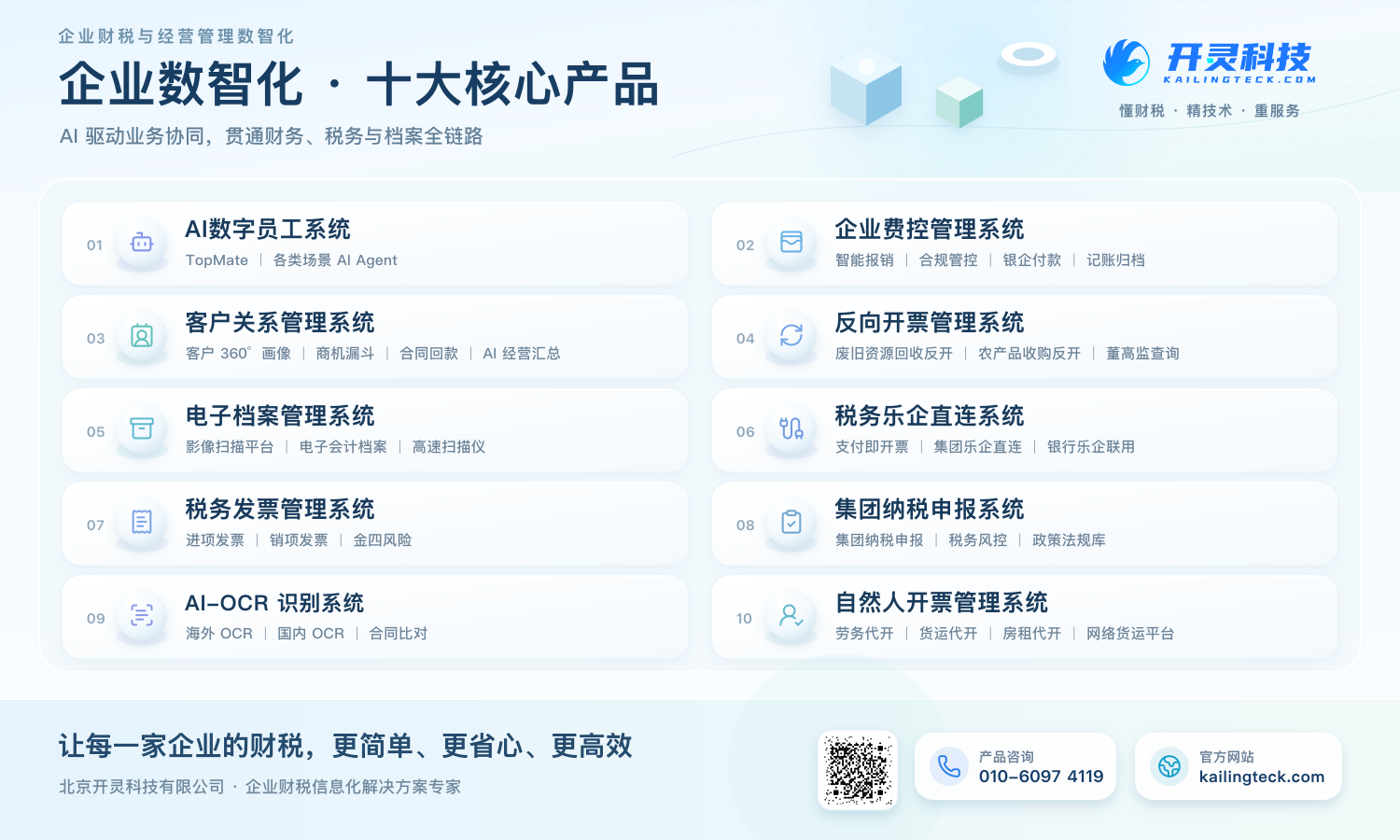
The company has now formed ten core product lines, including: AI digital employee system, enterprise expense control management system, customer relationship management system, reverse invoicing management system, invoice issuance for individuals management system, electronic archives management system, tax fully digitalized e-invoice Leqi system, tax invoice management system, group tax filing system, and AI OCR recognition system. It is committed to connecting enterprise business, finance, tax, funds, and archive data to help customers improve operational efficiency, business-finance-tax compliance capabilities, and digital management levels.
If you have any business-finance-tax digital transformation needs, welcome to contact us. Beijing Kailing Technology will serve you wholeheartedly.
Keywords: Electronic accounting archive management system, accounting archive search, archive retrieval, electronic voucher archiving, AI electronic accounting archives
As a comprehensive business-finance-tax digitalization solution service provider, Kailing Technology provides business-finance-tax management digital transformation products and operational services for various government agencies, institutions, and large, medium, and small enterprises. The product line includes: solutions for sales contract management system, procurement contract management system, fully digitalized Leqi interface project, automatic output invoicing system, reverse invoicing system, invoice issuance for individuals system, employee expense control and reimbursement system, input VAT invoice management system, supply chain collaborative reconciliation system, image AI OCR recognition system, automatic financial bookkeeping system, electronic accounting archives system, etc., comprehensively driving the digitalization process across various fields.
Consultation Hotline: 18513895936 / 010-60974119 Location: Beijing