
How to choose the voucher date after cross-month reimbursement? Kailing Technology enterprise AI expense control reimbursement management system connects document dates with open accounting periods

After cross-month reimbursement, the voucher date cannot be mechanically selected only by invoice date, submission date, or payment date. Enterprises should determine the bookkeeping arrangement based on business substance, accounting policy, and the currently open accounting period, and then connect document dates, approval results, and voucher fields through the Kailing Technology enterprise AI expense control reimbursement management system. The system helps rules execute consistently, while responsibility for closing judgments and accounting treatment still belongs to the enterprise.
▍Invoice last month, document this month: don't rush to choose a date
Month-end reimbursement most easily produces this kind of handoff: the employee says the expense indeed occurred last month, the supervisor only completed review this week, but the financial system has already closed last month's accounting period. Every date has an origin, but they record different events. Rather than arguing about "which one to use," it is better to first clarify which accounting fact the voucher is meant to express.
The occurrence date explains when the business was formed, the invoice date records when it was issued, the submission and approval dates indicate internal circulation, and the payment date reflects fund changes. These dates may be consistent or may span different months. Copying one field directly to all positions may save effort, but it can cause the materials to lose their proper explanatory role.
▍Two calendars: one records business, one manages accounting periods
The business calendar records materials in the order in which things actually happened, and should not be arbitrarily modified for convenience of booking. The accounting period calendar manages which period the financial system currently allows vouchers to be generated or processed in. The former is the source of facts, while the latter is the bookkeeping environment; the two need a rule-based connection, but cannot impersonate each other.
Whether a closed period can be adjusted and what processing method to use must be judged by enterprise finance in light of the specific matter. Not all cross-month reimbursements require reopening last month, nor does placing vouchers uniformly in the current month apply to all situations. Materiality of the amount, whether the related expense has already been confirmed, and correction requirements may all affect accounting treatment.
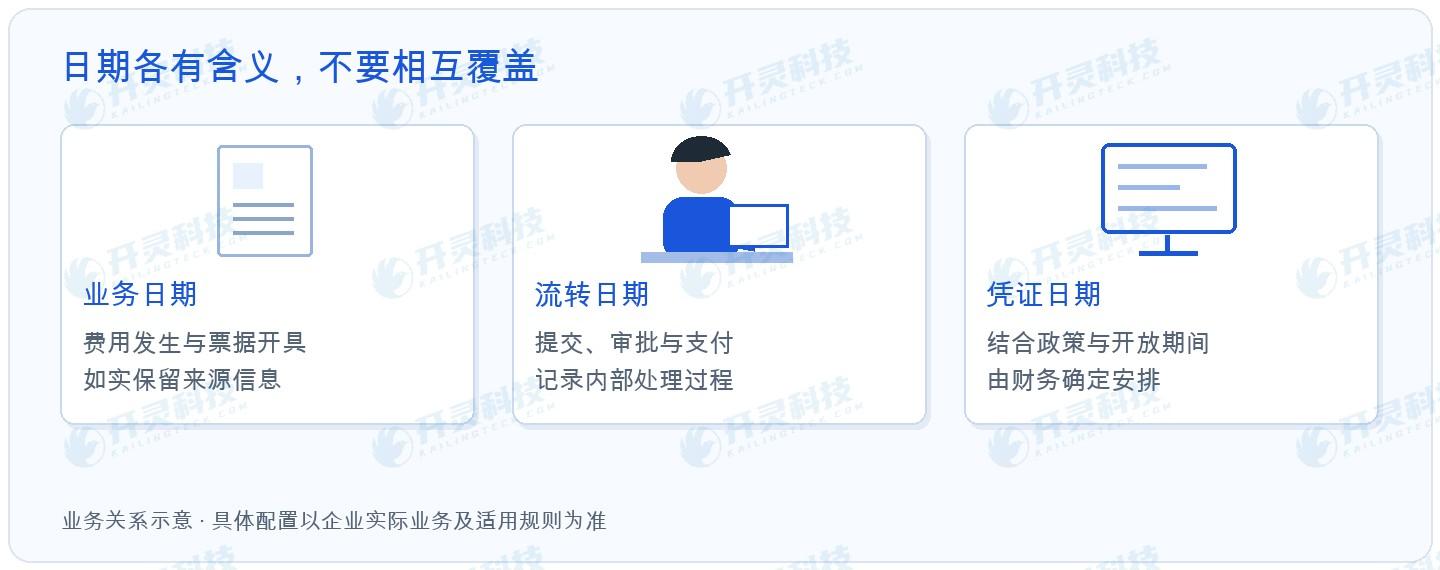
Therefore, it is best to display the original date and the current voucher date separately on the page, and record the basis for selection when needed. Later auditors can see the real business time and understand why it was processed in a certain accounting period, rather than facing a set of fields changed to the same date and losing the explanatory path.
▍Kailing Technology expense control reimbursement system applies date rules to voucher mapping
Lingdong Reimbursement supports field mapping from reimbursement documents to bookkeeping vouchers, and can establish correspondences among expense categories, accounting dimensions, and date fields in combination with the enterprise's existing financial system. When configuring cross-month rules, it should be clear where default values come from, how to prompt when encountering a closed period, and which situations are left for accountants to confirm.
The benefit of this kind of configuration is reducing repeated oral transmission of the same rule among different people. Handlers do not need to guess the accounting period themselves, reviewers know what information needs to be completed, and accountants can focus on exceptions. The system is responsible for organizing data according to already-defined rules; it should not arbitrarily change a closed accounting period to open, nor use automatic generation to replace necessary accounting judgment.
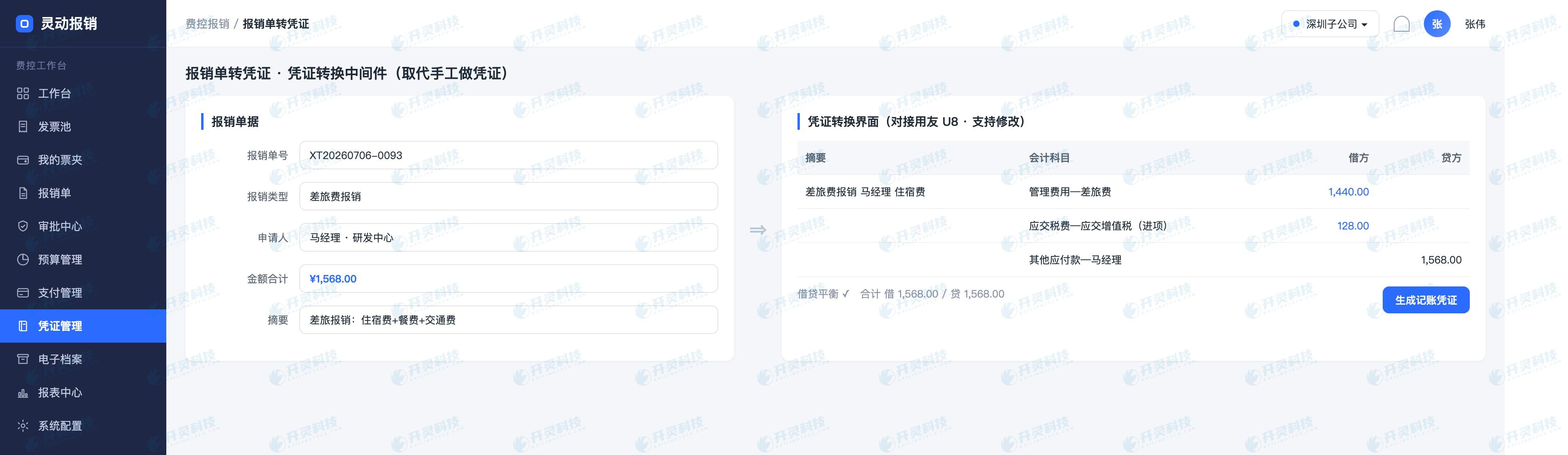
If an enterprise uses multiple accounting entities or multiple sets of financial books, whether the same date falls within an open period may also differ. During integration, it is necessary to simultaneously identify the affiliated company, ledger, or corresponding accounting scope, so as to avoid reading only one group-wide unified calendar and placing all documents into the same processing path.
▍What truly needs discussion is exceptions, not every ordinary reimbursement form
Routine reimbursements can be handled according to stable rules. What finance and business most need to agree on in advance are boundary situations: materials incomplete near closing, approval crossing months due to supplementary explanations, and discovery after voucher generation that expense attribution needs correction. Once these situations have clear owners and explanation methods, employees know what to supplement, rather than only receiving a rejection notice saying "the date is wrong."
For expenses already confirmed in other steps, subsequent reimbursement should also consider whether they will be counted twice. System integration needs to let accountants see the existing basis for handling, rather than only checking whether the current document is submitted for the first time. Date issues often appear together with business linkage issues, and changing a single date in isolation may not eliminate the risk of duplicate processing.
What employees can do is submit true and complete materials promptly and accurately explain when the business occurred; supervisors confirm the relationship between expenses and work tasks; finance determines the applicable bookkeeping arrangement. Once responsibilities are separated, reimbursement circulation will not become a guessing game in which employees choose accounting periods on behalf of accountants.
▍Explainable reports matter more than dates that look tidy
When business leaders read monthly expenses, they need to understand the business scope represented by the numbers. If cross-month matters are concentrated, explanations should be combined with finance's handling criteria, rather than directly treating the reimbursement submission month as the occurrence month of all expenses. Different statistical purposes use different dates, and report names and filter conditions should also let users distinguish them.
Enterprises can simultaneously track the distribution of expense occurrence, reimbursement processing progress, and actual payment arrangements, but should not mix them into a single "month." The same batch of documents appearing under different attributions in different reports is not necessarily a system error; the key is whether the criteria used by each report are clear and consistently applied.
Kailing Technology's linkage between expense control and vouchers can provide the basic materials for such explanations. Enterprises do not need to reorganize date notes at every month-end; instead, they can put commonly used rules into the process and leave explanations for a small number of special cases. Clear rules make accounting more well-founded and also make it easier for business staff to cooperate with finance's rhythm.
▍From one reminder before closing to improved collaboration throughout the month
Cross-month issues do not all need to be resolved only when vouchers are generated. Finance can explain material submission times, approval responsibilities, and how overdue matters are handled in internal arrangements, and business departments can organize in advance accordingly. The focus of reminders should be to inform what materials need to be prepared, not simply require everyone to fill in a certain date.
For project activities that often occur at month-end, agreeing in advance on how materials are collected is more helpful. Timely collection of electronic invoices, expense explanations, and approval records can reduce passive cross-month situations caused by missing information; for materials that truly need to be supplemented later, retain the real progress and let finance arrange processing according to the nature of the matter.
For long-term collaborative teams, these agreements can also serve as guidance for new employees handling reimbursements. Employees know which dates to fill in truthfully and which choices are made by finance, so they do not need to copy the previous colleague's method. Reducing unnecessary guessing is part of how expense control systems improve the daily experience.
▍FAQ: Date Q&A for cross-month reimbursement
Q: If the invoice was issued last month, must it be recorded as a voucher for last month?
A: It cannot be judged solely by the invoice date. It needs to be combined with the business substance, prior accounting treatment, and the enterprise's accounting policy, and finance determines the processing period and method.
Q: After the accounting period is closed, is it appropriate for the system to automatically change it to today?
A: Unconditional replacement is not appropriate. Approved rules may prompt or provide default values, but exceptions still require confirmation, and the original date and basis for handling should be retained.
Q: If payment crosses months, will it change the date of the original reimbursement materials?
A: Fund payment and expense materials reflect different events. The actual payment result should be recorded, and the original business information should not be overwritten due to a change in payment date; the corresponding accounting linkage is verified by finance.
Fewer date disputes at month-end, and more well-founded linkage. Learn about Kailing Technology expense control and voucher integration: https://www.kailingteck.com/feikong/ .
As a national high-tech enterprise, Kailing Technology focuses on the digital and intelligent transformation of enterprise business-finance-tax and operations management, providing software products, system integration, implementation and delivery, and operational services for various government agencies, institutions, group enterprises, and SMEs.
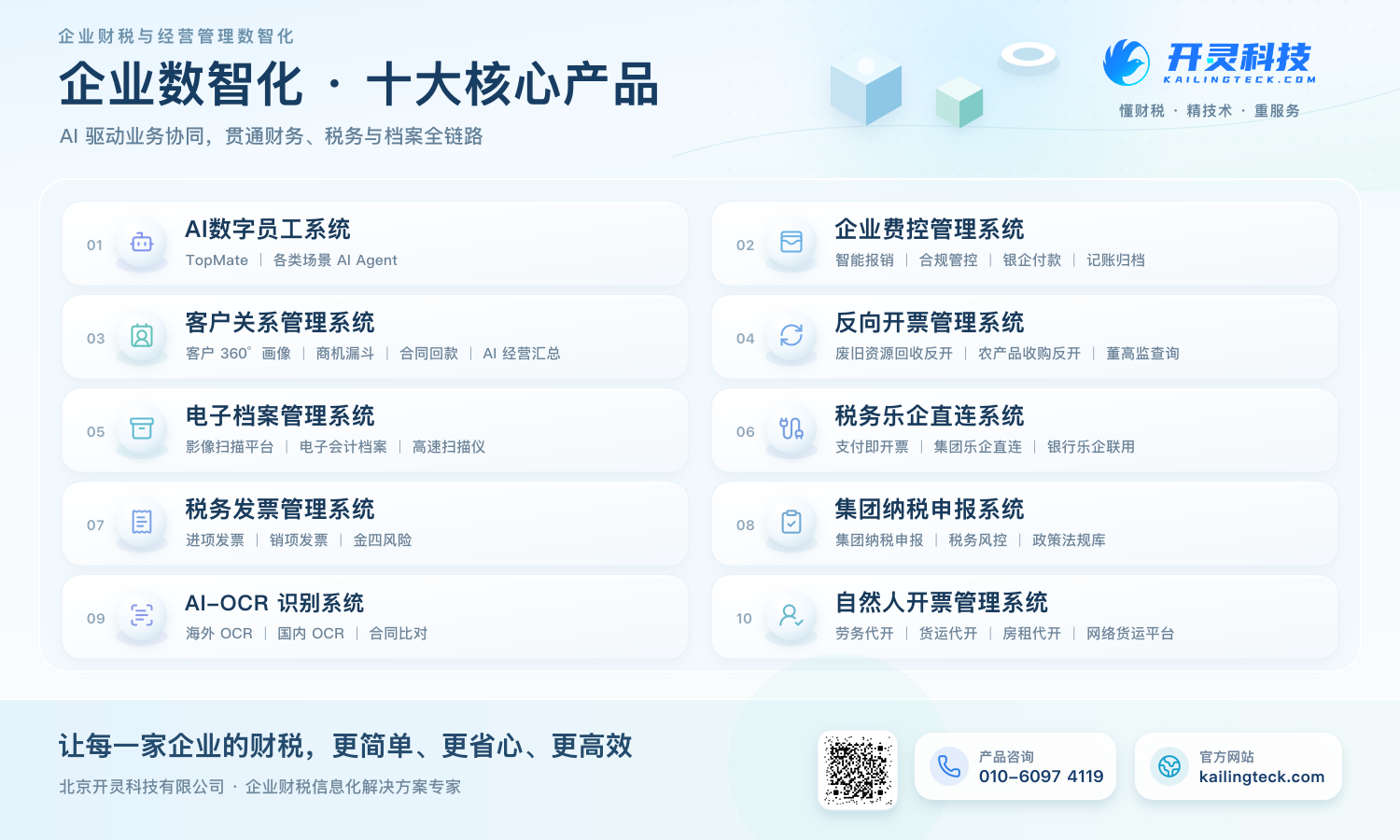
The company has now formed ten core product lines, including: AI digital employee system, enterprise expense control management system, customer relationship management system, reverse invoicing management system, invoice issuance for individuals management system, electronic archives management system, tax fully digitalized e-invoice Leqi system, tax invoice management system, group tax filing system, and AI OCR recognition system. It is committed to connecting enterprise business, finance, tax, funds, and archive data to help customers improve operational efficiency, business-finance-tax compliance capabilities, and digital management levels.
If you have any business-finance-tax digital transformation needs, welcome to contact us. Beijing Kailing Technology will serve you wholeheartedly.
Keywords: Cross-month reimbursement, voucher date, open accounting period, AI expense control reimbursement management system, automatic voucher
As a comprehensive business-finance-tax digitalization solution service provider, Kailing Technology provides business-finance-tax management digital transformation products and operational services for various government agencies, institutions, and large, medium, and small enterprises. The product line includes: solutions for sales contract management system, procurement contract management system, fully digitalized Leqi interface project, automatic output invoicing system, reverse invoicing system, invoice issuance for individuals system, employee expense control and reimbursement system, input VAT invoice management system, supply chain collaborative reconciliation system, image AI OCR recognition system, automatic financial bookkeeping system, electronic accounting archives system, etc., comprehensively driving the digitalization process across various fields.
Consultation Hotline: 18513895936 / 010-60974119 Location: Beijing