
When the employee reimbursement amount exceeds the loan, how is the difference settled? Kailing Technology's AI expense control reimbursement system separates loan write-off and supplementary payment

When employee reimbursement exceeds the loan, the amount the enterprise actually still needs to pay is the difference after deducting the loan amount that can be written off this time from the approved expense. Kailing Technology's AI expense control reimbursement system can connect reimbursement review, payment, and vouchers; loan association and write-off order should be configured according to enterprise policies. Employees can see how much of the expense was reimbursed, how much of the old loan was offset, and how much they will still receive, so finance no longer has to repeatedly explain the same amount of money.
▍Employees care about receipt; finance also needs to see two sets of accounts clearly
After the business trip ends, the employee submits train tickets, accommodation invoices, and itinerary materials all at once, and what they care about most is often "when will the company pay me the rest." Finance, however, faces more than a single payment: the loan previously issued is still on the books, the newly reimbursed expense needs confirmation, part of it is used to clear the account, and only the other part forms a bank payment.
If the reimbursement page has only one "amount," both sides can easily talk past each other. Employees think all approved expenses will arrive, cashiers worry that the loan was not offset after paying the total amount, and accountants ask which loan was actually written off this time. The problem is not necessarily in the calculation, but in the inconsistent meaning of the amount seen by different roles.
Present the settlement results separately, and communication has a common working paper. The reimbursement amount explains which expenses the enterprise has approved, the write-off amount explains how much of the previously prepaid money was used, and the supplementary payment amount answers how much the bank should pay this time. These three items should come from the associated data of the same transaction, and cannot each leave a version in chat records, manual spreadsheets, and online banking notes.
▍How the Kailing Technology AI expense control reimbursement system presents difference settlement
The settlement relationship can be understood as: amount to be supplemented this time = approved expense - loan actually written off this time. There are two qualifiers here. The expense must be on the post-review basis and cannot directly use the employee's reported figure; the loan must be the portion actually linked to this document and approved for write-off, and you cannot deduct all outstanding loans under the employee's name.
Kailing Technology Lingdong Reimbursement provides configurable forms, processes, and multi-organization management capabilities. When implementing loan offset scenarios, related fields can be designed around the employee, affiliated legal entity, loan purpose, and original document number, then clarify whether cross-instance write-off is allowed, which transaction is written off first, and who can adjust it. The page expression should let employees understand the expected settlement when submitting, and let finance see the basis clearly when approving.
Especially between different legal entities, employees cannot be merged based only on name. A person may undertake tasks for different entities within a group; which company the loan came from and who should bear the expense both need joint confirmation by business and finance. The system's role is to bring rules into the documents, not to conceal entity differences with a seemingly convenient automatic offset.
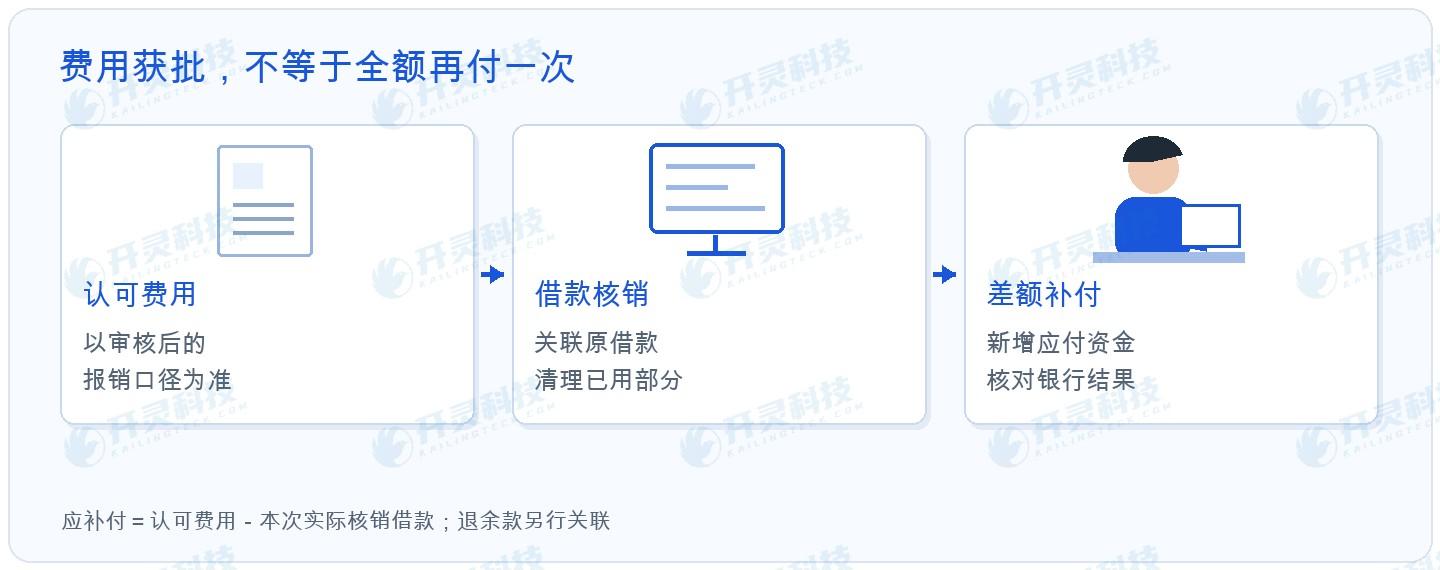
▍When the difference is positive, zero, or negative, the follow-up actions are not the same
When the approved expense is higher than the deductible loan, a supplementary payment is formed; when the two exactly offset, the corresponding write-off can be completed without initiating an additional payment; when the expense is lower than the loan, it is necessary to determine whether the remaining funds should be returned or retained according to the arrangement approved by the enterprise. The three results cannot all use the prompt 'reimbursement successful, waiting for arrival'.
If an employee has already returned the remaining balance, the refund receipt also needs to be matched with the original loan. If finance only updates the reimbursement status without confirming the refund, the ledger may still show it as unsettled; conversely, clearing the balance solely because the employee says "already transferred back" will also disconnect bank records from internal accounting. Every settlement result should have a traceable basis for completion.
When multiple reimbursement forms jointly write off one loan, the most noteworthy item is the remaining available balance. If the previous form is returned and the next form is still under approval, the same portion of the balance cannot be promised to both forms at the same time. During implementation, the rules for occupation, release, and final write-off should be clarified, and abnormal statuses should have a manual handling entry point.
▍The bank pays only the difference, while vouchers retain the complete business
The fact that the employee ultimately receives a supplementary payment does not mean that the enterprise only incurred this portion of expense this time. When bookkeeping, the relationship between approved expenses and loan clearing still needs to be presented, while the payment voucher explains the newly added cash outflow. Treating the received amount directly as the expense amount will lose the full picture of the business.
Lingdong reimbursement supports the mapping from expense documents to vouchers, and can connect to fund processing through payment files or bank-enterprise connections. Enterprises can determine the voucher generation method based on their existing financial systems, so that review results, payment batches, and bank receipts each have their corresponding place. Specific accounts and auxiliary accounting dimensions are determined by the enterprise's accounting policies and configuration, and cannot be replaced by a single formula in an article.
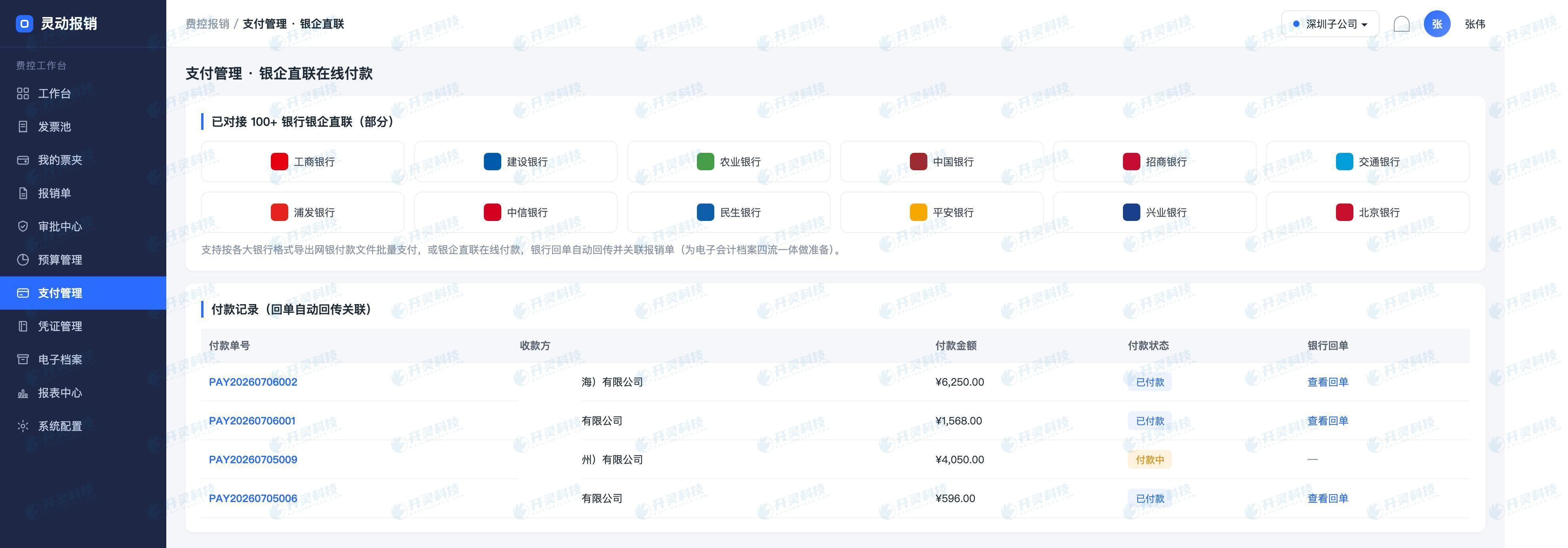
For cashiers, the most helpful page is not another summary table, but the ability to return from the payable difference to the original reimbursement form and to trace this payment batch from the bank return result. When payment fails, a re-processable status should be retained; when the bank has succeeded but the interface has not updated, check the result first, then decide whether to initiate again, to avoid duplicate payment.
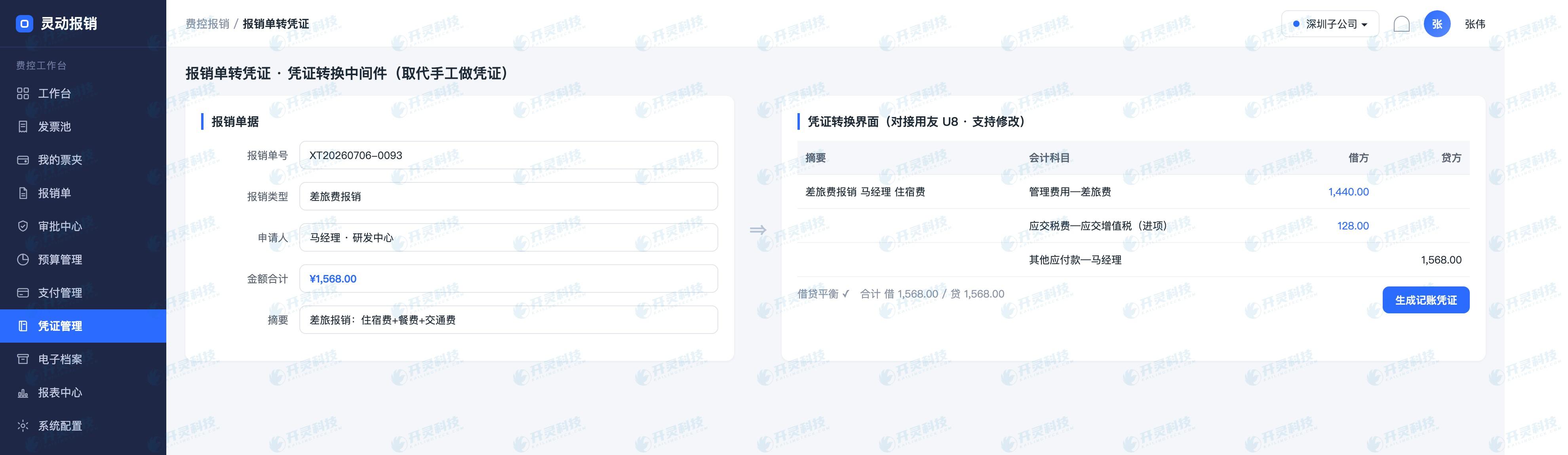
▍When returning for modification, bring the settlement basis back as well
After reimbursement enters the process, the number of accommodation days may be adjusted, a certain invoice may need supplementary explanation, and the original loan may have already been partially repaid through other business. Changing only the expense details without rechecking the loan association will make the previously calculated difference lose its basis.
A more appropriate handling is to present changes as part of the business: what changed, which write-off it affects, and whether payment needs to be reconfirmed. For already paid transactions, historical values cannot simply be overwritten after returning the document; before-and-after records should be left according to the enterprise's correction and fund handling arrangements. Finance does not need to piece together the process from memory, and employees also know why the expected arrival has changed.
When selecting a system, one can use common enterprise scenarios such as "multiple borrowings, installment reimbursements, and return of remaining funds" to discuss pages and rules. This makes it easier to judge whether a solution fits one's own management habits, rather than merely comparing whether there is a button called "loan write-off."
For teams that frequently travel, this clarity can also be moved earlier to before reimbursement submission. When employees view outstanding loans, they know which task to associate this time and which explanations to supplement; when supervisors approve, they can also distinguish whether they are confirming a business expense or approving continued occupation of a loan. Fewer verbal agreements are what allow the settlement experience to remain orderly as business volume grows.
▍ FAQ reimbursement difference settlement: several things employees often ask
Q: The reimbursement was approved, so why is the amount received less than the approved amount?
A: First check whether the settlement details have deducted the previous loan. If there is a write-off, the approved expense amount and the bank supplementary payment are not on the same basis; the system should display the difference rather than making employees guess.
Q: Can one loan be reimbursed in several installments?
A: This should be decided by enterprise policy. When processing in installments is allowed, the related amount of each installment and the remaining balance need to be recorded, while also considering amounts occupied in approval, to avoid multiple documents repeatedly using the same limit.
Q: Can a colleague's loan be used directly to offset one's own expenses?
A: It cannot be offset across individuals at will for convenience. The loan responsible person and the actual business relationship should first be clarified; if adjustment is truly needed, the enterprise's prescribed confirmation procedures should be followed and the basis for handling the account should be retained.
Q: If the system calculates a difference, does that mean the accounts are already settled?
A: No. Amount calculation, loan write-off, bank payment, and voucher processing each have their own completion conditions. Verification should be based on actual receipts and accounting results; a single success prompt cannot replace all confirmations.
Want employees to understand the reimbursement difference at a glance, and finance to clearly trace where the loan went? Learn about Kailing Technology Lingdong Reimbursement: https://www.kailingteck.com/feikong/ .
As a national high-tech enterprise, Kailing Technology focuses on the digital and intelligent transformation of enterprise business-finance-tax and operations management, providing software products, system integration, implementation and delivery, and operational services for various government agencies, institutions, group enterprises, and SMEs.
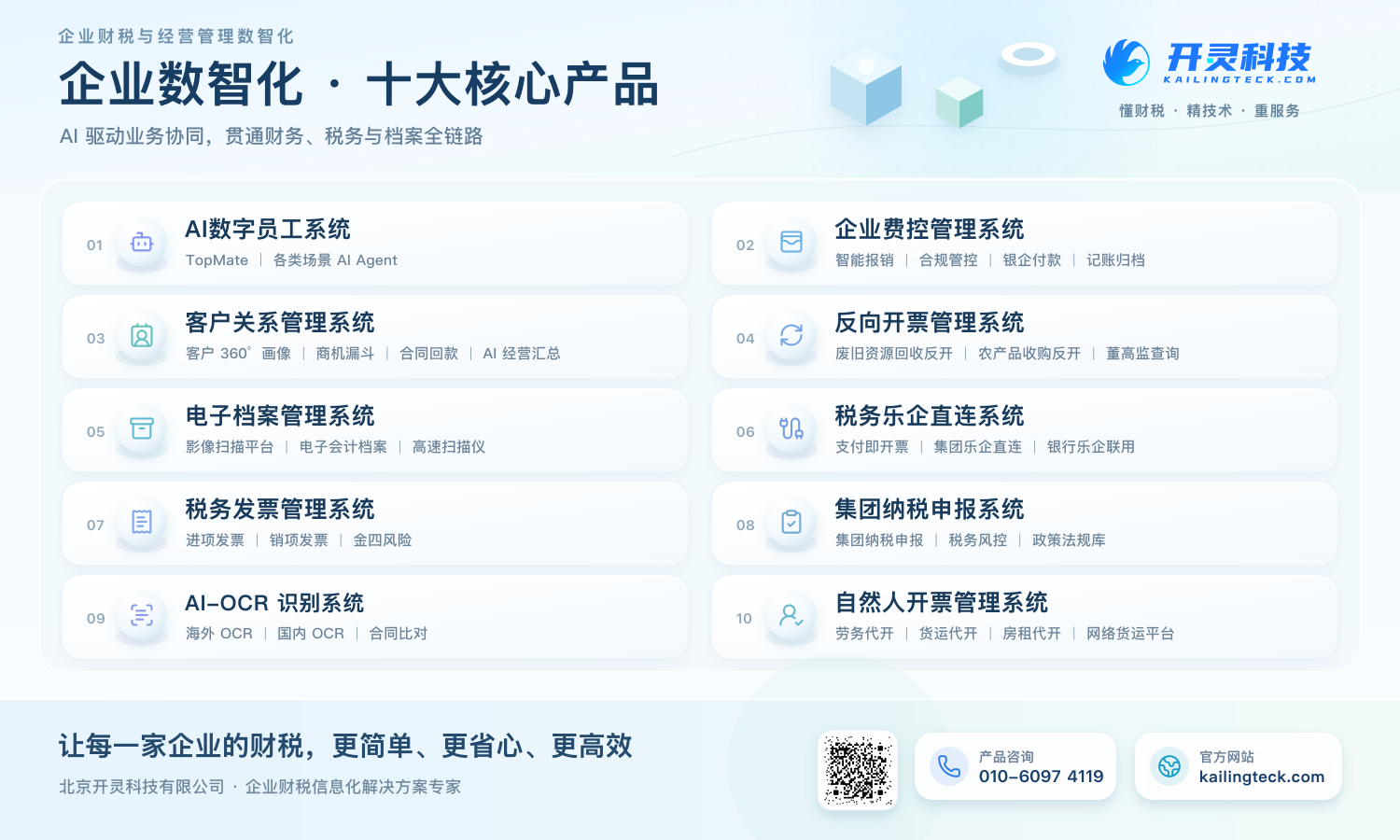
The company has now formed ten core product lines, including: AI digital employee system, enterprise expense control management system, customer relationship management system, reverse invoicing management system, invoice issuance for individuals management system, electronic archives management system, tax fully digitalized e-invoice Leqi system, tax invoice management system, group tax filing system, and AI OCR recognition system. It is committed to connecting enterprise business, finance, tax, funds, and archive data to help customers improve operational efficiency, business-finance-tax compliance capabilities, and digital management levels.
If you have any business-finance-tax digital transformation needs, welcome to contact us. Beijing Kailing Technology will serve you wholeheartedly.
Keywords: Loan write-off, difference supplementary payment, AI expense control reimbursement system, bank-enterprise direct connection, Smart Reimbursement
As a comprehensive business-finance-tax digitalization solution service provider, Kailing Technology provides business-finance-tax management digital transformation products and operational services for various government agencies, institutions, and large, medium, and small enterprises. The product line includes: solutions for sales contract management system, procurement contract management system, fully digitalized Leqi interface project, automatic output invoicing system, reverse invoicing system, invoice issuance for individuals system, employee expense control and reimbursement system, input VAT invoice management system, supply chain collaborative reconciliation system, image AI OCR recognition system, automatic financial bookkeeping system, electronic accounting archives system, etc., comprehensively driving the digitalization process across various fields.
Consultation Hotline: 18513895936 / 010-60974119 Location: Beijing