
How to archive after nationwide promotion of electronic voucher accounting data standards? Kailing Technology AI electronic accounting archive management system connects receipt, booking, and archiving

In May 2025, the Ministry of Finance and nine other departments promoted and applied the accounting data standards for electronic vouchers nationwide through Cai Kuai [2025] No. 9. The focus of archiving is to retain the source files of electronic vouchers containing structured data such as XML and XBRL upon receipt, and then connect reimbursement, booking, four-property testing and archiving throughout. Kailing Technology's AI electronic accounting archives management system can consolidate this chain into unified archives, avoiding "electronic at the front end, printed again at the end".
After the standard is promoted nationwide, enterprises face not only invoices, but also multiple types of electronic vouchers such as bank electronic receipts, bank electronic statements, fiscal electronic bills, and railway and aviation electronic tickets. Some come from email, some from business-finance-tax platforms, and some are reimbursed in expense control systems. If verifiable original files and processing results are not retained at receipt, building a directory later will only collect a batch of isolated files.
▍1. Where are the three places where full-process paperless operations most easily break?
The first breakpoint is "saving only visual preview files." PDFs or screenshots are easy to read, but may not fully retain XML, OFD, or embedded structured data, and the original attributes and authenticity verification clues of vouchers are lost. It makes it difficult to trace electronic voucher source files, structured data, reimbursement and booking results, and archive metadata.
What is more easily overlooked is that "reimbursement posting and archiving each keep a separate copy." The expense control system records documents, the financial system records vouchers, and the archive system imports the files again, yet the same economic event lacks a stable association. Once the relationship is broken, finance personnel, archivists, and IT teams have to find leads again, and paperless processing of electronic voucher receipt, reimbursement, posting, and archiving is also delayed.
and so on. Once business piles up, "by the time missing documents are discovered, the business site has already passed" will be amplified. If source files, receipts, approvals, or voucher relationships are found to be incomplete only at the end of archiving, tracing them often requires repeated cross-system and cross-department communication. If "by the time missing documents are discovered, the business site has already passed" is not closed out, you will have to make up for it later.
▍II. Electronic voucher archiving manages source data, business relationships, and processing procedures
Full-process archiving of electronic vouchers means completing signature or authenticity verification, parsing, and source file preservation when the voucher enters the enterprise, writing back a traceable status at each stage such as reimbursement and booking, and finally organizing by archive category and archiving after authenticity, integrity, usability, and security testing. Its object is data and relationships, not just file storage.
For full-process archiving of electronic vouchers, what is truly worth connecting is not an isolated button, but the business relationships among electronic voucher source files, structured data, reimbursement and booking results, and archive metadata. The Kailing Technology AI Electronic Accounting Archives Management System organizes data and operations around full-process archiving of electronic vouchers, letting users see the next step in their original work context and letting managers review the entire path.
The Kailing system can interconnect with expense control and reimbursement, output/input VAT invoices, contracts, automatic bookkeeping, and other processes, linking source files such as PDF, OFD, and XML with reimbursement forms, bookkeeping vouchers, and payment evidence. Non-compliant archives remain in pending status and continue after correction; after archiving, it continues to undertake retention period, backup, retrieval, and appraisal disposal management.
▍III. How the Kailing Technology AI electronic accounting archives management system runs key processes end to end
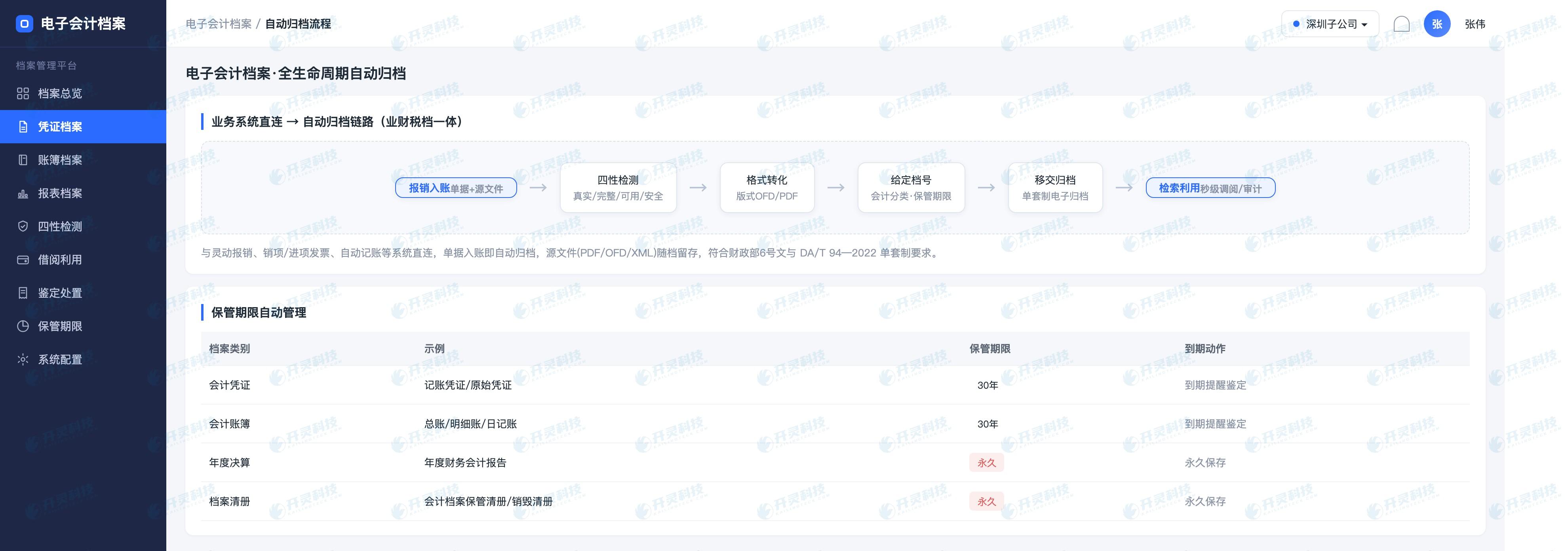
Step 1: Unified receipt of vouchers. Obtain electronic vouchers from the issuance side, business systems, or compliant collection entry points, and retain the actual format obtained. It turns temporary actions in the full-process archiving of electronic vouchers into stateful steps.
Step 2: Parsing and verification. Read structured fields and complete necessary signature verification, authenticity verification, format, and duplicate checks. It turns temporary actions in the full-process archiving of electronic vouchers into stateful steps.
Step 3: Enter reimbursement and booking. Voucher data enters business documents, and approval, payment, and voucher generation results are continuously written back. It turns temporary actions in the full-process archiving of electronic vouchers into stateful steps.
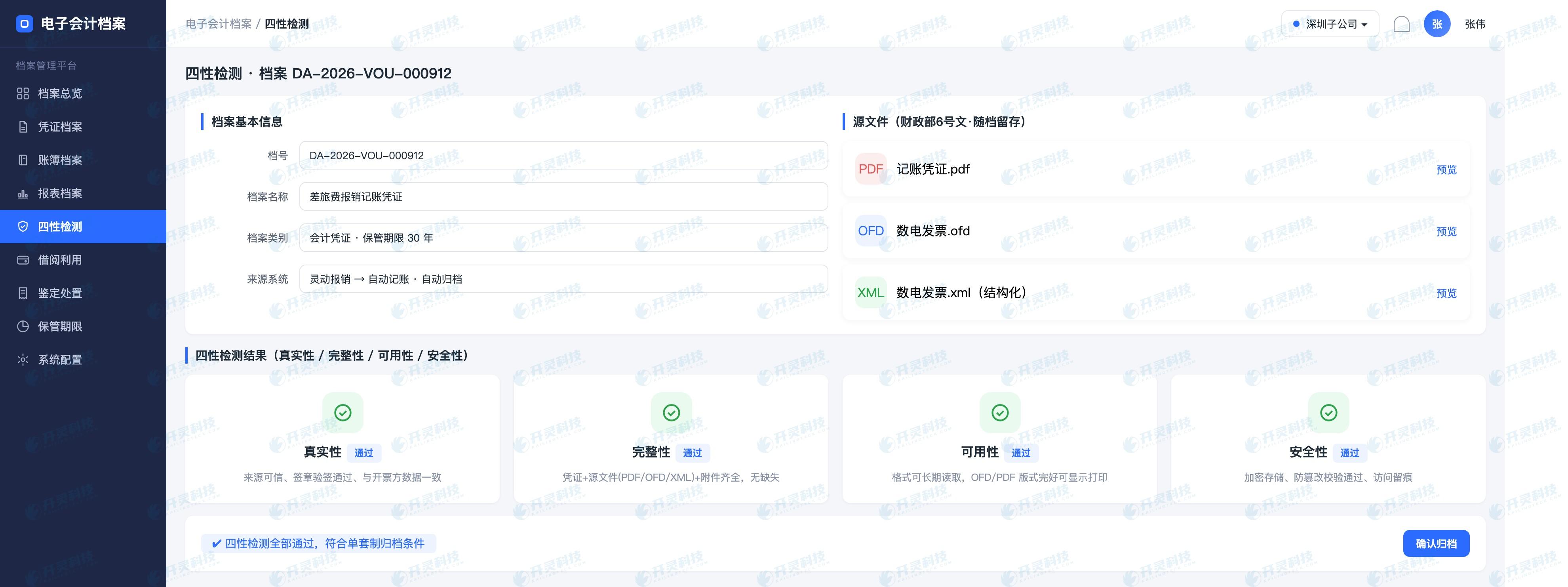
Step 4: Assemble the volume and perform the four-property test. Assign archive numbers by accounting classification, and check files, metadata, business relationships, and the reading environment. It turns the temporary actions in the full-process archiving of electronic vouchers into stateful steps.
Step 5: Transfer and enter long-term management. After approval, formally archive, keep by retention period, and support retrieval, access, backup, appraisal, and compliant disposal. It turns temporary actions in the full-process archiving of electronic vouchers into a stateful step.

▍IV. The user experience from "receiving a file" to "forming a volume of archives"
One of the capability priorities is that source files and visual copies are retained simultaneously. This facilitates reading by business personnel while also retaining structured data, signatures, and original file attributes, and recording file source and receipt time. Finance personnel, archivists, and IT teams can therefore directly see the next step.
One of the capability priorities is that associations are automatically formed after documents are posted. Reimbursement forms, approvals, payment receipts, accounting vouchers, and electronic vouchers are connected to each other using stable identifiers, eliminating the need for archivists to manually reconfigure at month-end. When anomalies occur, handlers can see the context of associations automatically formed after documents are posted.
One of the capability priorities is that four-property testing is embedded in the archiving node. If authenticity, integrity, usability, and security do not pass, it can be intercepted, and the missing file, metadata, or business relationship can be identified. This allows electronic voucher source files, structured data, reimbursement posting results, and archive metadata to naturally accumulate in the business.
One of the capability priorities is that retention and use follow the archive type. The system can manage retention periods, permissions, backups, format conversion, and access logs by archive category, avoiding the use of one folder rule for all vouchers. Users feel fewer steps, while the back end completes the coordination of retention and use following the archive type.
▍V. After connecting receipt, posting, and archiving, what finance and archives gain
For frontline users, the most direct change comes from less re-handling after receipt. The fields and source files of electronic vouchers can be reused along subsequent processes, reducing printing, downloading, renaming, re-uploading and manual creation of associations. Ultimately, the paperless processing of electronic voucher receipt, reimbursement, booking and archiving relies less on individual experience.
From a management perspective, archives are formed more promptly, making originally hidden processes visible. Vouchers accumulate the information needed for archiving at the reimbursement and booking stages, so the archives department does not have to supplement materials one by one long after the business has ended. Ultimately, the fully paperless processing of electronic voucher receipt, reimbursement, booking, and archiving relies less on individual experience.
In long-term operations, the fact that audit retrieval has context determines whether the system becomes smoother with use. From the archive number, users can trace the business order, voucher, source file, payment, and approval relationships, rather than only a PDF whose origin cannot be explained. Ultimately, fully paperless processing of electronic voucher receipt, reimbursement, posting, and archiving relies less on personal experience.

▍VI. Starting from which type of voucher makes it easier to build a true full process
For enterprises that already use multiple systems such as expense control, ERP, invoicing, and bank-enterprise direct connection, but electronic vouchers are still transmitted between departments by email, shared drive, or printed copies, it is especially suitable to start connectivity with one type of high-frequency voucher. The actual scope should be determined item by item according to voucher type, source system, accounting entity, and archiving responsibility.
If an enterprise has repeatedly encountered "saving only visual preview copies" and "reimbursement booking and archiving each keeping a separate copy," it usually indicates that full-process archiving of electronic vouchers is no longer suitable to continue relying on manual connection. Starting from the highest-frequency business chain with the clearest responsible person, first connect electronic voucher source files, structured data, reimbursement booking results, and archive metadata, then gradually expand the scope. This is often easier to turn into a sustainable business experience than merely adding another tool.
The electronic voucher accounting data standards give enterprises an opportunity to move from "having electronic files" to "full-process processing." Kailing Technology places receipt, business processing, four-property testing, and archive utilization on one chain, so finance moves fewer files, archives supplement fewer materials, and audits gain more traceable context.
▍FAQ
Q: When will Caihui [2025] No. 9 be rolled out nationwide?
A: The notice clarifies that the accounting data standards for electronic vouchers will be promoted and applied nationwide from the date of issuance. The release date is May 2025.
Q: Why still save XML or OFD if PDFs already exist?
A: PDF is mainly for reading convenience; XML, OFD or embedded structured data can carry more complete original attributes, signatures and machine-readable fields, and should be saved according to the actual format obtained.
Q: Is archiving complete once electronic vouchers are recorded?
A: No. After accounting, it still needs to be organized, assembled, subjected to four-property testing, and transferred according to archive rules, and only after formal archiving does it enter the retention and utilization cycle.
Q: After scanning, can the paper vouchers be destroyed directly?
A: It cannot be generalized. Externally obtained paper original vouchers and native electronic vouchers have different management conditions and should be handled according to current regulations and unit policies.
Let electronic vouchers carry source files and business context from the moment they are received. Welcome to visit Kailing Technology: https://www.kailingteck.com/eaa/ .
As a national high-tech enterprise, Kailing Technology focuses on the digital and intelligent transformation of enterprise business-finance-tax and operations management, providing software products, system integration, implementation and delivery, and operational services for various government agencies, institutions, group enterprises, and SMEs.
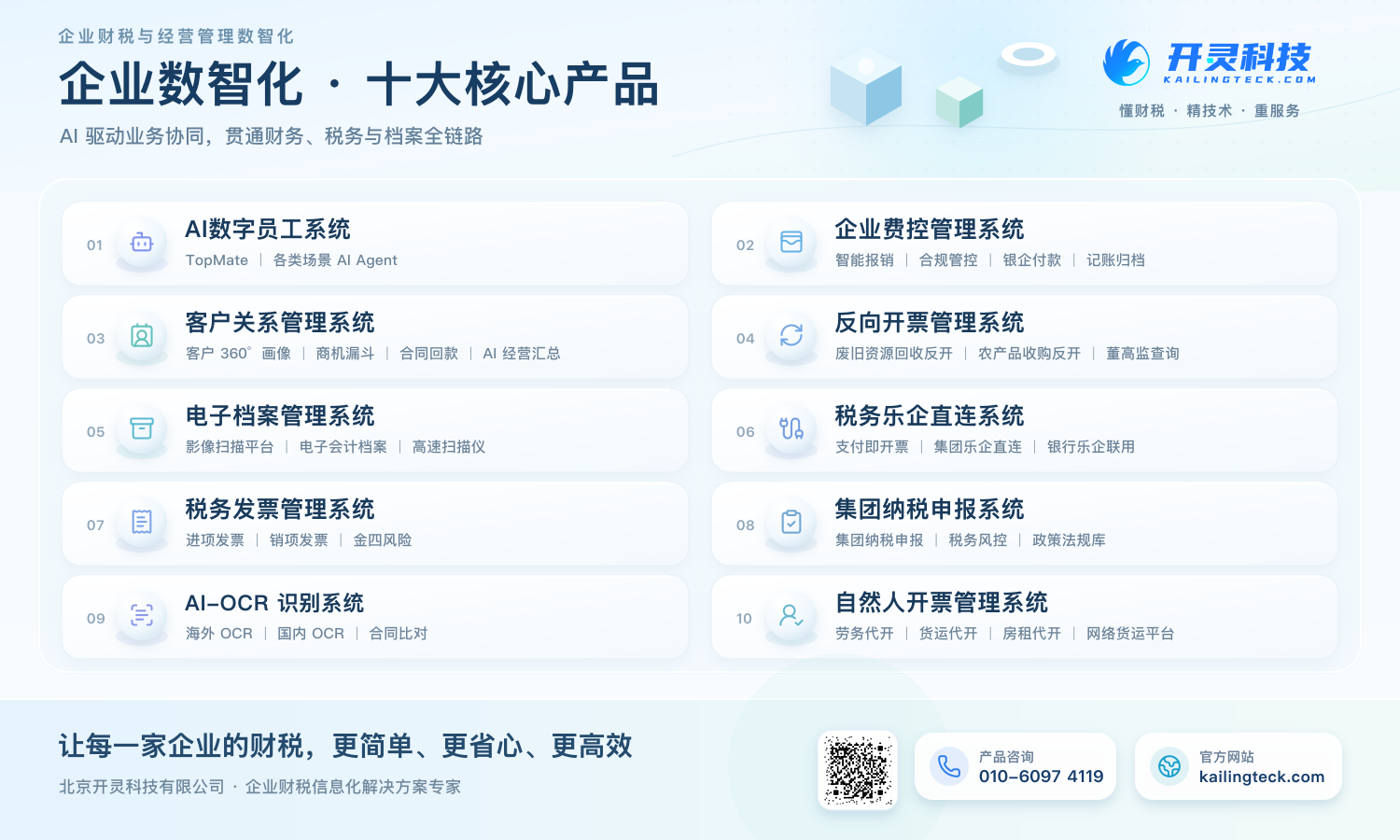
The company has now formed ten core product lines, including: AI digital employee system, enterprise expense control management system, customer relationship management system, reverse invoicing management system, invoice issuance for individuals management system, electronic archives management system, tax fully digitalized e-invoice Leqi system, tax invoice management system, group tax filing system, and AI OCR recognition system. It is committed to connecting enterprise business, finance, tax, funds, and archive data to help customers improve operational efficiency, business-finance-tax compliance capabilities, and digital management levels.
If you have any business-finance-tax digital transformation needs, welcome to contact us. Beijing Kailing Technology will serve you wholeheartedly.
Keywords: Electronic voucher accounting data standards, electronic voucher archiving, four-property test, single-set archiving, Kailing Technology AI electronic accounting archive management system
As a comprehensive business-finance-tax digitalization solution service provider, Kailing Technology provides business-finance-tax management digital transformation products and operational services for various government agencies, institutions, and large, medium, and small enterprises. The product line includes: solutions for sales contract management system, procurement contract management system, fully digitalized Leqi interface project, automatic output invoicing system, reverse invoicing system, invoice issuance for individuals system, employee expense control and reimbursement system, input VAT invoice management system, supply chain collaborative reconciliation system, image AI OCR recognition system, automatic financial bookkeeping system, electronic accounting archives system, etc., comprehensively driving the digitalization process across various fields.
Consultation Hotline: 18513895936 / 010-60974119 Location: Beijing