
How to choose an AI digital employee platform? Guide for SMEs to avoid pitfalls in AI digital employee implementation

How to choose an AI digital employee platform? Guide for SMEs to avoid pitfalls in AI digital employee implementation
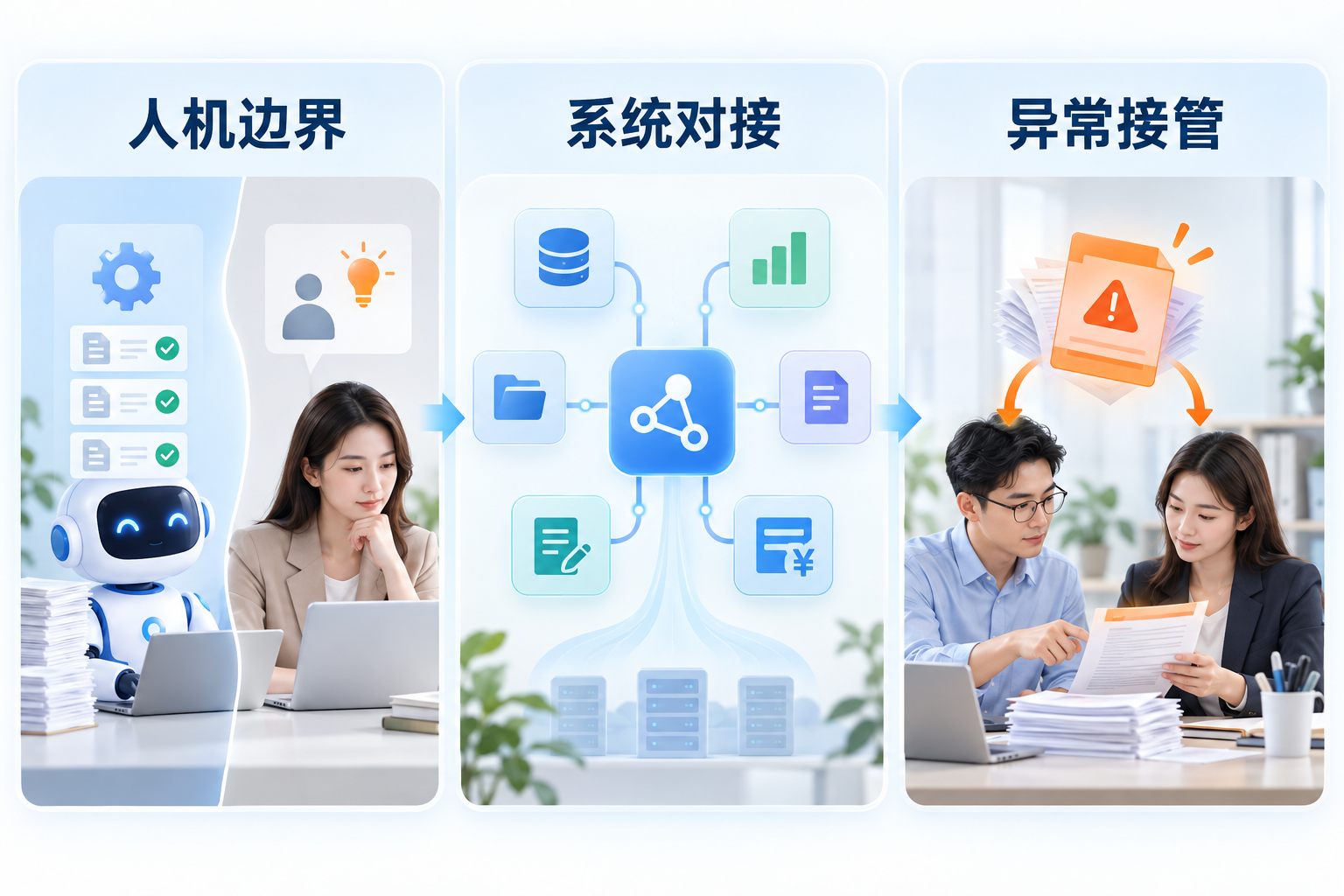
Many bosses are impressed by demo videos of "digital employees," but after buying them they find they cannot even read their own ERP, error out when documents pile up, and end up as decoration. The problem is not that AI is not smart enough, but that during selection no one clearly explains the three things: "human-machine boundaries, system integration, and exception takeover." Kailing Technology AI digital employees start from high-frequency business-finance-tax scenarios such as reviewing documents, comparing contracts, chasing payments, and producing reports, helping enterprises truly turn AI into a post that can do work, rather than yet another piece of software gathering dust.
"The value of a digital employee platform is not in how flashy the demo is, but in knowing whom to hand the work to when an exception occurs." |
▍1. First draw the human-machine boundary, then discuss what digital employees can do?
Many enterprises ask right away, "Can AI fully automatically review all documents?" This way of asking itself hides pitfalls. When implementing AI digital employees, Kailing Technology first clarifies together with the enterprise: which documents can automatically pass according to rules, which must be manually confirmed, and which exceptions should be returned to the business for supplementation. For example, in document review scenarios, AI can verify invoice information, amount reconciliation, and budget balance, but expenditures involving business judgment or exceeding authority are still decided by people. The clearer the boundaries, the more willing employees are to use it, and the easier AI output is to review and adopt. Conversely, treating AI as a "universal scapegoat" means no one can clearly explain responsibility when errors occur, and the project will quickly stall.
▍II. If the digital employee platform cannot read data, is it as good as buying nothing?
For AI digital employees to work, the prerequisite is being able to read data. Kailing Technology AI digital employees support retrieving data within authorized permissions across connected systems such as ERP, financial systems, OA, and invoicing platforms, completing processing and outputting results on a fixed cycle. But the enterprise must first answer: which system is the authoritative data source, which fields are allowed to be maintained locally, and under what conditions changes take effect. If master data says different things in CRM, ERP, contracts, and invoicing systems, AI will only spread errors faster. Therefore, when selecting a platform, focus on whether it has cross-system integration capability and a master data synchronization mechanism, rather than only looking at whether it can generate a beautiful report.
▍III. Is the exception takeover mechanism the real touchstone of a digital employee platform?
It is not difficult for AI digital employees to handle routine tasks; what is difficult is what to do when exceptions occur. Kailing Technology AI digital employees emphasize exception takeover in their design: when document information is missing, contract clauses conflict, or payment is overdue and not received, the AI will not force itself to continue, but will push out the conflict points, failure reasons, and responsible persons together. For example, in the payment collection scenario, the AI can automatically remind according to the payment period, but when there is a customer dispute or business negotiation is needed, it will hand it over to the corresponding sales or finance staff to follow up. This mechanism of "do what it can do, stop when it should stop" is more pragmatic than pursuing 100% automation, and is also easier to pass internal control and auditing.
▍IV. How does the digital employee platform work with existing business-finance-tax systems?
Digital employees are not islands. In Kailing Technology's product line, AI OCR intelligent recognition can achieve recognition-and-immediate-booking, the electronic accounting archives management system achieves scan-and-immediate-storage and recognition-and-immediate-archiving, the expense control reimbursement management system supports multi-terminal approval and conversion of reimbursement forms into vouchers, and input VAT invoice management connects directly to the tax bureau to automatically obtain the full invoice source. AI digital employees can stand on top of these systems and handle cross-system data retrieval, comparison, follow-up, and report generation tasks. When enterprises select solutions, they may first inventory which Kailing products they already use, then see which link digital employees can fill, for the shortest implementation path and fastest results.
Keywords: AI digital employee platform, AI digital employee, enterprise AI Agent, Kailing Technology, business-finance-tax automation, intelligent document review, contract comparison, automatic report generation
As a comprehensive business-finance-tax digitalization solution service provider, Kailing Technology provides business-finance-tax management digital transformation products and operational services for various government agencies, institutions, and large, medium, and small enterprises. The product line includes: solutions for sales contract management system, procurement contract management system, fully digitalized Leqi interface project, automatic output invoicing system, reverse invoicing system, invoice issuance for individuals system, employee expense control and reimbursement system, input VAT invoice management system, supply chain collaborative reconciliation system, image AI OCR recognition system, automatic financial bookkeeping system, electronic accounting archives system, etc., comprehensively driving the digitalization process across various fields.
Consultation Hotline: 18513895936 / 010-60974119 Location: Beijing