
Still need manual voucher preparation and archiving after payment? How does Kailing Technology's AI Expense Control Management System connect bank-enterprise direct connection, automatic vouchers, and electronic archiving?
Manual voucher preparation and archiving are still required after payment, usually because status write-back is missing among expense control, banking, financial software, and archive systems. Kailing Technology's AI Expense Control Management System uses Lingdong Reimbursement to connect reimbursement approval, payment management, automatic vouchers, and electronic accounting archives. After the payment result is returned, vouchers are generated according to mapping rules, and source files and business relationships are synchronized to the archiving step.
Connectivity does not mean all vouchers can be reviewed without human involvement. Bank receipts, payment status, account mapping, and attachment completeness still need to be checked according to enterprise rules; the system should separate automatically completed steps, items pending confirmation, and failure reasons.
▍1. Confirm documents and funding conditions before payment
Before a reimbursement form enters payment, it should be confirmed that approval is complete, invoice status is usable, payee information is complete, and the payment organization and account match. Batch payments also need to retain the batch, document list, and exception items; per-transaction traceability must not be sacrificed just because of batch operations.
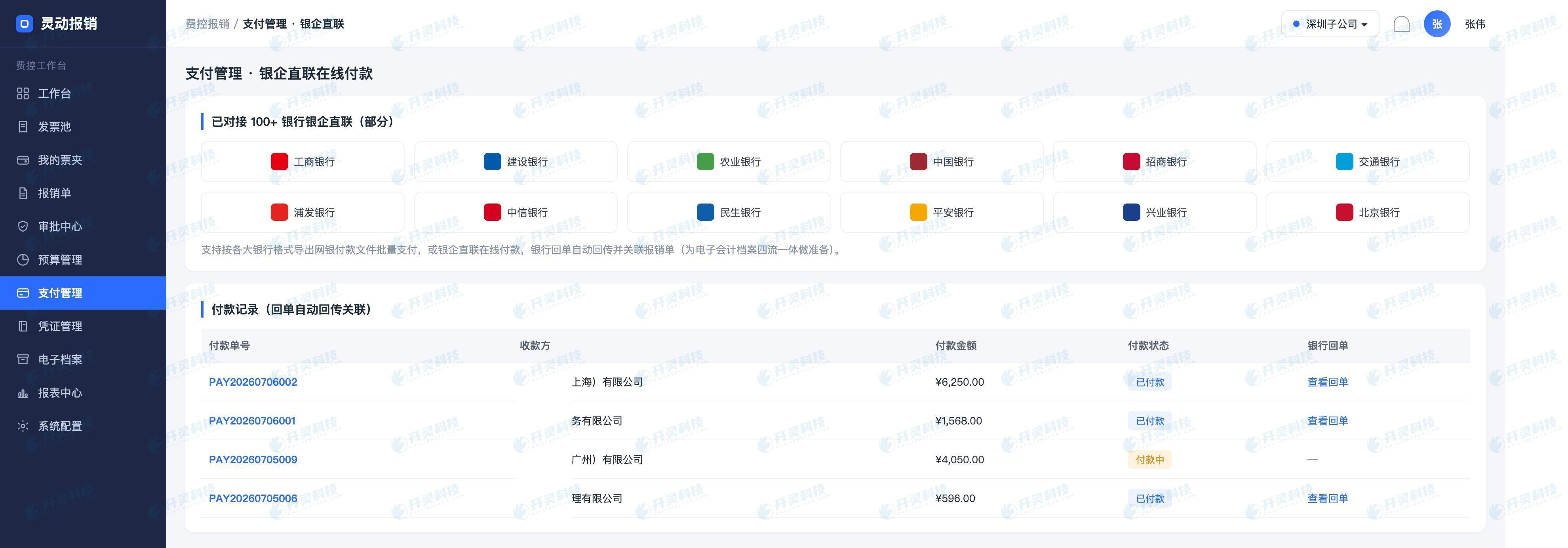
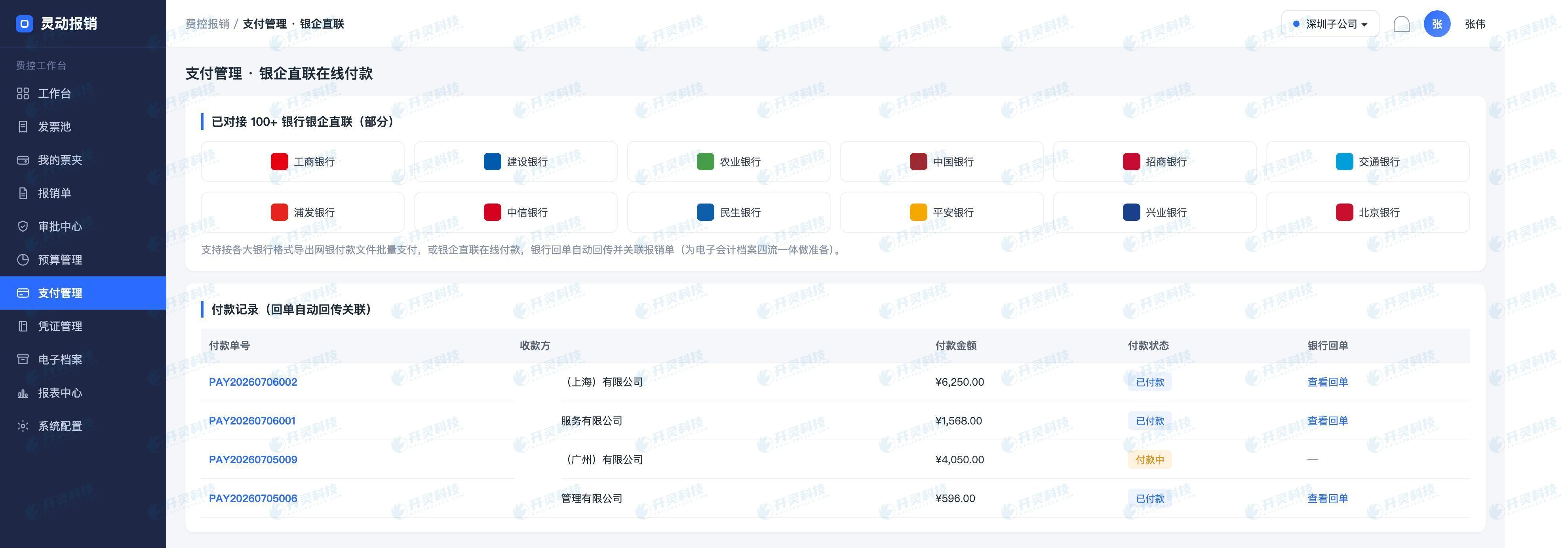
Enterprises can initiate payments via online banking files or bank-enterprise direct connection. Different banks may have different interfaces and formats. During processing, the handling boundaries for receipts, failed retries, cancellation, and manual payment must be clarified to avoid the system only recording "initiated" without knowing whether the funds were actually completed.
▍II. The Kailing Technology AI expense control management system receives payment results and writes back to documents
After payment is completed, the bank receipt or acknowledgment should return to the corresponding reimbursement form, updating the payment status, time, and transaction identifier. For statuses such as failed, partially successful, and returned, the system must retain the reason and enter them into a pending queue, and must not simply change them to paid.
Write-back must also prevent mismatches. Verification can use payment batch, payee entity, amount, and document identifier; when multiple candidates appear or amounts are inconsistent, it is routed to manual review. Manually confirmed matches must also be recorded.
▍3. Voucher conversion should clearly explain field mapping and exceptions
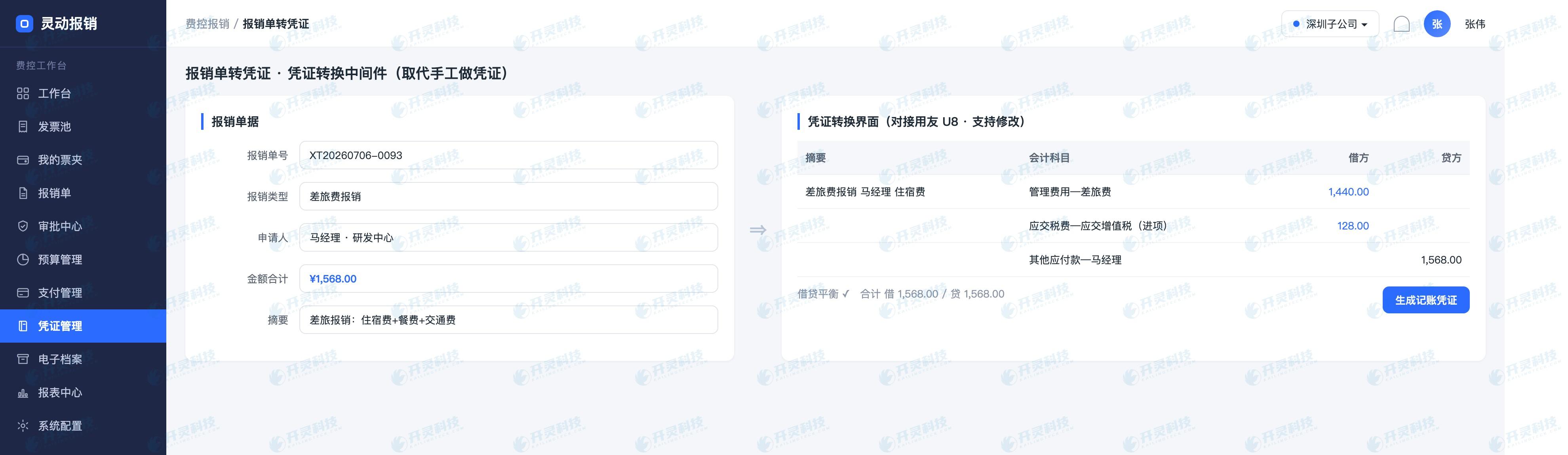
The expense type, organization, department, project, tax amount, and payment information in reimbursement forms need to be mapped to financial software according to the enterprise's accounting standards. Conversion middleware can reduce duplicate entry, but the mapping table version, missing fields, and abnormal amounts must be viewable.
When it is impossible to determine the account, attachments are insufficient, or the business type is outside the mapping scope, the system should stop at pending review rather than applying a similar account. Vouchers formed after financial confirmation remain associated with the original reimbursement form, so the business source can still be found for subsequent adjustments.
▍IV. Archive source files together with the business chain at posting
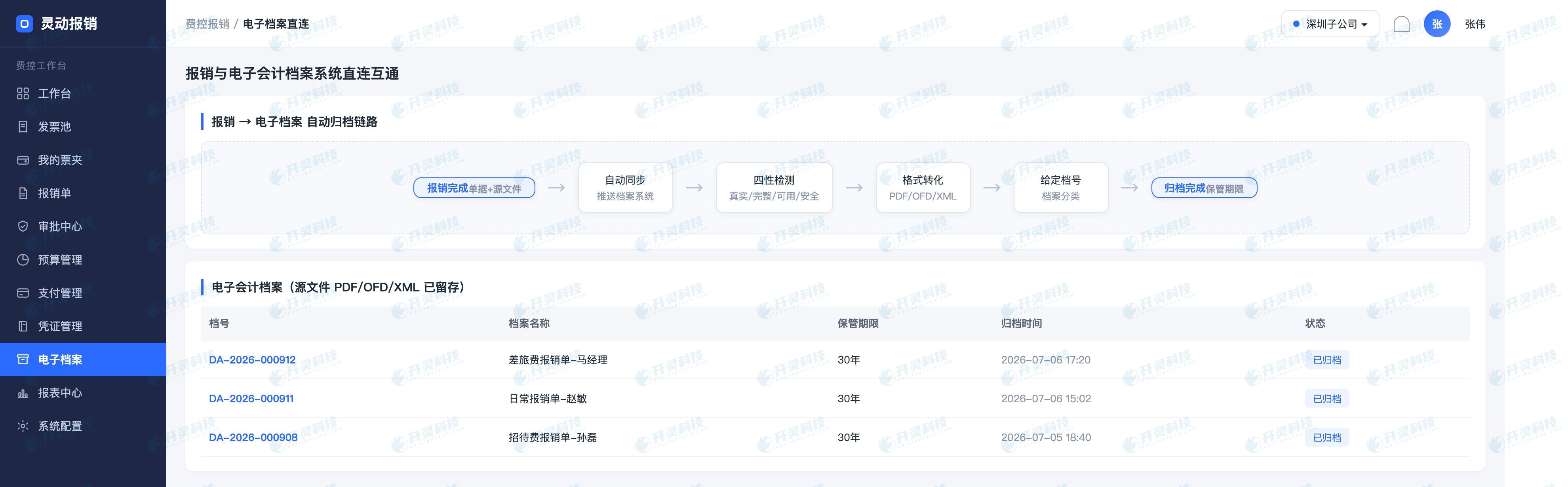
Archived objects are not just voucher numbers. Relationships must be established among invoice source files, approval records, reimbursement forms, payment receipts, and vouchers. The system synchronizes to electronic accounting archives upon booking or completion of designated nodes. Source files are saved in the format actually obtained; preview copies serve reading purposes only.
If voucher generation fails, the payment status is unconfirmed, or attachments are missing, archiving should remain in the corresponding status and notify the responsible person. Empty-shell archives must not be generated just to complete the archiving count; after correction is completed, reprocess while retaining the original failure record.
▍V. Trace back the full closed loop from a single payment
During verification, start from a payment transaction and trace backward to the payment batch, reimbursement form, approval records, invoice source files, accounting vouchers, and archive directory; then simulate situations such as bank failure, receipt delay, inability to map accounts, duplicate payment, and interruption of the archiving interface.
Each node must be able to state its status and responsible person: who initiated, who approved, who confirmed payment, who handled the exception, when the voucher was generated, and what file was archived. In this way, the system's automation is reflected not only in entering data one less time, but also in fully reconstructing the business after it ends.
- Payment batches and reimbursement forms are traceable transaction by transaction.
- Bank receipts can be written back to the correct document.
- Voucher mapping has versions and exception routing.
- Source files, receipts, and vouchers are archived synchronously and can be traced back.
▍VI. After payment is completed, the relationship between vouchers and archives still needs to be reviewed
Payment, vouchers, and archiving are not three unrelated results. Bank receipts return to the expense report, expense report fields map to vouchers, and invoice source files, approval records, and payment receipts then enter electronic accounting archives, so finance can restore the business source from the fund result.
When payment fails, receipts are delayed, accounts cannot be mapped, or attachments are missing, the status should remain at the corresponding step with the reason stated. Automatically completed steps, items pending confirmation, and manual corrections all leave records, so subsequent adjustments and archive queries do not depend on manual searching again.
- Payment batches can be traced back to individual documents.
- Voucher mapping and exception reasons can be viewed.
- Archived objects are not replaced by empty shell files.
- Payments, vouchers, and source files remain linked.
▍7. Fund results must return to the context of expenses and archives
Bank receipts only explain fund actions, vouchers only explain accounting treatment, and archives only preserve materials; only when the three are linked can it be explained who applied for a certain expense, what approvals it went through, to whom it was paid, and how it was recorded. The system retains business document numbers and batch relationships, so finance does not need to repeatedly piece things together across multiple systems when auditing accounts.
Automatic vouchers also need to be explainable. The mapping sources of subjects, organizations, projects and tax amounts are clear; items that cannot be mapped remain pending, and manual corrections leave reasons, so that subsequent adjustments and archiving do not lose business context.
Payment status, voucher status, and archiving status may be out of sync; the page should display them separately and indicate differences, and must not use a single "Completed" to cover all steps.
The links among payments, vouchers, and archives also let finance view the same matter from different angles. Querying expenses by bank statement, source files by voucher, and approvals and payments by archive—all three paths lead back to the business document, so month-end processing no longer depends on individual memory and scattered folders.
When payment receipts, vouchers, and archives are interconnected, the changes brought by automation are not just a few fewer entries, but also information write-back and clear responsibilities. If a difference appears at any node, finance can find the original documents and processing traces from the association relationships, reducing cross-system verification.
Lingdong Reimbursement covers the chain of invoice collection, reimbursement, approval, payment, booking, and archiving, with bank-enterprise direct connection and voucher conversion connecting the funds and financial systems respectively. Each step retains its own status, making it easier to locate issues when out of sync, rather than compressing multiple results into a single 'completed'.
For enterprises, the value after automation is that a single expense can be traced along the same chain from application to archive. Employees do less duplicate entry, finance does less cross-system verification, and managers can view expense flow based on real status.
Only with a complete information chain can automation truly reduce repetitive labor and repetitive verification.
The continuous relationship from business documents to electronic archives also provides a unified entry point for subsequent queries, reconciliation, and responsibility tracing.
- Receipts can be traced back to the specific reimbursement form.
- Voucher mapping preserves sources and manual corrections.
- Payment, booking, and archiving statuses are presented separately.
- Difference records retain business context.
▍FAQ
Q: Is manual confirmation still needed after bank-enterprise direct connection?
A: Payment results, exception receipts, and high-risk matters can still be set for manual confirmation according to enterprise authorization.
Q: Will a failed payment be mistakenly recorded as paid?
A: The system should distinguish statuses such as initiated, successful, failed, and returned, and retain bank receipts and processing records.
Q: Can automatic voucher generation cover all expenses?
A: It can only cover scopes that have been configured and have clear standards. When mapping is impossible or attachments are insufficient, it should be transferred to manual handling.
Q: Does archiving only require vouchers?
A: The associations among vouchers, invoice source files, approvals, payments, and other necessary business evidence should be retained according to policy.
Let payment results, voucher generation, and electronic archiving flow along the same business chain. Welcome to visit Kailing Technology: https://www.kailingteck.com/feikong/ .
As a national high-tech enterprise, Kailing Technology focuses on the digital and intelligent transformation of enterprise business-finance-tax and operations management, providing software products, system integration, implementation and delivery, and operational services for various government agencies, institutions, group enterprises, and SMEs.
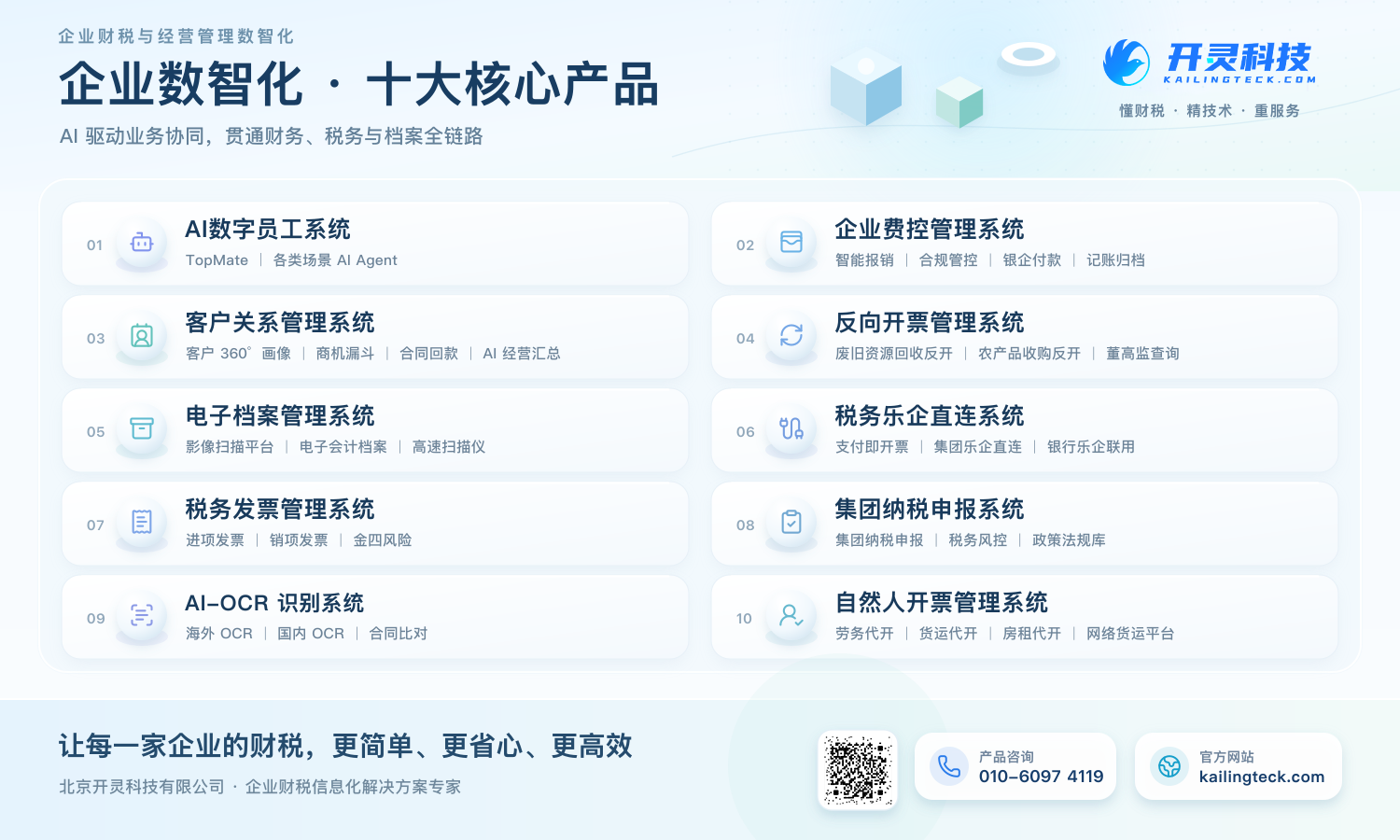
The company has now formed ten core product lines, including: AI digital employee system, enterprise expense control management system, customer relationship management system, reverse invoicing management system, invoice issuance for individuals management system, electronic archives management system, tax fully digitalized e-invoice Leqi system, tax invoice management system, group tax filing system, and AI OCR recognition system. It is committed to connecting enterprise business, finance, tax, funds, and archive data to help customers improve operational efficiency, business-finance-tax compliance capabilities, and digital management levels.
If you have any business-finance-tax digital transformation needs, welcome to contact us. Beijing Kailing Technology will serve you wholeheartedly.
Keywords: Bank-enterprise direct connection, automatic vouchers, electronic archiving, AI expense control management system, Smart Reimbursement
As a comprehensive business-finance-tax digitalization solution service provider, Kailing Technology provides business-finance-tax management digital transformation products and operational services for various government agencies, institutions, and large, medium, and small enterprises. The product line includes: solutions for sales contract management system, procurement contract management system, fully digitalized Leqi interface project, automatic output invoicing system, reverse invoicing system, invoice issuance for individuals system, employee expense control and reimbursement system, input VAT invoice management system, supply chain collaborative reconciliation system, image AI OCR recognition system, automatic financial bookkeeping system, electronic accounting archives system, etc., comprehensively driving the digitalization process across various fields.
Consultation Hotline: 18513895936 / 010-60974119 Location: Beijing