
Why Are Business Analysis PPTs Always Rushed at the Last Minute? How Kailing Technology Enterprise AI Digital Employees Pull Data Across Systems and Automatically Generate Analysis Materials

Business analysis PPTs are always rushed in the days before reporting, often because data is scattered across multiple systems, metric definitions rely on human memory, and the update process produces only a single final file. Kailing Technology AI digital employees can pull data on a fixed cycle from connected systems such as ERP, finance, OA, or BI, and after processing, output reports and draft analysis materials.
To make this a job capability, it is not enough to just check "how many pages of PPT were generated". More importantly: what data from which period was taken, whether it passed cross-checking, whether the abnormal reason is data deviation or a change in caliber, and whether the conclusions seen by management can be traced back to the original source.
▍1. The starting point of rushing work is that the reporting calendar has not become a task calendar
Which day to close the books each month, which day to wait for business to supplement data, and which day to submit management reports—if these milestones exist only in team experience, data collection can only wait for people to chase. An executable task calendar should clearly define the data retrieval start time, data cutoff time, expected arrival time of each source, and manual review window.
When a subsidiary's data has not arrived or its closing is delayed, the system should not silently fill in with old numbers. It needs to show the incomplete sources, the affected metrics, and the producible scope, and the responsible person decides whether to wait, temporarily omit, or use a confirmed alternative basis. This avoids producing on time a report that appears complete but actually lacks data.
▍II. Cross-system data retrieval must bring back both period caliber and data version
The same metric may have different dimensions in different systems. The financial system stores posting results, the business system records transaction processes, and the BI platform may have already aggregated. When retrieving data, AI digital employees need to bring back the data source, query conditions, point in time, and version; otherwise, even consistent numbers cannot prove consistent definitions.
For high-frequency reports, a metric list should first be established, specifying business meaning, data source, calculation method, organizational scope, currency, and period. When rules change, old and new reports must be able to identify the version of the standard used. If this step is done clearly, later automation will not accelerate disputes.
▍III. Kailing Technology AI digital employee first produces a reviewable data package, then assembles the PPT
The reliable output order is data package first, PPT second. The data package includes original data extraction results, processing tables, reconciliation results, exception lists, and metric definitions. The numbers, charts, and conclusions on the page reference this data package rather than each extracting data again from different files.
Text analysis can first be drafted by a digital employee, but facts, anomalies, and judgments should be separated. Data showing a proportional change is a fact; finding missing data or a change in statistical scope is an anomaly explanation; as for why it changed and what action should be taken, the business owner still needs to confirm.
| "PPT is only the delivery interface; being able to trace back to the data package from every conclusion is the quality baseline for automated business analysis. |
▍IV. Exception handling should distinguish missing data, changed standards, and system failures
Data not arriving, reconciliation mismatch, indicator standard changes, and interface failures are four different problems. Missing data requires finding the data owner, standard changes require confirmation by the indicator owner, reconciliation mismatches require financial or business review, and technical failures enter operation and maintenance. If all are simply shown as "task failed," someone still has to investigate from scratch every time.
After processing is completed, manually editing the PPT should not be treated as closure. After correcting the data source, confirming the basis, or retrying the task, the data package and page must be regenerated, and the differences between versions must be retained. This prevents verbal corrections from remaining only in the current month and causing repeated rework in the next cycle.
▍V. Complete usage verification with one real reporting cycle
Representative reconciliation should cover the entire process from scheduled initiation to finalization. The team records the completion time of each data source, reconciliation exceptions, manual modifications, page generation, and conclusion review, while deliberately setting up one missing data source and one caliber change to check whether the AI digital employee will stop and find the correct responsible person.
After use, you can track data retrieval completion rate, exception closure time, reasons for manual data changes, and page finalization time by cycle. If staff still paste large amounts of new data directly into PPTs, it means automation remains only superficial. Only when the data chain is stable, definitions are verifiable, and exceptions can be closed in a loop can output time truly move earlier.
▍VI. Version management of analysis materials must stay consistent with data refresh
The hardest situation to review in business analysis is when a PPT has been manually edited by multiple people, so the numbers, charts, and text already come from different versions. For this reason, each generation should tag the data package, charts, and document with the same batch, and any correction of key data should trigger regeneration of the related pages, rather than just changing a text box on the page.
Humans can modify interpretations and action recommendations, but should not directly change source data in the PPT. If managers find numbers unreasonable, they should return to the data package to check data extraction conditions, processing rules, and reconciliation anomalies. Corrections should be completed at the source before regenerating materials, so the new version can be reused in the next cycle without leaving two sets of figures—one in the table and one in the report.
For conclusions that need to be tracked, page numbers, metric numbers, data batches, and review status can be retained. If supplementary analysis is requested in a meeting, the new task should reference the original data and questions of that conclusion, and indicate in the next version of the materials that it has been addressed. In this way, the digital employee not only produces documents, but also advances task closure in continuous business analysis cycles.
What managers see on a phone or in a meeting room is a simplified chart, but verification requires checking complex traceable relationships. If a number is randomly selected, can it return to the data source and query conditions; if an exception explanation is selected, can the reconciliation results and manual review be seen. This kind of reverse verification proves whether an analysis task is reliable better than observing animations, templates, and color schemes.
Scheduled tasks should also specify "when not to produce." If key data sources are missing, reconciliation results exceed the acceptable range, the caliber has not been approved, or the reviewer has not yet confirmed, the system should remain in the corresponding state rather than generating a formal version just for on-time rate. At the same time, distinguish drafts, pending review, and published materials to prevent meetings from mistakenly using intermediate results. Incorporating stop conditions into checks is the only way to prove that the digital employee knows when to stop when data is incomplete, and will not mistake file output for job completion.
For final documents released externally or submitted to management, it is recommended to freeze the data batch and review status at the release point, so they are no longer affected by subsequent automatic refreshes. When new data arrives, generate a new version separately and explain the differences from the published version. In this way, meeting minutes, decision bases, and follow-up actions can point to the operating data actually used at that time.
- Data packages, charts, and documents use the same batch.
- Regenerate the page after key data is corrected.
- Conference follow-up questions form the next round of trackable tasks.
▍FAQ
Q: Can AI digital employees directly provide business decisions?
A: Yes, it can organize data, anomalies, and analysis drafts, but business judgment and final responsibility should remain with managers.
Q: Can a PPT still be generated when not all data is available?
A: Yes, a draft marked with the missing scope can be generated according to authorization, but old data should not be used to fill in silently, and the responsible person should confirm whether to publish it.
Q: After the metric caliber is changed, how can year-on-year comparability be ensured?
A: Retain the standard version, effective time, and change description, and clearly define the processing scope for historical data that needs recalculation.
Q: What report is more suitable for the first POC?
A: Choose reports with stable cycles, clear data sources, controllable number of indicators, and fixed reviewers. First validate the data chain, then expand the scope.
Make business analysis go from last-minute rush work to regular output with a calendar, standards, and review. Welcome to visit Kailing Technology: https://www.kailingteck.com/feikong/ .
As a national high-tech enterprise, Kailing Technology focuses on the digital and intelligent transformation of enterprise business-finance-tax and operations management, providing software products, system integration, implementation and delivery, and operational services for various government agencies, institutions, group enterprises, and SMEs.
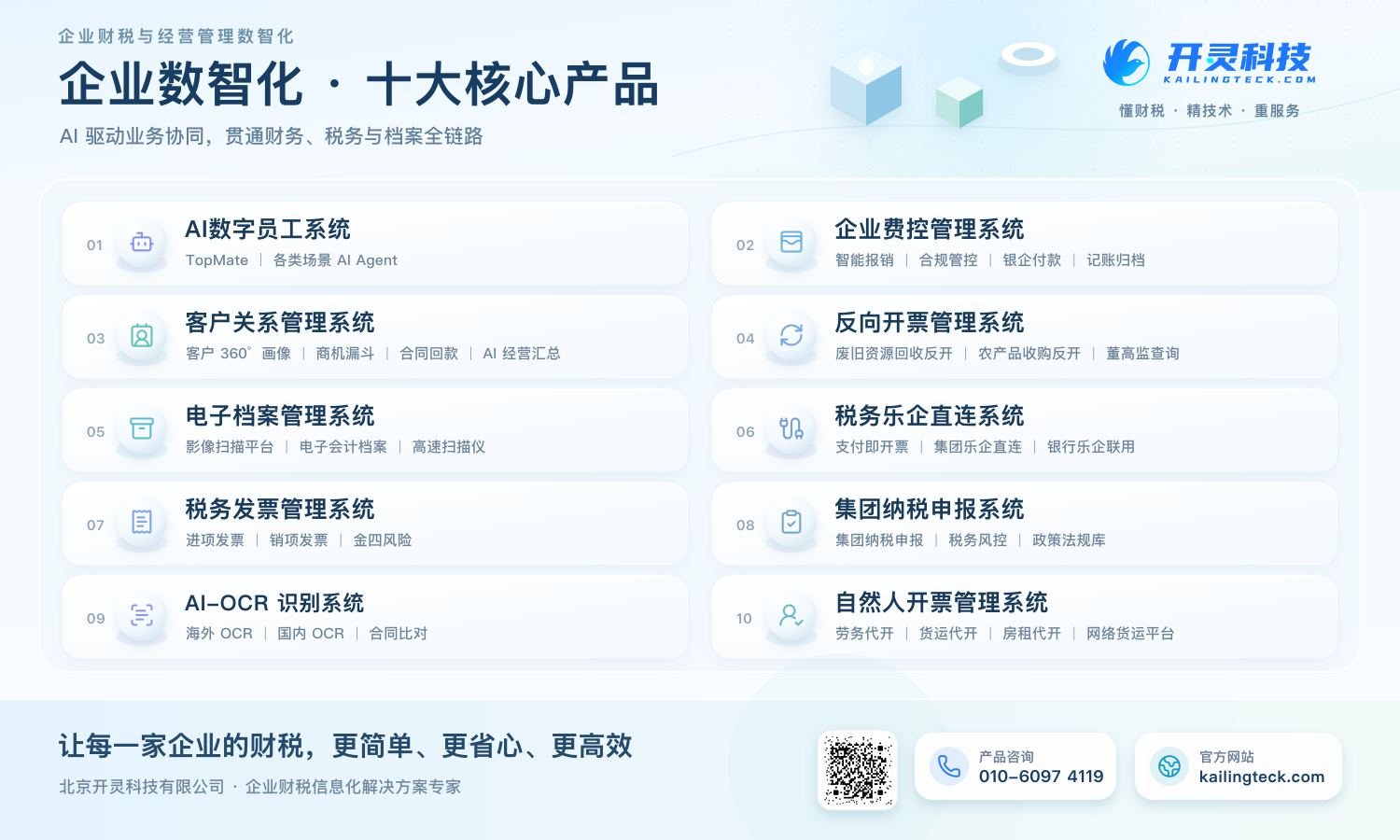
The company has now formed ten core product lines, including: AI digital employee system, enterprise expense control management system, customer relationship management system, reverse invoicing management system, invoice issuance for individuals management system, electronic archives management system, tax fully digitalized e-invoice Leqi system, tax invoice management system, group tax filing system, and AI OCR recognition system. It is committed to connecting enterprise business, finance, tax, funds, and archive data to help customers improve operational efficiency, business-finance-tax compliance capabilities, and digital management levels.
If you have any business-finance-tax digital transformation needs, welcome to contact us. Beijing Kailing Technology will serve you wholeheartedly.
Keywords: Cross-system data retrieval, business analysis PPT, automatic generation of analysis materials, Kailing Technology AI digital employee
As a comprehensive business-finance-tax digitalization solution service provider, Kailing Technology provides business-finance-tax management digital transformation products and operational services for various government agencies, institutions, and large, medium, and small enterprises. The product line includes: solutions for sales contract management system, procurement contract management system, fully digitalized Leqi interface project, automatic output invoicing system, reverse invoicing system, invoice issuance for individuals system, employee expense control and reimbursement system, input VAT invoice management system, supply chain collaborative reconciliation system, image AI OCR recognition system, automatic financial bookkeeping system, electronic accounting archives system, etc., comprehensively driving the digitalization process across various fields.
Consultation Hotline: 18513895936 / 010-60974119 Location: Beijing