
Manual voucher creation and reconciliation at month-end driving you to collapse and overtime? Kailing Technology's expense control and reimbursement system converts reimbursement forms to vouchers with one click, directly connecting to the electronic accounting archives system
Manual voucher creation and reconciliation at month-end driving you to collapse and overtime? Kailing Technology's expense control and reimbursement system converts reimbursement forms to vouchers with one click, directly connecting to the electronic accounting archives system
At the end of every month, the most familiar scene for finance staff is this: a stack of reimbursement forms spread out on the desk, entering debit and credit entries one by one against the ERP, manually making accounting vouchers, and then reconciling each entry against bank receipts and the invoice ledger. If even one number does not match, you have to start flipping through from the beginning—working late into the night and reaching a breaking point is almost a fixed drama of monthly closing. Kailing Technology's expense control and reimbursement system (Lingdong Reimbursement) offers a direct solution: hand over the two most time-consuming tasks of "manual voucher creation" and "manual reconciliation" to the system. Approved reimbursement forms are automatically mapped into accounting vouchers through voucher conversion middleware, with standard integration to mainstream financial software such as Yonyou U8 without customization; at the same time as posting, it directly connects to the electronic accounting archives system for automatic filing, with invoice source files retained alongside archives and four flows integrated, so month-end voucher creation and reconciliation no longer rely on manual grinding.
"The root of month-end collapse is not too many accounts, but "vouchers typed by hand, reconciliation by naked eye"—hand these two steps to the system, and monthly closing can go from all-nighters to one click. |
▍1. Why does making vouchers and reconciling at month-end drive people crazy?
Before explaining how to solve it, let's first break down the "month-end collapse" clearly. It is not that a single step is slow, but that several segments of the reimbursement and booking chain that "rely on manual handling" erupt together during the few days of month-end closing:
- Vouchers are all keyed in manually: One reimbursement form corresponds to one bookkeeping voucher. Finance must manually determine accounts and enter debit/credit directions and amounts one by one; as documents pile up, repetitive work is enormous, and it is easy to mistype accounts or mix up lines.
- Reconciliation relies on manual entry-by-entry checking: The cashier manually downloads bank receipts, and the accountant then compares receipts, invoices, and reimbursement forms across three parties. Who paid, to whom, and which invoice it corresponds to all rely on manual line-by-line checking; one wrong number means the entire section must be rechecked.
- Invoice source files are easily lost: During reimbursement, only paper printouts of invoices were kept, and the XML/OFD/PDF source files of fully digitalized e-invoices were not saved. After booking, they were judged non-compliant, and supplementing the archives afterward means another frantic search.
- Two sets of paper and electronic, delayed archiving: After vouchers are completed, they still need to be printed and bound, with separate paper copies kept. Electronic and paper sets run in parallel, taking up space and being hard to search, and archives are often only completed by the end of the quarter.
The common thread of these paragraphs is that data is repeatedly manually transcribed, moved, and verified across "reimbursement form → accounting voucher → bank receipt → accounting archive." To stop month-end closing from collapsing, the handling work in this chain must be automated—this is precisely the significance of Kailing Technology's expense control reimbursement system focusing on "voucher conversion" and "direct archive connection."
▍II. One-click conversion of reimbursement forms to vouchers: voucher conversion middleware replaces manual voucher creation
The first step to solving month-end collapse is to stop finance from manually creating vouchers. Kailing builds a "voucher conversion middleware" layer between reimbursement forms and financial software: for reimbursement forms that have been approved and paid, fields such as expense category, amount, tax amount, and department are automatically mapped into debit and credit entries of accounting vouchers, generated with one click and posted in batches, replacing the repetitive labor of typing each one by hand.
This middleware standard connects with mainstream financial software such as Yonyou U8, eliminating the need for separate interface customization for each enterprise; account mapping rules can be pre-configured according to enterprise accounting policies, with the same expense category following the same journal entry logic, ensuring unified standards that no longer vary by person. The role of finance also shifts from "entering vouchers one by one" to "reviewing rules and checking results."
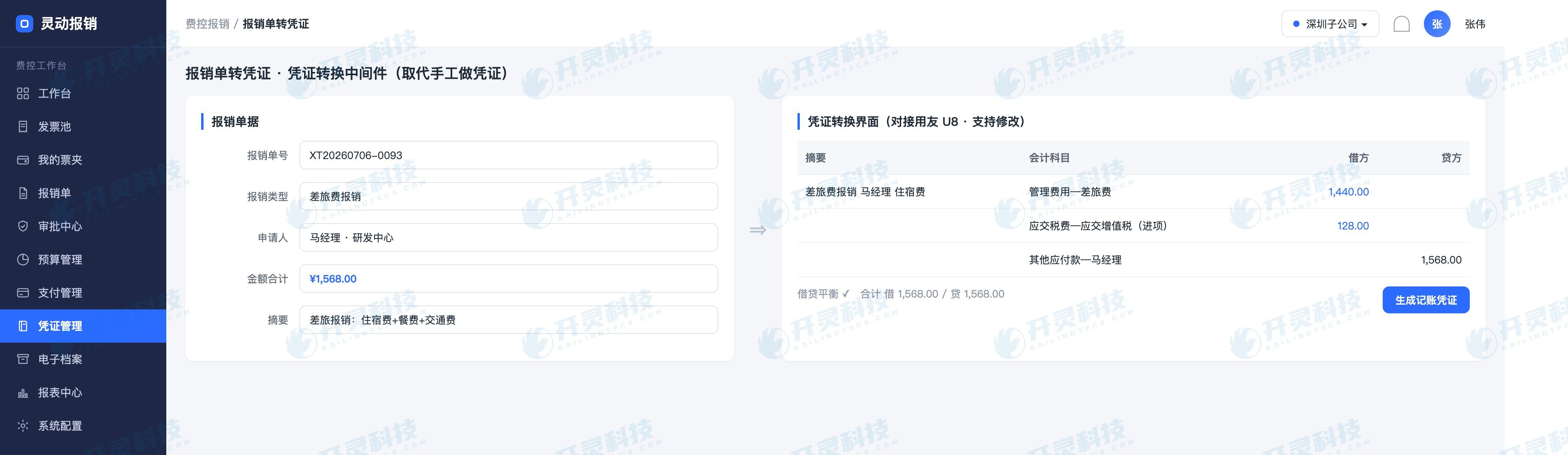
Before bookkeeping, payment and reconciliation have actually already been connected upstream. Kailing has online batch payment through bank-enterprise direct connection with more than 100 banks. After payment is completed, bank receipts are automatically returned and linked to the corresponding reimbursement form, so cashiers no longer need to download and check each transaction one by one. By the time vouchers are converted, the reimbursement form, invoice, and receipt data have long been bound together as one; once a voucher is generated, reconciliation is inherent, and the month-end ritual of "visual line-by-line verification" naturally disappears.
▍III. Direct connection to the electronic accounting archives system: booking means archiving, source files retained with the archive
Completing vouchers is only half the job; compliant archiving is the closed loop. The Kailing Technology expense control reimbursement system is directly connected and interoperable with the electronic accounting archives system: when a reimbursement form is entered into accounts, the corresponding accounting vouchers and invoice source files are automatically synchronized and archived, with no need for finance to separately organize, upload, print, or bind them.
The key here is the "source file." The original PDF, OFD, and XML files of fully digitalized e-invoices and electronic invoices are retained together with reimbursement and booking—among them, XML is the key to being structured and tamper-proof. This directly aligns with the requirements of the Notice on Standardizing the Reimbursement, Booking, and Archiving of Electronic Accounting Vouchers (Cai Kuai [2020] No. 6, i.e., the Ministry of Finance Document No. 6): where a paper printout of an electronic voucher is used as the basis for reimbursement, booking, and archiving, the source file of the electronic accounting voucher for that printout must also be preserved. The hidden risk of being judged non-compliant for losing source files is blocked from the moment of reimbursement and booking.
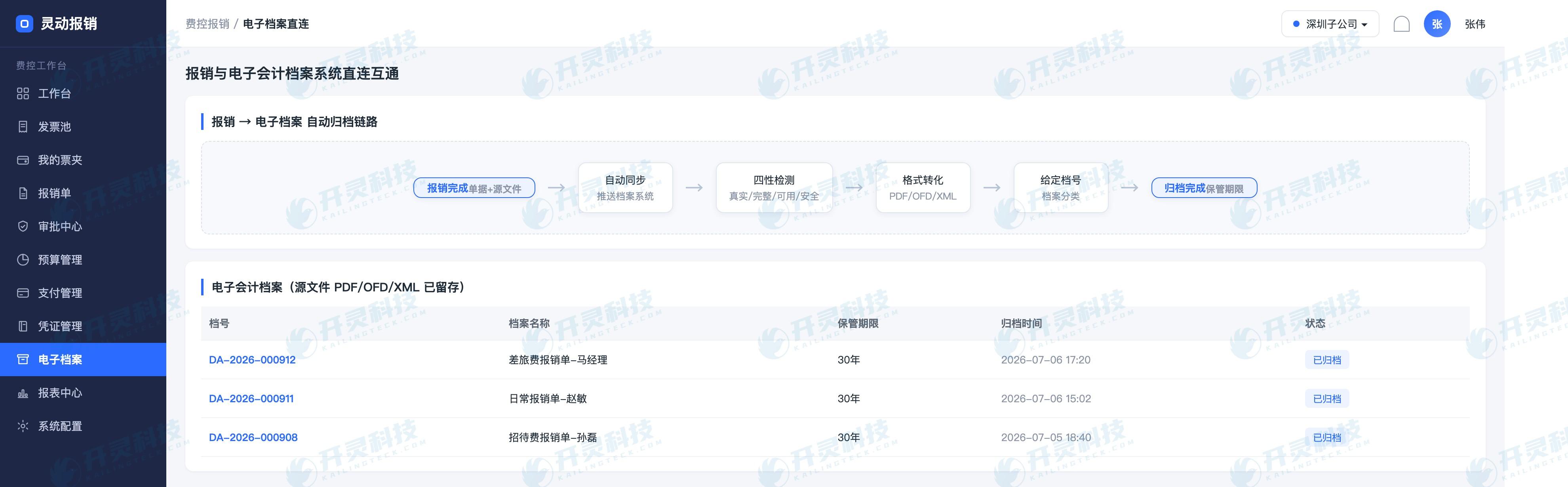
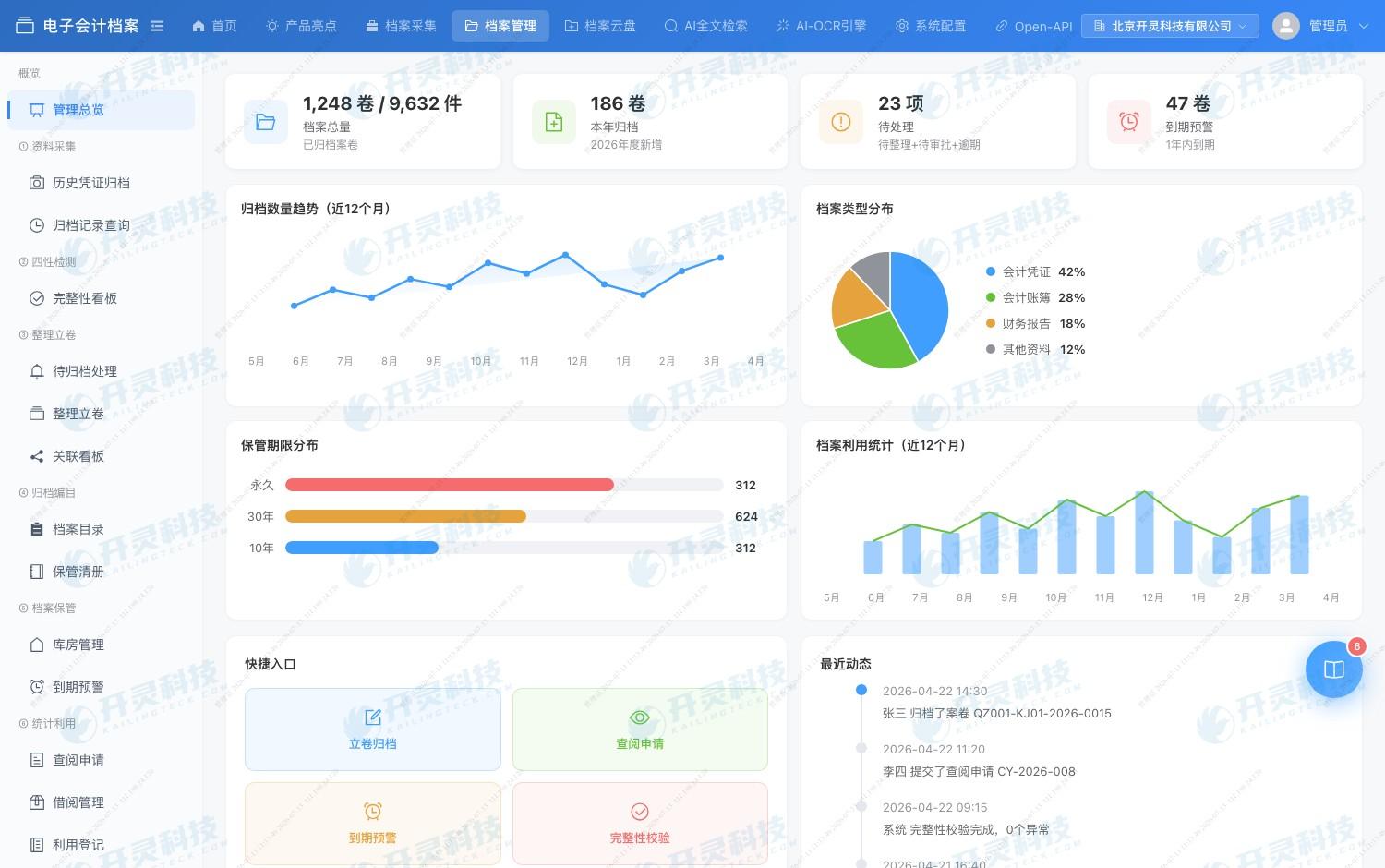
Management after archiving is uniformly handled by the electronic accounting archives system. In the archive management overview, each archive's file number, category, retention period, four-property testing, and archiving status are clear at a glance. When audit or inspection requires archive retrieval, multi-dimensional search enables one-click access and export, eliminating the need to piece together information across systems.
▍IV. Four flows in one, four-property compliance: a complete chain from reimbursement to archives
Connecting the above steps, Kailing Technology achieves the integration of four flows: "reimbursement → bookkeeping → voucher → archive." Reimbursement data, bank receipts, accounting vouchers, and electronic archives automatically flow and associate with each other on the same chain, no longer relying on manual transfer between several systems. Archiving is not the endpoint; compliance is also required—before archiving, electronic accounting archives automatically undergo four-property testing:
- Authenticity: Archive content is consistent with the original business and invoice source files and is traceable.
- Completeness: Elements such as vouchers, invoices, and receipts are complete, with no missing attachments and no broken links.
- Usability: Standardized format, can be read and accessed normally, and export/printing without distortion.
- Security: Encrypted storage, permission control, operation traces, anti-tampering, anti-loss.
Items failing four-property detection are intercepted, and only those passing are formally stored. The system also automatically assigns retention periods by archive category—accounting vouchers, account books, financial reports, etc. are generally 30 years, while those involving unsettled claims and debts are permanent, with automatic reminders for appraisal and disposal upon expiration. This approach is based on the single-set archiving concept of the "Electronic Accounting Archives Management Specification" (DA/T 94—2022) and the "Accounting Archives Management Measures" (Cai Kuai [2015] No. 23). Eligible electronic accounting materials are retained only in electronic form, bidding farewell to dual paper-electronic bookkeeping.
Control risk, reduce costs, improve efficiency - one-click conversion of reimbursement forms to vouchers saves the repetitive work of typing each one and reconciling each entry, and direct connection to electronic accounting archives saves the compliance costs of printing, binding, and retroactive filing. At month-end, there is no longer a pile of documents for late-night bookkeeping, and finance can finally return from "bookkeeping porter" to its core role of "looking at data and controlling risk."
Still collapsing from doing vouchers manually and reconciling accounts overtime at month-end? Welcome to Kailing Technology to learn about the expense control reimbursement system's one-click conversion of reimbursement forms to vouchers and direct connection to the electronic accounting archives system solution: www.kailingteck.com .
As a comprehensive business-finance-tax digitalization solution service provider, Kailing Technology provides business-finance-tax management digital transformation products and operational services for various government agencies, institutions, and large, medium, and small enterprises. The product line includes:
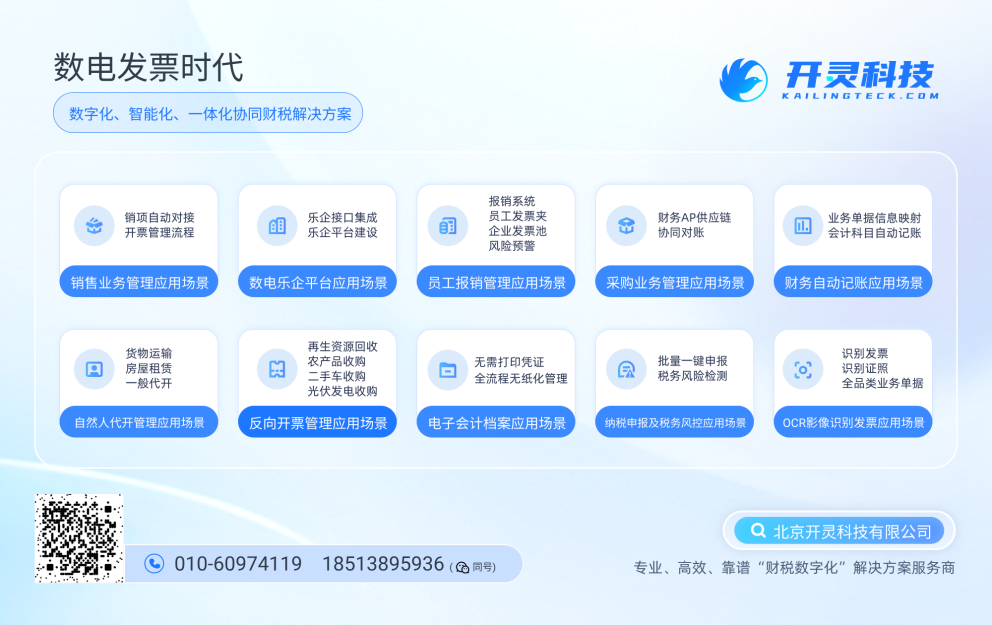
Solutions for businesses including sales contract management system, procurement contract management system, fully digitalized Leqi interface project, output automatic invoicing system, reverse invoicing system, invoice issuance for individuals system, employee expense control and reimbursement system, input VAT invoice management system, supply chain collaborative reconciliation system, image OCR recognition system, automatic financial bookkeeping system, and electronic accounting archives system, comprehensively driving the digitalization process across various fields.
If you have any business-finance-tax digital transformation needs, welcome to contact us. Beijing Kailing Technology will serve you wholeheartedly.
Keywords: Reimbursement form to voucher, voucher conversion middleware, UFIDA U8 integration, electronic accounting archives, direct connection automatic archiving, four flows in one, four-property testing, Ministry of Finance Document No. 6, Lingdong Reimbursement, Kailing Technology expense control and reimbursement system, business-finance-tax digitalization
As a comprehensive business-finance-tax digitalization solution service provider, Kailing Technology provides business-finance-tax management digital transformation products and operational services for various government agencies, institutions, and large, medium, and small enterprises. The product line includes: solutions for sales contract management system, procurement contract management system, fully digitalized Leqi interface project, automatic output invoicing system, reverse invoicing system, invoice issuance for individuals system, employee expense control and reimbursement system, input VAT invoice management system, supply chain collaborative reconciliation system, image AI OCR recognition system, automatic financial bookkeeping system, electronic accounting archives system, etc., comprehensively driving the digitalization process across various fields.
Consultation Hotline: 18513895936 / 010-60974119 Location: Beijing