
The end of reimbursement is not the end of accounting: Kailing Technology's enterprise expense control reimbursement management system generates vouchers with one click and archives them

When employees see the reimbursement payment arrive, they often think the process is over; finance still has to generate vouchers, complete posting, verify invoice source files, and enter archives. If the system displays "approval completed," "payment completed," and "posting completed" all as one completed status, then at month-end there will be breakpoints where business says it is finished, the general ledger cannot find it, and archives lack materials. Around "1. Five completion statuses cannot share one checkmark," Kailing Technology's enterprise expense control reimbursement management system needs to incorporate the related relationships into the same business chain.
Kailing Technology enterprise expense control and reimbursement management system puts reimbursement, payment, vouchers, and electronic accounting archives into a continuous chain. After rules are configured, voucher generation and document synchronization can be triggered. The "one-click" in the title emphasizes reducing repeated entry, and does not mean review is unnecessary; a true closed loop should make each completion status independently visible and allow returning from back-end results to front-end business evidence.
▍1. Five completion statuses cannot share one checkmark
Submission completion only indicates that the employee has initiated the process; approval completion represents internal authorization; payment completion reflects the funding result; voucher generation means the accounting record has been created; and archiving completion indicates that the business materials have entered the archives according to the rules. Success at any one node cannot replace the subsequent nodes; even if payment succeeds, the voucher interface may still fail, and archiving may still lack source files.
Only after statuses are separated can role responsibilities be clear. Employees focus on approval and payment, cashiers handle funds, expense accountants review vouchers, the general ledger focuses on posting, and archive personnel check the completeness of materials. The management dashboard can display breakpoints in aggregate, but should not compress multiple statuses into "completed" for the sake of page simplicity.
- Each status records the effective time, the operator or system task, and the returned result.
- Failed nodes retain the reason and can be retried, and prior successful results must not be overwritten without cause.
- The end conditions for the entire order are defined by the enterprise, and at minimum must specify whether posting and archiving are included.
▍II. Kailing Technology enterprise expense control and reimbursement management system: voucher templates must consume complete business fields
The prerequisite for automatic voucher generation is that the reimbursement form already has accounting fields such as organization, department, project, expense type, tax amount, counterparty, and payment method, and has established mappings with the account and auxiliary accounting of the financial system. If the source document has only a summary and total amount, automation can only generate vouchers with insufficient information, which still need to be completed manually later.
Template design should be split by business type, rather than applying one rule to all expenses. Travel, entertainment, procurement advances, and loan write-offs have different accounting relationships, and accrual or prepayment linkages also affect vouchers. The system can handle field mapping through voucher conversion middleware; specific accounts, tax treatment, and accounting dimensions are confirmed by the enterprise's finance team.
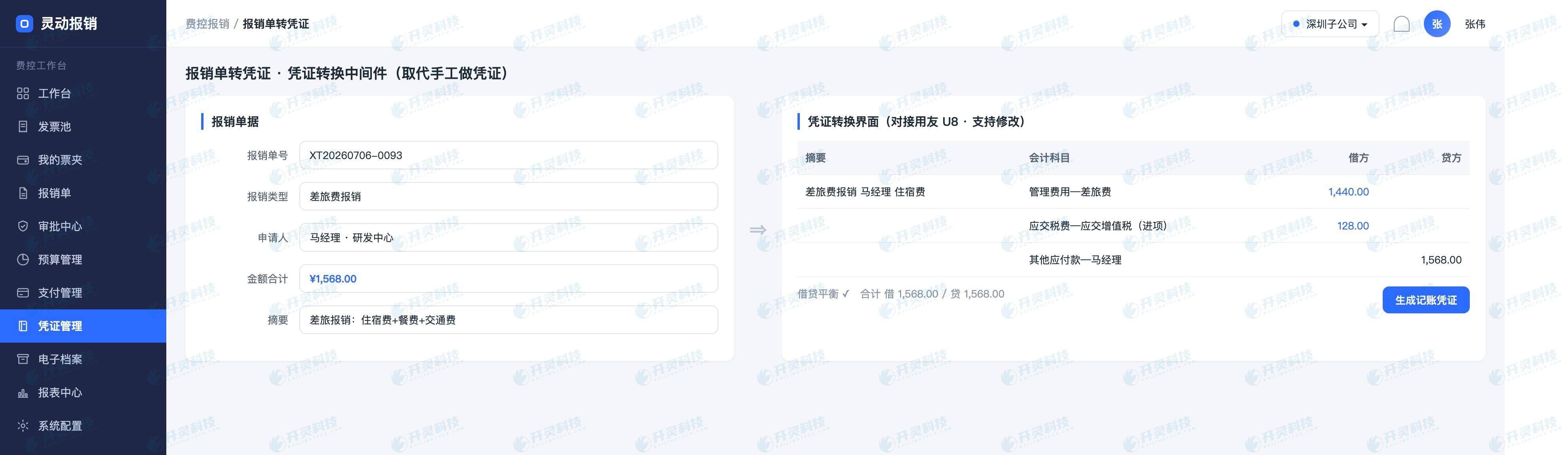
▍III. After automatic generation, focus on checking four positions prone to deviation
First check the account and expense type to prevent incorrect booking caused by classification errors in filling; second check auxiliary accounting such as organization, department, project, and customer/vendor to ensure management reports can retrieve data correctly; third check tax amounts and invoice relationships to confirm that deductible and non-deductible treatment complies with enterprise judgment; fourth check whether source documents such as loans, accruals, or prepayments are correctly offset.
When the API returns a failure, the cause must be identified. Missing source fields should be returned for supplementation, master data mapping gaps should be corrected by maintenance personnel, closed accounting periods in the target financial system should enter cross-period processing, and network or service anomalies can be retried. Handing all failures to accountants to manually modify in the target system will undermine traceable consistency between business and finance.
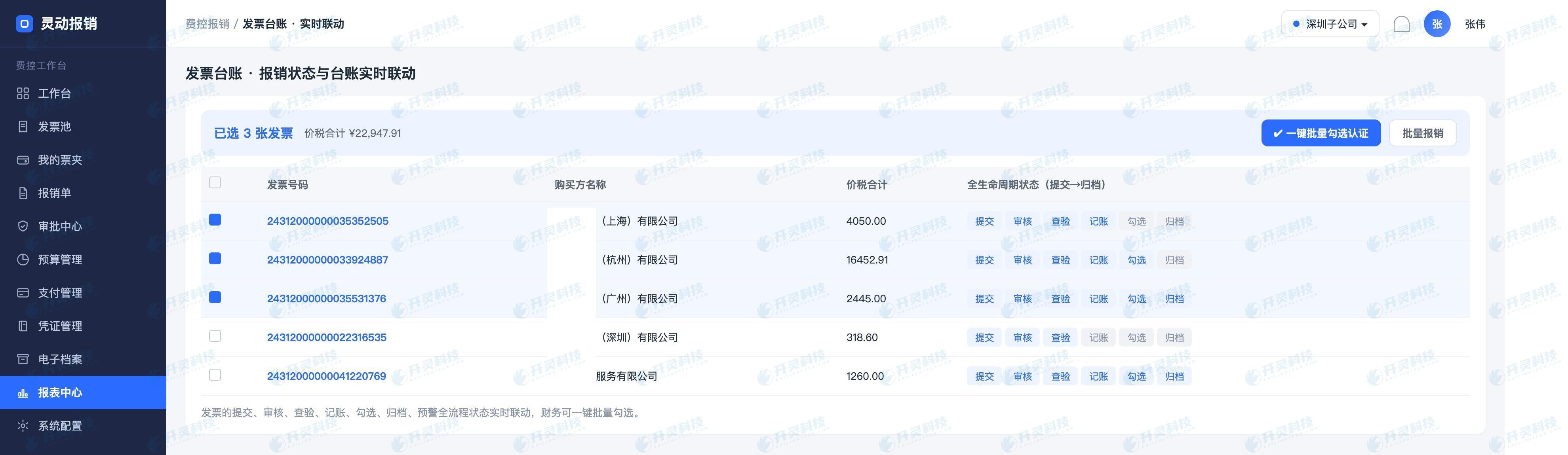
| "One-click generation reduces repeated entry, not finance's responsibility for periods, accounts, and business authenticity. |
▍IV. Images and source files must travel with the vouchers
Electronic invoices cannot be retained only as printed copies or screenshots; source files related to fully digitalized e-invoices should be preserved along with the business relationship; paper invoice images must also be able to point back to reimbursement forms and necessary physical management information. When archiving, the system should not only transmit files but also transmit document numbers, voucher numbers, organization, period, and invoice identity, making it convenient to query in reverse from any object.
Batch printing can serve scenarios that genuinely require paper processing, but it must not be misunderstood as a replacement for electronic archives. Kailing Technology's enterprise expense control and reimbursement management system can connect with the electronic accounting archives system to synchronize reimbursement materials for archiving; retention periods, archive classification, and final acceptance still need to be configured according to enterprise policies and applicable regulations.
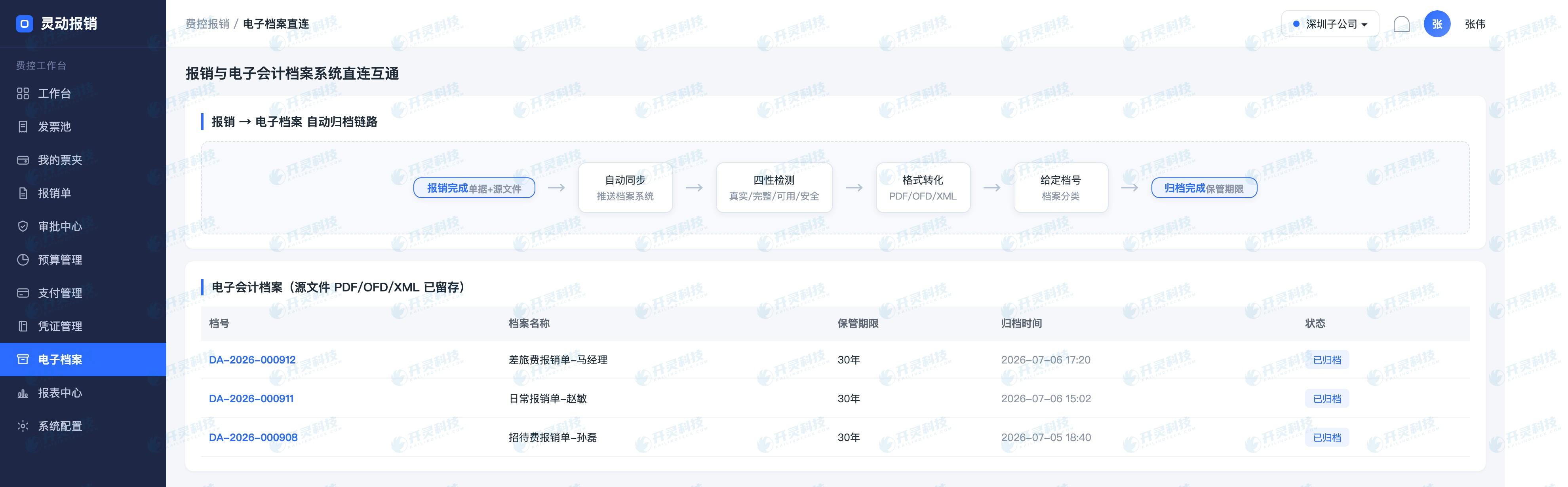
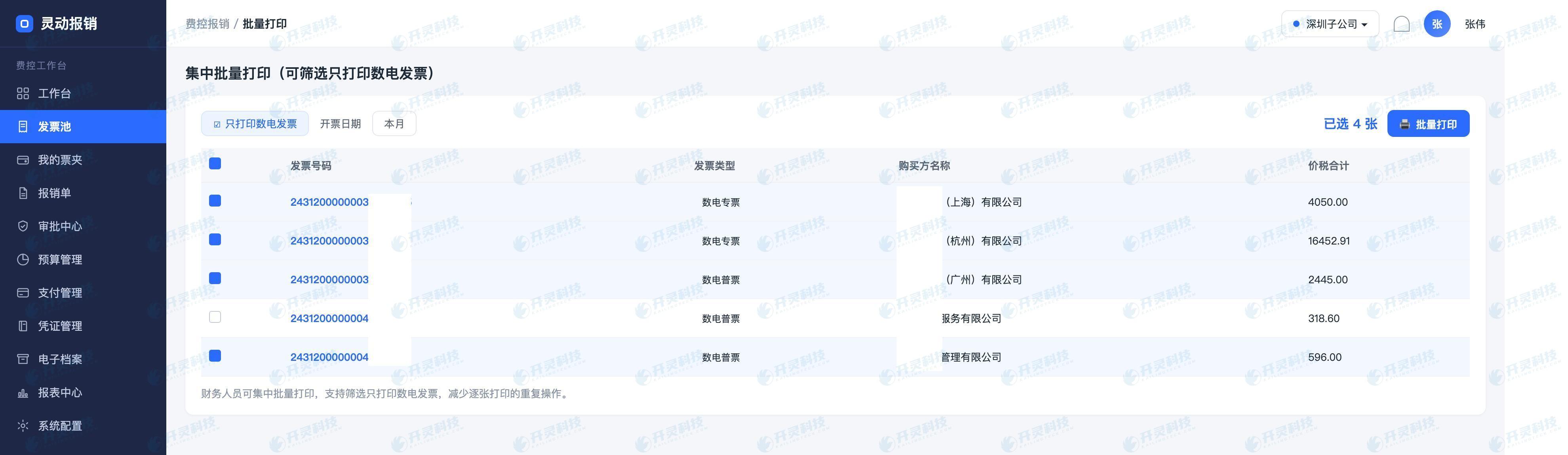
- Before archiving, check whether source files exist, can be opened, and are consistent with invoice fields.
- After voucher regeneration or reversal, archive relationships must retain versions rather than being silently overwritten.
- Failed archive receipt enters an independent queue, and "sent" is not displayed as "archived".
▍V. At month-end, start with the breakpoint list rather than the total amount
At month-end, screening can be done by combining five statuses: approval completed but unpaid, payment successful but voucher not generated, voucher generated but not posted, posted but archiving failed, and source files missing. Each exception document shows dwell time, failure reason, and responsible person, so finance can directly handle the breakpoint without inferring business from general ledger amounts.
During acceptance, it is necessary to walk through the process forward from the business side and also conduct reverse spot checks from vouchers and archives. Forward verification checks whether statuses are updated in sequence, while reverse verification confirms that accounting records can find approval, payment, and invoice evidence. Only when the system is configured together with the enterprise's financial system, archive system, and position workflows can a truly usable integrated link be formed.
- Check the state machine with four types of samples: normal, interface failure, duplicate retry, and cross-period.
- Agree on response time limits for each type of breakpoint to avoid exceptions remaining long-term in an unowned queue.
- Periodically review high-frequency failure nodes and implement fixes at the source field or rule maintenance level.
When "completion" is broken down into observable nodes, the business, cashier, accounting, and archives roles see the same chain rather than each having their own table. Whether there is a voucher after reimbursement and payment, and whether there is original evidence behind the voucher, can be answered directly, which also makes monthly closing and post-event review more unhurried.
Status reports should also distinguish between quantity and scope of impact. A document missing source files and a batch of voucher interfaces being stalled do not have the same processing priority; managers need to see the organizations, periods, and business importance involved, then arrange the repair order. Replacing simple red dots with clear impact information is the only way breakpoint management will not again evolve into manual queuing.
After rule changes, the versions of old voucher templates and archiving relationships should be retained. During subsequent reversals or audit reviews, the mapping used by the original document at the time can be seen, rather than reinterpreting historical results with the current configuration. Version traceability turns automatic generation from a one-time tool into long-term reliable accounting infrastructure.
For materials that genuinely need offline supplementation, the system should also register the responsibility for supplementation, receipt time, and final archiving location. A small number of exceptions that cannot be fully automated should not cause the entire document to leave the online chain. Only when exceptions are explicitly managed will the completeness rate continue to improve.
▍FAQ
Q: Does one-click voucher generation mean no review is needed?
A: No. It maps fields based on configuration, and finance still needs to review the period, accounts, accounting dimensions, tax amounts, and associated documents.
Q: If payment succeeds but voucher generation fails, is the reimbursement considered complete?
A: It should not be shown only as completed as a whole. The payment result is retained while the voucher enters the failure queue and continues after repair.
Q: Can electronic invoices be kept only as printed copies?
A: Not recommended. Electronic source files and their relationship to reimbursement and vouchers should be retained according to applicable requirements.
Q: Will archiving failure affect vouchers that have already been generated?
A: Prior results do not need to be erased, but the entire business item should remain in an unarchived status and be assigned for handling, avoiding the situation where vouchers exist but the evidence chain is missing.
Let reimbursement continue from payment to vouchers, posting, and archives. Welcome to visit Kailing Technology: https://www.kailingteck.com/feikong/ .
As a national high-tech enterprise, Kailing Technology focuses on the digital and intelligent transformation of enterprise business-finance-tax and operations management, providing software products, system integration, implementation and delivery, and operational services for various government agencies, institutions, group enterprises, and SMEs.
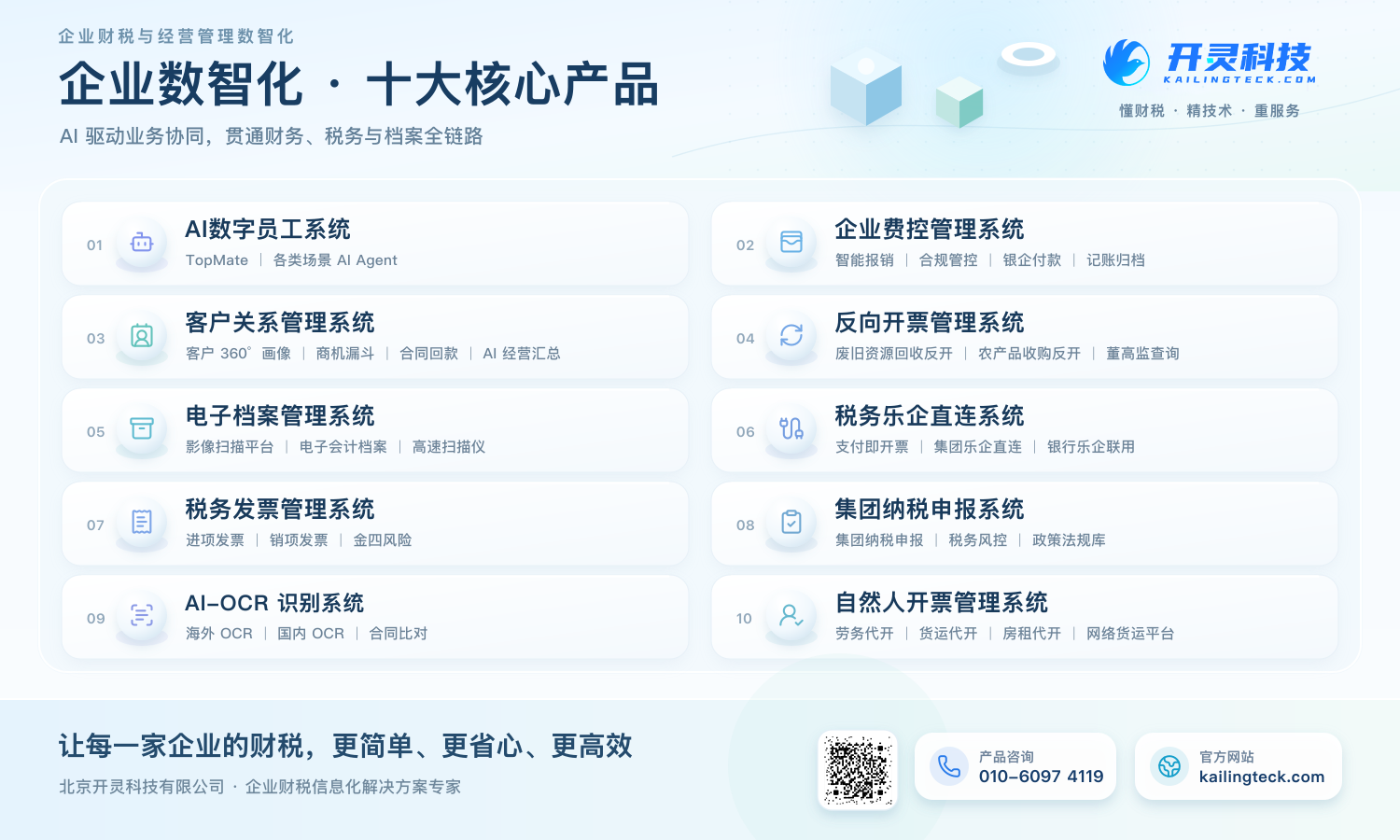
The company has now formed ten core product lines, including: AI digital employee system, enterprise expense control management system, customer relationship management system, reverse invoicing management system, invoice issuance for individuals management system, electronic archives management system, tax fully digitalized e-invoice Leqi system, tax invoice management system, group tax filing system, and AI OCR recognition system. It is committed to connecting enterprise business, finance, tax, funds, and archive data to help customers improve operational efficiency, business-finance-tax compliance capabilities, and digital management levels.
If you have any business-finance-tax digital transformation needs, welcome to contact us. Beijing Kailing Technology will serve you wholeheartedly.
Keywords: Automatically generate vouchers, electronic accounting archives, expense accounting, Kailing Technology, enterprise expense control and reimbursement management system
As a comprehensive business-finance-tax digitalization solution service provider, Kailing Technology provides business-finance-tax management digital transformation products and operational services for various government agencies, institutions, and large, medium, and small enterprises. The product line includes: solutions for sales contract management system, procurement contract management system, fully digitalized Leqi interface project, automatic output invoicing system, reverse invoicing system, invoice issuance for individuals system, employee expense control and reimbursement system, input VAT invoice management system, supply chain collaborative reconciliation system, image AI OCR recognition system, automatic financial bookkeeping system, electronic accounting archives system, etc., comprehensively driving the digitalization process across various fields.
Consultation Hotline: 18513895936 / 010-60974119 Location: Beijing