
Employee reimbursement always gets stuck on invoices and approvals? How does Kailing Technology's expense control system connect business travel, reimbursement, and booking

Employees find reimbursement troublesome often not because there are many approval nodes, but because the same business trip is split into several repeated actions: fill out an application before the trip, fill in personnel and project again when booking, after returning search for receipts in email, invoice folders, and mobile phones, and then copy the order amount onto the reimbursement form. Finance appears to only review at the end, but in fact still has to verify budget, itinerary, invoices, policies, and payee information, and after approval continues to move payment and voucher data. Where the process gets stuck is exactly where data is not handed off.
Kailing Technology Lingdong Reimbursement focuses on the three handoff points after business travel occurs: where invoices enter, when rules intercept, and where data goes after approval. Employees retain the necessary business confirmation, while the system handles automatic entry and verification, and finance shifts from finding information order by order to handling anomalies. This is not about pursuing "zero operations," but about letting each role supplement only what they truly know.
▍An employee's day: after a business trip, find invoices first or fill out forms first?
The traditional approach usually starts with a blank reimbursement form. Employees first recall the business trip application number, then log into the business travel platform to check flights and hotels, download electronic tickets from email, photograph paper tickets, and fill in date, amount, tax, and expense type line by line. If the project, cost center, or receiving account is filled in incorrectly, they must re-verify after approval is returned. Invoices and orders clearly already exist in the system, but because there is no business association, employees can only carry them over again.
In the Kailing Technology expense control system, business trip applications can clarify personnel, reason, budget, project, and expense standards in advance; after travel orders are returned, they are automatically associated with the application; employees can upload invoices by taking photos with their phones, uploading invoice files, or selecting invoices from the invoice pool, and the system recognizes fields and compares them with orders. Employees mainly confirm expense attribution, add special notes, and select unassociated invoices, rather than rebuilding an already-occurred business from scratch.
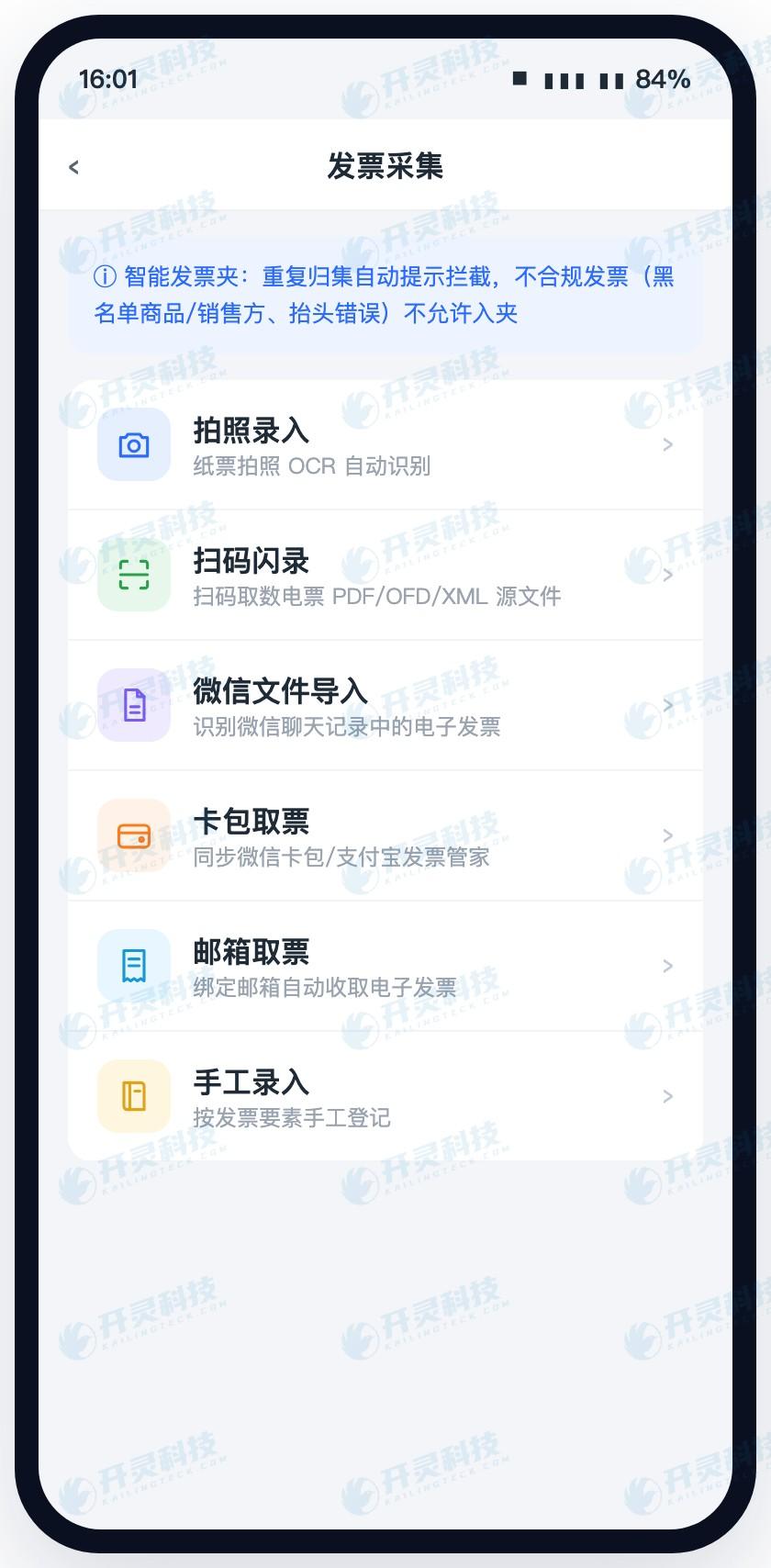
▍Handover point one: documents change from scattered attachments into usable data
After invoices enter the invoice pool, they should have clear statuses: unused, occupied, reimbursed, rejected and reusable, reversed, or abnormal. When an employee submits, the system verifies invoice fields, verification results, duplicates, and the relationship between invoice amounts and reimbursement details; once an invoice is occupied by a document, others who submit it again should receive a prompt. In this way, finance does not need to manually review historical attachments at the end of the process.
But automatic invoice recognition cannot replace business judgment. For example, whether a restaurant invoice belongs to this business trip, how to allocate it among multiple travelers, and why the invoice amount differs from the amount borne by the enterprise still require employee explanation. The system should separate "machine-verifiable" from "business-required explanation": the former provides status and evidence, while the latter requires the responsible person to supplement the reason, avoiding blocking all situations with a vague "invoice abnormality."
▍Handover point two: rules prompt before submission, and exceptions go to approval with reasons
If a hotel expense exceeds the standard, the budget is insufficient, the business trip application is missing, or the invoice is duplicated, a prompt should be given at the latest before the employee submits it. The prompt is not just a red warning; it should also tell the employee which rule it is, what the standard value is, what can be changed, and in what circumstances an exception can be applied for. For expenses allowed with special approval, the system brings the reason for exceeding the standard, the difference, and attachments to the approval node; for situations explicitly prohibited by policy, it directly blocks submission.
Approvers' responsibilities are therefore clearer: direct supervisors judge business necessity, budget owners judge resource arrangements, and finance judges receipts and accounting standards. Kailing Technology's expense control system routes approvals by organization, amount, project, and anomaly type, so each node does not need to repeatedly check all content. When the process is returned, opinions and verified data are retained, and employees only modify erroneous fields, avoiding refilling the entire form.
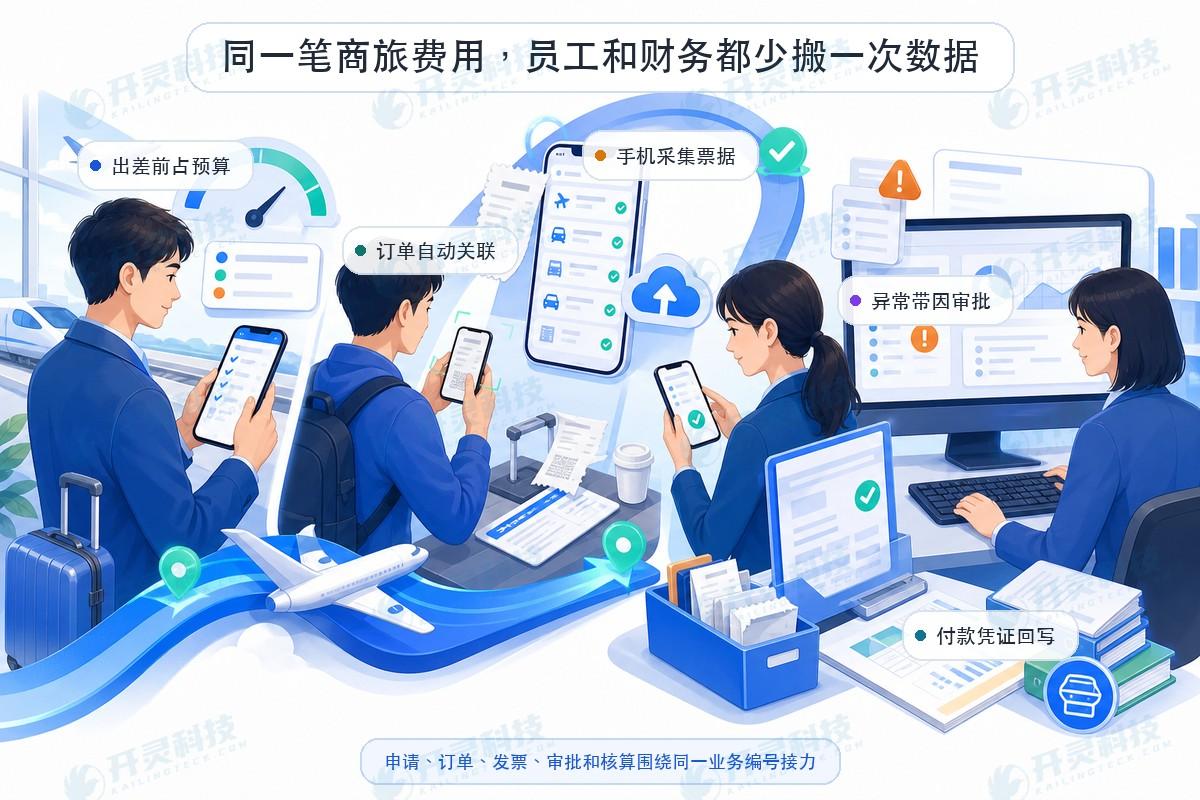
▍A day in finance: shifting from hunting for evidence order by order to handling exceptions in a centralized way
When orders, invoices, budgets, and applications are already linked, financial review can prioritize viewing the discrepancies flagged by the system: no application, exceeding standards, duplicate invoices, unbalanced amounts, cross-project, changes in payee information, etc. Ordinary compliant documents flow according to unified rules, and complex businesses enter manual judgment. Finance still holds review authority, but does not need to spend time on mechanical comparison of every invoice.
Management rules should not be scattered in training materials either. Travel standards, reimbursable invoice types, city levels, job-level limits, budget dimensions, and approval conditions need to be configured, with effective dates and change records. After policies are updated, new business is executed according to new rules, while historical documents retain the original basis. In this way, the prompts employees receive and the basis for finance review come from the same set of rules.
▍Handover point three: after approval ends, payment, vouchers, and images continue downstream
Completion of approval is only the midpoint of the reimbursement business. Kailing Technology's expense control system can pass payee information, amounts, and payment batches to the payment step and receive success or failure status; then generate voucher data according to confirmed accounting rules, and hand it over with receipt images and approval records to ERP and electronic archives. Finance needs to review key fields and batches, rather than re-entering departments, projects, tax amounts, and summaries.
When an interface fails, the system should retain pending status, failure reason, and retry records. A payment failure cannot directly mark the document as paid, and a voucher returned by ERP cannot lose the original approval evidence. Only when these reverse statuses can return to the expense control ledger will employees not see "approval passed" but funds not arriving when checking progress, and finance can locate the bottleneck from a single entry point.
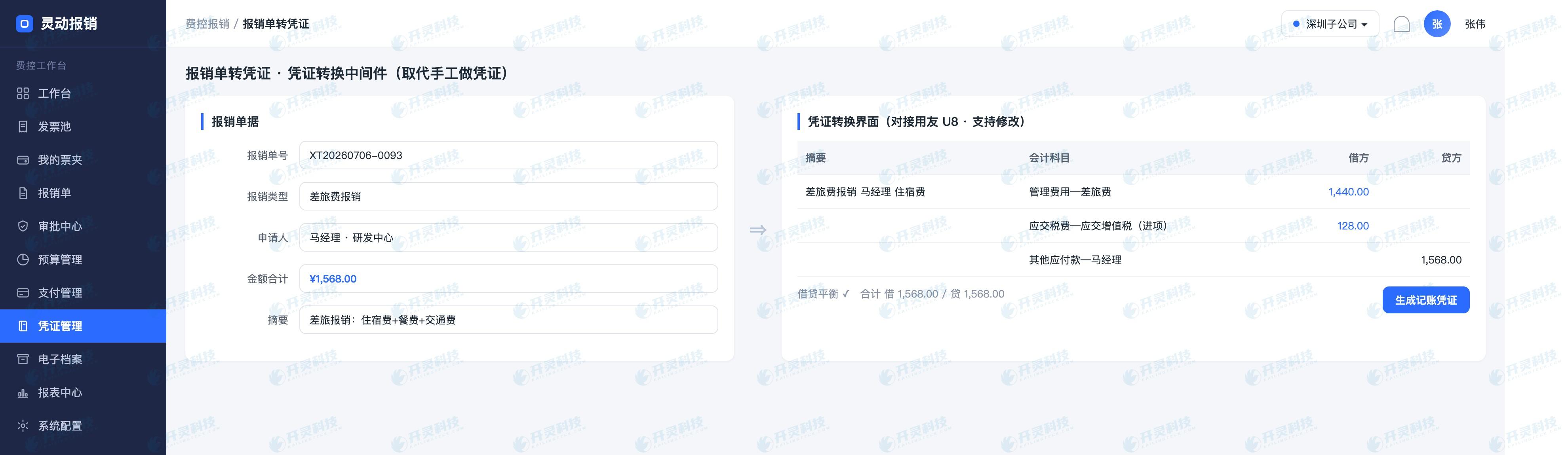
▍During implementation, first watch whether three "manual transfer actions" have truly disappeared
First, whether employees still have to copy business travel orders item by item into reimbursement forms; second, whether finance still has to download invoice lists and then check for duplicates elsewhere; third, whether after approval the same transaction still has to be recreated in online banking and ERP. Enterprises can each select ten ordinary expenses and ten abnormal expenses, and count the number of duplicate entries, reasons for returns, and manual verification points before and after go-live. If it merely replaces paper forms with electronic forms, the three transfer actions still remain, and the project has not truly been connected end to end.
The role of Kailing Technology Lingdong Reimbursement is to establish a continuous state of expense business among existing business travel, OA, banking, and ERP systems. Enterprises do not necessarily need to replace all systems, but they must determine the unique application number, unique invoice status, unique payment status, and unique voucher write-back responsibility. Employees filling in less, approvals being understandable, and finance moving less data are the common results of a smooth reimbursement process.
▍FAQ
Q: Without a unified business travel platform, can reimbursement still be connected end to end?
A: Yes, you can start with travel applications, the invoice pool, expense rules, and ERP handover; offline orders are confirmed by employees, and travel sources can be connected later by priority.
Q: After invoice recognition, do employees still need to confirm?
A: Yes. The system identifies the fields on the invoice face and provides verification and duplicate-check status, but employees still need to confirm business attribution, allocation, and special notes.
Q: Why keep the expense control status after approval?
A: Because payment failure, voucher return, red invoice, or withdrawal can all occur. Complete status write-back allows employees and finance to locate the real blocker.
Q: We already have OA and ERP; where does the expense control system fit?
A: A common approach is for OA to retain the unified entry point, expense control to handle budgets, invoices, travel, and reimbursement rules, and ERP to handle accounting; the specific boundaries need to be confirmed based on master data and interface responsibilities.
Let employees move data one less time and let finance see one more layer of risk. Kailing Technology helps you connect the entire reimbursement chain: https://www.kailingteck.com/feikong/ .
As a national high-tech enterprise, Kailing Technology focuses on the digital and intelligent transformation of enterprise business-finance-tax and operations management, providing software products, system integration, implementation and delivery, and operational services for various government agencies, institutions, group enterprises, and SMEs.
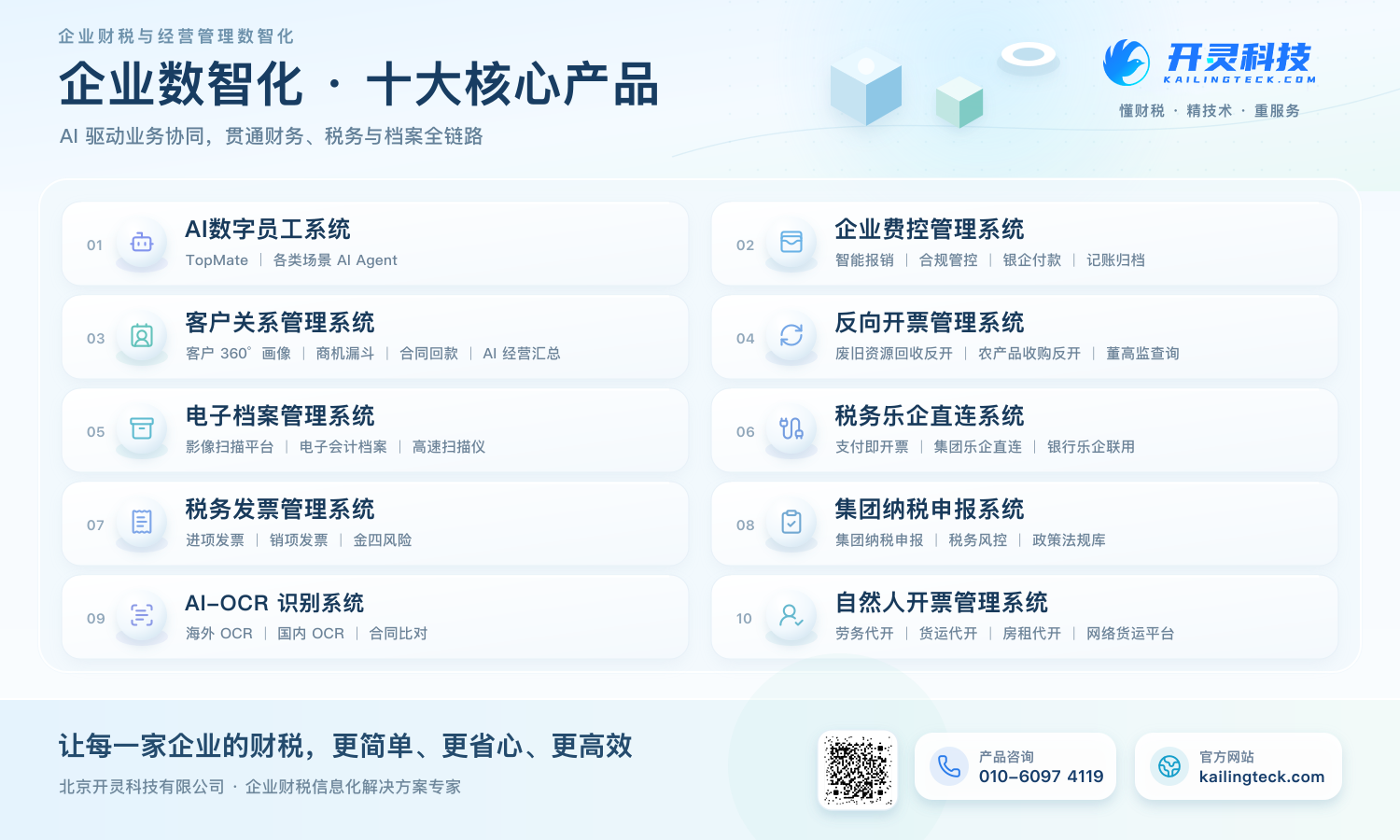
The company has now formed ten core product lines, including: AI digital employee system, enterprise expense control management system, customer relationship management system, reverse invoicing management system, invoice issuance for individuals management system, electronic archives management system, tax fully digitalized e-invoice Leqi system, tax invoice management system, group tax filing system, and AI OCR recognition system. It is committed to connecting enterprise business, finance, tax, funds, and archive data to help customers improve operational efficiency, business-finance-tax compliance capabilities, and digital management levels.
If you have any business-finance-tax digital transformation needs, welcome to contact us. Beijing Kailing Technology will serve you wholeheartedly.
Keywords: Employee reimbursement, Kailing Technology expense control system, Lingdong reimbursement, business travel reimbursement, invoice management, reimbursement approval, financial posting
As a comprehensive business-finance-tax digitalization solution service provider, Kailing Technology provides business-finance-tax management digital transformation products and operational services for various government agencies, institutions, and large, medium, and small enterprises. The product line includes: solutions for sales contract management system, procurement contract management system, fully digitalized Leqi interface project, automatic output invoicing system, reverse invoicing system, invoice issuance for individuals system, employee expense control and reimbursement system, input VAT invoice management system, supply chain collaborative reconciliation system, image AI OCR recognition system, automatic financial bookkeeping system, electronic accounting archives system, etc., comprehensively driving the digitalization process across various fields.
Consultation Hotline: 18513895936 / 010-60974119 Location: Beijing