
Kailing Technology enterprise expense control and reimbursement management system: from budget control to invoice verification, how can enterprise expenses truly be managed?
In the last three days of the month, the lights in the finance department always stay on late. Hundreds of reimbursement forms are piled on the desk, pasted crookedly: some have sequentially numbered fixed-amount invoices attached, someone has resubmitted last month's already-reimbursed meal expenses, and one special VAT invoice is made out to a branch company that was deregistered long ago. The cashier logs into online banking to transfer each payment one by one while waiting for receipts to download before manually creating vouchers.
What is more troublesome is the front end. When business spends money, no one reminds them how much budget remains; by the time documents are submitted and finance calculates the overage, the money has already been spent, and control becomes after-the-fact ratification. Group enterprises have another layer: with more than a dozen legal entities, each with different expense standards, approval authorities, and payment accounts, if headquarters wants a unified report, it must first wait for each entity to submit its Excel files.
These steps are inefficient not because anyone is not diligent, but because they are inherently disconnected. The budget sits in one table, business travel orders in another system, invoices lie on employees' phones, approvals are initiated in group chats, payments are completed in online banking, vouchers are entered by hand, and archives are locked in metal cabinets. Seven stages, seven sets of carriers, with people moving data in between—as long as that manual transfer remains, errors and omissions are inevitable. Kailing Technology's enterprise expense control and reimbursement management system (product name "Lingdong Reimbursement") is designed to solve exactly this breakpoint: connecting the seven steps into one line and letting data flow on its own.

▍I. Seven-step closed loop: How Kailing Technology's enterprise expense control and reimbursement management system connects the steps
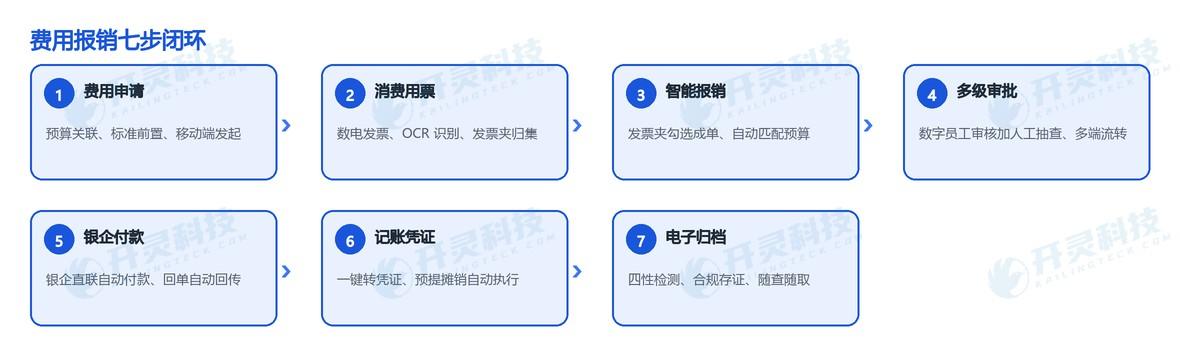
The key is not the number of steps, but that no step requires re-entering data. When an invoice is captured, it already brings back the header, amount, line items, and source file; during reimbursement, it is simply checked to create the document. After approval, the payment instruction is issued automatically, and when the receipt returns it is automatically attached to the original document. Vouchers automatically generate journal entries by account. At archiving, the source file follows into the archive repository. There is only one entry throughout the entire process—the one time the employee takes a photo to capture it.
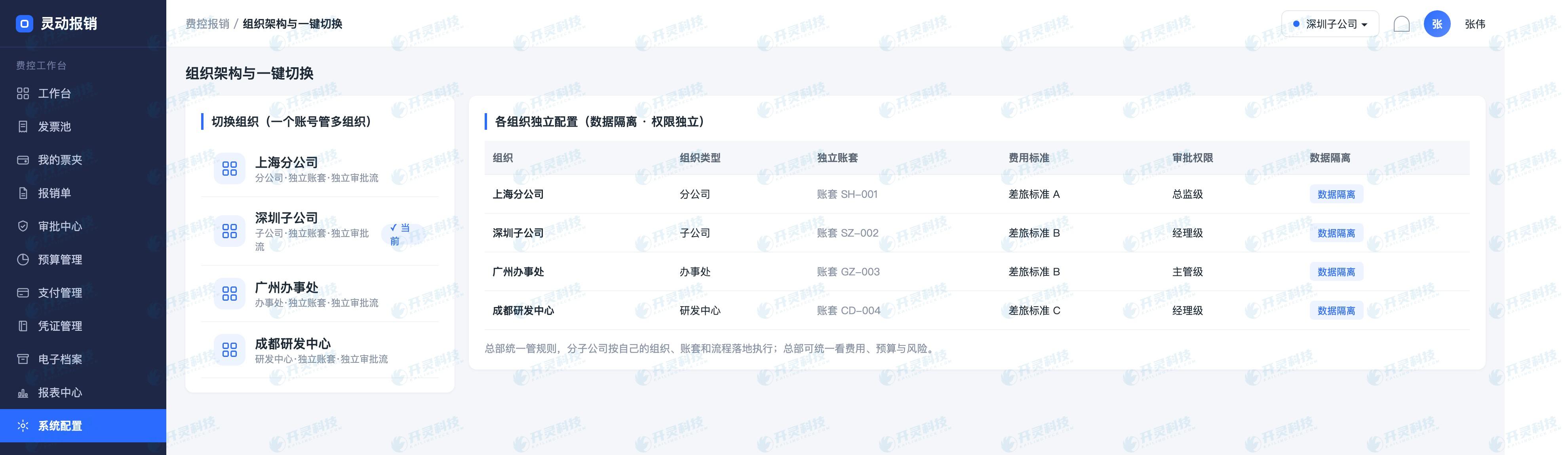
Group scenarios must first resolve "whose money and whose rules." The system supports managing multiple organizations with one account, with one-click switching at the top, data isolation and independent permissions for each organization, and documents and approval flows that do not interfere with each other, while headquarters can still exercise unified control; newly acquired companies can be onboarded by applying rule templates.
▍II. Pre-control: put budget and standards before spending
The most valuable point of intervention in expense control is not reviewing reimbursement forms, but the moment an employee prepares to spend. Judging compliance after the money is spent leaves the system able only to refuse payment, and refusal brings disputes, not savings.
The system establishes an expense control model based on multi-dimensional combinations of organization, dimension, and account. When submitting a travel or expense application, it associates the corresponding budget account, prompts the balance in real time and occupies the budget, and gives instant reminders when exceeding the standard; the budget cycle supports two strategies: natural period and rolling accumulation, and approvers can drill through the approval page to view the execution of that account. Travel accommodation is graded by city, entertainment by rank and number of people, and car use scope by department—these rules that used to rely on human memory are configured by the compliance engine into executable standards, automatically checked at each stage of expense occurrence, recording, application, and submission. Employees know whether they are over standard when filling out the form, and if over standard, it leaves a trace and triggers additional approval, rather than waiting for finance to reject the form.

▍3. In-process verification: invoice authenticity verification, duplicate checking, and one-click order generation
Manually verifying a single invoice requires checking the header, tax number, address and phone, bank account, and also determining whether it's a duplicate reimbursement and whether the seal has been tampered with—a few minutes per invoice, adding up to hundreds of work hours for thousands of invoices annually. For collection, the PC end automatically retrieves genuine input VAT invoices from the tax bureau, including XML, PDF, and OFD source files; the mobile end supports photo recognition, scan-and-flash entry, email invoice retrieval, WeChat card wallet retrieval, and chat record file recognition. Scan-and-flash entry directly retrieves source files, corresponding to the Ministry of Finance's requirements on electronic accounting voucher reimbursement, booking, and archiving—source files must be saved for booking, not just printouts. OCR covers special invoices, general invoices, electronic general invoices, fully digitalized e-invoices, roll invoices, general machine-printed invoices, fixed-amount invoices, motor vehicle and used vehicle invoices, passenger transport invoices, and all categories.
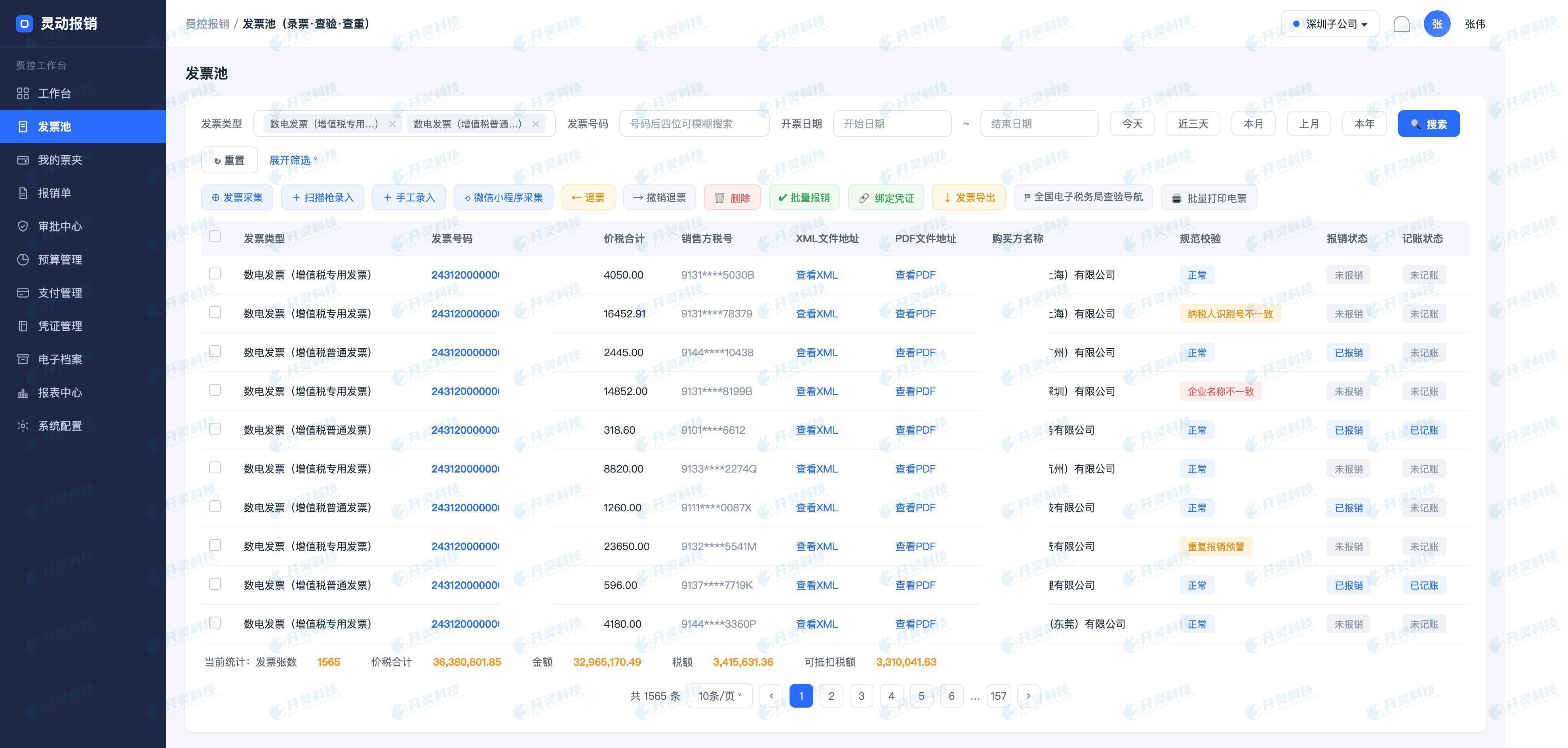
When each invoice is filed, its authenticity is automatically verified and duplicates checked: verify whether the title, tax number, address and phone, and bank account are consistent with the enterprise; compare paper invoice numbers with the electronic tax bureau; verify electronic invoice signatures to prevent tampering; and separately mark blacklisted goods and sellers. If it matches "already entered" or "already reimbursed," it is intercepted in real time, and the same invoice is not allowed to be added repeatedly. Verification results are marked directly in the list, such as "Normal," "Taxpayer identification number inconsistent," and "Enterprise name inconsistent"; fixed-amount invoices support consecutive-number recognition and can embed local verification.
After collection is completed, checking items in the invoice folder automatically generates a reimbursement form, with header, amount, and details automatically populated. The reimbursement form and invoices are bidirectionally linked one-to-one and traceable at any time. Once the reimbursement form is initiated, the related invoices automatically lock their tax booking status (booked with pre-tax deduction, not deducted, booking revoked), mechanically preventing malicious red-ink reversal and multiple reimbursement of the same invoice. Forms and approval flows support drag-and-drop configuration; new scenarios require no development, take effect upon saving, and go live the next day—if the business form changes several times a year and the system cannot keep up, it will be bypassed, and once bypassed, the online data will be incomplete.
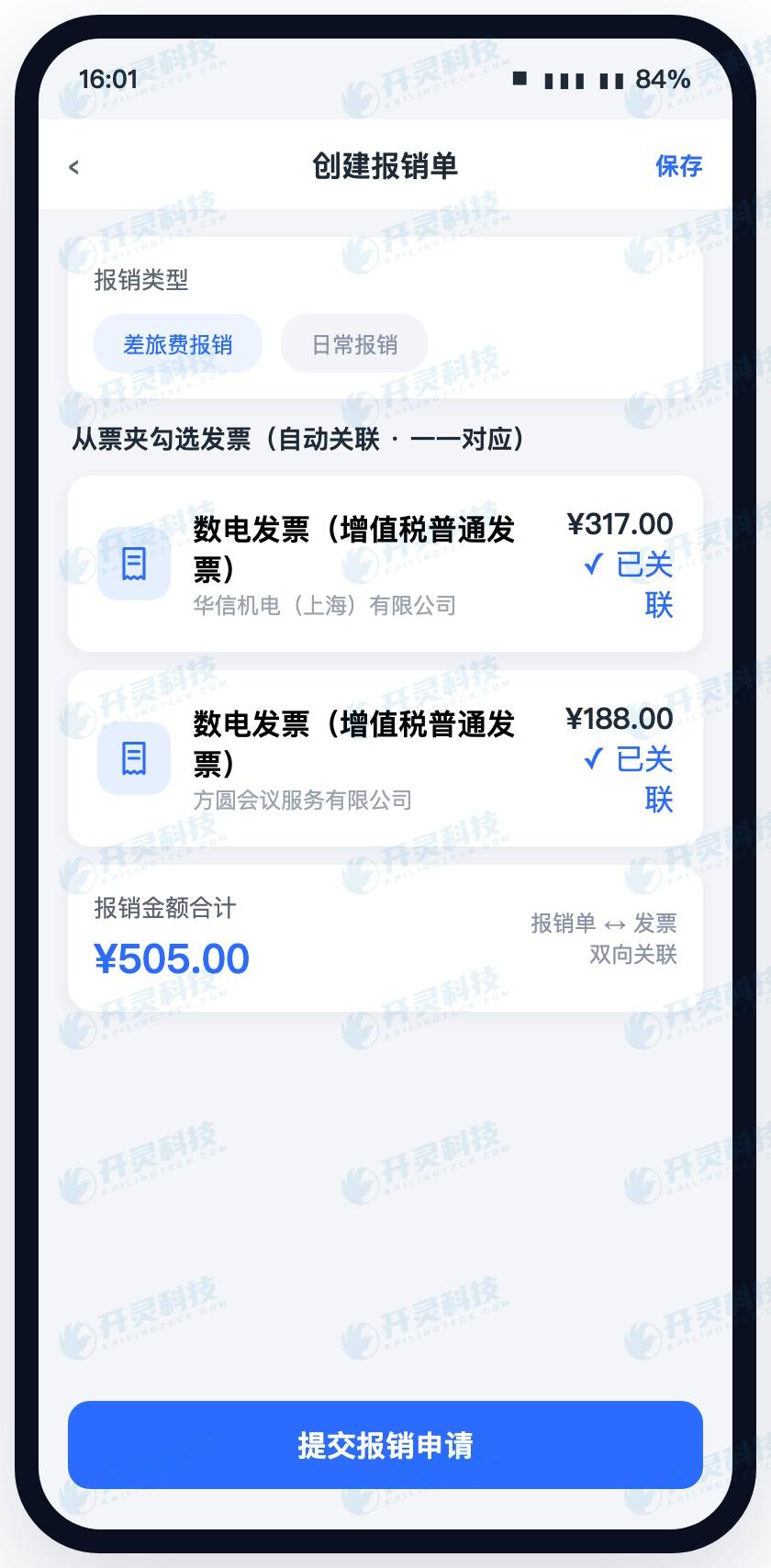
▍IV. Multi-terminal approval and digital employees: compliant documents approved in seconds
The approval dilemma has always existed: detailed review is slow, fast review misses things. Lingdong Reimbursement separates "checking rules" from "making judgments"—clear rules go to the system, and judgments are left to people. After a reimbursement form is submitted, approvers can handle it on PC, App, mini program, DingTalk, Feishu, or WeCom, with real-time message delivery, and the approval page can directly display attached invoices; it supports rejecting back to the initiator or to the previous level.
AI digital employees intelligently compare internal control rules with invoice business information, checking item by item according to the enterprise's own policy documents (for example, the Employee Allowance and Travel Management Policy): whether the amount exceeds the standard, whether the invoice type matches the reason, whether the date matches the travel application, and whether the allowance calculation is correct. Compliant documents pass in seconds, and only those hitting risks or exceptions are transferred for manual spot checks. Finance's attention shifts from "reviewing everything" to "only looking at problematic ones," which is why efficiency and compliance can improve at the same time.
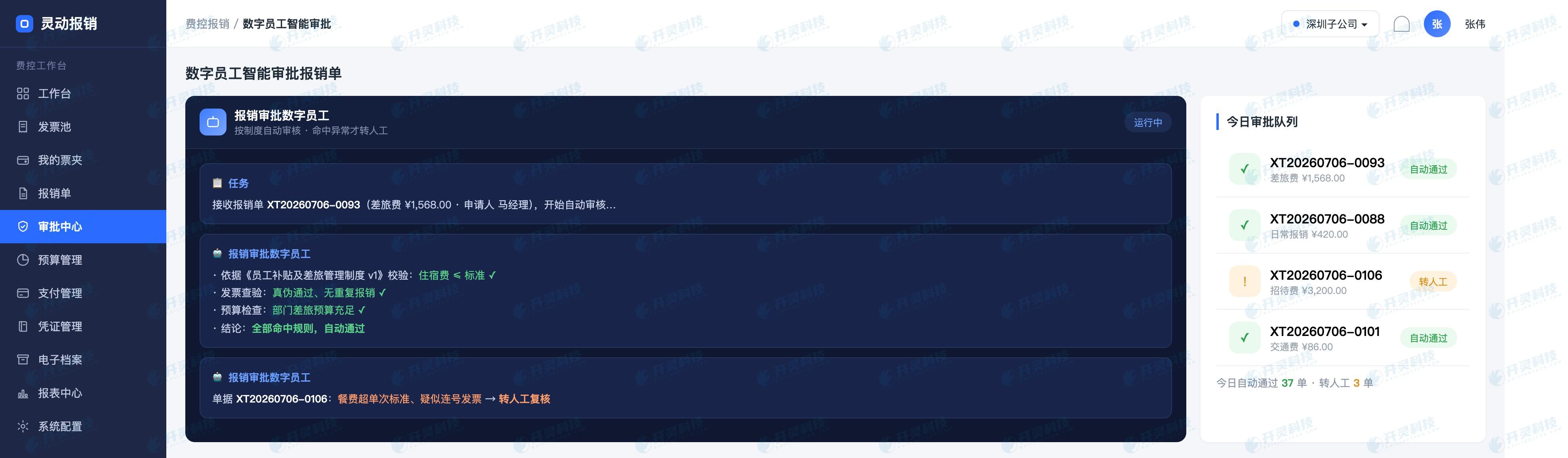
▍V. Post-settlement: payment, bookkeeping, and archiving in one step
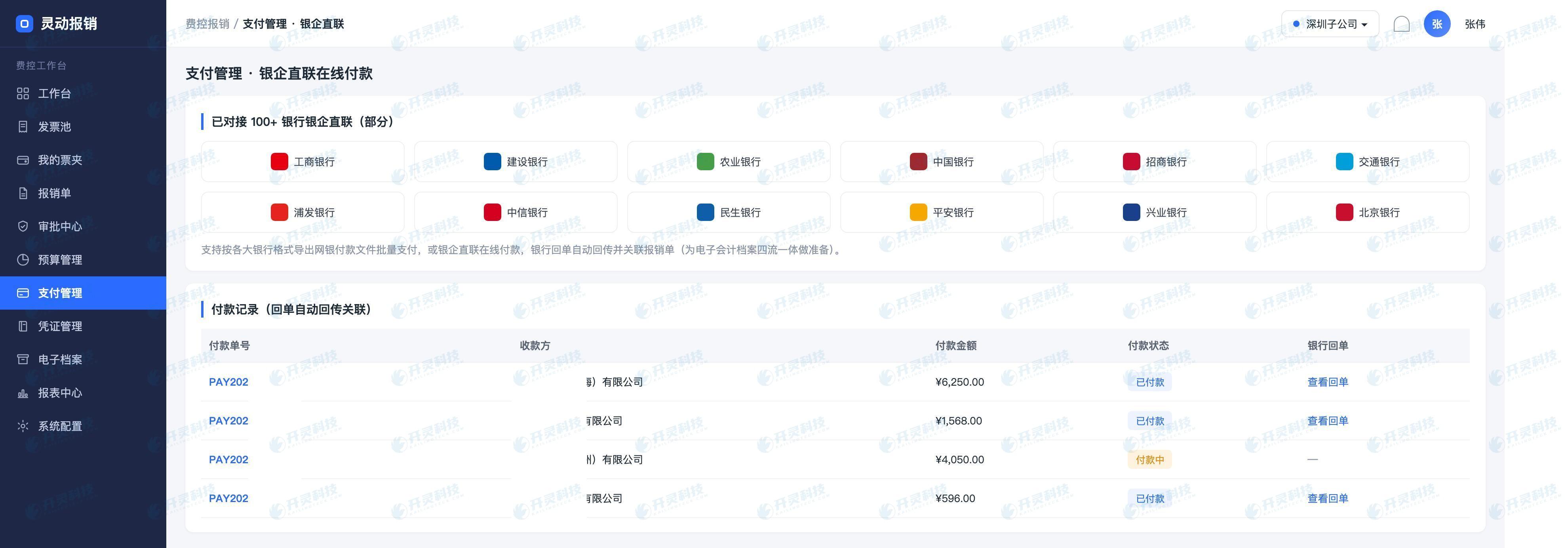
After approval, the system directly connects to the bank to automatically initiate payment. Cashiers do not need to log in to online banking to process each transaction one by one, and payment files can also be exported in the formats of major banks for batch payment. After payment is completed, bank receipts are returned in real time, can be viewed and downloaded online, and are automatically reconciled with reimbursement forms and vouchers. It currently supports direct bank-enterprise connection with more than 100 banks. The step of automatically associating receipts is critical—it is the prerequisite for the "four flows in one" of electronic accounting archives. Without receipts, the business flow, invoice flow, and fund flow cannot be linked together.
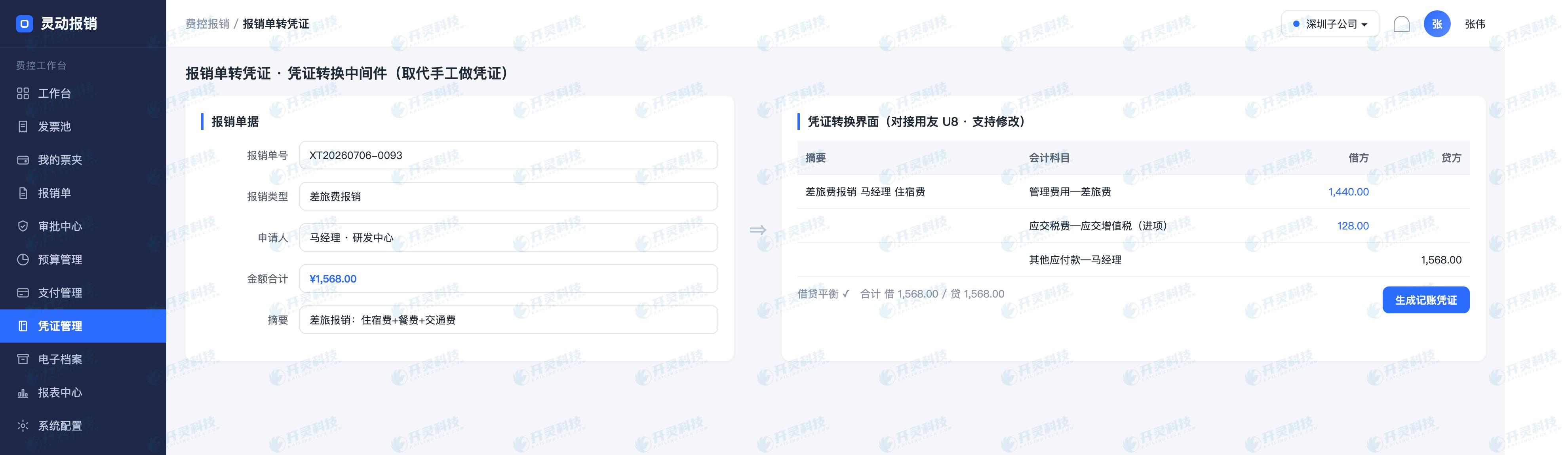
Voucher conversion middleware automatically maps document fields to the ERP, generates debit-credit entries by account, automatically executes accrual and amortization rules, and standard plug-ins connect to mainstream financial software such as Yonyou U8, with no customization needed for routine scenarios. In addition, reimbursed and booked invoices can be filtered and selected with one click for input VAT, automatically linking to the tax digital account of the Electronic Tax Bureau to complete certification and deduction; passenger transport invoices automatically generate deduction statistics tables by invoice type formula.
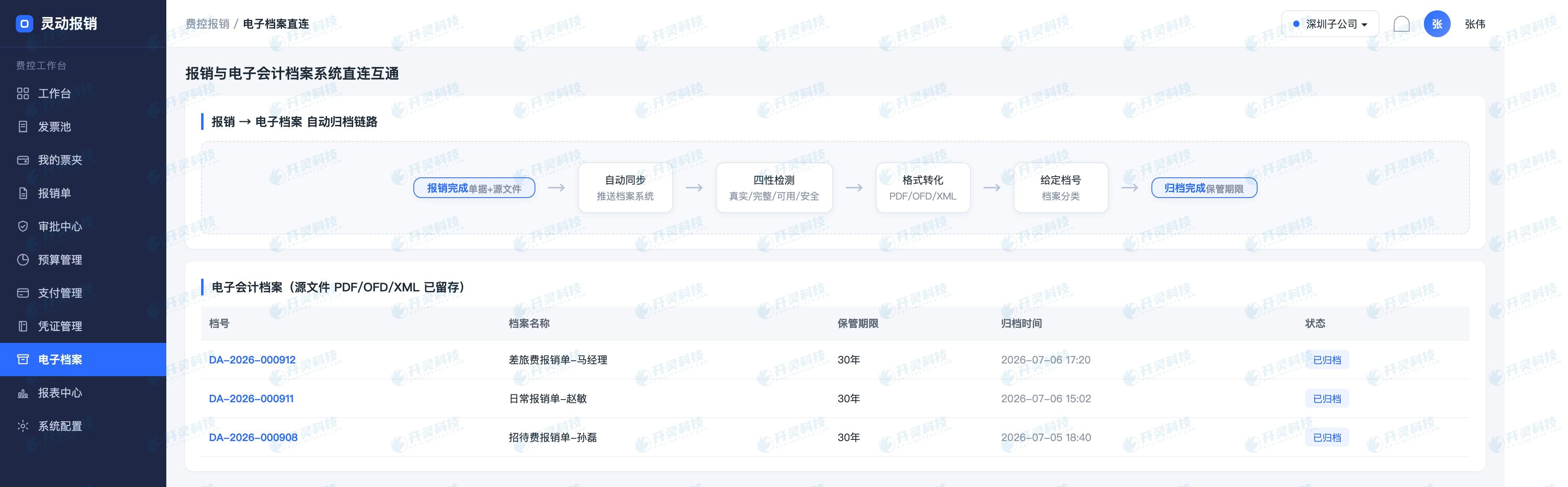
Save invoice source files at the same time as booking; original materials such as reimbursement forms, invoices, vouchers and receipts automatically flow to the electronic accounting archives system, where the four-property test of authenticity, integrity, usability and security is performed, in compliance with the requirements of the Measures for the Management of Accounting Archives. Archives and expense control are directly connected and interoperable, so archiving no longer requires finance to export and upload again, and retrieval by document number, date or supplier is available at any time.
▍VI. Data insights and integration with four types of systems: bring expense data back to the decision table
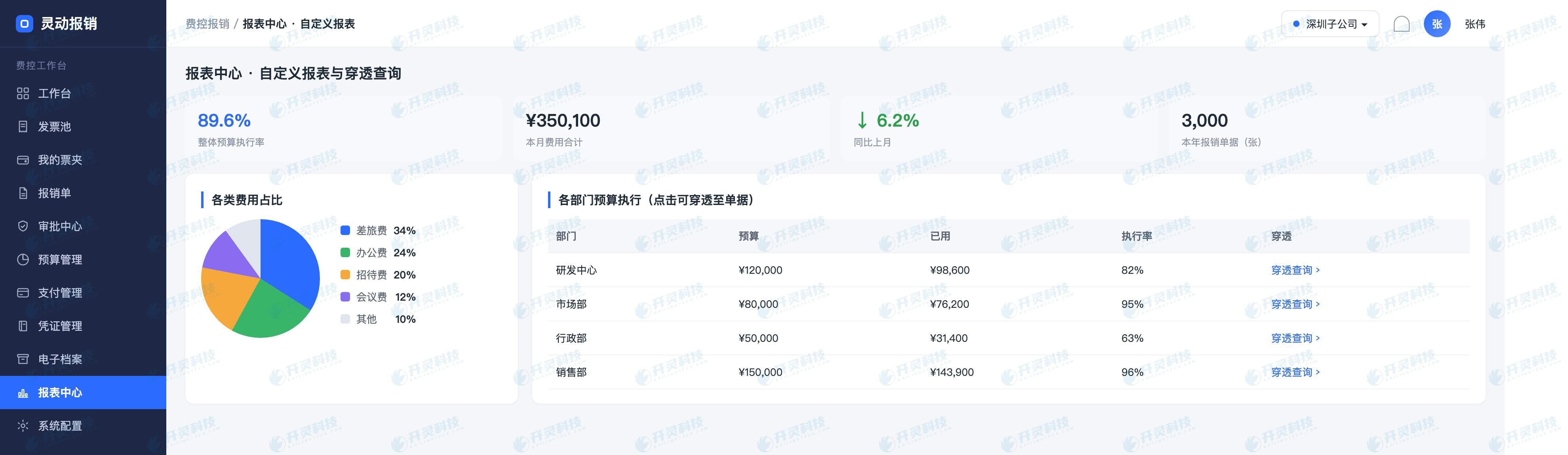
The system provides custom reports, with multi-dimensional combinations of expenses, budgets, and reimbursement progress, supporting drill-down so users can reach details with one click; new report scenarios are released and launched the next day, and the mobile end can directly view output value analysis by department, personnel, and project dimensions.
Integration covers four directions: obtaining invoices from tax invoice systems (Electronic Tax Bureau, Leqi Direct Connection, etc.), exchanging document and contract data with collaboration and business systems (various OA, ERP, CRM, HR, procurement systems, with open APIs provided), directly connecting with fund systems for payment and retrieving receipts, and writing back vouchers and ledgers to financial systems. Once the four directions are connected, expense data no longer needs manual export and import. Deployment supports private independent deployment and can satisfy internal/external network isolation.
Take a company with about 3,000 reimbursement documents per year: on the employee side, no need to advance funds or attach receipts afterward, with subsidies and travel expenses calculated automatically; on the finance side, no need to enter invoices, prepare vouchers, make bank payments one by one, or export, upload, and archive; on the management side, budget execution has a real-time dashboard and expense composition can be drilled down across multiple dimensions; on the compliance side, verification and duplicate checking prevent repeated reimbursement, with complete traces of source files and receipts. The degree of improvement depends on the original management foundation and document volume; implementation results will vary across companies, and the specific potential needs to be measured against actual business volume.
▍FAQ
Q: We are a group, and each subsidiary has different expense standards and approval flows; can they run in one system?
A: Yes. One account manages multiple entities. Each organization's expense standards, budget models, approval flows, payment accounts, and chart of accounts can be configured independently, with data isolation and independent permissions, while headquarters can view and control uniformly. When adding subsidiaries or integrating acquisitions, access can be achieved by applying rule templates.
Q: How exactly is duplicate reimbursement prevented?
A: It is divided into three layers: at the collection layer, the same invoice is not allowed to enter the folder repeatedly; at the verification layer, each invoice is automatically verified and checked for duplicates, with real-time interception when "already entered" or "already reimbursed" is hit; at the reimbursement layer, reimbursement forms and invoices are bidirectionally linked one-to-one. After reimbursement is initiated, the invoice automatically locks the tax booking status to prevent reimbursement again after malicious red-ink reversal.
Q: Will AI digital employees make mistakes in automatic approval? How is compliance responsibility ensured?
A: The digital employee compares against the policy rules configured by the enterprise itself, with clear and traceable judgment basis, and every conclusion is traceable. Compliant documents pass automatically, while abnormal documents that hit risks or are not covered by rules are all transferred to manual spot review, with no vague approvals.
Q: We are already using financial software; do we still need a separate expense control system?
A: The two have different positioning. Financial software handles accounting, while expense control systems handle the business process before accounting—budget occupation, standard verification, invoice verification, approval routing, and payment execution. Vouchers are written back to the financial system through standard plugins, effectively completing the front-end business loop.
Q: How is the archiving compliance of reimbursement materials satisfied?
A: Save invoice source files (XML/PDF/OFD) synchronously at booking. Reimbursement forms, invoices, vouchers, and bank receipts automatically flow to the electronic accounting archives system, and are archived after passing the four-property tests of authenticity, completeness, usability, and security, in compliance with the Measures for the Administration of Accounting Archives.
From budget control to invoice authenticity verification, truly bringing enterprise expenses under management. Kailing accompanies you through this closed loop: https://www.kailingteck.com/feikong/ .
As a national high-tech enterprise, Kailing Technology focuses on the digital and intelligent transformation of enterprise business-finance-tax and operations management, providing software products, system integration, implementation and delivery, and operational services for various government agencies, institutions, group enterprises, and SMEs.
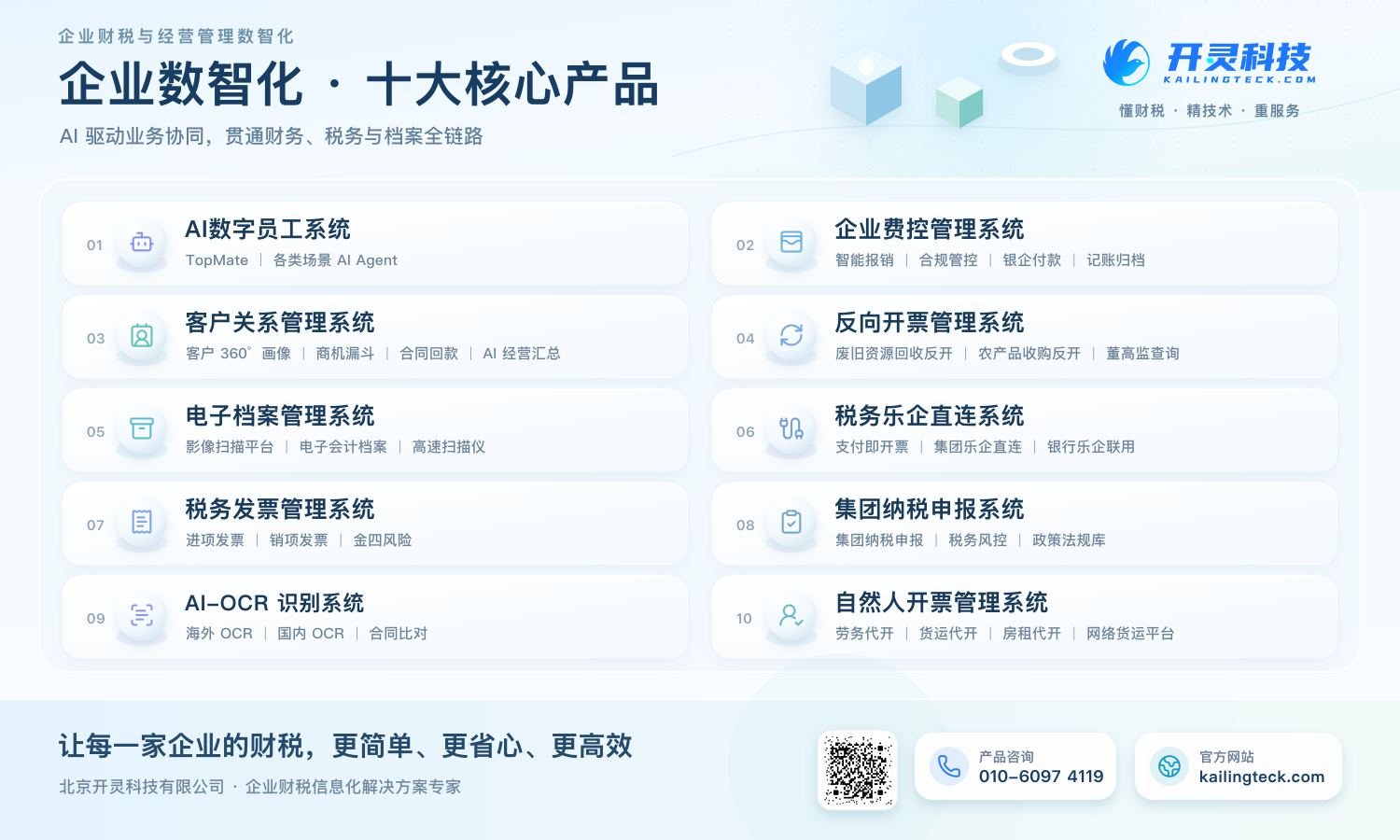
The company has now formed ten core product lines, including: AI digital employee system, enterprise expense control management system, customer relationship management system, reverse invoicing management system, invoice issuance for individuals management system, electronic archives management system, tax fully digitalized e-invoice Leqi system, tax invoice management system, group tax filing system, and AI OCR recognition system. It is committed to connecting enterprise business, finance, tax, funds, and archive data to help customers improve operational efficiency, business-finance-tax compliance capabilities, and digital management levels.
If you have any business-finance-tax digital transformation needs, welcome to contact us. Beijing Kailing Technology will serve you wholeheartedly.
Keywords: Kailing Technology enterprise expense control and reimbursement management system, expense control system, expense control and reimbursement system, budget control, invoice verification, invoice duplicate checking, bank-enterprise direct connection, reimbursement form to voucher, electronic accounting archives, multi-organization expense control.
As a comprehensive business-finance-tax digitalization solution service provider, Kailing Technology provides business-finance-tax management digital transformation products and operational services for various government agencies, institutions, and large, medium, and small enterprises. The product line includes: solutions for sales contract management system, procurement contract management system, fully digitalized Leqi interface project, automatic output invoicing system, reverse invoicing system, invoice issuance for individuals system, employee expense control and reimbursement system, input VAT invoice management system, supply chain collaborative reconciliation system, image AI OCR recognition system, automatic financial bookkeeping system, electronic accounting archives system, etc., comprehensively driving the digitalization process across various fields.
Consultation Hotline: 18513895936 / 010-60974119 Location: Beijing