010-6097 4119Book a Demo


Japanese invoice OCR recognition system: Kailing Technology supports complex Japanese layouts, speeding up financial processing by 80%Published: 2025-12-19 17:26 In the financial processing of multinational enterprises, Japanese invoices, due to their special language, diverse layouts, and complex tax rates, have long been an efficiency bottleneck. The traditional manual entry model not only faces the challenges of Japanese character recognition and special format parsing, but also must handle differentiated processing of multiple invoice types, resulting in cumbersome processes, high error rates, and persistently high labor costs. The Japanese invoice OCR recognition system launched by Kailing Technology specifically addresses the pain points of recognizing complex Japanese layouts, achieving full-process automation of invoice processing, helping enterprises improve financial efficiency by 80%, and providing core support for the digital transformation of multinational finance.
I. Core pain points and industry challenges in Japanese invoice processingThe Japanese invoice system has distinct regional characteristics, and its processing difficulty is mainly concentrated in three dimensions: - Fragmented formats across multiple invoice types: invoice types cover payables and consumption, and payables alone include payment agency fees, warehousing operation fees, transportation fees, housing rent, merchandise procurement fees, withheld consumption tax, and other subdivided scenarios. Some invoices also come in a "bill + detail statement" combination, with significantly different layouts. - Complex language and tax rate rules: invoices are mainly in Japanese, with some involving mixed English text (such as international air freight customs invoices), and tax rates are divided into the 10% standard rate, 8% reduced rate, and non-taxable items. Some invoices also need to distinguish special fields such as internal consumption tax and prior-period carryforward amounts, making manual recognition prone to confusion and missed judgments. - High requirements for data extraction accuracy: documents contain complex dimensions of key information, including transaction date, amount (pre-tax/tax-inclusive/tax amount), payer and payee information, bank accounts, goods/services details, payment methods, etc. Some fields are hidden in multi-column tables or irregular layouts, making accurate extraction difficult for traditional OCR. These challenges cause traditional manual processing modes to require several minutes for a single invoice's entry, verification, and archiving, with error rates often exceeding 5%, seriously affecting financial reconciliation efficiency and compliance. II. Kailing Technology OCR System: Three Core Capabilities Solve Complex ScenariosKailing Technology's Japanese invoice OCR recognition system is based on deep learning and computer vision technology, with special optimization for the particularities of Japanese invoices, building core competitiveness of "full-type coverage, high-precision recognition, and strong adaptability": 1. Full coverage of multi-dimensional bills, adapting to scenarios without blind spots The system has achieved comprehensive compatibility with mainstream Japanese invoice types, covering various scenarios common in business operations: - Payable invoices: including standard request forms (such as transportation fees, housing rent, logistics service fees, etc.), combined invoices (bill + detail statement, such as warehousing operation fees), special-purpose invoices (withheld consumption tax request forms, utility bills, international air freight tariff invoices), equipment procurement invoices (request form + sales order), etc.; - Consumption-related receipts: covering hotel hot spring fee statements, restaurant consumption itemized bills, convenience store shopping receipts, golf course usage fee receipts, taxi fare receipts, etc., adapting to receipt formats corresponding to various payment methods such as cash and electronic payments (Suica, transportation IC payments, etc.). Whether the invoice is in standard format, a multi-column table, mixed text layout, or contains complex information such as detailed line items, surcharge explanations, and tax rate distinctions, the system can accurately adapt.
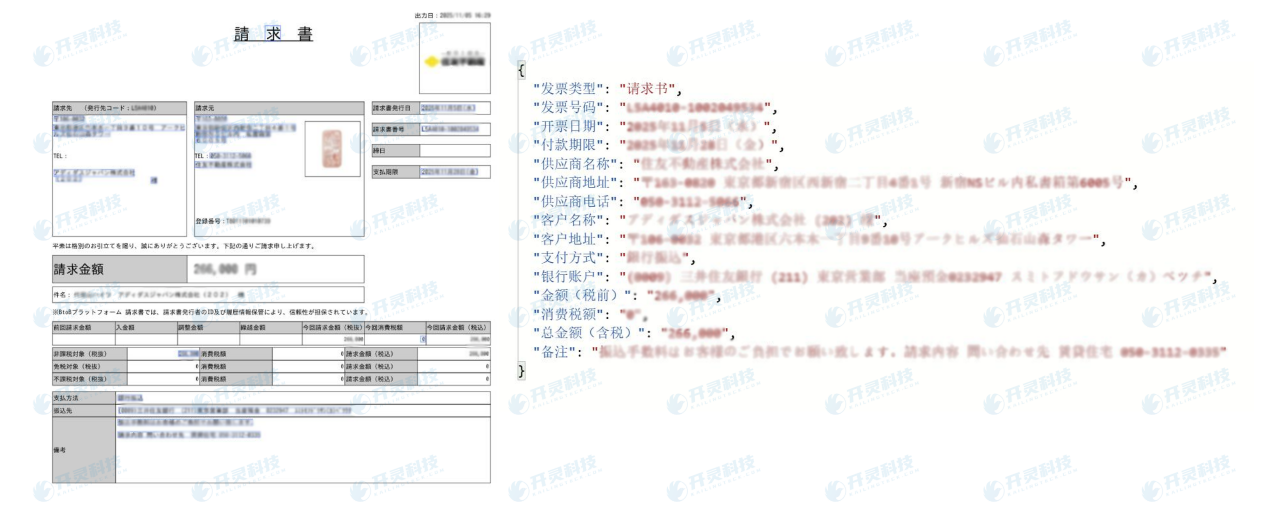
2. Precise parsing of complex layouts, with no key information missed In response to the layout complexity of Japanese invoices, the system adopts a layout adaptive segmentation algorithm that can automatically identify different areas such as tables, text blocks, and detail entries, achieving precise extraction of multi-dimensional key information: - Basic information: document type, invoicing date, document number, payer/payee names and related registration information; - Amount information: pre-tax amount, tax-inclusive amount, tax amount, non-taxable amount, prior-period carryforward amount, total amount, etc., accurately distinguishing different tax rates such as 10% and 8% and non-taxable items; - Detail information: product/service name, quantity, unit price, remarks; - Auxiliary information: bank account, payment deadline, payment method, flight information (international invoices), vehicle number (taxi invoices), etc. In actual testing, the system achieved recognition accuracy of over 99.2% for mixed Japanese characters, numbers, and English text, and over 98.5% for special fields such as tax rate distinction and non-taxable labeling, far exceeding manual processing accuracy.
3. AI-driven technical optimization, adapting to dynamic scenario changes Relying on a massive training library of Japanese invoice samples, the system has built a dynamically optimized recognition model: - Specialized optimization for Japanese: targeting Japanese kanji, kana, and special symbols、Carry out feature enhancement training to solve problems such as Japanese characters being easily confused with Chinese and dense layouts; - Layout self-adaptation capability: Automatically adapts to abnormal receipt conditions such as print misalignment, wrinkles, blurriness, and multi-column distribution, without manual template presetting; - Data verification mechanism: built-in logical verification rules automatically verify the matching relationship between amounts and tax amounts, date reasonableness, tax rate applicability, etc., and automatically flag anomalies, reducing the risk of data errors.
III. Application value: financial processing efficiency increased by 80%, costs significantly reducedThe implementation of Kailing Technology's Japanese invoice OCR recognition system brings enterprises a full-chain financial efficiency revolution: - Doubled processing efficiency: the full process from recognition and extraction to data entry for a single document is compressed to within 10 seconds, 80% faster than manual processing. Monthly processing of tens of thousands of documents requires only 1-2 finance staff for auxiliary verification, greatly reducing labor input; - Error rate drops significantly: the data extraction error rate is controlled below 0.8%, far lower than the 5% error rate of manual processing, avoiding reconciliation disputes and compliance risks caused by data errors; - Automated closed-loop upgrade: The system can directly connect to enterprise ERP, financial software, and other systems to achieve automatic entry, categorized archiving, and reconciliation matching of recognized data, forming an automated closed loop of "document scanning - recognition and extraction - data entry - reconciliation and write-off," reducing manual intervention; - Compliance assurance: accurately distinguishes different tax rates, non-taxable items, and related compliance fields, meets the strict requirements of Japanese tax filing for invoice information, and reduces cross-border financial compliance risks. Against the backdrop of globalized operations, enterprises' requirements for the efficiency and accuracy of cross-border financial processing continue to rise. Through deep adaptation to complex Japanese layouts and high-precision recognition, Kailing Technology's Japanese document OCR recognition system has broken the bottleneck of traditional manual processing, not only achieving a leap in financial processing efficiency, but also reducing labor costs and compliance risks for enterprises through automated and standardized process optimization. For more domestic and overseas voucher and general document recognition scenarios, please consult Kailing Technology:https://www.kailingteck.com/h-col-109.html 。 Kailing TechnologyAs a comprehensive business-finance-tax digitalization solution service provider, we provide business-finance-tax management digital transformation products and operational services for various government agencies, institutions, and large, medium, and small enterprises. The product line includes: Sales contract management system, procurement contract management system, fully digitalized Leqi interface project, output automatic invoicing system,Reverse invoicing system,Solutions for the invoice issuance for individuals system, employee expense control and reimbursement system, input VAT invoice management system, supply chain collaborative reconciliation system, image AI OCR recognition system, automated financial bookkeeping system, electronic accounting archives system, and other businesses, comprehensively advancing the digitalization process across various fields. If you have any business-finance-tax digital transformation needs, welcome to contact us. Beijing KailingKailing TechnologyWe will serve you wholeheartedly.
#OCR Recognition #Image Recognition System #Invoice Recognition #Overseas Invoice Recognition #Global Invoice Recognition System #Paperless Office #Intelligent Finance #Digital Business-Finance-Tax |