010-6097 4119Book a Demo


Supports full-text recognition in global languages. Kailing Technology OCR case practice sharing on recognizing Thai invoices/documentsPublished: 2025-11-05 17:41 As China-Thailand trade continues to deepen, bilateral trade volume exceeded USD 130 billion in 2024, and more and more Chinese enterprises are involved in Thai commodity imports, cross-border e-commerce retail, and other businesses. However, Thai invoice/document processing, as a core part of cross-border business, has long faced three major pain points: first, mixed Thai and English text is common, and general recognition tools are prone to semantic breaks; second, document formats are diverse (including bordered/unbordered tables, red stamps and black stamps, handwritten notes, etc.), and manual adaptation costs are high; third, manual entry is inefficient, with an error rate exceeding 5%, directly affecting financial accounting and customs clearance timeliness. Kailing Technology is based on OCR general text recognition technologySystem, customized optimization for Thai document scenarios, achieving a full-process breakthrough from "character recognition" to "structured information extraction". I. Technical foundation: OCR core capabilities adapted to Thai documentsKailing Technology OCRofAdvantages andIt is not a simple application of a general-purpose recognition tool, but targeted enhancement for cross-border document scenarios; its core capabilities can be summarized as "four-dimensional adaptation"。 1. Global language coverage: precisely overcoming Thai recognition challengesRelying on recognition capabilities for 50+ mainstream languages worldwide, Kailing Technology OCR has specially optimized the Thai model: - Supports recognition of both printed Thai text (such as invoice headers and product names) and handwriting (such as remarks and signatures), especially suited to the common "printed fields + handwritten supplements" format of local Thai enterprises; - Solve the Thai language problems of "word segmentation without spaces" and "variable character forms," increasing recognition accuracy to 99% through a semantic pre-training model, far exceeding the industry averageLevel。
2. Multi-format compatibility: covers the core forms of Thai documentsIn response to the common composite form of "table + seal + handwriting" in Thai documents, Kailing Technology OCR integrates four specialized capabilities: - Table recognition:Supports parsing of bordered/borderless tables and merged cells, precisely extracting structured data such as product details and amount subtotals; - Seal detection:Automatically locate Thai customs stamps and enterprise seals, and return seal text in a structured format to avoid interference from obscured text; - Handwriting recognition:Adapts to common connected cursive handwriting styles in Thailand, distinguishing "printed fields" from "handwritten notes"; - Layout analysis:Automatically split multi-table and multi-paragraph layouts to avoid confusion of information between different modules.
3. Complex scenariosStability: Handle Thai documentsofRecognition difficulties Thai documents often present recognition difficulties due to paper quality (yellowing, thin and translucent) and scanning conditions (reflection, skew). Kailing Technology's AI OCR solves this through two major technologies: - Image preprocessing:Automatically complete deblurring, deskewing, and shadow removal; even for low-pixel scans, a high recognition rate can still be maintained; - Multi-modal verification:Combining text semantics and visual features, automatically correct character misrecognition (such as distinguishing "0" from "O").
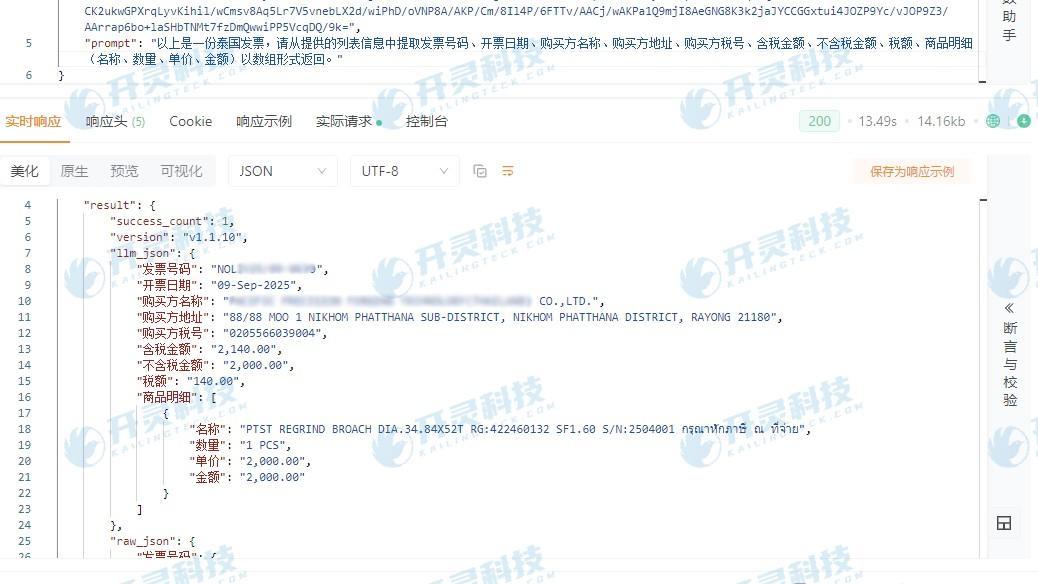
4. End-to-end automation: "Zero manual intervention" from recognition to entry Relying on general NLP information extraction technology, Kailing Technology OCR can directly extract key business information from Thai documents: - Invoice scenarios:Automatically capture core fields such as invoice number, issuance date, taxpayer identification number, amount excluding tax, and VAT rateparagraph; - Customs clearance documents:Automatically extracts key customs clearance information such as bill of lading numbers, container numbers, and declaration dates, and supports output in structured formats like JSON/Excel for seamless integration with enterprise ERP and financial software.
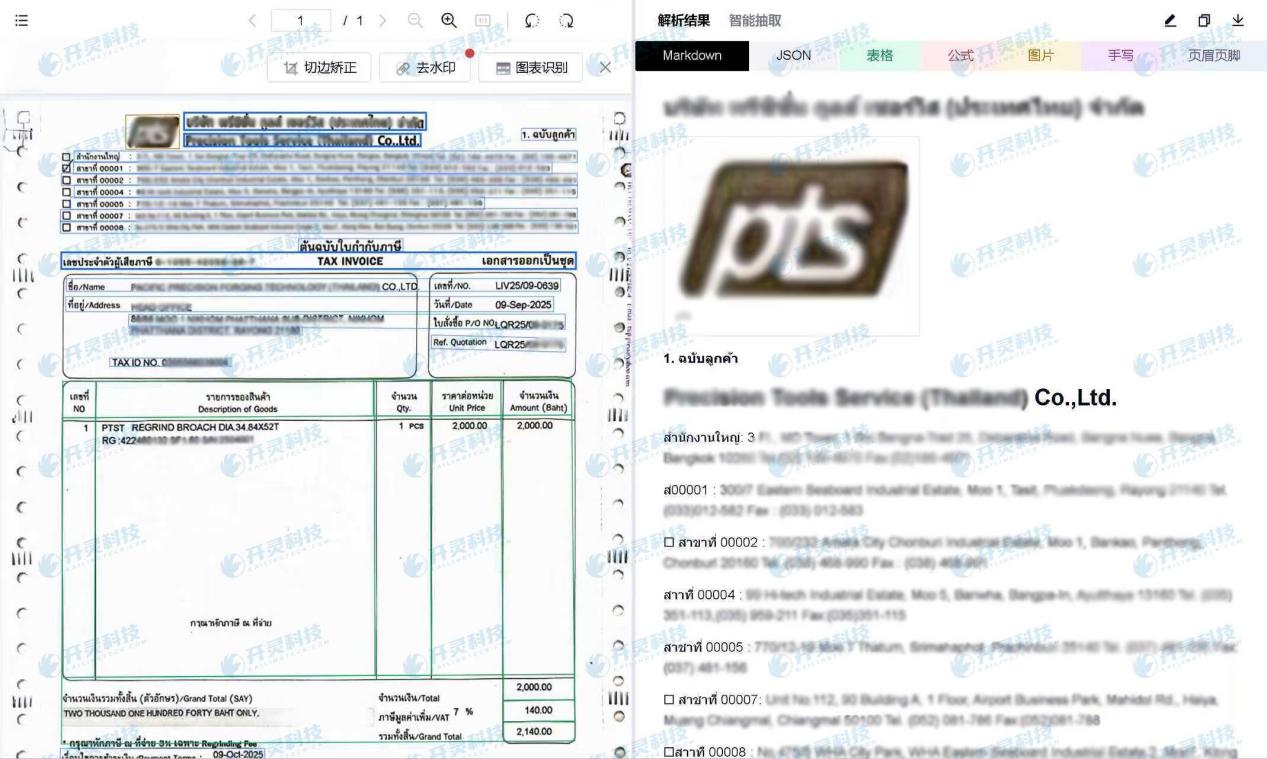
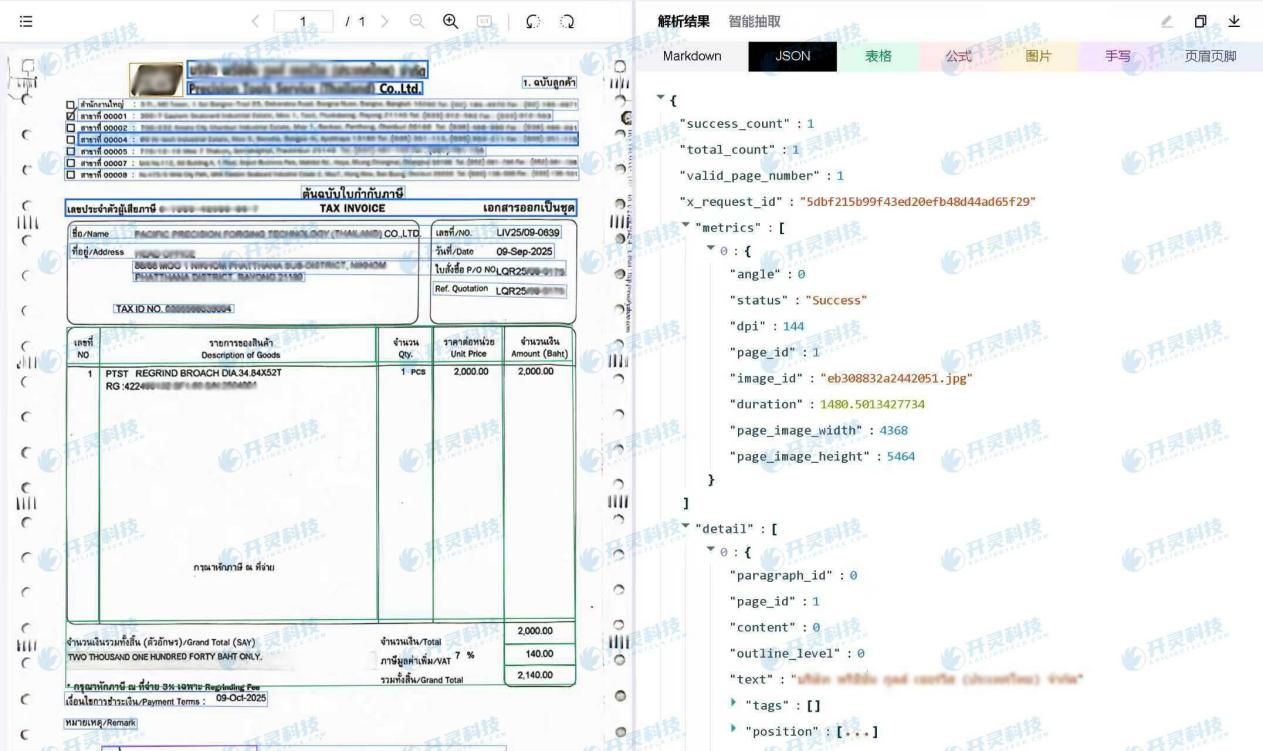
II. Case implementation: OCR recognition practice for four typical types of Thai documentsThe following combines a real case of a China-Thailand cross-border e-commerce enterprise served by Kailing Technology to break down the specific application process and effects of Kailing Technology OCR in four core document formats. Scenario 1: Standard Thai VAT invoice (ruled table + printed Thai script) - Document characteristics: A4 paper, with the invoice header at the top, a lined table in the middle, and the total amount and signature/seal section at the bottom. - Recognition pain point: table row-column alignment requires high precision, and Thai enterprise names contain uncommon characters、。 - OCR processing flow: Layout analysis: automatically locate the three major modules of "header area - table area - signature area" to avoid region confusion; Table detection: identify table border lines and determine cell positions; Text recognition: extract Thai/English text cell by cell, and for rare words, ensure accuracy through verification against a Thai lexicon; Structured output: export table data to Excel, with header information correspondingly filled into the "Supplier Name" and "Address" fields, and the total amount automatically linked to the "Total Amount" field. - Practical results: 3 seconds to recognize a single invoice, 100% accuracy in table data alignment, and no errors or omissions in Thai header recognition. Scenario 2: Thai freight document with handwritten notes (mixed handwritten and printed text) - Document characteristics: A5 thermal paper, with handwritten notes beside printed fields; some handwriting has connected strokes and alterations. - Recognition pain point: the boundary between handwriting and printed text is blurred, and alteration marks are easily misrecognized as characters. - OCR processing flow: Text classification: use multimodal models to distinguish "printed text areas" from "handwritten text areas" to avoid mutual interference; Handwriting adaptation: invoke a dedicated Thai handwriting model to semantically complete connected characters; Alterations and corrections: recognize alteration traces and confirm final values in context; Information association: bind handwritten notes with printed text and synchronously enter them into the logistics management system. - Practical results: 98.5% handwriting recognition accuracy, error rate in alteration scenarios controlled within 1%, and single-document processing efficiency improved 120 times compared with manual work. Scenario 3: Thai customs clearance document with multiple seals (seals + complex background) - Document characteristics: A3 paper, with a Thai Customs "inspected" stamp and a company "customs declaration seal"; the seals partially obscure printed fields such as "declaration date" and "customs clearance number"; slight scanning glare in the background. - Recognition pain point: seal obstruction leads to incomplete fields, and red seals are easily confused with the paper background color. - OCR processing flow: Seal detection: locate 2 seal areas through color thresholds and shape features; Region separation: for obscured fields, use a "seal removal algorithm" to restore the text underneath while retaining the seal cutout; Seal recognition: extract the Thai text within the seal and perform correlation verification against the customs clearance number; Layered output: text information and seal cutouts are stored separately, ensuring both field completeness and the evidentiary value of seals. - Practical results: 100% seal detection rate, 99% accuracy in restoring obscured fields, and customs clearance document review time shortened from 20 minutes per document to 3 minutes per document. Scenario 4: Thai procurement document integrating multiple tables (mixed ruled and unruled tables) - Document characteristics: A4 paper, containing 3 tables: "Supplier Information Table" at the top, "Commodity List Table" in the middle, and "Payment Terms Table" at the bottom, with no obvious dividing lines between the tables. - Recognition pain point: borderless table boundaries are blurred, making cross-table field confusion likely. - OCR processing flow: Layout segmentation: distinguish the independent regions of the 3 tables through text density and field semantics; Wireless table recognition: for the "supplier information table," construct virtual rows and columns through field positional relationships; Field mapping: logically associate the "quantity, unit price" in the "commodity list table" with the "payment ratio" in the "payment terms table" to avoid data conflicts; Template saving: save the document format as a dedicated template, so subsequent documents of the same type can be called directly without repeated configuration. - Practical results: 100% accuracy in distinguishing multiple tables, 0% field mapping error rate, and only 25 minutes to configure a template for a new document format. III. Practical results: the "triple breakthrough" in enterprise cross-border document processingAfter a certain China-Thailand cross-border e-commerce enterprise introduced Kailing Technology AI OCR, its Thai document processing workflow achieved significant optimization。 1. Efficiency improvement: A leap from "days" to "seconds"- Document processing timeliness: in the manual entry era, 100 Thai invoices required 3 people and 1 day to complete; after introducing AI OCR, 1 person can process 500 in 1 hour, a 24-fold efficiency improvement; - Customs clearance process acceleration: customs clearance document recognition and ERP entry are completed simultaneously, shortening customs clearance time from 3 working days to 1 working day and avoiding port demurrage charges caused by document delays. 2. Accuracy improvement: from "manual error correction" to "zero review" - Recognition accuracy: Monthly statistics show that the overall recognition accuracy of Thai documents reaches 99.2%, of which Thai printed text accuracy is 99.5% and handwritten text accuracy is 98.5%; - Error rate reduction: the error rate in the financial review stage dropped from 5.8% to 0.3%, reducing more than 10 financial adjustments per month caused by recognition errors. 3. Cost reduction: from "labor-intensive" to "automated"- Labor costs: document entry positions reduced from 3 to 1 (only responsible for reviewing exception documents), saving RMB 420,000 in annual labor costs; - Hidden costs: reducing customs clearance penalties caused by document errors and supplier reconciliation disputes, with annual hidden cost savings exceeding 200,000 yuan. Kailing Technology's multilingual OCR recognition technology provides a complete solution for enterprises processing invoices from Thailand and Southeast Asia. Through deep integration of deep learning algorithms and industry knowledge, we not only achieve high-precision text recognition but also provide full-process intelligent services from image processing to information extraction,Help enterprises reduce operating costs, improve data processing efficiency, and provide reliable technical support for global business expansion. For more customized solutions for OCR intelligent image recognition systems, please consult Kailing Technology:https://www.kailingteck.com/h-col-109.html 。 As a comprehensive business-finance-tax digitalization solution service provider, Kailing Technology provides business-finance-tax management digital transformation products and operational services for various government agencies, institutions, and large, medium, and small enterprises. The product line includes: Solutions for sales contract management system, procurement contract management system, fully digitalized Leqi interface project, automatic output VAT invoicing system, invoice issuance for individuals system, employee expense control and reimbursement system, input VAT invoice management system, supply chain collaborative reconciliation system, imaging OCR recognition system, automatic financial bookkeeping system, electronic accounting archives system and other businesses, comprehensively advancing the digitalization process across various fields. If you have any business-finance-tax digital transformation needs, welcome to contact us. Beijing Kailing Technology will serve you wholeheartedly.
|