010-6097 4119Book a Demo


Interpretation of the State Council's new rules: Practical manual for platform enterprises' tax-related information reporting (with one-click tax filing tool)Published: 2025-08-19 16:46 On June 13, 2025, the 61st executive meeting of the State Council adopted the Provisions on the Reporting of Tax-Related Information by Internet Platform Enterprises (State Council Decree No. 810), effective from the date of promulgation. This regulation aims to standardize platform enterprises' reporting of tax-related information to tax authorities, improve tax service efficiency, protect taxpayer rights, and promote the healthy development of the platform economy. As platform enterprises, compliant reporting of identity information, income information, and other information has become a legal obligation. Violators will face fines of 20,000 to 500,000 yuan or even the risk of suspension for rectification. In response to the pain point that small and medium-sized platform enterprises lack professional tax teams,WeCombined with in-depth interpretation of the original policy text, provide practical guidance and introduce Kailing TechnologyIntelligent tax calculationTax filing tools help you complete compliance tasks efficiently and with zero errors. I. In-Depth Interpretation of New Policy Regulations: Core Clauses and Compliance PointsBased on the Provisions on the Reporting of Tax-Related Information by Internet Platform Enterprises, enterprises need to focus on the following: 1. Reporting entity and scope (Article 2):▪ Platform enterprises include e-commerce platforms and legal/non-legal organizations providing services for online transactions (such as food delivery and ride-hailing platforms). ▪ Practitioners refer to natural persons who provide for-profit services in their own name through the platform (such as riders and streamers). ▪ Identity information (name, ID number, etc.) and income information (quarterly transaction amount, commission, etc.) must be reported to the competent tax authority.
2. Reporting time and content (Articles 3 and 4):▪ Initial reporting: Within 30 days after the new rules take effect or business begins, report the platform domain name, business type, unified social credit code, etc. ▪ Periodic reporting: Within the month following the end of the quarter, report the previous quarter's income information of practitioners. Exceptions: labor service personnel in delivery, domestic services, etc. who enjoy tax preferences may be exempt from reporting income information; information already reported through withholding filing need not be reported again.
3. Responsibilities and Penalties (Articles 6 and 10):▪ Platform enterprises are responsible for the authenticity and accuracy of information, but are not held liable for information errors not caused by their own fault. ▪ Violations (such as concealment, omission, or refusal to report) will face fines of 20,000-100,000 yuan; in serious cases, fines of 100,000-500,000 yuan and suspension of business for rectification.
4. Information sharing and security (Articles 8 and 9):▪ Tax authorities share data with departments such as industry and information technology and human resources and social security to avoid duplicate reporting by enterprises. ▪ Enterprises need to legally preserve tax-related information, and tax authorities shall keep data confidential and implement security management systems. Policy highlights: the new rules simplify the reporting process (such as eliminating duplicate reporting), but emphasize data accuracy. Small and medium-sized enterprises need to establish systematic reporting mechanisms to avoid manual operation risks.
II. Practical manual: a four-step compliance implementation guideCombined with Kailing Technology's solutions, enterprises can implement the new regulations step by step to ensure efficient compliance.
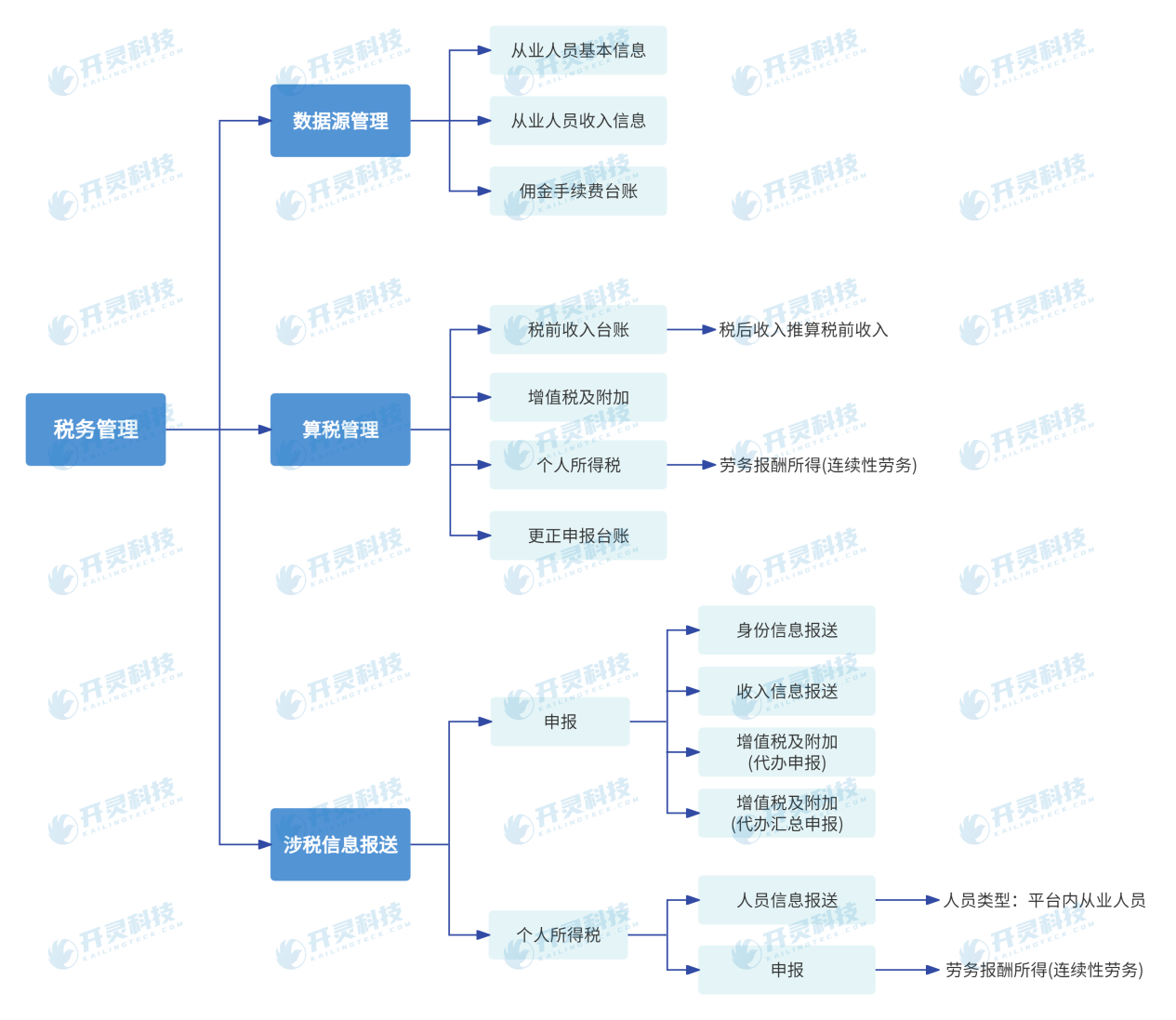
1. Step 1: Build a data source management systemAccording to Article 4 of the policy, "reporting identity information and income information," enterprises need to integrate multi-source data: ▪ Practitioner basic information database: records full lifecycle data of real-name registered users (such as ID cards and contact information), used to generate identity submission forms and individual income tax personnel information. ▪ Practitioner income information database: collects each transaction order (such as order amount and time) as the basis for income submission and tax calculation. ▪ Commission and fee ledger: track commissions collected by the platform, back-calculate income to prevent tax evasion (Article 4 of the policy emphasizes that platforms must report income back-calculation information). 2. Step 2: Real-time tax calculation managementArticle 4 of the policy requires platforms to file or withhold taxes on behalf of practitioners. Kailing Technology's "Tax Calculation Management Module" achieves automation: ▪ VAT and surcharge calculation: real-time calculation of taxes payable on behalf based on transaction orders (e.g., 6% VAT and surcharge rate). ▪ Individual income tax withholding: real-time calculation of individual income tax on remuneration for labor services (Article 4 of the policy clarifies that platforms must withhold individual income tax), supporting filing of continuous labor service income. ▪ Pre-tax income and correction management: if practitioners agree on after-tax settlement, the system automatically calculates pre-tax income; supports filing adjustments when cross-month payments fail (adjust current-period data before filing, and correction at the tax authority end is required after filing). 3. Step 3: Tax-related information reporting and filing executionArticle 4 of the policy requires quarterly reporting, and Article 5 emphasizes "reporting through online and other means." The Kailing module supports one-click operation: ▪ Filing module: - Identity information reporting: automatically generate the identity data set stipulated by policy. - Revenue information reporting: aggregates quarterly transaction data and generates standardized reports. - VAT and surcharges agency filing: agency filing for a single household or summary filing (Article 4 of the policy allows agency filing). ▪ Individual income tax module: - Personnel information reporting: synchronized to the tax authority system. - Individual income tax filing: designed specifically for platform practitioners, with income type matching "labor remuneration income (continuous labor services)." 4. Step 4: Risk Prevention and Optimization▪ Verification mechanism: regularly review the authenticity of information (Article 6 of the policy); Kailing tools have built-in validation rules to prevent concealment and omission. ▪ Secure storage: encrypted data storage (Article 9 of the policy), meeting tax authority security requirements. ▪ Cross-departmental collaboration: leverage information sharing (Article 8 of the policy) to reduce the burden of duplicate reporting. III. One-click tax filing tool: the value of Kailing Technology's tax calculation management moduleIn response to the pain points of small and medium-sized platform enterprises, Kailing Technology's solution, with one-click tax filing at its core, directly addresses policy compliance difficulties: ▪ Automated tax calculation and reporting, reducing manual error rates (avoiding the risk of fines of RMB 100,000 to 500,000), with compliance costs down 70%. ▪ Calculate taxes in real time (such as individual income tax withholding), improve efficiency, and support the deadline requirement of "within the month following the end of the quarter" under Article 4 of the policy. ▪ Attract practitioners to settle in: compliant and transparent settlement enhances trust (Article 1 of the policy, "protect taxpayer rights and interests"). ▪ Advantages During the Policy Dividend Period: As one of the first tools adapted to the new rules, it helps small and medium-sized platform enterprises quickly seize the market,ContentsAhead lies a golden window period. ▪ Direct connection to the tax authority interface (Article 5 of the policy, "provide direct connection reporting"), ensuring seamless data transmission. ▪ Modular design: data source management → tax calculation core → submission and filing, covering policy requirements across the full chain. State Council Decree No. 810 not only regulates the tax environment but also injects fair vitality into the platform economy. ThroughKailing Technology Solutions, enterprises can systematically implement the new regulations: from data integration to real-time tax calculation, and then to one-click submission. Kailing Technology lowers the compliance threshold through technological innovation, allowing small and medium-sized enterprises to focus on business innovation and avoid penalty risks. ImmediatelyConsult Kailing Technology, seize policy dividends,Make compliance a growth engine:https://www.kailingteck.com/ 。 As a comprehensive business-finance-tax digitalization solution service provider, Kailing Technology provides business-finance-tax management digital transformation products and operational services for various government agencies, institutions, and large, medium, and small enterprises. The product line includes: Solutions for sales contract management system, procurement contract management system, fully digitalized Leqi interface project, automatic output VAT invoicing system, invoice issuance for individuals system, employee expense control and reimbursement system, input VAT invoice management system, supply chain collaborative reconciliation system, imaging OCR recognition system, automatic financial bookkeeping system, electronic accounting archives system and other businesses, comprehensively advancing the digitalization process across various fields. If you have any business-finance-tax digital transformation needs, welcome to contact us. Beijing Kailing Technology will serve you wholeheartedly.
|