010-6097 4119Book a Demo


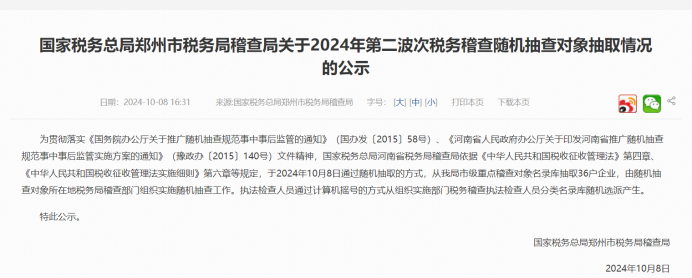
Under the "tax governance by data" environment, enterprise tax compliance is imperativePublished: 2024-10-23 17:31 In recent years, tax collection and administration reform has continued to deepen, successfully building a new tax supervision system with "double random, one public" supervision and "Internet + supervision" as the main means, key supervision as a supplement, and "credit + risk" supervision as the foundation. It has completed a magnificent transformation from "tax control by invoices" to classified and precise "tax governance by data," and tax law enforcement has also achieved a major breakthrough from experience-based enforcement to scientific and precise enforcement, with smart tax construction beginning to show results. In the future, tax authorities will further focus on "tax governance through data," fully leveraging modern information technology to lead tax governance toward a more refined, precise, and intelligent modern direction. It can be seen that tax risk prevention and control is of extraordinary significance to enterprises, as it relates to their lawful and compliant operations and sustainable development. Enterprises must attach great importance to it and make every effort to shore up this weak link in tax risk. At the same time, many regions have issued announcements and public disclosures on launching random tax audit inspections this year, making the building of corporate tax compliance even more urgent.
Currently, most enterprises have already raised their awareness of tax compliance and increased their attention to tax risks. However, the prevention and control of tax-related risks is quite difficult. On the one hand, enterprises lack professional risk analysis tools and have not built risk warning mechanisms, so that when responding to risks after the fact they are caught off guard, resulting in direct economic losses such as supplementary tax payments, late fees, and fines. ▪ Tax-related data collection is difficult and standards are inconsistent Tax data sources are complex and scattered across heterogeneous systems. Data in different systems may have inconsistent standards, and manual data entry is prone to errors, which is extremely unfavorable for the analysis and application of tax data. ▪ Defects in enterprise internal management and poor information communication Enterprises lack a dedicated tax risk management mechanism internally, and their ability to identify, assess, and analyze tax risks is insufficient. Moreover, for large enterprises with complex businesses, the tax management processes of various subsidiaries are unclear, analysis standards are inconsistent, and information communication is not smooth. The group cannot examine risks from an overall perspective, and centralized control capability is weak. ▪ Tax risk assessment is fraught with difficulties, lacking effective assessment tools Many enterprises rely only on experience-based judgment and subjective estimation, lacking an objective, intelligent professional risk assessment system. For example, they lack risk analysis of the reconciliation relationships in tax filing materials and cannot promptly eliminate abnormal conflicting data in filing materials. These situations easily trigger tax authority assessments or even audits, creating hidden risks of tax fines or late fees. ▪ The external environment is complex and changes frequently, and tax management costs are high Tax policies are complex and changeable, and enterprise finance personnel often find it difficult to fully and accurately understand the specific requirements of each policy. At the same time, tax authority policies differ across regions, which brings huge challenges to enterprises whose business covers multiple regions. Kailing TechnologyIt is recommended to build a one-stop tax risk management platform. Facing the complex internal and external tax environment,Kailing TechnologyBased on long-term business-finance-tax digital service and practical experience, provide enterprises with a one-stop intelligent tax risk management platform. Based on tax-related data authorized by the enterprise, it uses visual methods to analyze risks from multiple dimensions and establish a unified risk control indicator system。Based on the enterprise's financial data, filing data, and invoice data, and grounded in tax policies and regulations, it combines analytical experience and risk models with the software's tax health algorithms to assist enterprises in conducting multi-scenario, multi-dimensional, and all-round risk control over the tax-related data of themselves and their subsidiaries.
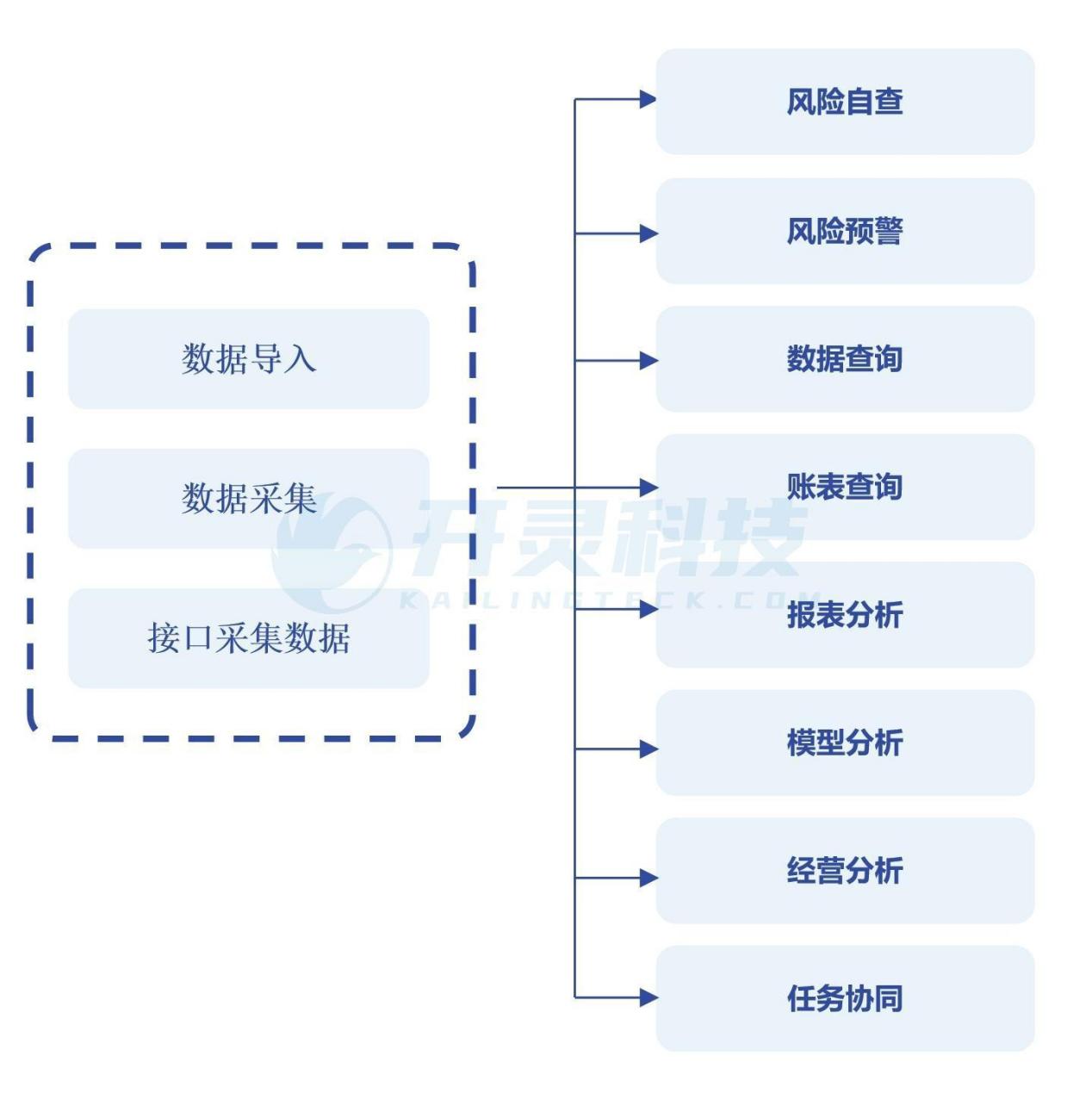
1. Diversified data collection supportData collection: Collect data through interfaces, automatically + report external data, including public opinion data, customs data, bank data, business registration data, public security data, etc. Data extraction capability: intelligent collection of financial data, industry data, and cloud data, covering 400+ categories, 5,000+ interfaces, and 600+ versions. Data factory: Extract, govern, and analyze data from enterprise operations and project management systems, enterprise financial management systems, financial systems, tax systems, etc., to achieve data sharing. 2. Construction of a risk indicator system and risk control model across all dimensionsIndicator sorting: combining the tax authority's risk indicator design and risk survey results, summarizing usable risk compliance indicators. Indicator selection: through enterprise business, confirm compliance detection indicators that fit the enterprise's actual business scenarios. Model construction: retrieve sample companies' business data, financial data and tax return data, and use the model to verify the feasibility of the risk screening model. Model optimization: based on comparison with risks identified through enterprise analysis and combined with research results, adjust indicator weights to optimize the risk screening model so that its risk investigation results are more accurate. Indicator expansion: supplementing the indicator library with new indicators. 3. Related-Party Risk Analysis and External Risk PreventionReview risks: including tax filing risk review, financial report risk review, and invoice risk review. Guided response: provide abnormal risk details, display of involved data, penetrating analysis and positioning, as well as risk detail descriptions, abnormal warning dissection, intelligent matching guidance, and analysis, judgment, and response. Positioning data: conduct account fluctuation analysis, intelligent voucher assessment, tax-related indicator analysis, and sensitive business analysis. Comprehensive self-inspection: Achieve full-chain tax risk monitoring, monitor various tax-related risks across all business scenarios, and generate a health check report with one click. 4. Precise control across the entire risk processRisk introduction: introduce internal and external risks and provide intelligent guided response. Intelligent matching: Based on risk detection results, intelligently match response plans. Response execution: Conduct risk response according to the response plan. Response report: Record the response process and results, forming a response report. Retrieval and query: convenient for users to retrieve and query risk response related information. 5. Visualization of risk results and decision supportTax type inspection: lists a large number of common tax-related issues by tax type, and automatically displays the relevant models required for inspection based on these issues. Intelligent self-inspection: covers comparison analysis, model analysis, project analysis, and industry analysis. Free account viewing: general ledger - subsidiary ledger - vouchers - fixed assets - inventory, with various analysis tools. Self-inspection report: manual analysis + intelligent analysis results are summarized to form a self-inspection report. Derived Tools: Provides various commonly used and efficient analysis tools such as sorting, red-letter detection, and voucher filtering. Anomaly handling: Tax-related issues in the operation process are recorded at any time, forming self-check documents that are traceable, auditable, and printable. Revenue statistics, cost and expenses, profit statistics,Assets and Liabilities: Display the enterprise's revenue, costs, profits, assets and liabilities, and other conditions. Input - Sales, regional statistics, invoice type statistics, trend statistics: analyze statistics and trend changes of input, sales, regions, invoice types, etc. VAT - income tax, tax amount statistics, tax burden statistics, trend changes: display tax amount statistics, tax burden statistics, and trend changes for VAT and income tax. Risk statistics, internal risks, trend statistics: statistics on risk situations, including trend statistics of internal risks. Financial analysis, invoice analysis, filing analysis, business analysis, risk introduction: conduct comprehensive visual analysis across the five dimensions of finance, invoices, filing, operations, and risk, providing users with strategic support such as statistical analysis and decision-making planning.
Typical cases of tax-related risk control Project Background:Under the broader environment of "Golden Tax Phase IV" tax governance by data, a certain group enterprise lacks a centralized tax management platform and has relatively weak control over its subsidiaries, which can easily trigger tax risks and bring unnecessary economic losses to the group. Therefore, the enterprise urgently needs to focus on building an intelligent tax risk management platform, strengthening the enterprise's risk defense line through centralized control and proactive prevention. Project Plan:Build a risk control indicator system based on enterprise tax-related data, use risk control indicators to detect potential enterprise risks, and achieve real-time monitoring and early warning of enterprise tax risks. At the same time, visualize and analyze risk detection results across multiple dimensions, providing a basis for group tax risk control and tax planning, enhancing the enterprise's ability to withstand risks, and building an information platform covering risk identification, analysis and assessment, and response for the enterprise. 1. Data collection: establish a tax-related data warehouse, uniformly collect relevant tax-related data of each entity, form a comprehensive tax-related data warehouse, and provide a reliable source for the efficient application of tax data. 2. Indicator management: Relying onKailingThe risk system's mature indicator system connects with enterprise tax-related data to build a risk indicator and scanning scheme system tailored to the customer's industry characteristics. 3. Risk analysis and response: monitor various risk information of the group from the dimensions of the enterprise group and individual tax numbers, and analyze and display risk identification results in a visual and multi-dimensional manner. At the same time, provide response solutions from a business perspective, providing a basis for the group's tax compliance control. 4. Risk report: regularly generate risk analysis reports for single tax number entities based on enterprise risk monitoring conditions, comprehensively and deeply analyzing the overall tax risk situation of the enterprise. Value enhancement:Shift from passive post-event risk response to proactive pre-event risk analysis; expand from single-business-domain risk analysis to cross-business-domain risk analysis; upgrade from decentralized manual risk response to group digital risk analysis; transform from decentralized manual risk self-inspection to group-unified-standard assessment; upgrade from manual risk aggregation to automated risk detection and report generation. Enterprises should strengthen tax risk management and establish a complete tax risk control system to respond to changes in the tax collection and management environment under China Golden Tax Phase IV. ThroughKailing Tax Risk Control Monitoring System Solution, enterprises can promptly identify and resolve potential tax risks, improve financial management, reduce tax costs, and enhance market competitiveness. If your enterprise wants to learn more about relevant information and tax solutions, you are welcome to contactKailing TechnologyContact. As a comprehensive business-finance-tax digitalization solution service provider, Kailing Technology provides business-finance-tax management digital transformation products and operational services for various government agencies, institutions, and large, medium, and small enterprises. The product line includes: Solutions for businesses including sales contract management system, procurement contract management system, fully digitalized Leqi interface project, output automatic invoicing system, employee expense control and reimbursement system, input VAT invoice management system, supply chain collaborative reconciliation system, image OCR recognition system, automatic financial bookkeeping system, and electronic accounting archives system, comprehensively driving the digitalization process across various fields. If you have any business-finance-tax digital transformation needs, welcome to contact us. Beijing Kailing Technology will serve you wholeheartedly.
|