010-6097 4119Book a Demo


Kailing Technology industry experts authoritatively interpret the Guidelines for the Construction of Enterprise Digital Archives (Rooms)Published: 2024-10-21 16:37 With the rapid development of information technology, the construction of enterprise digital archives (rooms) has become a key measure for enterprise archives work to adapt to the needs of the times. The Guidelines for the Construction of Enterprise Digital Archives (Rooms) organized and compiled by the National Archives Administration provide enterprises with comprehensive and systematic construction guidance. Original text description: I. Concept and characteristics of enterprise digital archive repository (room)
Authoritative interpretation: (1) Concept An enterprise digital archive repository (room) is an integrated management system platform through which enterprises use modern information technology to solidify archive work business processes, collect, organize, and preserve electronic archives or other digital resources of the enterprise or enterprises with asset affiliation relationships with it, and provide archive information services and shared utilization through the network. (II) Basic characteristics ▪ Digitization of archive resources Through electronic file archiving and digitization of traditional carrier archives, archive information is stored in digital form. This makes archive storage and retrieval more efficient and convenient, providing enterprises with faster access to archive information. ▪ Digitalization of archive management Embed the archive management business process into the electronic archive management system to achieve automated management of digital archive resources. The collection, management, storage, and use of archives are all completed with information technology, greatly improving the efficiency and accuracy of archive management. ▪ Knowledge-Based Archive Services Use concepts and technologies such as knowledge management and big data to conduct in-depth processing and knowledge-based organization of archive information, so as to meet enterprises' diverse needs for archive utilization and provide decision support services for enterprises. II. Build objectives and principlesOriginal text description:
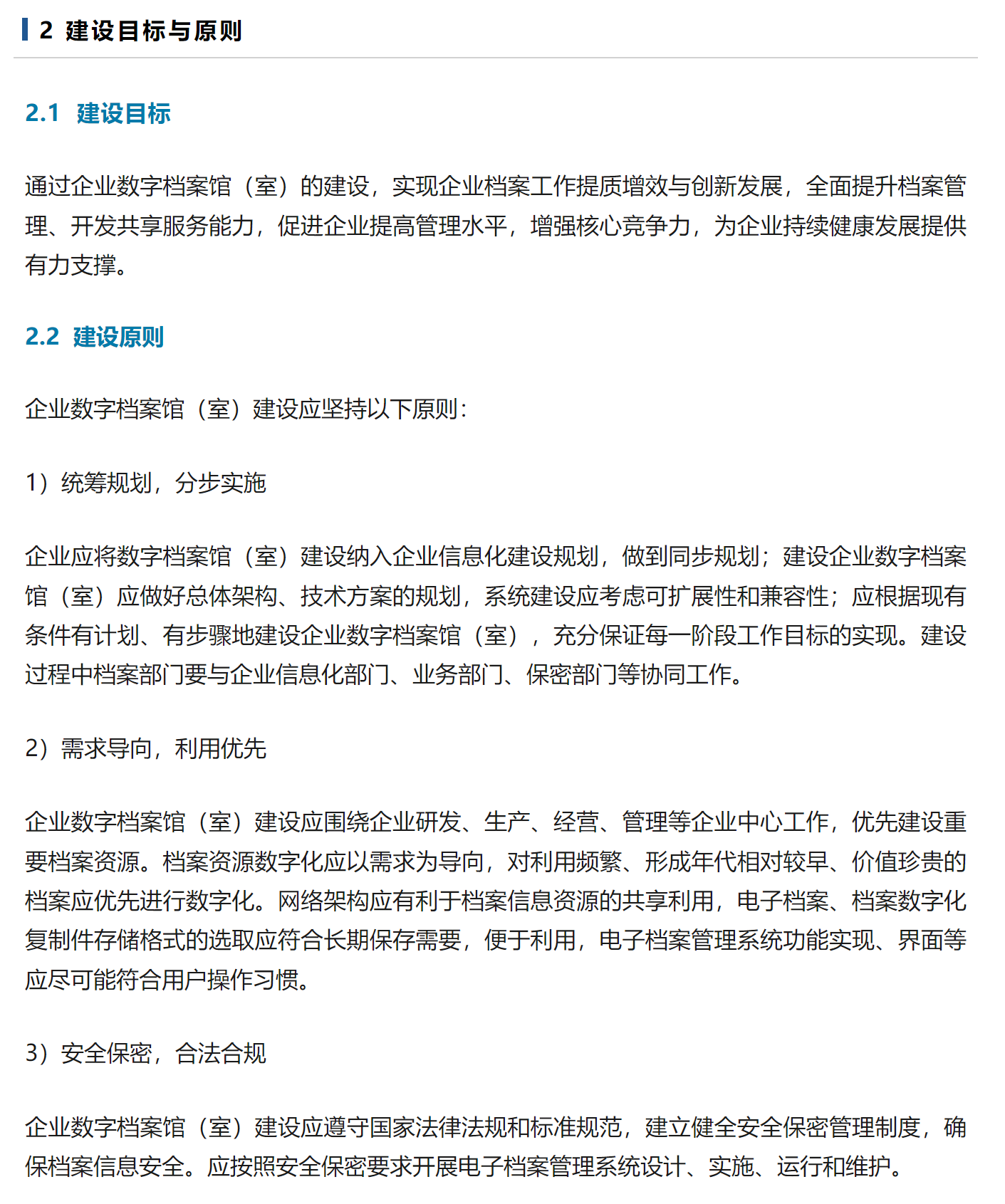
Authoritative interpretation: (1) Construction Goals Achieve quality and efficiency improvement and innovative development in enterprise archive work, enhancing archive management and development-sharing service capabilities, promoting enterprise management level improvement, strengthening core competitiveness, and providing strong support for sustained and healthy enterprise development. (II) Construction principles ▪ Overall planning, step-by-step implementation Enterprises should incorporate the construction of digital archives (rooms) into their corporate informatization plans, plan the overall architecture and technical solutions well, and consider the scalability and compatibility of the system. At the same time, they should build in a planned and step-by-step manner according to existing conditions, and work collaboratively with multiple departments within the enterprise. ▪ Demand-oriented, utilization priority Centered on the construction of enterprise core work, prioritize the digital utilization of frequently used and valuable archives. The network architecture should facilitate sharing and utilization, the storage format of electronic archives should meet the requirements for long-term preservation and easy utilization, and system functions and interfaces should conform to user operating habits. ▪ Secure and confidential, legal and compliant Comply with national laws, regulations, and standards, establish and improve security and confidentiality management systems, and ensure archive information security. In the design, implementation, operation, and maintenance of the electronic archive management system, security and confidentiality requirements must be strictly followed. III. Infrastructure constructionOriginal text description:
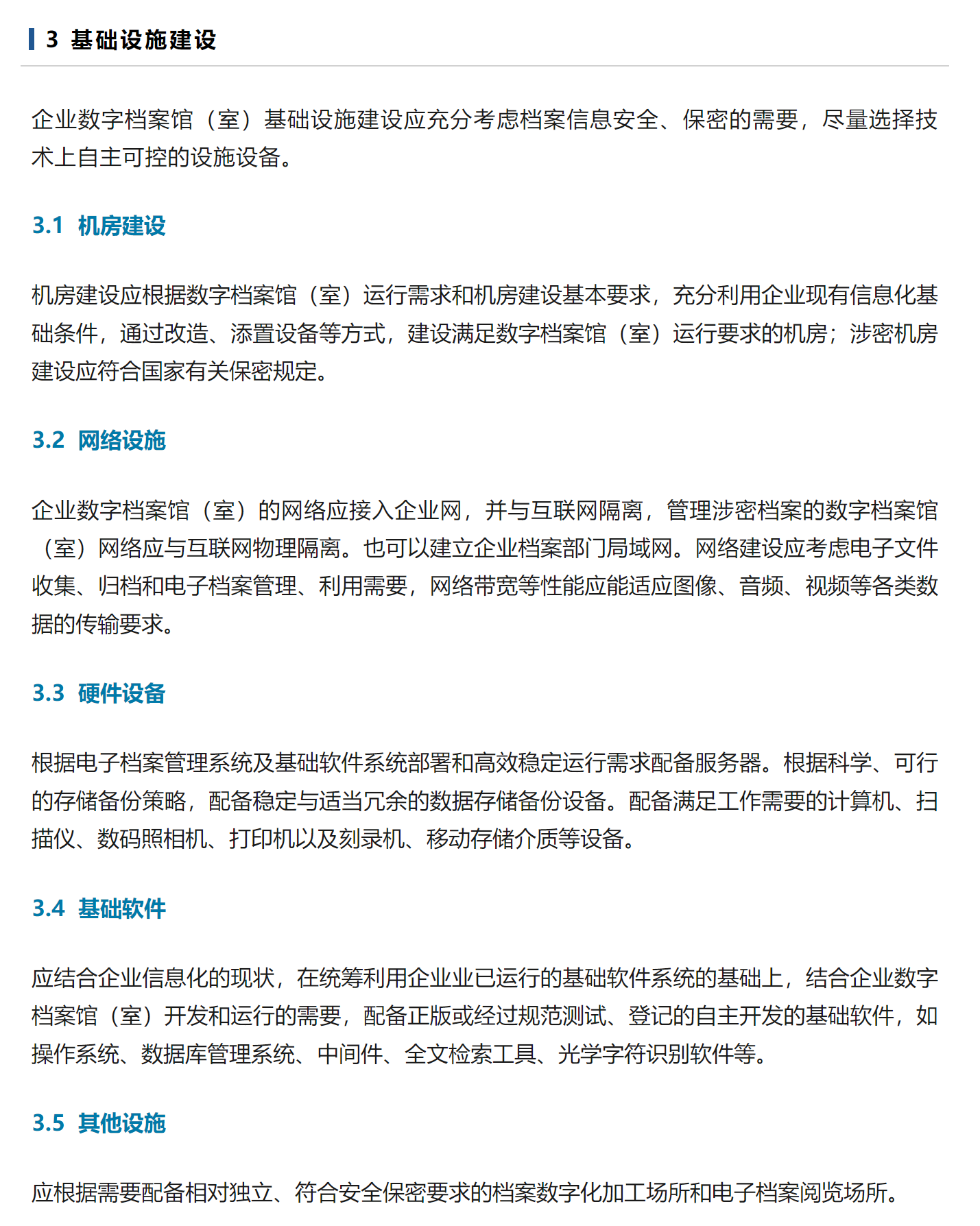
Authoritative interpretation: (1) Server Room Construction According to the operational needs of digital archives (rooms) and the basic requirements for computer room construction, build the computer room using the enterprise's existing informatization infrastructure; classified computer rooms must comply with national confidentiality regulations. (II) Network Facilities The network should be connected to the enterprise network and isolated from the internet; networks involving confidential archives require physical isolation, and an enterprise archives department LAN can also be established. The needs of electronic file collection, archiving, electronic archives management, and utilization must be considered to meet various data transmission requirements. (3) Hardware equipment Equip servers, data storage and backup devices, computers, scanners, and other equipment to meet the deployment and efficient, stable operation needs of the electronic archives management system and basic software systems. (4) Basic software Based on the enterprise's current informatization status, equip licensed or self-developed basic software, such as operating systems and database management systems. (5) Other facilities Equip archive digitization processing sites and electronic archive reading sites that meet security and confidentiality requirements. IV. Electronic Archives Management System DevelopmentOriginal text description:
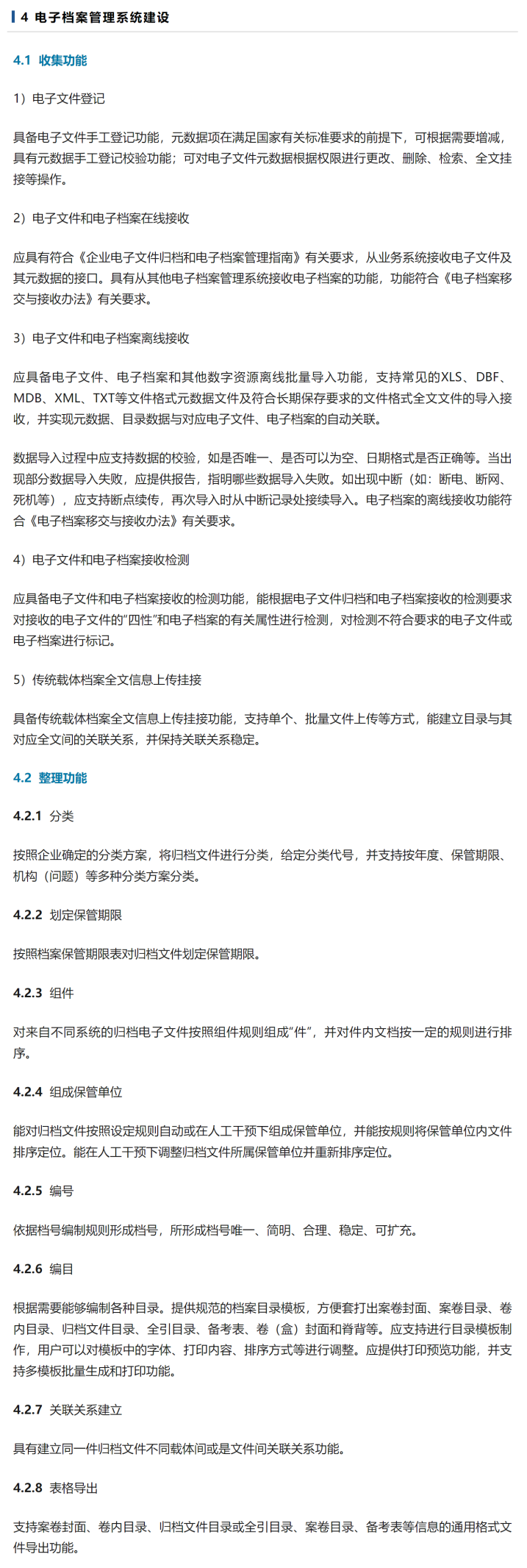
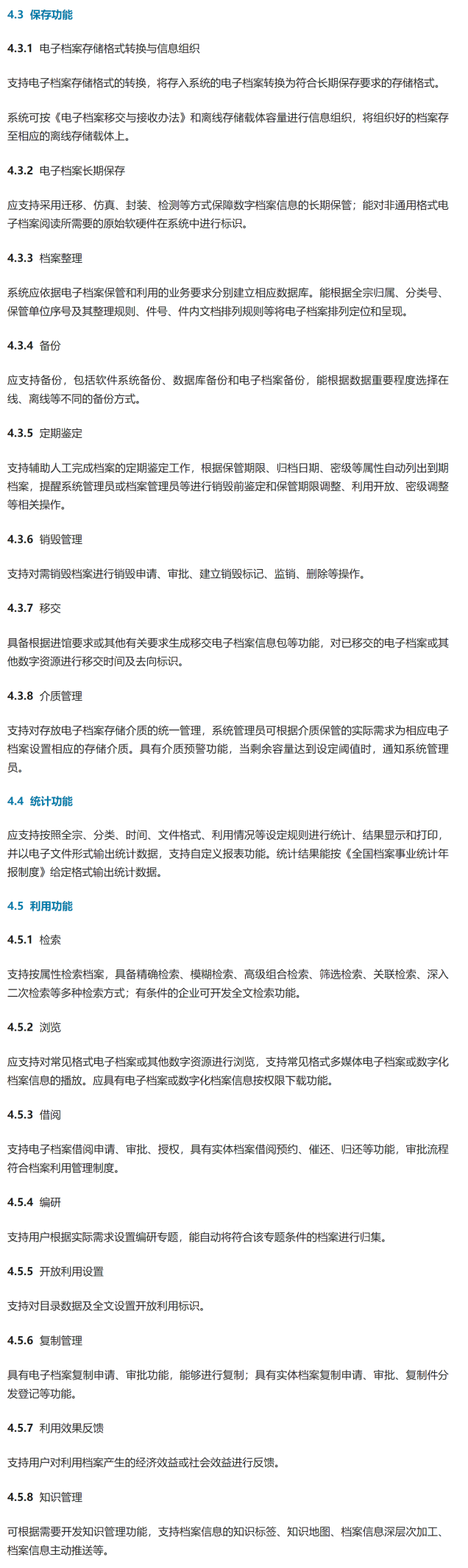
Authoritative interpretation: (1) Collection Function ▪ Registration of electronic files Equipped with manual registration and verification functions, able to perform various operations on metadata. ▪ Online receipt of electronic files and electronic archives Has interfaces compliant with the requirements of relevant guidelines and measures, able to receive from business systems and other management systems. ▪ Offline receipt of electronic files and electronic archives Supports offline batch import of multiple file formats, with data validation during import and support for resumable upload. ▪ Receipt and testing of electronic files and electronic archives Can detect the relevant attributes of received electronic files and electronic archives, and mark those that do not meet requirements. ▪ Upload and linking of full-text information for traditional carrier archives Supports single and batch upload, establishing associations between directories and full text. (II) Organizing function Includes functions such as classification, determination of retention periods, assembly, formation of custody units, numbering, cataloging, establishment of associated relationships, and table export, ensuring standardized organization of archived documents. (3) Preservation function ▪ Electronic archive storage format conversion and information organization Supports format conversion, organizing information as required and storing it in offline storage media. ▪ Long-term preservation of electronic archives Use multiple methods to ensure long-term preservation, and identify the software and hardware required to read non-common formats. ▪ Archive Arrangement Establish a database according to business requirements to arrange, locate and present electronic archives. ▪ Backup Supports multiple backup methods, including software, database, and electronic archive backup. ▪ Periodic appraisal Assists staff in completing periodic appraisals and reminds relevant operations. ▪ Destruction management Supports a series of operations including destruction application and approval. ▪ Transfer Equipped with functions such as generating transfer information packages, marking the transfer time and destination. ▪ Medium Management Unify management of storage media, with early warning functions. (4) Statistics function Supports statistics according to multiple rules, can output statistical data, and supports custom report functions. (5) Utilization functions ▪ Retrieval Supports multiple search methods, including exact search and fuzzy search. ▪ Browse Supports browsing and downloading of common formats, and playback of multimedia archives. ▪ Borrowing Supports functions such as borrowing applications and approvals for electronic archives and physical archives. ▪ Compilation and research Supports setting up compilation and research topics, collecting archives that meet the conditions. ▪ Open Utilization Settings Supports setting open utilization identifiers for catalog data and full text. ▪ Copy management Has application and approval functions for electronic archive and physical archive duplication. ▪ Utilization effect feedback Supports user feedback on the benefits generated by archive utilization. ▪ Knowledge management Knowledge management functions can be developed to process and push archive information as knowledge. (6) System management functions ▪ Log management Record system-related information and provide retrieval, audit, and statistics functions. ▪ System Settings Supports process-based archive management, with maintenance of code tables and metadata, and fonds setup functions. ▪ User management Supports entry and reading of user information, supports binding of users to IP addresses, and separation of the "three roles." ▪ Organizational structure setup management Supports entry and reading of organizational information, and supports multi-level management. ▪ Permission management Ensure legitimate operations by authorized users, finely control access and usage permissions, and set validity periods. ▪ Multi-fonds management Establish fonds units, support fonds group management, with each fonds unit relatively independent. ▪ Work process record management Record management process information in detail. (7) Auxiliary management functions for traditional carrier archives ▪ Information collection for traditional carrier archives Equipped with directory cataloging and full-text linking functions, verifying data during collection. ▪ Archive location management Suggest and locate a storage location according to the rules. ▪ Intelligent warehouse management Qualified units can achieve intelligent management of physical archives, including positioning, outbound, inbound, inventory counting, and other operations, as well as temperature and humidity control. (8) Other optional functions Enterprises can add functions such as document material distribution control according to their own needs. V. Digital archive resource developmentOriginal text description:
Authoritative interpretation: (1) Digitization of traditional carrier archives ▪ Content and scope Includes multiple archive types such as management archives, core product or business archives, and scientific research archives. Except in certain cases, digitization should be carried out as much as possible, and different archive types have corresponding digitization sequences. ▪ Technical Requirements Proceed according to relevant specifications, such as the Specifications for Digitization of Paper Archives (DA/T 31 - 2017), etc. (II) Electronic File Archiving The scope includes electronic documents formed in various business activities of the enterprise. Electronic documents formed by information systems should be archived even if they are not on the enterprise's own servers. Relevant information systems should have archiving functions, and during construction, electronic document archiving for some systems should be completed. (3) Special topic database construction Based on existing digital archive resources, organize archives for specific topics, such as corporate leadership, meetings, policies and regulations, and other thematic databases. Six, Policy and standard developmentOriginal text description:
Authoritative interpretation: (1) System development Formulate a series of systems including job responsibilities for digital archive repository (room) personnel and system operation and maintenance management systems. (II) Standards and specifications development With reference to relevant national standards and specifications and in light of enterprise realities, form a system of standards, specifications and implementation requirements for the receipt, management, storage and use of electronic archives, including specifications for each stage such as digitization of traditional carrier archives and archiving of electronic documents. Seven, Security and confidentiality system constructionOriginal text description:
Authoritative interpretation: Strengthen security management, comply with confidentiality provisions, configure security equipment, control the scope of information utilization, formulate review systems, control data access permissions, and establish complete management specifications. Classified systems shall be built in accordance with the hierarchical protection management requirements for classified information systems, and non-classified systems shall determine security levels and be built by reference to relevant standards. Eight, Funding and talent guaranteesOriginal text description:
Authoritative interpretation: (1) Funding guarantee Includes various costs such as hardware procurement fees and software development fees. Enterprises should formulate funding plans to ensure implementation. (2) Talent guarantee Train the skills of archival department personnel and introduce relevant talent to meet construction and operation needs. IX. Build stepsOriginal text description:
Authoritative interpretation: (1) Project planning ▪ Establish a project working organization A project team composed of personnel from the enterprise's archives department, informatization department, confidentiality department, etc., is responsible for planning, implementation, inspection, and other work. ▪ Formulate project plan Includes current situation research, feasibility study, requirement analysis, and preparation of construction plans. For classified systems, a security and confidentiality plan should also be prepared. (2) Project initiation Organize expert demonstration and review, and apply for project initiation after approval. (3) Project implementation ▪ Talent team building Improve the skills of existing personnel or bring in new personnel. ▪ Improvement and standardization of basic business Improve the archives management system, rationalize systems and mechanisms, standardize business processes, and unify related documents. ▪ Formulation of system standards and specifications Adopt or establish institutional standards and specifications to ensure standardized operations. ▪ Hardware Device Configuration Relying on existing infrastructure or equipped according to requirements. ▪ Electronic Archives Management System Implementation Includes stages such as system development, basic data preparation, system testing, personnel training, system cutover and trial operation, and system evaluation and acceptance. ▪ Digitalization implementation for traditional carrier archives Advance step by step according to certain principles; it can be completed independently or outsourced, and different types of archives have different digitization methods. ▪ Archive thematic database construction Build with demand as the orientation. ▪ Implementation of electronic file archiving Develop a plan based on the assessment and carry out work as required. (IV) Project Acceptance Form relevant reports, organize expert acceptance, and apply for evaluation acceptance. (5) Project operations and maintenance Carry out work with reference to relevant specifications, including establishing organizational structures, determining operation and maintenance objects and content, and selecting operation and maintenance models. Building an enterprise digital archive repository (room) is a systematic project requiring collaboration across enterprise departments. In accordance with guideline requirements, it should be comprehensively advanced from multiple aspects including infrastructure construction, electronic archive management system construction, digital archive resource construction, institutional and regulatory construction, security and confidentiality system construction, funding and talent guarantees, and construction steps, so as to realize the digital transformation of enterprise archive work, improve enterprise archive management level and service capabilities, and provide strong support for the sustainable development of the enterprise. Kailing TechnologyDigitalThe archive system is powerful, covering collection, organization, preservation, statistics, utilization, system management, and many other aspects, all in line with construction guideline requirements. In terms of security and confidentiality, it complies with laws and regulations and adopts encryption technology and strict permission management. It has auxiliary management functions for traditional carrier archives and provides enterprises with a one-stop solution. Kailing TechnologyCanHelp enterprises efficiently build and manage digitalArchivearchives, improving the quality and efficiency of archive work, providing strong support for the sustainable development of enterprises, and is an advanced choice for enterprise archive management.Click the link to view details and contact us for a trial:https://www.kailingteck.com/h-col-110.html。 As a comprehensive business-finance-tax digitalization solution service provider, Kailing Technology provides business-finance-tax management digital transformation products and operational services for various government agencies, institutions, and large, medium, and small enterprises. The product line includes: Sales contract management system, procurement contract management system, fully digitalized Leqi interface project, output autosolutions for invoicing systems, employee expense control and reimbursement systems, input VAT invoice management systems, supply chain collaborative reconciliation systems, imaging OCR recognition systems, automated financial bookkeeping systems, electronic accounting archives systems, and other businesses, comprehensively advancing digitalization across various fields. If you have any business-finance-tax digital transformation needs, welcome to contact us. Beijing Kailing Technology will serve you wholeheartedly. |