010-6097 4119Book a Demo


Kailing Technology archives industry expert authoritative interpretation of the "14th Five-Year Plan National Archives Development Plan"Published: 2024-09-30 16:48 As an important carrier for recording history and transmitting civilization, archives play an irreplaceable role in social development. The "14th Five-Year Plan" period is the first five years of China's new journey to fully build a modern socialist country, and also a critical period for the high-quality development of archive undertakings. The "14th Five-Year Plan for National Archive Development," issued by the General Office of the CPC Central Committee and the General Office of the State Council, pointed the way for archive work during this period. I. Review and outlook of the development environmentOriginal text description:
Authoritative interpretation: (1) The development achievements of the "13th Five-Year Plan" laid a solid foundation During the "13th Five-Year Plan" period, China's archival undertaking made considerable progress. In serving the central overall situation, archival work was precisely integrated into national strategies, performed outstandingly in major activities and work, and its capacity for policy consultation continued to improve. Legal construction achieved fruitful results: the newly revised Archives Law was promulgated and implemented, supporting regulations were continuously improved, law enforcement and supervision became more standardized, and archival awareness across society increased. Archival resources became increasingly rich and diverse, with a more reasonable structure and a substantial increase in holdings. Public service capacity continued to improve, with a considerable number of archives opened, numerous users, and continuous progress in cross-regional and cross-departmental access and use. Informatization construction accelerated, digital archive (room) construction achieved remarkable results, and important breakthroughs were made in electronic document archiving and management. Security protection was strengthened, archive repository facilities improved, and security risk prevention and control capacity enhanced. Talent team construction made obvious progress, with professional talent training and title evaluation becoming more scientific and reasonable. External exchanges deepened increasingly, and the influence of Chinese archival culture continued to expand. (2) Facing new situations and challenges Entering the "14th Five-Year Plan" period, the archival cause faces both opportunities and challenges. With the construction of a socialist country under the rule of law and the implementation of the newly revised Archives Law, higher requirements have been raised for governing archives according to law. As people's living standards improve, demand for archival information and culture grows, prompting the need to further improve archive opening and utilization services. The widespread application of a new generation of information technology has changed the environment, objects, and content of archival work, requiring innovation in work concepts and models and the realization of comprehensive digital transformation and intelligent upgrading. At the same time, issues in archival work involving concepts, systems, technology, and talent, as well as imbalances in regional and industry development, insufficient utilization services, and weak grassroots foundation work, all need to be resolved in the future. II. Overall requirements clarify the development directionOriginal text description:
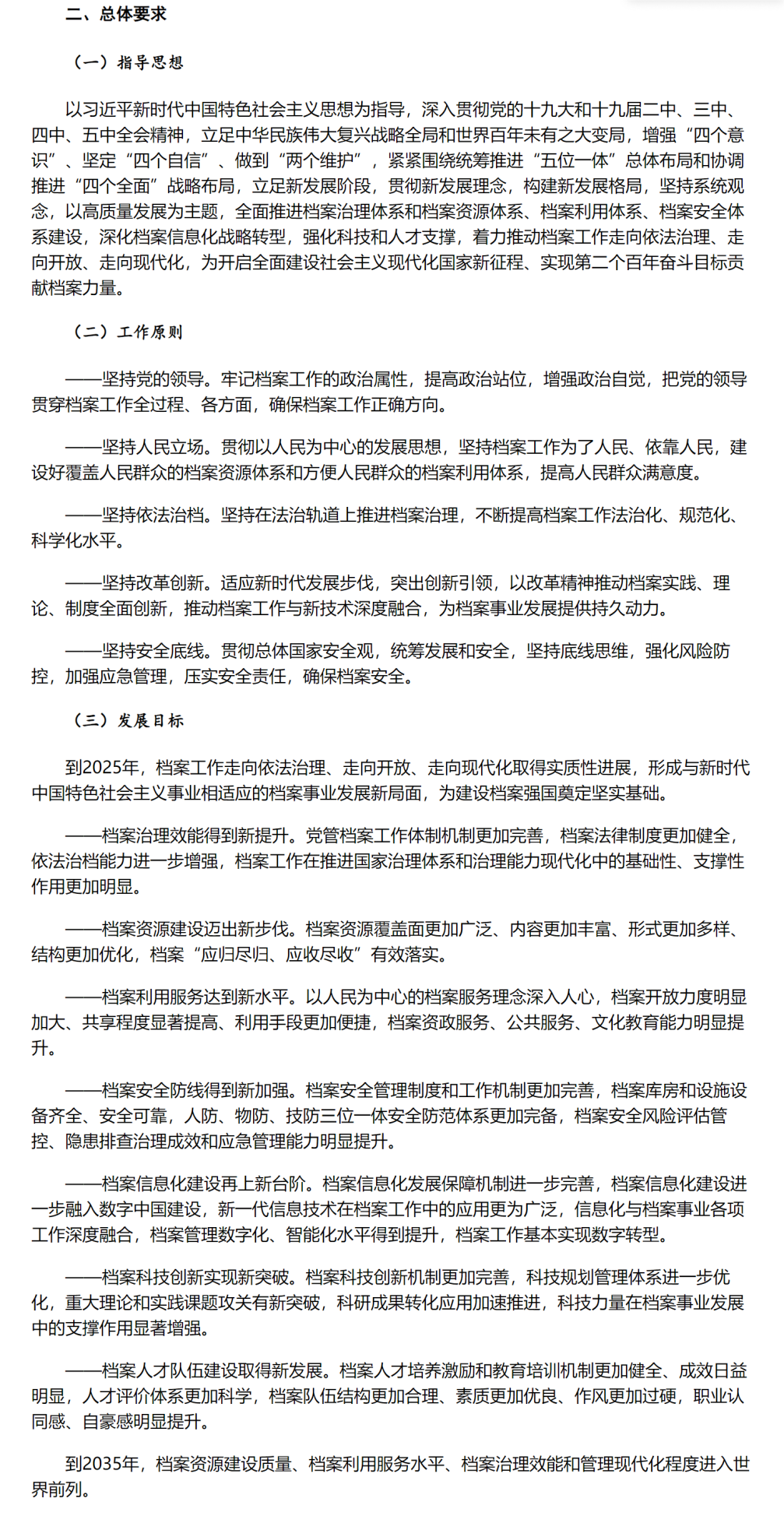
Authoritative interpretation: (1) Guiding Ideology Leads the Overall Approach Guided by Xi Jinping Thought on Socialism with Chinese Characteristics for a New Era, archival work closely revolves around the country's major strategic layout, stands on the new development stage, implements the new development concept, and builds a new development pattern. With high-quality development as the theme, comprehensively advance the construction of the archival governance system, resource system, utilization system, and security system, deepen the strategic transformation of informatization, strengthen support from technology and talent, and promote archival work toward law-based governance, openness, and modernization, contributing archival strength to national construction. (II) Working principles ensuring the correct path Upholding Party leadership is the fundamental political principle of archival work, ensuring the correct direction. Upholding the people's standpoint, carrying out archival work with the people at the center, and meeting the people's needs for archival resources and utilization services. Upholding law-based archival management and raising the level of rule-of-law in archival work. Upholding reform and innovation, advancing archival work with the times and deeply integrating it with new technologies. Upholding the security bottom line and safeguarding the physical and information security of archives. (3) Clear blueprint for development goal planning By 2025, archives work should achieve substantive progress in multiple aspects, forming a new situation compatible with the cause of socialism with Chinese characteristics for a new era, and laying the foundation for building a strong archives nation. This includes improving archives governance effectiveness, advancing resource development, upgrading utilization services, strengthening security defenses, bringing informatization to a new level, achieving breakthroughs in technological innovation, and developing the talent team. By 2035, archives-related indicators should rank among the world's leading. III. Main tasks focus on core workOriginal text description:
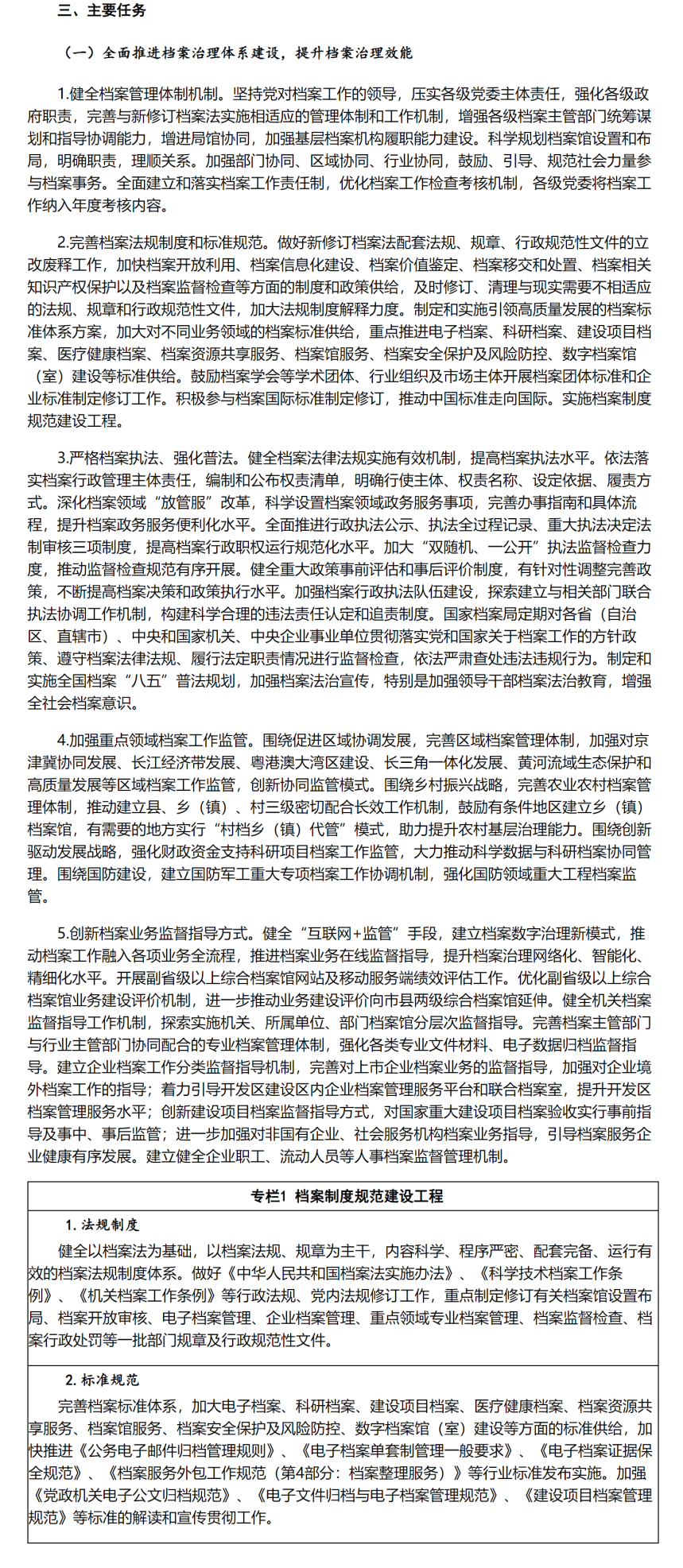
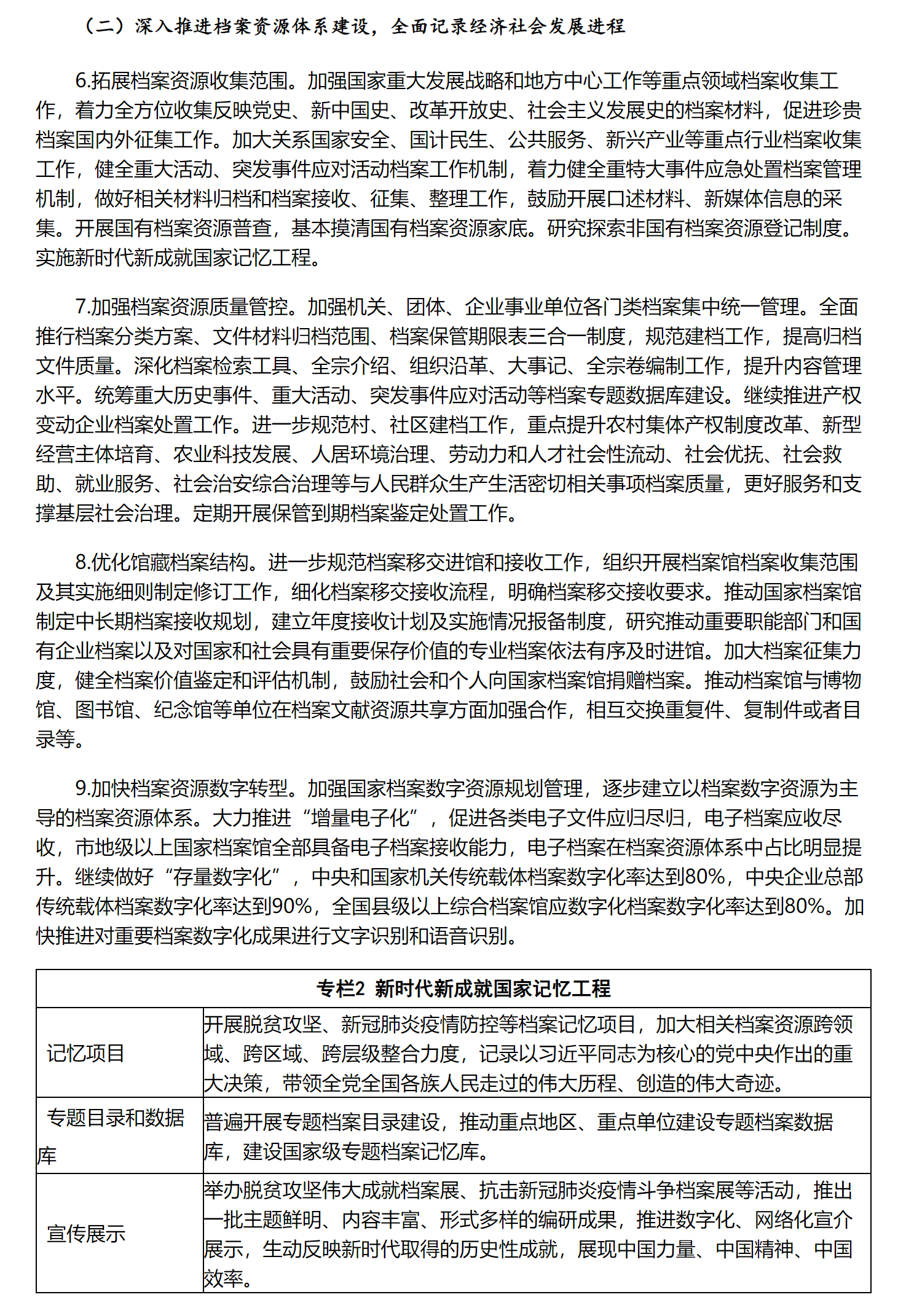
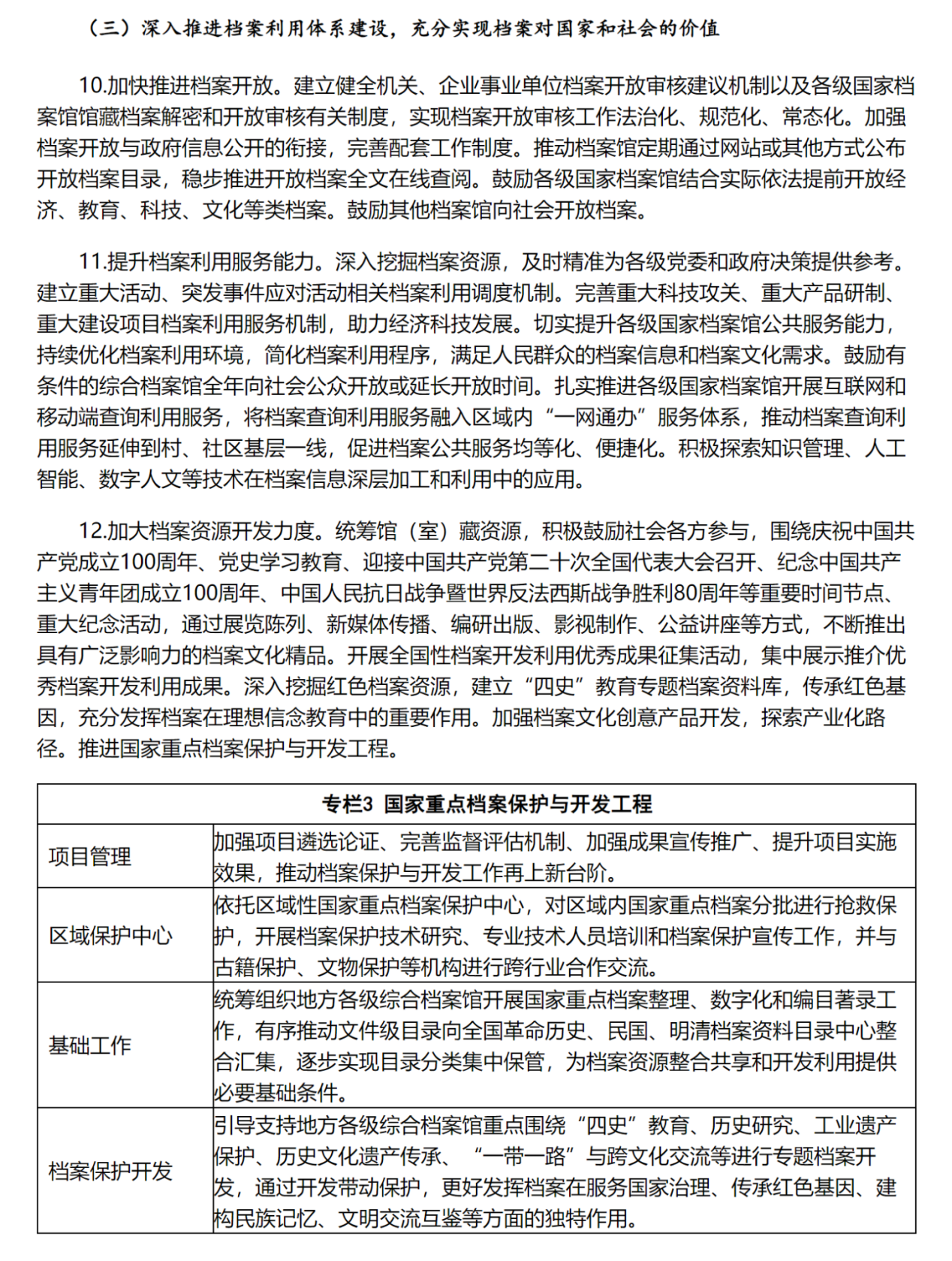
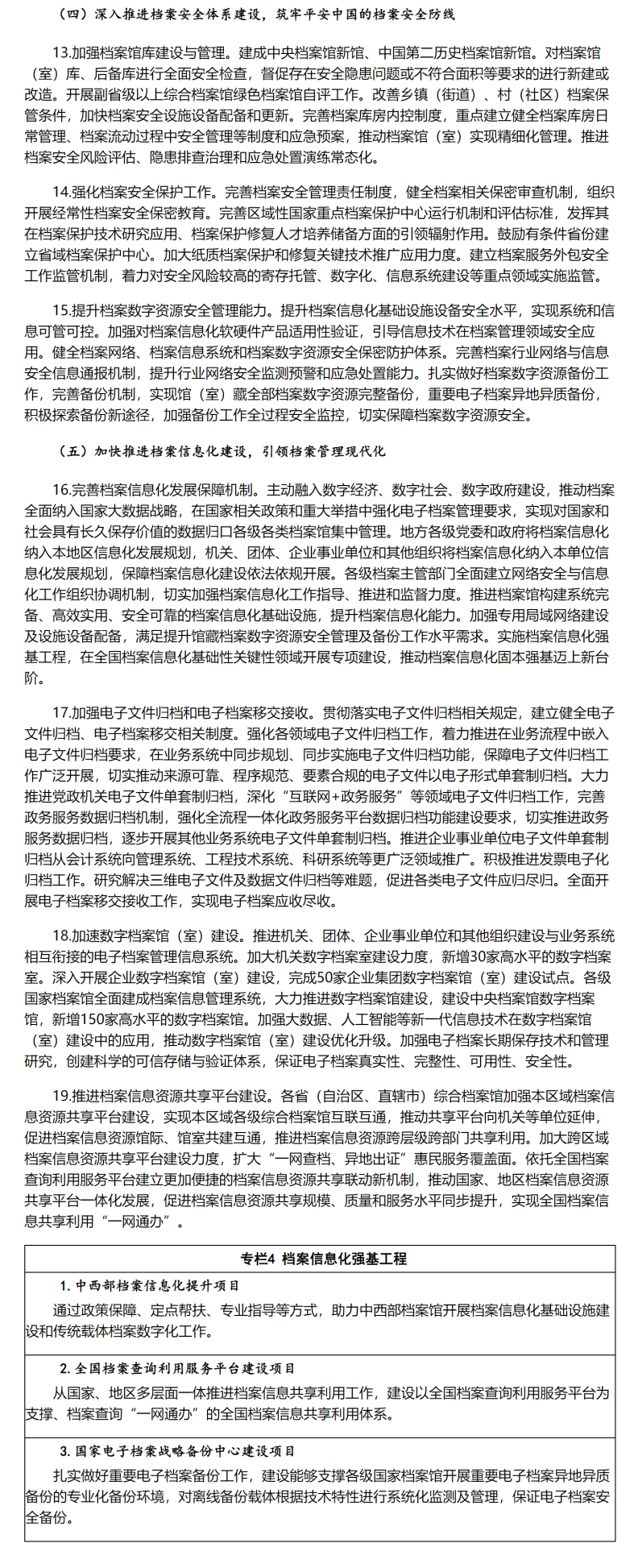
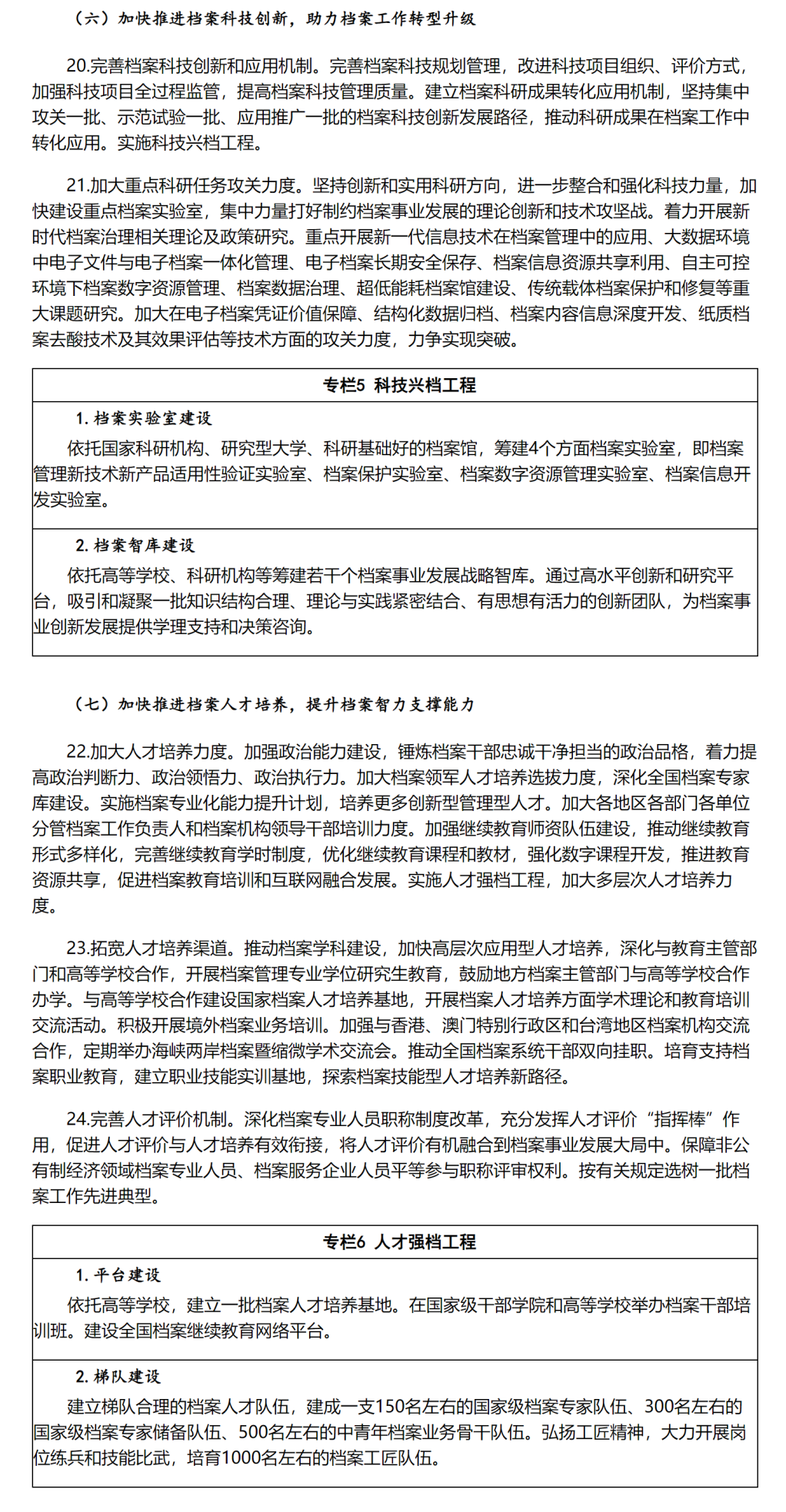
Authoritative interpretation: (1) Comprehensive Advancement of Archive Governance System Construction ▪ Improve systems and mechanisms: emphasize the Party's leadership over archive work. Party committees and governments at all levels must clarify responsibilities, improve management systems and working mechanisms, strengthen departmental coordination and participation of social forces, and establish and improve archive work responsibility systems and assessment mechanisms. ▪ Improve laws, regulations, systems, and standards: Do a good job in enacting, revising, abolishing, and interpreting supporting regulations for the Archives Law, strengthen institutional and policy supply, build a scientific archives standards system, encourage all parties to participate in standard formulation, and actively participate in international standard formulation. ▪ Strict law enforcement and strengthened legal popularization: improve law enforcement mechanisms, raise law enforcement standards, implement the primary responsibility of administrative management, deepen the reform of "streamlining administration, delegating power, improving regulation, and optimizing services," advance the three systems of administrative law enforcement, strengthen the building of law enforcement teams, and at the same time formulate and implement the national archives "Eighth Five-Year" legal popularization plan. ▪ Strengthen supervision in key areas: around major national development strategies, strengthen supervision of archive work in key areas such as regions, agriculture and rural areas, scientific research projects, and national defense and military industry, and innovate supervision models. ▪ Innovative supervision and guidance methods: use "Internet + supervision" means, establish a new digital governance model, carry out performance evaluation and business construction evaluation, and improve various archive supervision and guidance mechanisms. (II) In-Depth Advancement of Archives Resource System Construction ▪ Expand collection scope: strengthen archive collection in key areas and reflecting history, promote domestic and international solicitation, carry out a census of state-owned archive resources, explore a registration system for non-state-owned archive resources, and implement the National Memory Project. ▪ Strengthen quality control: implement the three-in-one system to standardize archiving work, strengthen the compilation of archive retrieval tools, coordinate the construction of thematic databases, standardize village and community archiving work, and regularly carry out archive appraisal and disposal. ▪ Optimize collection structure: standardize archive transfer and receipt processes, formulate medium- and long-term plans and annual plans, increase archive collection efforts, and strengthen cooperation and sharing with other cultural institutions. ▪ Accelerate digital transformation: strengthen planning and management of archive digital resources, advance "incremental electronification" and "retrospective digitization," and accelerate text and speech recognition of digitized results. (3) Deep value mining through archives utilization system development ▪ Accelerate opening: establish and improve archive opening review mechanisms and related systems, strengthen alignment with government information disclosure, publish catalogs of opened archives, and encourage early opening of certain archives. ▪ Enhance service capabilities: deeply mine archive resources to provide reference for decision-making, establish archive utilization and scheduling mechanisms for major events, improve various archive utilization service mechanisms, enhance public service capabilities, advance internet and mobile query and utilization services, and explore the application of new technologies. ▪ Increase development efforts: coordinate museum and archive collection resources, encourage social participation, focus on important time nodes and major commemorative activities, develop premium archival cultural products, carry out collection activities, tap red archival resources, and strengthen the development of archival cultural creative products. (4) Building an archive security system to strengthen the security defense line ▪ Strengthen archive repository construction and management: complete the new Central Archives building, etc., conduct safety inspections and renovations of archive repositories, carry out green archive self-assessments, improve grassroots storage conditions, refine internal control systems, and advance normalized work such as security risk assessments. ▪ Strengthen safety protection work: improve the archive safety management responsibility system, improve the confidentiality review mechanism, improve the operating mechanism of regional protection centers, encourage the establishment of provincial protection centers, promote key technologies for paper archive protection, and establish a safety supervision mechanism for archive service outsourcing. ▪ Improve digital resource security management capabilities: improve the security level of archive informatization infrastructure and equipment, verify product applicability, improve the protection system, perfect the industry network and information security information notification mechanism, and do a good job in backing up archive digital resources. (5) Archives informatization construction leads the modernization process ▪ Improve safeguard mechanisms: Actively integrate into the development of the digital economy, digital society, and digital government, strengthen electronic archives management requirements, incorporate archives informatization into local and unit planning, establish coordination mechanisms, and build archives informatization infrastructure. ▪ Strengthen electronic document archiving and transfer receipt: establish and improve relevant systems, strengthen electronic document archiving work in various fields, promote single-set archiving, comprehensively carry out electronic archive transfer and receipt work, and solve electronic document archiving difficulties. ▪ Accelerate digital archive repository (room) construction: advance the construction of electronic archive management information systems, increase the construction of digital archive repositories (rooms) in government agencies and enterprises, apply next-generation information technology, and research long-term preservation technology for electronic archives. ▪ Advance the construction of information resource sharing platforms: strengthen the construction of regional archive information resource sharing platforms, promote extension to organs and other units, expand the coverage of cross-regional sharing platforms, establish linkage mechanisms, and promote integrated development. (6) Archives technology innovation facilitates transformation and upgrading ▪ Improve mechanisms: Improve archives science and technology planning management, establish mechanisms for the transformation and application of scientific research achievements, and implement the project of invigorating archives through science and technology. ▪ Increase research efforts: adhere to the direction of innovative and practical scientific research, integrate scientific and technological forces, build archive laboratories, carry out major subject research, and increase technological research efforts. (7) Providing intellectual support for archive talent cultivation ▪ Increase training efforts: strengthen the political capacity building of archive cadres, cultivate leading talents, implement professional capability improvement plans, strengthen the construction of continuing education teaching staff, and implement the talent-strengthening archive project. ▪ Broaden training channels: promote archival discipline development, carry out graduate education, cooperate in running schools, build talent training bases, conduct overseas training, strengthen exchanges and cooperation, and cultivate vocational education. ▪ Improve the evaluation mechanism: Deepen the reform of the professional title system for archives professionals, safeguard the right of personnel in the non-public economic sector to participate equally in professional title evaluations, and select and promote advanced models. (8) External exchange and cooperation of archives enhances international influence ▪ Expand exchanges and cooperation: consolidate existing cooperation results, implement bilateral archive cooperation agreements, participate in high-level people-to-people exchange mechanisms, promote cooperation with countries along the Belt and Road Initiative, and deepen cooperation with international organizations. ▪ Participate in the Memory of the World Programme: strengthen cooperation with relevant UNESCO bodies, participate in activities of the Memory of the World Programme Asia-Pacific Committee, and implement projects to enhance the influence of archival documentary heritage. IV. Guarantee measures ensure plan implementationOriginal text description:
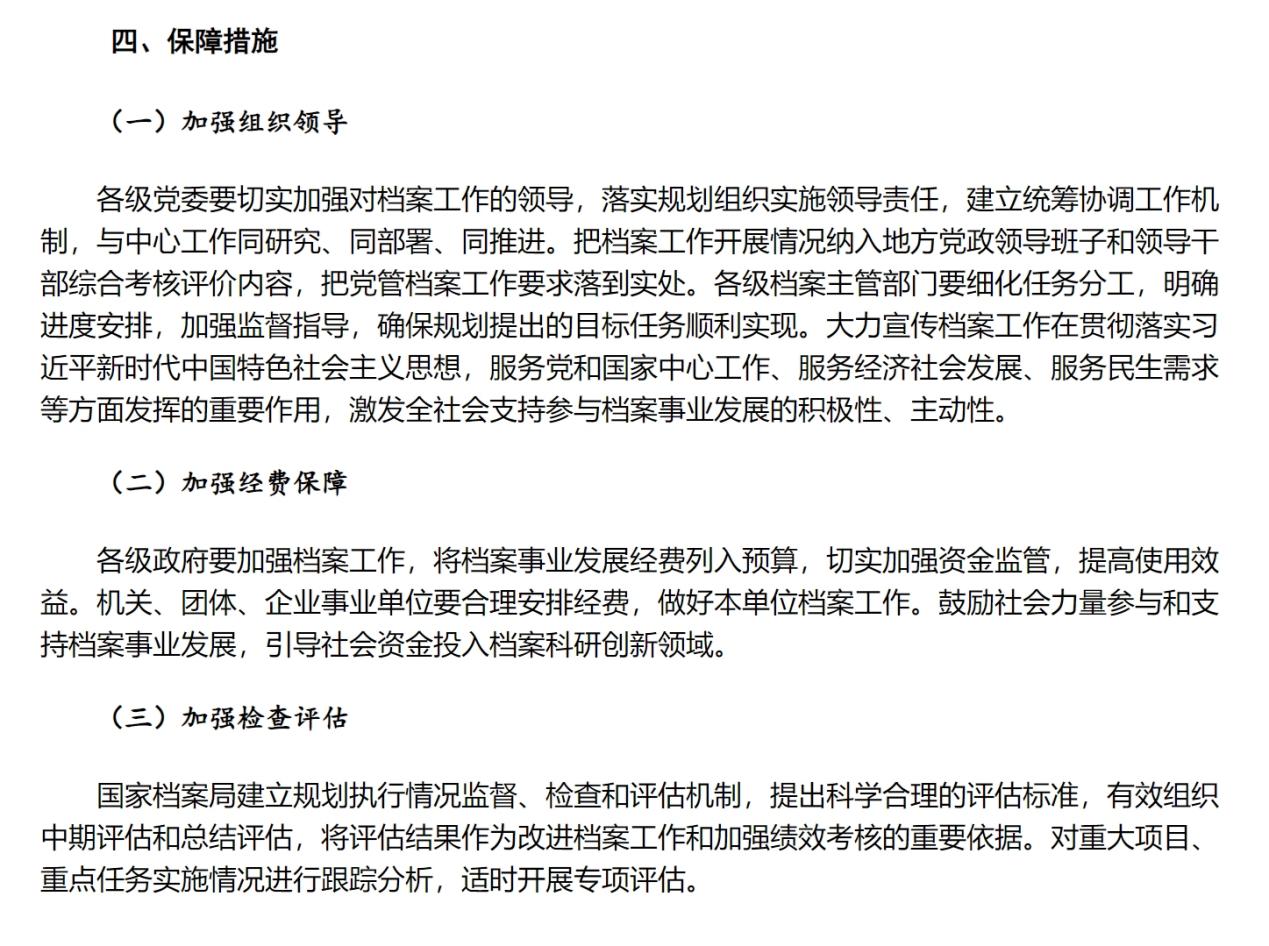
Authoritative interpretation: (1) Strengthen organizational leadership Party committees at all levels shall strengthen leadership over archive work, fulfill planning implementation responsibilities, establish a coordinated working mechanism, and incorporate archive work into assessment. Archive authorities shall refine task division, strengthen supervision and guidance, publicize the important role of archive work, and stimulate public participation. (2) Strengthen funding guarantee Governments at all levels shall include archive development funds in their budgets, strengthen fund supervision, and improve usage efficiency. Organs, organizations, enterprises, and public institutions shall reasonably arrange funding, encourage social forces to participate in and support archive development, and guide social capital investment into archive research and innovation. (3) Strengthen inspection and evaluation The National Archives Administration shall establish supervision, inspection, and evaluation mechanisms for plan implementation, propose scientific and reasonable evaluation standards, organize mid-term evaluations and summary evaluations, use evaluation results as an important basis for improving archives work and strengthening performance assessment, and track and analyze the implementation of major projects and tasks. "The 14th Five-Year Plan for National Archives Development" provides comprehensive and systematic guidance for the development of China's archives cause during the 14th Five-Year Plan period, with important strategic significance. Archives workers should deeply understand the spirit of the plan, actively implement its tasks, promote high-quality development of the archives cause, and contribute to national development and historical inheritance. Kailing Technology Electronic Archives System is an innovative model in the field of archive management. Supported by advanced technology, it brings users an efficient, convenient, and secure archive management experience. Its efficiency is reflected in the ability to quickly realize archive entry, storage, and retrieval. Whether it is a large amount of documents and materials or complex archive types, they can be quickly accepted and properly placed by the system, greatly saving time and effort. Convenience runs throughout the entire use process. Users can access the system through the network anytime and anywhere, unrestricted by time and space. In terms of security, the Kailing Technology electronic archive system has multiple safeguards. It uses advanced encryption technology to ensure the security of archive information during transmission and storage. At the same time, a strict permission management mechanism allows users at different levels to access only archives within their corresponding permissions, effectively preventing information leakage and illegal access. Kailing Technology Electronic Archives System, stepping into a new era of archive management,Archive management is smarter, more efficient, and more reliable,Click the link to view details and contact us for a trial:https://www.kailingteck.com/h-col-110.html 。 Kailing Technology provides enterprise business-finance-tax digital product lines according to enterprise needs: Solutions for businesses including sales contract management system, procurement contract management system, fully digitalized Leqi interface project, output automatic invoicing system, employee expense control and reimbursement system, input VAT invoice management system, supply chain collaborative reconciliation system, image OCR recognition system, automatic financial bookkeeping system, and electronic accounting archives system, professionally and efficiently supporting the transformation and upgrading of enterprise business-finance-tax digital management. If you have any business-finance-tax digital transformation needs, welcome to contact us. Beijing Kailing Technology will serve you wholeheartedly.
|