010-6097 4119Book a Demo


Overseas documents for import-export enterprises are slow and error-prone when entered manually? Kailing Technology AI OCR supports automatic recognition of multiple languages including English, Thai, Japanese, and Korean. Import-export enterprise overseas documentsPublished: 2026-07-01 15:27 Manual entry is slow and error-prone. The root cause is that cross-border procurement documents come in many languages (English, Thai, Japanese, Korean, etc.), messy formats (jpg/png/pdf/ofd mixed) and inconsistent fields, so finance can only key them in one by one, which is slow and prone to misreading and entry errors. The answer from the Kailing Technology AI OCR global invoice recognition engine is: after photographing or uploading multilingual overseas documents in English, Thai, Japanese, Korean, etc., they are automatically recognized, automatically split and automatically structured, and collected into the input VAT invoice pool with one click and directly connected to ERP/expense control systems — invoice recognition rate 99%, automatic splitting of multiple invoices over 99%, and recognition of core fields of certificates 98%, turning overseas invoices from "manual entry" into "automatic system posting".
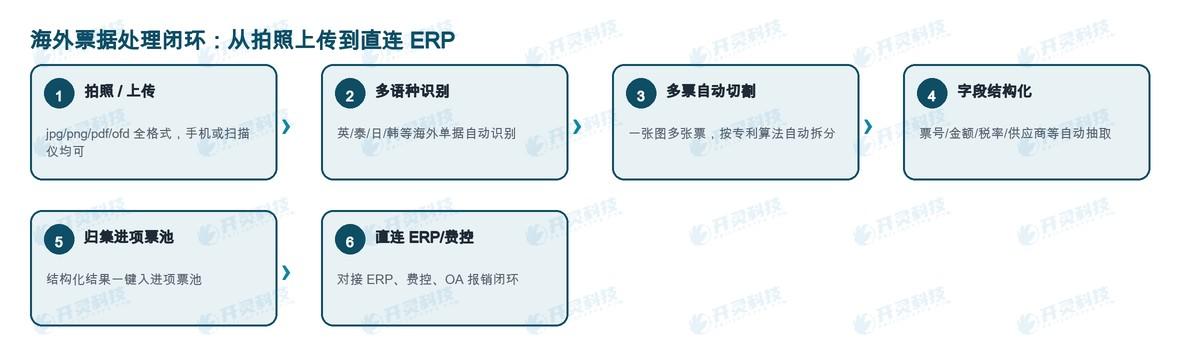
I. Where exactly are the bottlenecks in overseas documents for import-export enterprises?Finance staff doing cross-border procurement and import-export trade must handle a large number of invoices, pro forma invoices, freight bills, and customs-related documents issued by overseas suppliers every month. These documents and domestic fully digitalized e-invoices are completely different worlds: Many languages:English is the foundation. Thai is common in Southeast Asian procurement, while Japanese and Korean appear in Japanese and Korean supply chains. Finance may not be able to read and enter every one accurately. Chaotic formats:Some are PDFs, some are jpg/png photos taken by suppliers with mobile phones, and some are in ofd and other formats mixed together, with vastly different layouts. Slow entry:Field positions are not fixed, so staff must search invoice by invoice for the invoice number, amount, tax amount, and supplier name. It takes several minutes per invoice, and during peak season there is simply no way to keep up. Error-prone:Foreign letters, numbers, and upper/lowercase are dizzying; one amount entered incorrectly or one supplier name misspelled throws off all subsequent reconciliation, booking, and tax refunds. Difficult collection:After entry, documents still need to be classified and archived, matched to purchase orders, and organized into the input invoice pool, and they are disconnected from the ERP/expense control system, relying on manual transfer. Look at the scenario a bit more closely: suppliers in Southeast Asia send invoices and freight bills all at once as several blurry jpgs photographed with phones, Thai mixed with English; Japanese and Korean supply chains send PDFs full of Japanese and Korean; some even combine several invoices into one image. Currencies are also diverse—USD, JPY, THB, and KRW mixed together, and during manual transcription, decimal points and thousands separators can easily shift with one careless moment. After entry, someone still has to manually determine which purchase order it belongs to, which supplier it is attributed to, which month's input VAT invoice pool it goes into, and then separately import it into ERP. Behind one transaction are often six or seven purely manual actions: "identify—transcribe—convert—sort—archive—import." Ultimately, the handling of overseas invoices is an inefficient chain of "can't understand—slow to key in—error-prone—hard to aggregate—no linkage." The more people hired, the more frustrating the error correction, while import-export business volume keeps growing; simply adding people cannot keep up with the growth of documents. II. How Does the Kailing AI-OCR Global Invoice Recognition Engine Solve This?Kailing Technology AI OCR Global Document Recognition Engine, is an automatic invoice recognition and collection capability built for import-export and cross-border procurement scenarios. It is not "translating a foreign language" but treating the entire document as a structured object—recognition, segmentation, field extraction, collection, and linkage in one go. 1. Automatic recognition of multilingual overseas documentsThe engine supports automatic recognition of multilingual overseas documents in English, Thai, Japanese, Korean, and others, so finance does not need to identify foreign languages character by character; it also covers all devices and all formats (jpg/png/pdf/ofd), whether scanned copies or photos casually taken by suppliers with mobile phones. 2. Automatic Splitting and StructuringWhen one image contains multiple invoices, the engine automatically cuts them into independent documents based on a patented algorithm; after cutting, it extracts key fields such as invoice number, amount, tax amount, and supplier one by one, forming structured data that can be calculated and booked, rather than merely "scanning into an image." 3. Recognition is collection, direct connection to business systemsThe structured results obtained from recognition do not stop on the screen waiting to be copied, but directly participate in the four-document matching for procurement, one-click collection into the input VAT invoice pool, and direct connection to ERP/expense control, integrated with WeChat mini-program OA reimbursement. The following most critical capabilities deserve further detailed explanation.
III. Several of the most critical capabilities, explained separatelyWhat import-export enterprises care about most is often not "whether a single invoice can be recognized", but whether the real documents that are "messy, mixed, and numerous" can hold up. Kailing AI OCR has made specialized engineering treatments in these areas: Automatic splitting of multiple invoices: multiple invoices in one image, automatically split by patented algorithm It is very common for overseas suppliers to combine multiple documents into one image or one PDF. Manually, each document must first be cut out and then entered separately, and sorting alone takes considerable time. The Kailing engine uses patented algorithms for automatic multi-document cutting, automatically identifying boundaries in a single image with multiple documents and precisely splitting them into individual documents. The accuracy rate of automatic multi-document cutting exceeds 99%, so finance no longer needs to manually crop images or separate documents—just upload the entire image. Red seal occlusion training: fields are still recognized even when covered by a seal Red seals on invoices and certificates often cover key fields such as invoice numbers, amounts, and company names. Traditional OCR tends to miss or misread when blocked by red seals. The Kailing engine has undergone specialized training for red seal occlusion, strengthening recognition in scenarios where seals cover fields. Even when key fields are partially obscured, it can restore them reliably. Combined with a 99% document recognition rate, it reduces rework caused by "having to send it back to manual processing just because a seal was stamped." All devices and all formats: photos, scans, PDF, and ofd are all accepted The engine covers all devices and all format inputs—jpg/png taken by mobile phones, scanned copies, PDFs sent by suppliers, and even OFD layout files can be processed directly, without requiring suppliers to unify formats or converting formats before entry. This is especially important for overseas procurement: you cannot require overseas suppliers to issue invoices in your format, and being able to "accept everything as received" is truly convenient. 50+ types of certificates and contracts: not just invoices, the entire input chain can be recognized Besides all categories of tax invoices, the engine can also recognize original vouchers, more than 50 types of certificates and licenses, contracts and other objects, with a comprehensive certificate recognition rate of 95% and a core field recognition rate of 98%. Business licenses, customs and qualification-related certificates, procurement contracts, etc. can all automatically extract key fields and be archived, making materials across the entire input and procurement chain structured, rather than only entering invoices into the system while certificates and contracts still rely on manual searching.
IV. Recognition is only the beginning; collection and linkage form the closed loopNo matter how accurate the recognition is, if the results still need to be manually moved into the system, the efficiency improvement will be greatly reduced. Kailing AI OCR also handles the "after recognition" steps: Procurement four-way matching:The structured results after recognition can be matched against purchase orders, goods receipt notes, invoices, and contracts in a "four-document match," automatically verifying whether quantities, amounts, and suppliers are consistent, with early warnings for mismatches rather than discovering problems only at month-end reconciliation. One-click collection into input VAT invoice pool:Structured results are collected into the input VAT invoice pool with one click and automatically categorized by supplier and period, eliminating the manual sorting step. Direct Connection to ERP/Expense Control:Structured results can be directly connected to ERP and expense control systems, and the identified data enters the business flow directly, no longer relying on people to export and transfer tables back and forth. WeChat Mini Program integrated with OA reimbursement:By integrating OA reimbursement through a WeChat mini-program, employees can initiate reimbursement by taking photos of documents, and recognition results are collected with one click, truly achieving 'photo-taking is reimbursement, recognition is accounting entry'. In this way, overseas invoices form an automated closed loop from “entry” to “booking”: upload means recognition, recognition means splitting, splitting means structuring, structuring means aggregation, and aggregation means linkage. Manual work is only needed for review and confirmation at key nodes. V. After go-live, what changes will occur in finance work?After handing overseas invoices to AI OCR, the role of finance positions shifts from "data entry clerk" to "reviewer": Faster:Overseas documents are recognized upon photo capture or upload, with automatic cutting of multiple documents, saying goodbye to the inefficiency of typing each one; More accurate:Recognition rate of 99% and 98% for core fields; amounts and tax amounts are automatically extracted and participate in four-document matching, reducing manual errors; More worry-free:Structured results are collected into the input VAT invoice pool with one click and automatically connected directly to ERP/expense control, so reconciliation and bookkeeping no longer require manual transfer; More compliant:Unified recognition and archiving for all categories of invoices, licenses, and contracts, with a clear and traceable input chain for more confident audit response.
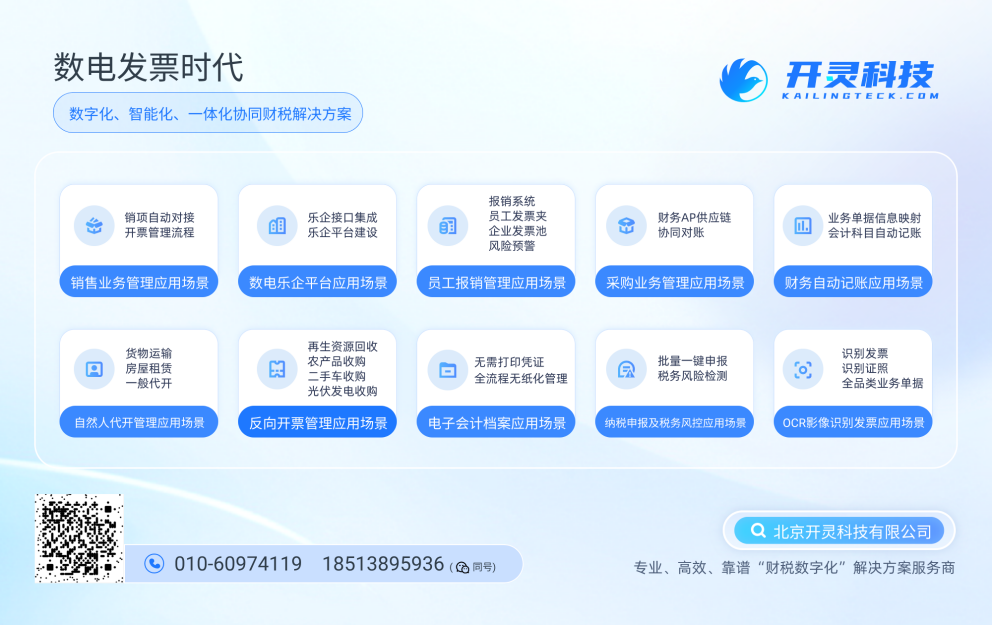
Want overseas invoices to change from "manual entry" to "automatic posting by the system"? Welcome to learn about the Kailing Technology AI OCR global invoice recognition engine: www.kailingteck.com . As a comprehensive business-finance-tax digitalization solution service provider, Kailing Technology provides business-finance-tax management digital transformation products and operational services for various government agencies, institutions, and large, medium, and small enterprises. The product line includes: Solutions for businesses including sales contract management system, procurement contract management system, fully digitalized Leqi interface project, output automatic invoicing system, reverse invoicing system, invoice issuance for individuals system, employee expense control and reimbursement system, input VAT invoice management system, supply chain collaborative reconciliation system, image OCR recognition system, automatic financial bookkeeping system, and electronic accounting archives system, comprehensively driving the digitalization process across various fields. If you have any business-finance-tax digital transformation needs, welcome to contact us. Beijing Kailing Technology will serve you wholeheartedly.
Keywords:AI OCR, overseas invoice recognition, multilingual invoice recognition, import and export enterprise finance, automatic multi-invoice splitting, input VAT invoice management, ERP integration, Kailing Technology |