010-6097 4119Book a Demo


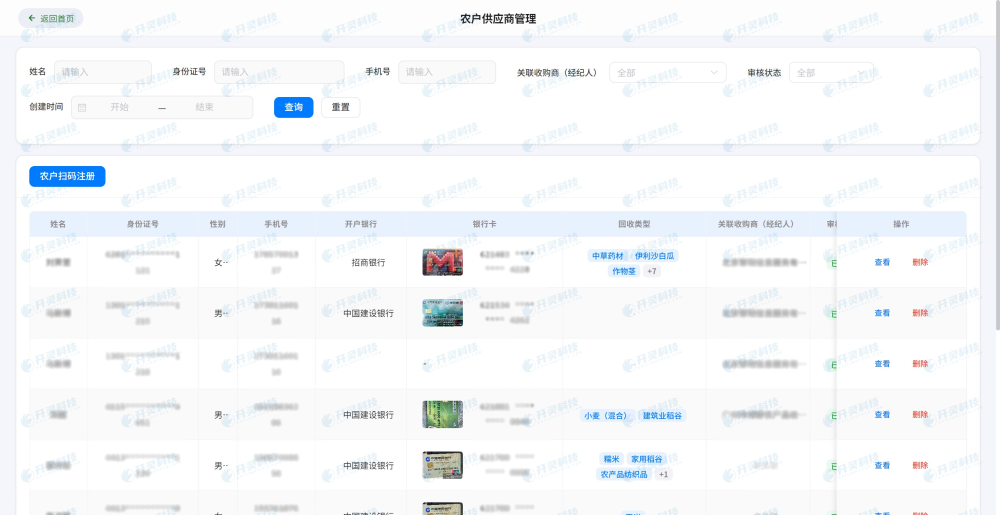
A grain procurement station receives a hundred truckloads a day during peak season, and not a single farmer can issue an invoice? Kailing Technology's reverse invoicing platform: from weighing to invoice issuance in just 3 minutesPublished: 2026-06-11 17:52 June wheat harvest and October autumn grain—grain purchasing stations have two "battle periods" a year. When the peak season arrives, farmers drive tricycles and small four-wheelers and line up waiting to be weighed. The purchasing station is busy from dawn to dusk, with dozens or even hundreds of vehicles received daily being the norm. Everyone at the site is focused on one thing: speed. Fast weighing, fast moisture testing, fast grading, fast payment calculation, fast clearing of the site so the next truck can enter. But finance's attention is on another matter: invoices. Of these hundreds of truckloads of grain, all the sellers are farmers from surrounding villages and towns. They do not know what an invoice is, will not go to the tax bureau for invoice issuance, and are even less likely to cooperate with you in any "invoicing operation" while queuing under the scorching sun. After peak season ends, the purchasing station's warehouse is full, but the finance ledger is full of holes—millions or even tens of millions in grain procurement expenditures with not a single corresponding input VAT invoice. I. It is not a small problem, but structural tax burden pressureThe profit margin of grain procurement stations is already thin. For categories such as wheat, corn, and rice, the price difference between procurement price and selling price is often only a few cents per jin, and profits depend on volume. Under this thin-margin model, the tax burden pressure caused by missing input VAT invoices is especially fatal: Without input VAT invoices, VAT cannot be deducted. Grain procurement could originally deduct input tax at 9% (10% for products used in deep processing at the 13% tax rate), but without invoices it is zero. Without compliant vouchers, procurement costs cannot be deducted before corporate income tax. For a grain station purchasing RMB 50 million a year, if 60% of expenditures cannot obtain invoices, it means RMB 30 million in costs "disappears out of thin air," profits are falsely increased, and the tax burden is passively raised. Under China Golden Tax Phase IV, bank statements show you making large outbound payments every day, but input VAT invoices are scarce—this characteristic of "large capital outflow, small invoice inflow" is exactly the abnormal signal that tax early warning models prioritize capturing. In the past, it might still have been possible to get by relying on "industry practice"; now this path has been completely closed. II. Reverse invoicing for agricultural products: the policy was paved long agoGrain (wheat, corn, rice, sorghum, barley, buckwheat, etc.) falls under the "cereals" category explicitly listed in the "Notes on the Scope of Taxation of Agricultural Products" and is within the applicable scope of the reverse invoicing policy. When a purchasing station buys self-produced grain from farmers, it can issue agricultural product purchase invoices in reverse. As agricultural producers selling self-produced agricultural products, farmers are exempt from VAT and do not require withholding or payment of any taxes or fees. The purchasing station directly obtains a 9% input VAT deduction. Policies are fully unobstructed, and the key lies in:At the pace of hundreds of vehicles a day in peak season, how can reverse invoicing be implemented without slowing down grain collection efficiency? III. Kailing Technology's Answer: Bind to the Weighing Action, Complete the Entire Process in 3 MinutesThe Kailing Technology Reverse Invoicing Platform has only one design principle for grain purchase scenarios:It does not add any extra burden to the grain collection site. Weighing is a mandatory action for every truck of grain entering the station, whether or not there is a system. Kailing Technology binds the entire reverse invoicing process to this natural node of weighing—when the truck is on the scale, the person beside it taps a few times on a mobile phone, and by the time the truck leaves the scale, invoicing has already been completed. Farmer file creation: done while queuingWhen farmers come to sell grain for the first time, they complete file creation while waiting in line. Procurement station staff, holding a phone or tablet, guide the farmer: Face scan authentication (10 seconds) Photo capture of the front and back of ID cards Bind grain purchase payment bank card Sign electronic acquisition agreement The system simultaneously completes identity verification, confirming that the farmer is not a corporate legal representative, supervisor, senior manager, or sole proprietor, and confirming that the cumulative annual invoicing amount has not exceeded 5 million. The whole process takes less than 3 minutes. The farmer's feeling is simply "while queuing, the staff asked me to scan my face and photograph my ID card with my phone," and it does not feel like doing anything complicated. Filing is completed once, and can be reused directly each subsequent time they come to sell grain.
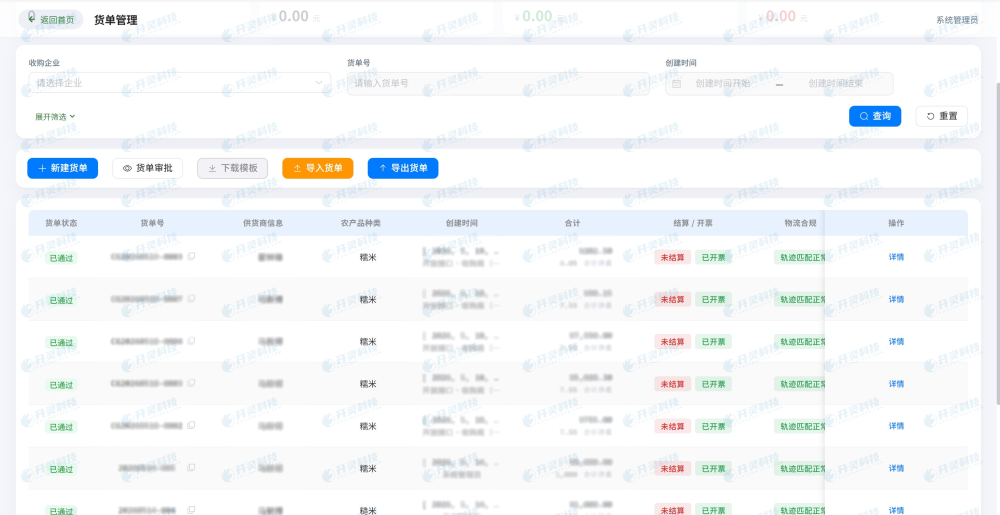
Weighing is entered immediately: the acquisition order is automatically generatedAfter the farmer's grain truck is weighed, the on-site operator selects the farmer in the system (already filed, directly selectable from the list) and enters the grain variety. Weighbridge data is automatically captured via a direct connection to the weighbridge system (manual entry is also supported). The system automatically calculates the procurement amount based on variety + weight + the day's listed procurement price, and generates a procurement order. If moisture deduction or impurity deduction is involved, it can also be automatically calculated within the system according to preset rules. The operator's actions are: select person, select variety, confirm weight, confirm amount. Four clicks, completed in tens of seconds.
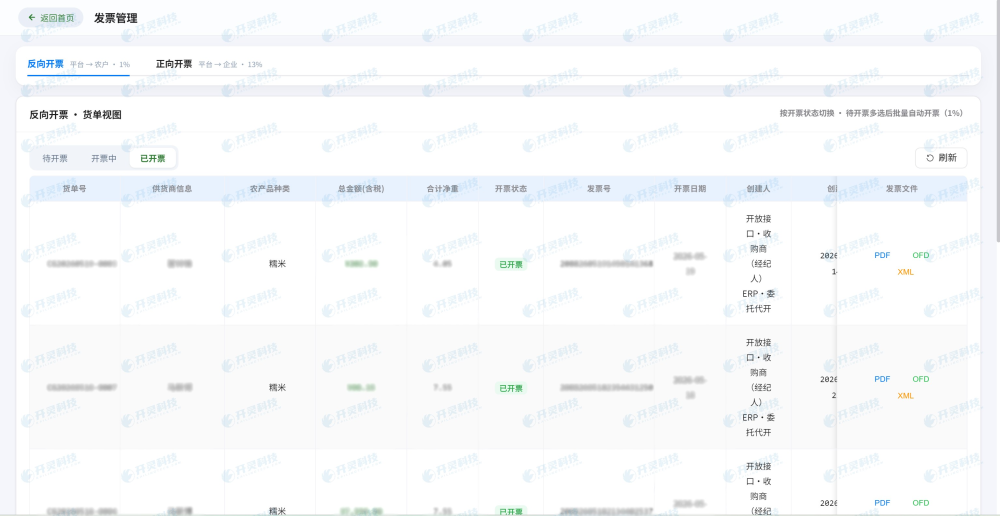
Automatic invoicing trigger: the invoice is ready before the car drives awayAt the moment the purchase order is confirmed, the system backend automatically starts the reverse invoicing process: Verify the farmer's annual balance of 5 million Call the electronic tax bureau interface to issue fully digitalized e-invoices tagged "agricultural product purchase" in login-free mode Self-produced and self-sold agricultural products are VAT-exempt, with no withholding or remittance required Automatic archiving of invoice PDF/OFD/XML source files From purchase order confirmation to invoice generation, the system processing time is usually within 30 seconds. By the time the farmer's truck has just rolled off the weighbridge, the invoice is already quietly sitting in the system.
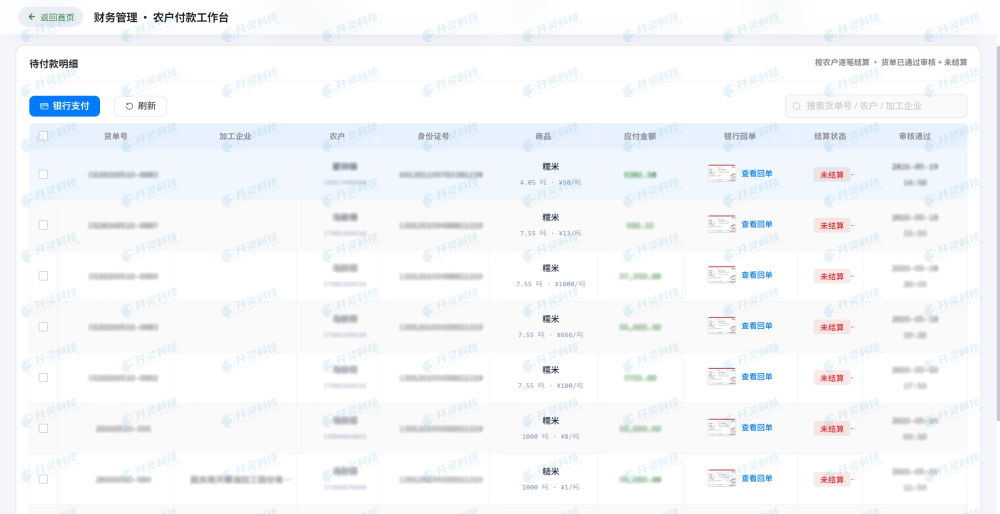
Payment closes the loop: grain payment reaches the card the same dayThe most important foundation of trust in grain procurement is "paying quickly." The Kailing Technology platform supports automatically triggering bank-enterprise direct connection transfers after invoicing is completed, with grain payments reaching the bank card bound when the farmer's profile was created. Before the farmer even walks out of the procurement station after unloading grain, the phone rings — a payment received text message. This experience is even faster than the traditional "weigh the load, then queue at the window to collect cash." For farmers, the experience is better; for enterprises, the flow of funds is clearer—every payment has a bank receipt automatically linked to the corresponding purchase order and invoice.
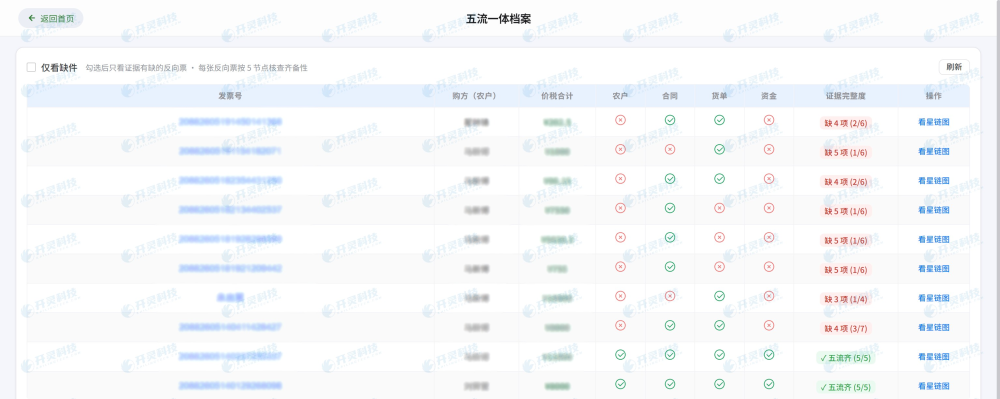
Full-process traceability: automatic archiving of five flowsFor each truckload of grain from station entry to completion, the system automatically forms a complete archive: Farmer identity information + electronic procurement agreement Purchase order (variety, weight, moisture, impurities, grade, unit price, amount) Source files of fully digitalized e-invoices Bank transfer receipt Identity validation records All data is associated under the same transaction. When retrieval is needed, search by farmer name, date, variety, and amount, with second-level response.
IV. Peak-season stress test: no lag even with a hundred vehicles received dailyGrain procurement is characterized by strong seasonality. Normally there may be only a dozen truckloads a day, but during peak season it suddenly surges to hundreds. If the system lags or queues under high concurrency, on-site efficiency will be affected. The architecture design of the Kailing Technology platform fully considers peak-season scenarios. Multiple vehicles weighing simultaneously, multiple invoices being issued simultaneously, and multiple households paying simultaneously are processed in parallel by the system without interference. Under the pressure of processing several hundred transactions per day, the complete process from weighing to invoice issuance for a single transaction can still be controlled within 3 minutes. Peak season at a grain procurement station is like fighting a war, and every minute is precious. If invoicing requires extra time, extra staffing, and extra processes, the site simply will not cooperate. The approach of the Kailing Technology Reverse Invoicing Platform is: no extra time, no extra actions, no extra manpower. Weighing already has to be done, and while weighing, profiling, invoicing, payment, and archiving are all completed automatically. In 3 minutes, a truckload of grain goes from station entry to both invoice and payment settled. It stays fast even in peak season, and invoices remain complete:https://www.kailingteck.com/h-col-127.html 。 As a comprehensive business-finance-tax digitalization solution service provider, Kailing Technology provides business-finance-tax management digital transformation products and operational services for various government agencies, institutions, and large, medium, and small enterprises. The product line includes: Solutions for businesses including sales contract management system, procurement contract management system, fully digitalized Leqi interface project, output automatic invoicing system, reverse invoicing system, natural-person invoicing system, employee expense control and reimbursement system, input VAT invoice management system, supply chain collaborative reconciliation system, image OCR recognition system, automatic financial bookkeeping system, and electronic accounting archives system, comprehensively driving the digitalization process across various fields. If you have any business-finance-tax digital transformation needs, welcome to contact us. Beijing Kailing Technology will serve you wholeheartedly.
#Reverse Invoicing Solution #Reverse Invoicing System #Resource Recycling Enterprise Reverse Invoicing Solution #Agricultural Product Procurement Reverse Invoicing Solution #Digital Business-Finance-Tax |