Against the backdrop of the continued development of cross-border e-commerce and global supply chains, the invoices, receipts, reimbursement documents, and other archival materials generated in enterprises' daily operations are showing characteristics of large volume, multiple languages, long processing chains, and high archiving requirements. Especially for enterprises with a high proportion of foreign-related business, how to efficiently complete the scanning and collection, text recognition, content translation, field extraction, and electronic archiving of multilingual documents has become an important topic in the upgrade of digital management.
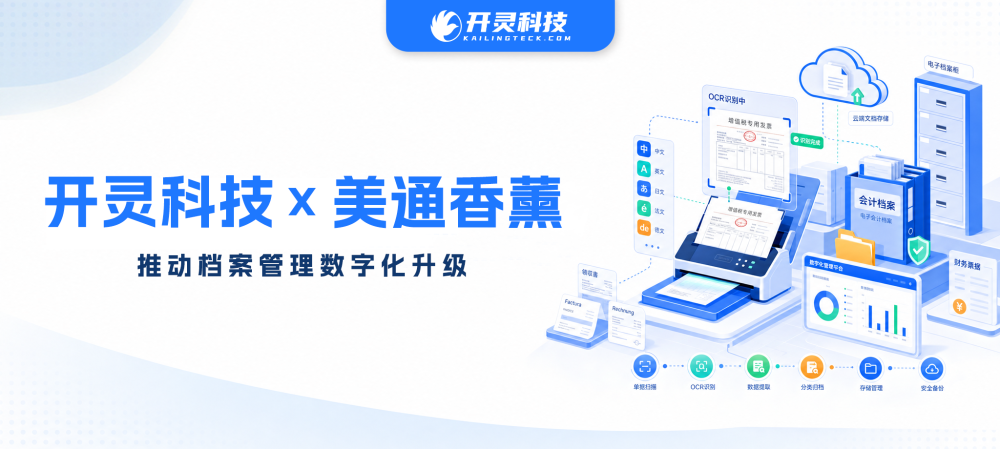
Recently, Beijing Kailing Technology Co., Ltd. undertook the multilingual document intelligent recognition and digital archiving platform construction project of Meitong Aromatherapy. The project will center on multilingual document processing scenarios, building a digital platform integrating scanning and collection, AI OCR, AI translation, semantic parsing, structured output, and image archiving, helping the enterprise improve archive management efficiency, enhance data utilization capabilities, and solidify the foundation of internal digital operations.
I. Client enterprise introduction
Zhejiang Meitong Aromatherapy Technology Co., Ltd. is an international enterprise specializing in aromatherapy products, integrating R&D, design, production, and sales, with its headquarters in Xihu District, Hangzhou, Zhejiang. The company adheres to the corporate culture of "integrity, diligence, cooperation, gratitude," the corporate vision of "aromatherapy for the world, fragrance for all," and the corporate mission of "delivering rich spirit and blessings to fill the world with love," havingworked extensively in the olfactory economy for 28 years.
With the continued development of its business, the enterprise has accumulated a large number of paper vouchers and image archives in cross-border trade, e-commerce operations, procurement settlement, financial reimbursement, and document retention. Because its business involves overseas markets and multilingual scenarios, the enterprise needs to handle mixed documents in Chinese, English, Vietnamese, and other languages in daily archive processing. Traditional processing methods relying on manual scanning, manual recognition, manual translation, and manual archiving can no longer meet the enterprise's management requirements for efficiency, accuracy, standardization, and traceability. To this end, Meitong Aromatherapy launched this digital archive platform construction, hoping to establish a more efficient, standardized, and sustainably evolving document processing and archiving system through intelligent technical means.
II. Project Background: Demand for Multilingual Archive Processing Continues to Rise
As enterprise international operations continue to deepen, multilingual documents have become common content in finance, reimbursement, bank settlement, and archives management. Compared with single-language invoices, such documents have several typical difficulties in processing:
Document sources are complex and formats are inconsistent;
There are many language types, and the cost of manual recognition and understanding is high;
Extraction of key financial fields relies on manual work, with limited efficiency;
Paper voucher archiving is scattered, making subsequent retrieval and queries inconvenient;
Traditional electronic archiving mostly remains at the level of "scanning and retention," making it difficult to further consolidate into usable data.
For Meitong Aromatherapy, digital archive construction is not just a matter of improving document processing efficiency, but also relates to the standardization of internal financial management, material traceability, cross-department collaboration efficiency, and the foundation for subsequent data governance. Therefore, the focus of this project is not simply to launch a document management tool, but to build a multilingual intelligent document processing platform oriented to real business scenarios.
III. Overall Project Goal: Build an Integrated Capability System of "Scanning—Recognition—Translation—Parsing—Archiving"
This project will be based on Kailing Technology's Electronic Image Management Platform and AI capability system, building a locally privatized deployment multilingual document intelligent processing and digital archiving platform for Meitong Aromatherapy. The overall objectives mainly include:
Achieve efficient electronic collection of paper documents;
Achieve automatic OCR recognition of multiple languages including Vietnamese, Chinese, English, etc.;
Achieve automatic translation of non-Chinese document content into Chinese;
Achieve intelligent semantic parsing and structured extraction of key fields;
Achieve unified archiving of original images with recognition, translation, and structured data;
Achieve localized platform deployment and data security control;
Provide standardized data support for subsequent calls by enterprise internal systems and archive utilization.
Through this platform build, Meitong Aromatherapy will drive archive management from traditional paper circulation and manual processing to an intelligent archive management model driven by AI and centered on data accumulation.
IV. Main project construction content
1. Build an electronic image management platform to create the foundational base for digital archive management
The project will build an electronic imaging management platform as the core platform carrying the digital archive capability. The platform supports full lifecycle management of scanned files, enabling functions such as image capture, data entry, image retention, data association, and archive retrieval, establishing a unified electronic archive management foundation for the enterprise.
Unlike traditional electronic methods that simply "archive images," the platform provided by Kailing Technology emphasizes the synergy of images and data. In other words, the system not only manages the scanned copies themselves, but can also uniformly associate original images with OCR text, translation results, and structured fields to form searchable, traceable, and callable digital archive assets.
2. Build multilingual OCR recognition capabilities to meet complex document processing needs
For the multilingual document scenarios in Meitong Aromatherapy's business, the platform will have multilingual AI OCR automatic recognition capabilities, able to recognize Vietnamese, Chinese, and English text in paper vouchers, covering common document types such as financial invoices, bank receipts, and reimbursement documents.
The project places high demands on recognition capability, especially for key fields such as amount, date, and document number, which require high accuracy. This is crucial for enterprise financial archive processing, because accurate extraction of key fields directly affects subsequent entry efficiency, query efficiency, and data usability.
At the same time, the platform will also be compatible with different collection methods, including high-speed sheet-fed scanners and document cameras, adapting to enterprises' document collection needs in different business scenarios.
3. Introduce AI translation models to improve the readability of multilingual documents
Recognizing a document does not mean the enterprise can use it efficiently. For non-Chinese invoices, finance and archive management staff still need to understand their meaning in order to complete review, organization, and archiving. Therefore, this project specifically introduces an AI translation model to automatically translate recognized non-Chinese content into Chinese.
This capability can effectively break down the barriers to understanding multilingual materials, helping enterprises grasp the key contents of invoices more quickly and reducing reliance on manual translation. Especially in scenarios such as financial vouchers, transaction summaries, and account information, content converted into Chinese is more conducive to internal judgment, review, and archiving, and can also improve the subsequent efficiency of archive use.
4. Build AI semantic parsing capabilities to achieve structured field extraction
On the basis of multilingual OCR and translation, the platform will further use AI semantic parsing capabilities to understand and structurally extract voucher content, automatically extract key fields such as amount, date, and document number, and form structured data records.
This means the platform can not only "understand" documents, but also convert them into manageable, searchable, and analyzable data. For companies, this kind of structured output will significantly increase the value of archives management: subsequently, materials can be searched not only by image, but also by field, improving the efficiency of financial reconciliation, voucher retrieval, and internal collaboration.
5. Unified management of original images, OCR text, translation results, and structured data
An important feature of this project is that the platform will automatically generate and save a complete data chain, including:
Original scanned images;
OCR recognizes text;
Chinese content after AI translation;
Structured fields after semantic parsing.
This makes archives no longer just isolated scanned images but data objects with complete context and traceability. Enterprises can both retain the original appearance of source documents to meet archive retention requirements and improve daily retrieval and business invocation efficiency through structured data.
6. Local private deployment to meet enterprise data security and autonomous controllability needs
Considering the high sensitivity of financial archives, reimbursement materials, and business documents, this project adopts local private deployment. The electronic image management platform and its related AI models, including OCR models, translation models, and semantic parsing models, will all be deployed locally on the enterprise's designated GPU servers.
This deployment model helps enterprises complete data processing in an internal environment, avoiding the external transmission of sensitive information, while also meeting enterprises' requirements in information security, data permissions, and internal management. The platform also supports offline scanning, data transmission encryption, and database permission control, providing more comprehensive security safeguards for the archive digitization process.
7. Support batch document processing and high-concurrency processing scenarios
This project values not only recognition and parsing capabilities but also engineering processing efficiency. According to project requirements, the platform must handle large-scale voucher digitization tasks and possess real-time or near-real-time recognition processing capabilities under multi-device concurrency conditions.
This shows that system construction does not remain at the level of experimental AI applications, but faces real enterprise production environments, requiring continuous processing capability, stable operation capability, and batch delivery capability, and can support the long-term development of daily archive digitization work.
V. Expected project value
After completion, the project will bring management improvements in multiple aspects to Meitong Aromatherapy.
First, there is a significant improvement in document processing efficiency. A large amount of work originally relying on manual recognition, translation, entry and archiving will be completed automatically by the system, shortening processing cycles and reducing repetitive manual input.
Second, it is the improvement of standardized archive management. By undertaking images, text, translation, and structured data through a unified platform, enterprises can establish a more standard, clear, and traceable archive management mechanism.
Third, it is the enhancement of multilingual data utilization capability. Chinese translation and structured field output can effectively lower the threshold for internal use, helping finance, archive and management personnel to access and understand voucher content more quickly.
Fourth, the strengthening of data security and internal controllability. Local private deployment and permission management mechanisms enable enterprises to firmly control data boundaries and the processing environment while enjoying AI capabilities.
Fifth, it lays the foundation for subsequent digital collaboration. Structured data output and system invocation capabilities can further support linkage with enterprise financial systems, reimbursement systems, and internal management systems, improving the overall level of digitalization.

The Meitong Aromatherapy multilingual document intelligent recognition and digital archiving platform construction project is a representative case of enterprise archive digitalization upgrading from "imaging" to "intelligent, structured, and utilizable." Kailing Technology's solution is based on an electronic image management platform, with OCR recognition, AI translation, and semantic parsing at its core, and local private deployment as the safeguard, building a complete capability chain covering scanning, recognition, translation, parsing, and archiving.
As the project advances and is implemented, MeiTong Aromatherapy will further improve multilingual document processing efficiency, archive management standardization, and data utilization levels, injecting new momentum into enterprise financial archive management, cross-border business support, and internal digital construction. As the project undertaker, Kailing Technology will continue to leverage its capability advantages in intelligent recognition, electronic image management, and enterprise-level private deployment to help more enterprises achieve high-quality digital upgrading.
Note:Images in this article are sourced fromMeitong AromatherapyWebsite; images are used for illustrative purposes only in this article. Copyright belongs to the original content source. If there are any copyright issues or objections to image use, please contact us promptly and we will handle it immediately.
As a comprehensive business-finance-tax digitalization solution service provider, Kailing Technology provides business-finance-tax management digital transformation products and operational services for various government agencies, institutions, and large, medium, and small enterprises. The product line includes:
Solutions for businesses including sales contract management system, procurement contract management system, fully digitalized Leqi interface project, output automatic invoicing system, reverse invoicing system, natural-person invoicing system, employee expense control and reimbursement system, input VAT invoice management system, supply chain collaborative reconciliation system, image OCR recognition system, automatic financial bookkeeping system, and electronic accounting archives system, comprehensively driving the digitalization process across various fields.
If you have any business-finance-tax digital transformation needs, welcome to contact us. Beijing Kailing Technology will serve you wholeheartedly.