010-6097 4119Book a Demo


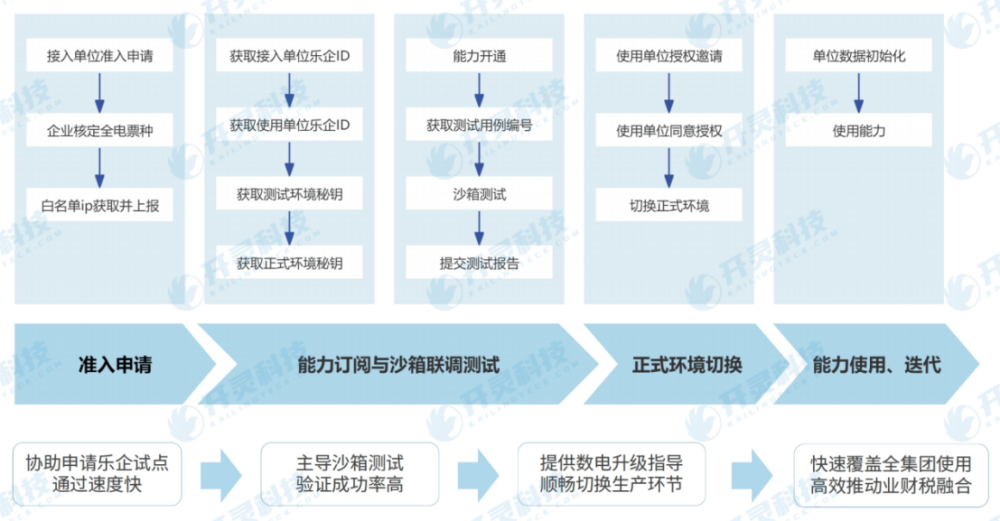
Leqi Platform technical integration in practice: How does Kailing Technology help group enterprises achieve direct connection between multiple business systems and tax authorities?Published: 2026-04-15 17:03 In the wave of comprehensive promotion of fully digitalized e-invoices and accelerated implementation of China Golden Tax Phase IV, the Leqi platform is quietly changing the underlying logic of enterprise tax management. The Leqi platform launched by the State Taxation Administration embeds tax policies and invoicing and invoice-use rules into enterprise business processes through direct connection between the tax system and enterprises' own information systems, achieving integrated business-finance-tax convergence. However, for group enterprises with multiple business systems and hundreds of tax entities, behind the two words "direct connection" lies a set of technical integration challenges far more complex than imagined. One SAP system must be connected, dozens of regional ERPs must be compatible, and invoice logic under different business scenarios must be adapted—this is the real practice of technical integration. So how does Kailing Technology help group enterprises connect this "last mile"? I. Leqi Direct Connection: the policy significance of moving from "usable" to "well used"Leqi is a platform through which the tax authority provides eligible enterprises, via direct connection between the tax information system and the enterprise's own information system, with rule-embedded, data-interoperable tax-related services. The Leqi Platform is a digital platform built by the State Taxation Administration based on the principles of open rules and unified standards, providing enterprises with functions such as access application, capability subscription, testing and verification, rule application, and authorization management. From the perspective of access thresholds, local tax authorities have clear requirements for enterprise qualifications. Taking the Leqi joint-use specification guidelines issued by Shanghai in 2026 as an example, direct connection units must meet conditions such as paid-in registered capital of more than RMB 10 million, and cumulative revenue of more than RMB 100 million from transactions conducted by the direct connection unit and the intended user units through the direct connection unit's own information system in the 12 months before applying for access. The 2025 version of the self-use specification guidelines requires that the direct connection unit and its filed user units have total operating revenue of more than RMB 50 million in the previous year, and cumulative invoice issuance and receipt volume of no less than 10,000 invoices or cumulative invoicing amount of no less than RMB 100 million. These "hard indicators" themselves filter the applicable groups, and also mean that Leqi Direct Connection is essentially a deep integration solution for large and medium-sized enterprises. Another deeper meaning of the policy lies in the clear division of responsibility boundaries. Direct Connection Units must not only handle the connection between the direct connection platform and the Leqi platform and maintain the affiliated relationships of user units, but also implement the cybersecurity multi-level protection system in accordance with laws and regulations such as the Cybersecurity Law, the Data Security Law, and the Personal Information Protection Law, assume cybersecurity protection responsibilities for the direct connection platform, and ensure that the original data for invoice issuance and use comes from the unit's own information system and is traceable and verifiable. In other words, connecting to Leqi is not just a technical action, but a systematic project spanning corporate governance, data security, and compliance risk control. II. Group Enterprises Connecting to Leqi: Ideal Is Plump, Reality Is BonyFor group enterprises, the appeal of Leqi Direct Connection is obvious: 365×24 uninterrupted invoicing, no need for frequent face-scan authentication, and delivery upon invoicing, greatly shortening the collection cycle. But between the ideal and reality lie concrete and thorny technical hurdles. The first hurdle: the "heterogeneity dilemma" of multiple business systems. A large group typically deploys dozens or even hundreds of business systems: headquarters uses SAP, one regional company uses Oracle, another business segment runs Yonyou NCC or Kingdee, plus self-developed supply chain systems, contract management systems, order systems... These systems carry transaction data from different business scenarios. Leqi Direct Connection is not something that can be solved by "connecting one line"; it requires connecting all source systems that generate transaction data to ensure every invoice issued can be traced back to real business transactions. This is like connecting dozens of railways built in different eras and to different standards into one new hub station—just adapting interface protocols is a massive project. The second hurdle: The "difficulty of reverse-engineering" interface logic. The Leqi Platform provides standardized basic interfaces, but for enterprises to deeply integrate them with internal business systems, they must design complete business processes themselves. Taking the most common invoice red-letter reversal as an example, reversing a blue invoice originally requires calling at least 3 sets of interfaces, involving multiple stages such as application, confirmation, and cancellation. Any incorrect interface call sequence will cause the operation to fail. Leqi only provides "atomic" capabilities, and enterprises need to string these capabilities together into complete business processes like building blocks—and once reverse processes and exception handling are involved, the design difficulty rises exponentially. The third hurdle: The "black box pain" of verification logic. Every parameter passed in invoicing data must meet strict validation standards, but the Leqi interface only returns a simple "success/failure" result without indicating the specific error reason. Whether the tax rate matches the tax code, whether customer information is compliant, whether commodity details exceed limits—these business-level validation risks must be borne by the enterprise itself, and any deviation may trigger tax compliance issues. For IT teams lacking tax technical expertise, troubleshooting a single parameter error may take several days. The Fourth Hurdle: The "Synthesis Dilemma" of Fixed-Layout Documents. After successful Leqi invoicing, only an XML data stream is returned; PDF and OFD invoice layout files must be synthesized by the enterprise itself. When encountering complex scenarios such as multi-line details, merging and splitting, and remark concatenation, the development difficulty far exceeds expectations. In addition, the extensibility of the tax bureau's preset templates is limited, so enterprises with personalized layout requirements must invest substantial development resources themselves. The fifth hurdle: the "72-hour countdown" of sandbox testing. After each capability application, all sandbox tests must be completed within 72 hours, otherwise the application process must be restarted. This places extremely high demands on an enterprise's technical response speed and project collaboration capability. A single parameter configuration error may require starting over and waiting for a new round of approval. The sixth hurdle: the "invisible burden" of continuous operations and maintenance. The Leqi interface is frequently upgraded along with tax policies, and the average annual iteration cost cannot be underestimated. Enterprises not only need to build systems, but also need a professional team familiar with tax rules and technical interfaces to continuously follow up and maintain them.
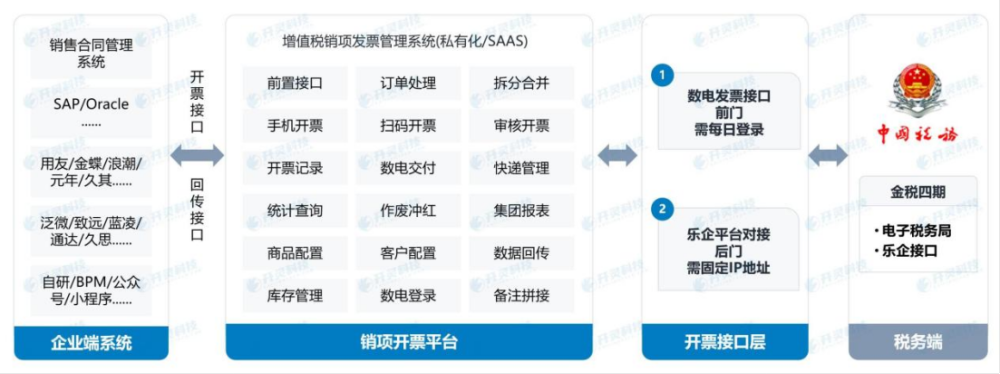
III. Kailing Technology's Technology Integration Solution: From "Point-to-Point Connection" to "Network-Wide Connectivity"Facing the above challenges, Kailing Technology's solution is not to provide a "universal interface," but to build a layered, decoupled, and flexibly adaptable integration architecture, enabling group enterprises to achieve comprehensive direct connection between multiple business systems and the tax bureau at minimal cost. 1. Pre-packaged interface layer: Assemble "atomic capabilities" into "business processes"What Leqi provides is "atomic" interface capabilities, while Kailing Technology encapsulates these atomic capabilities into business-level interface modules that can be called directly. It comes with preset full-process interface suites for invoice issuance, delivery, and reversal, and an embedded automated validation engine that can precisely locate the cause of errors and greatly reduce troubleshooting costs. Layout files for multiple invoice types are automatically generated, supporting XML, OFD, and PDF output, so enterprises no longer need to invest development effort in layout composition. The value of this pre-packaged interface is that it solidifies implicit knowledge such as "interface call sequence" in the system, so enterprise developers only need to focus on the input of business data and do not need to understand the complex underlying interface orchestration logic. For a typical invoicing request, from triggering in the business system to invoice delivery, dozens of steps in between—including parameter validation, commodity code matching, tax rate adaptation, and blue-red invoice association—are all completed automatically by the packaging layer. 2. Multi-system adaptation layer: Enabling heterogeneous ERP integrationTo address the challenge of heterogeneous integration across multiple business systems in group enterprises, Kailing Technology's solution has established deep integration capabilities with mainstream business systems such as SAP, Oracle, Yonyou NCC, and Kingdee, supporting rapid connection to enterprises' existing business systems through standardized interfaces for seamless data flow. Whether it is a centrally deployed SAP system at headquarters or Yonyou/Kingdee systems independently deployed by regional branches, all can connect to the Leqi platform through a unified adaptation layer, forming an integration network of "one hub, multiple access points." What is more important is that this adaptation layer is not simple "data transfer," but realizes full-process connectivity from contract to invoicing, payment collection, and bookkeeping, completely solving the disconnect between business and finance systems. For example, when a sales contract completes approval in the contract management system, the system automatically triggers the invoicing process; after invoicing is completed, it automatically syncs to the financial system to generate accounting vouchers; after the customer pays, the system automatically matches and writes off — the entire chain requires no manual intervention, truly achieving "transaction triggers invoicing, invoicing triggers bookkeeping." 3. Group unified control layer: centralized management of multiple tax numbersLarge group enterprises often have dozens or even hundreds of tax entities, each with an independent tax number and invoicing needs. Kailing Technology's solution supports unified management and control of multiple group entities, enabling centralized management of the invoicing permissions, invoice pools, and tax data of all subordinate units on one platform, while meeting the needs of each user unit for independent invoicing and independent accounting. Under this architecture, the group headquarters, as the direct connection entity, is responsible for overall connection with the Leqi platform, while each subordinate unit, as a user entity, uses tax-related services through the direct connection platform. The headquarters can monitor each unit's invoicing and invoice usage in real time, promptly detect anomalies and issue warnings, meeting the compliance requirement for direct connection entities to "supervise the daily tax-related behavior of user entities." 4. Source code delivery and private deployment available: secure, autonomous and controllableAn often overlooked but crucial consideration is: according to Leqi access requirements, enterprises may not deploy the direct connection platform in a manner hosted by third-party service providers, and must ensure the security and autonomous controllability of tax data. Kailing Technology provides 100% system source code delivery and supports private deployment, giving enterprises core control. This model both complies with the State Taxation Administration's requirement that the Leqi system not adopt third-party hosting and ensures that enterprises have fully autonomous system management capabilities, avoiding the risk of "technology lock-in."
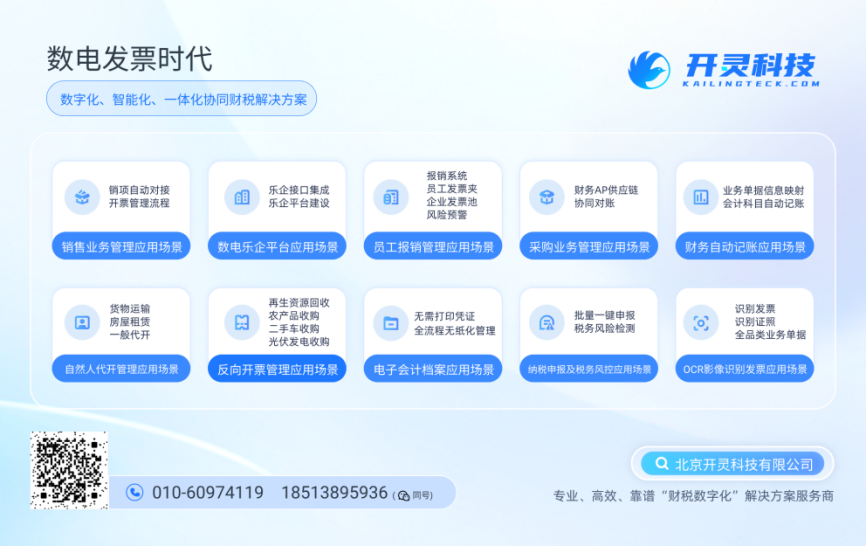
IV. Practical case: from blueprint to implementationThe following are several typical practical scenarios of Kailing Technology in Leqi Direct Connection implementation: Scenario 1: The "grand system assembly" of a large comprehensive groupA certain central enterprise group has dozens of subsidiaries, with business covering manufacturing, trade, logistics, and other sectors, and internally runs multiple business systems including SAP, Yonyou NCC, and Kingdee, with invoice data long fragmented across systems. After integrating with Kailing Technology's solution, the project team completed the connection between core business systems and the Leqi platform within 60 days, achieving automatic matching of mall orders with invoices, online financial review, second-level invoicing, and automatic delivery in three formats (PDF/OFD/XML), with overall invoicing efficiency increased by 300%. The group's CFO commented: "Previously, during month-end concentrated invoicing, the finance team had to work overtime until dawn. Now the system runs automatically, labor costs have dropped significantly, and compliance risks have also been notably reduced." Scenario 2: A financial institution's "security and compliance red line"The financial industry has extremely high regulatory requirements for data security, and any data "leaving the network" may trigger compliance risks. This institution adopted Kailing Technology's fully intranet privatized deployment solution, with all system components running in the institution's own data center. Under the premise of ensuring data never leaves the intranet, it efficiently completed direct interconnection with business systems and automatic delivery and archiving of fully digitalized e-invoices. The solution also passed the strict review of the institution's information security department, becoming a compliance benchmark for Leqi Direct Connection in the financial industry. For group enterprises, Leqi Direct Connection is no longer a multiple-choice question of "whether to do it," but a mandatory question of "how to do it quickly and well." Choosing a mature technology integration solution means enterprises can focus on core business rather than spending effort on interface testing and policy tracking. In the wave of tax digitalization, the real winners are not those enterprises that "do everything themselves," but those that know how to leverage resources and make good use of professional tools. Kailing Technology's fully digitalized e-invoice Leqi full-stack solution helps group enterprises take every step of Leqi Direct Connection steadily, moving the vision of business-finance-tax integration from PPT to the production line:https://www.kailingteck.com/h-col-123.html 。 As a comprehensive business-finance-tax digitalization solution service provider, Kailing Technology provides business-finance-tax management digital transformation products and operational services for various government agencies, institutions, and large, medium, and small enterprises. The product line includes: Solutions for businesses including sales contract management system, procurement contract management system, fully digitalized Leqi interface project, output automatic invoicing system, reverse invoicing system, invoice issuance for individuals system, employee expense control and reimbursement system, input VAT invoice management system, supply chain collaborative reconciliation system, image OCR recognition system, automatic financial bookkeeping system, and electronic accounting archives system, comprehensively driving the digitalization process across various fields. If you have any business-finance-tax digital transformation needs, welcome to contact us. Beijing Kailing Technology will serve you wholeheartedly.
#Leqi Direct Connection #Fully Digitalized Leqi Solution #Leqi Interface #Fully Digitalized E-Invoice #Leqi Integration #Digital Business-Finance-Tax #China Golden Tax Phase IV #Business-Finance-Tax Integration |