010-6097 4119Book a Demo


Kailing Technology's tax APP invoice issuance for individuals interface solution: author royalty invoicing ensures complete publisher processes and tax compliancePublished: 2026-02-10 16:49 Remuneration settlement in the publishing industry naturally has the characteristics of "many natural person entities, scattered single amounts, and frequent cross-regional collaboration." Traditional invoicing models have long been unable to adapt to current regulatory requirements and business efficiency needs, and multiple pain points urgently need to be resolved. At the policy level, the State Taxation Administration and local governments continue to promote compliant invoicing for natural persons. The Law of the People's Republic of China on the Administration of Tax Collection clearly stipulates that taxpayers must keep accounts and conduct accounting based on legal and valid vouchers. As core vouchers, the compliance of invoices directly determines the legality of enterprise tax handling. I. Driven by both policy and industry, compliant invoicing for manuscript fees is urgentFor publishers, the China Golden Tax Phase IV system has achieved penetrating verification of the four-flow data of "contract, funds, business and invoice." "White slip booking" or non-compliant invoices will directly trigger risks such as tax adjustments, tax payments in arrears and late fees. In industry practice, the pain points faced by publishers are more specific and acute. First, authors have low willingness to cooperate with invoicing. The author groups nationwide vary greatly in age and operational ability, causing nearly 70% of authors to be resistant, and publishers' invoice collection rates are generally below 50%. Second, enterprises face high tax risks. A large amount of manuscript fee expenditures cannot be deducted before tax due to the lack of compliant invoices, causing inflated book profits and exposure to tax audit fine risks. Third, cross-regional policy implementation is difficult. Provinces and municipalities differ in the scope of items, tax rate preferences, and prepayment rules for invoice issuance for individuals, making it difficult for publisher finance staff to adapt accurately and prone to filing errors. Fourth, management efficiency is low. Manually collecting author identity information, guiding invoicing processes, and verifying invoice information costs more than 2 million yuan in annual operating costs, and the average cycle from application to booking for a single invoice is as long as 7 days, seriously affecting financial settlement efficiency. II. A full-process digitalization solution that builds a solid compliance foundation for publisher royalty invoicingKailing Technology's tax APP invoice issuance for individuals interface solution takes "compliance as the core, convenience as the guide, and efficiency as the goal," realizing full-process digital transformation for the author royalty scenario, building a closed-loop service covering "registration and authentication - information filling - review and tax payment - invoice archiving," with core advantages reflected in six dimensions.
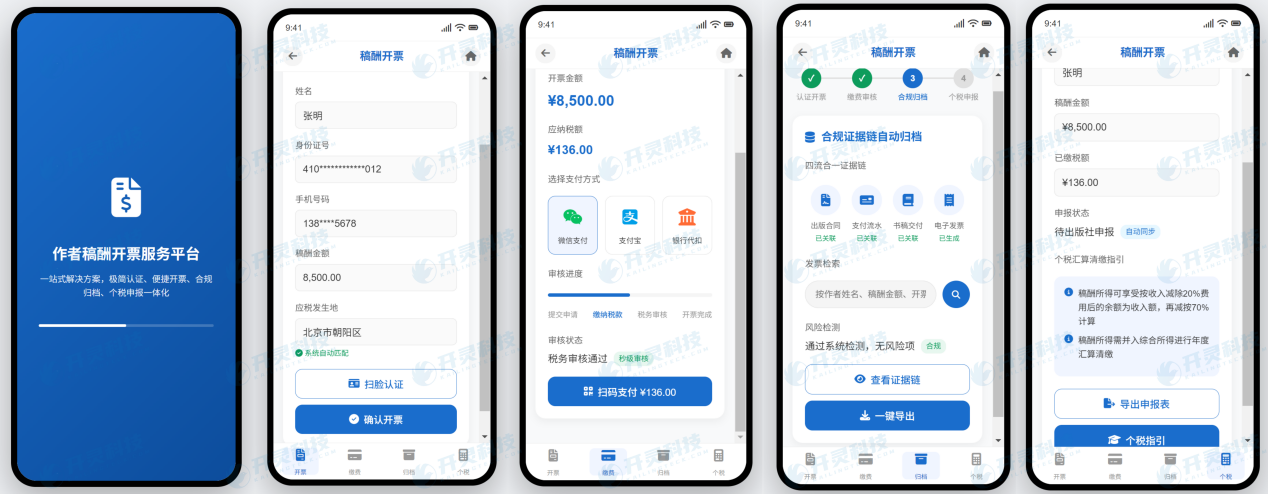
▪ Minimalist identity authentication, lowering the operational threshold for authors The solution provides two registration methods: facial recognition and UnionPay bank card recognition. Authors do not need to download the tax authority app and can complete registration only through the Kailing Technology tax app or H5 page cooperated with the publisher. First-time registration requires real-name authentication, supporting upload of front and back photos of ID cards and face-scan verification. In Beijing and other regions, convenient authentication without face scan is also available, and the entire process takes no more than 3 minutes. The authentication integration solution embeds Electronic Tax Bureau functions into existing applications, so authors do not need to jump to other platforms, greatly improving operational cooperation, especially adapting to the usage habits of middle-aged and elderly author groups. ▪ Smart information filling, improving invoicing accuracy and efficiency After the author completes authentication, the system can automatically pre-fill the basic information of the invoicing party (name, ID number, phone), while the invoice recipient information (publisher name, taxpayer identification number) is pre-configured by the publisher. The author only needs to confirm the manuscript fee amount and select the taxable place of occurrence (down to district/county) to complete the application. For the corresponding manuscript fee category, the system has preset standardized classifications, so authors do not need to select manually, avoiding invalid invoices caused by incorrect category entry. The taxable place of occurrence supports direct transmission of full data sources from the publisher's business system, ensuring consistency with the actual place of business occurrence and avoiding the risk of questioning tax source loss. ▪ Diversified tax payment channels, flexibly adapting to settlement needs The solution supports two tax payment modes: enterprise payment on behalf and author self-payment, meeting the remuneration settlement policies of different publishers. Enterprises can automatically pay taxes through China Merchants Bank corporate accounts, and the system supports bank-enterprise direct connection configuration, with taxes transferred to the national treasury system in real time; authors can also choose WeChat or Alipay QR code payment, and the tax payment QR code has no validity period limit, ensuring payment convenience. The system automatically calculates the tax payable based on the invoicing amount, and all tax calculations are transparent throughout, allowing authors to view details in real time. ▪ Four flows consistent preservation, meeting compliance verification requirements The system automatically collects and associates electronic contracts, fund payment vouchers, author service confirmation records, and invoice information related to manuscript fee payments, forming a complete business evidence chain stored in a structured manner in the cloud. Publishers can retrieve the full-chain materials corresponding to any invoice with one click through the enterprise management dashboard, meeting the China Golden Tax Phase IV verification requirements for business authenticity. Each invoice has a unique traceability identifier, supporting multi-dimensional retrieval by time, amount, author name, manuscript fee item, etc., facilitating financial audits and tax self-inspections for publishers. ▪ Intelligent control on the enterprise side, enabling full-process visualization Publishing houses can use a management dashboard accessible via web, APP and other channels to view in real time the invoicing progress of all their authors (pending application, under review, invoiced, tax paid), with data such as monthly invoicing volume and tax amount summaries automatically generating reports without manual statistics. The system supports invoicing quota control, adapting to different authors' remuneration scales. For failed invoicing or cases requiring red-letter reversal, the system automatically pushes failure reason prompts; after red-letter reversal, taxes are generally refunded via the original route within T+1 days, and detailed guidance is provided for some scenarios requiring offline processing. ▪ Security and compliance assurance, safeguarding data privacy and security The solution strictly follows the requirements of the Personal Information Protection Law, encrypting the storage and transmission of sensitive data such as authors' ID numbers, bank card information, and contact details, implementing tiered permission management, with access granted only to authorized publishing house finance personnel on a need-to-know basis. All operation logs are retained throughout the entire process, including key steps such as registration and authentication, invoicing applications, tax payments, and invoice downloads, ensuring audit traceability and avoiding data leakage or misuse risks.
Today, driven by both digital tax administration and industry compliance requirements, Kailing Technology uses technology as a bridge and compliance as the criterion to build a new paradigm for manuscript fee settlement in the publishing industry, where authors can easily issue invoices, publishers can manage easily, and the entire process is traceable. We not only provide invoicing tools, but are also committed to becoming a reliable partner for business-finance-tax digitalization in the publishing industry, making every delivery of knowledge value smooth, transparent, and worry-free. Kailing Technology Invoice Issuance for Individuals Solution helps publishers achieve online, automated, and compliant author manuscript fee invoicing, making finance easier and cooperation more efficient:https://www.kailingteck.com/h-col-126.html 。 Kailing TechnologyAs a comprehensive business-finance-tax digitalization solution service provider, we provide business-finance-tax management digital transformation products and operational services for various government agencies, institutions, and large, medium, and small enterprises. The product line includes: Sales contract management system, procurement contract management system, fully digitalized Leqi interface project, output automatic invoicing system,Reverse invoicing system,The invoice issuance for individuals system, employee expense control and reimbursement system, input VAT invoice management system, supply chain collaborative reconciliation system, image AI OCR recognition system, automated financial bookkeeping system, electronic accounting archives system, and other business solutions comprehensively advance digitalization across various fields. If you have any business-finance-tax digital transformation needs, welcome to contact us. Beijing KailingKailing TechnologyWe will serve you wholeheartedly.
#IndividualsInvoicingSolutions #IndividualsInvoicingSystem #Invoice Issuance for Individuals API Interface #Batch IndividualsInvoicingInterface #Digital Business-Finance-Tax Compliance #Enterprise Tax Risk Control |