
Can you still get reimbursed if the header, tax ID, address, and phone number are all wrong? Kailing Technology turns invoice verification into automatic interception before submission
"This invoice won't work, the title is written incorrectly."
"Didn't I write the company name?"
"It's written as an abbreviation; the invoice title must be the full name on the business license."
"Oh... then I'll remind the other party next time."
"Also, the last three digits of the tax number do not match, the address and phone number are from before we moved, and the bank account is also old."
"This one... can it still be reimbursed?"
"Figure it out yourself; anyway, the money can't come into the accounts."
This conversation is repeated in finance offices almost every month, and the recurring problem is that small area in the upper-left corner of the invoice: the company name is written as an abbreviation, the tax number is missing several digits, the address and phone number are still from before the move, and the bank account is one that has long been unused. When serving enterprise expense control and reimbursement scenarios, Kailing Technology repeatedly sees the same contradiction—the person who discovers the problem is finance, the person who makes the mistake is the employee, and the time of discovery is often after the consumption has already been completed and the counterparty’s invoicing system has long been closed. By the time finance circles those few words on the reimbursement form, there are not many remedial actions left.
▍It's not the employee who is wrong, but the timing of discovering the problem
First say a fair word for employees. It is not easy for a colleague in a non-finance role to accurately report the company's taxpayer identification number. Issuing a special invoice requires four pieces of information: full enterprise name, taxpayer identification number, registered address and telephone, and bank and account number; issuing a general invoice usually requires only the name and tax number. These rules are rarely explained seriously, and most employees rely on a screenshot in their phone album—perhaps sent by a colleague years ago. The company may have moved offices or changed its basic account since then, but the screenshot has never been updated.
What is more troublesome is the time lag. In the traditional approach, verification happens at month-end: employees paste a stack of invoices and submit them, finance flips through them one by one and checks item by item, and problems are sent back. By then two or three weeks have passed since invoicing, and asking the other party to exchange invoices requires going through voiding and reissuing, or red-letter reversal if across months; after several rounds of back-and-forth communication, the result is often that employees bear the loss and finance reluctantly accepts them.
So the question is never "whether to verify", but "when to verify". When invoice volume is small, manual verification one by one is still manageable; once volume grows, manual verification degrades from a quality checkpoint into a slow process on the assembly line—the more detailed the verification, the longer documents are held up, and the more complaints there are.
▍Kailing Technology's approach: moving verification to the moment the invoice comes in the door
Kailing Technology's Lingdong Reimbursement reverses the order of this process: instead of verifying after the reimbursement form is submitted, it completes verification the moment an invoice is collected into the personal invoice folder. Employees can scan a code, take a photo, or manually type it in on their phones; the one lying in the card wallet, files forwarded by colleagues on WeChat, and electronic invoices received by email can also be collected into this folder. Once an invoice enters the system, compliance verification begins immediately, and the results are marked directly on the invoice.
The order of comparison is actually the few questions finance asks face to face: whether the company name is written as the full name on the business license, whether the tax number is correct digit by digit, whether the address and phone number are the current ones, and whether the bank and account number are still the set in use. The baseline comes from the invoicing information archive maintained by the enterprise itself; after moving, changing accounts, or renaming, it is changed once in the backend, and invoices collected that day are verified according to the new standard. This is also Kailing Technology's purpose in moving verification forward — to maintain only one set of rules, rather than having hundreds of employees each remember their own.
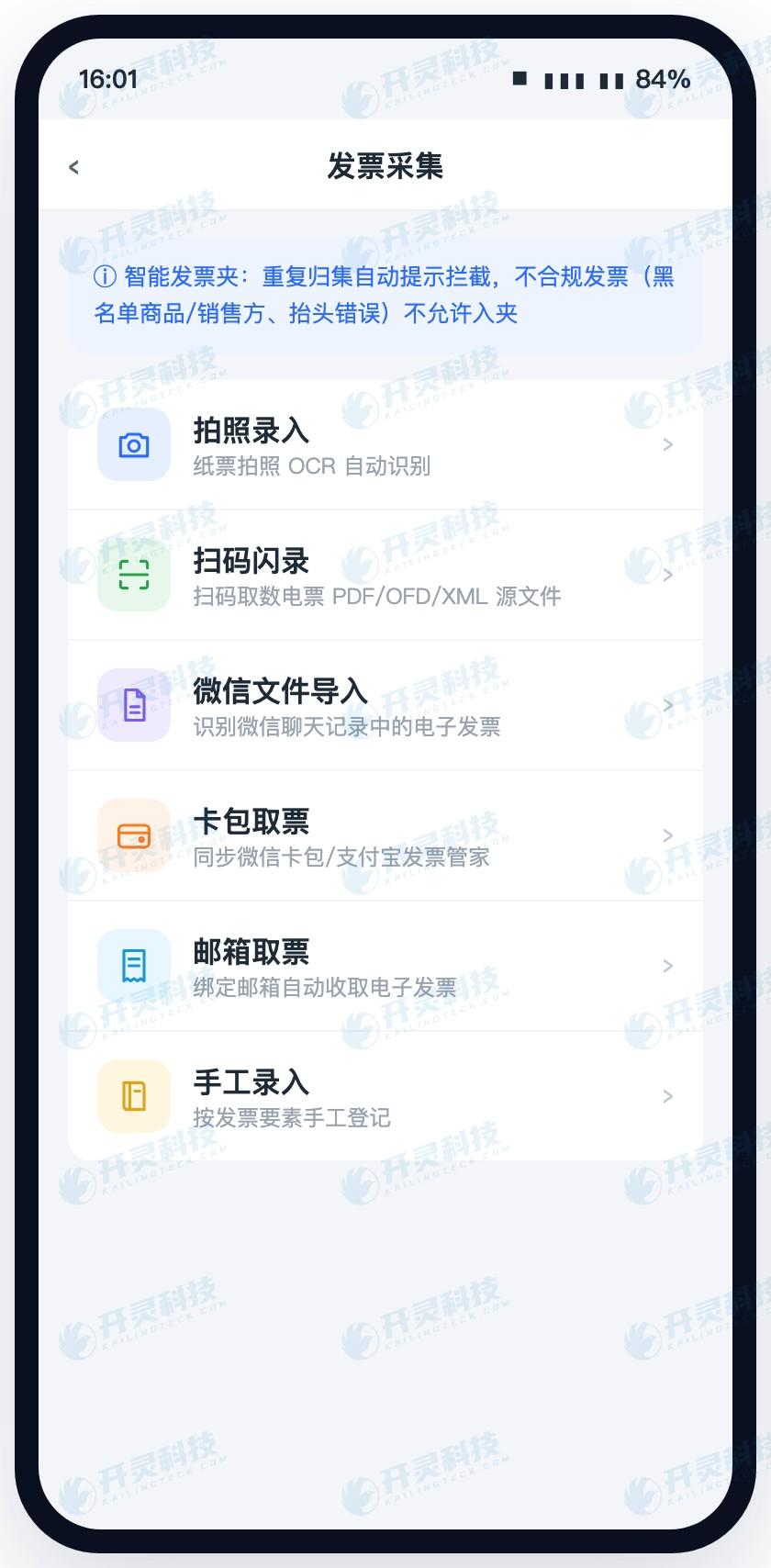

▍Validation results have three states, not simply right or wrong
Many people think that the output of verification should be two values: "pass / fail." In actual use, they find that two states are not enough. In the invoice pool of Lingdong Reimbursement, the compliance verification column gives three results: one is normal, and the other two point to the tax number and name respectively — indicating that the taxpayer identification number is inconsistent, or indicating that the enterprise name is inconsistent. The significance of marking them separately is that the follow-up actions for these two types of issues are completely different.
- Marked as normal—— If the invoice face information matches the enterprise archives, this invoice can enter the invoice folder and participate in subsequent reimbursement and booking.
- If the tax number does not match— The tax number is the identity primary key of an invoice. If it does not match, it usually means this invoice was issued to another entity, or the other party entered the wrong number, and in almost all cases the invoice can only be replaced. The earlier it is discovered, the easier it is to replace.
- If the name does not match— The situation is relatively complex. It may be that the other party wrote the full name as an abbreviation, omitted bracketed content such as "(Beijing)", or that two entities with similar names within the group issued invoices interchangeably, requiring a human to make a judgment.
Mark the reasons for inconsistencies directly, so what finance sees is no longer "a pile of problematic invoices" but "which item is wrong on which invoice." This column can be filtered directly in the invoice pool and can also be viewed together with reimbursement status and bookkeeping status, so there is no need to go through everything again at month-end.
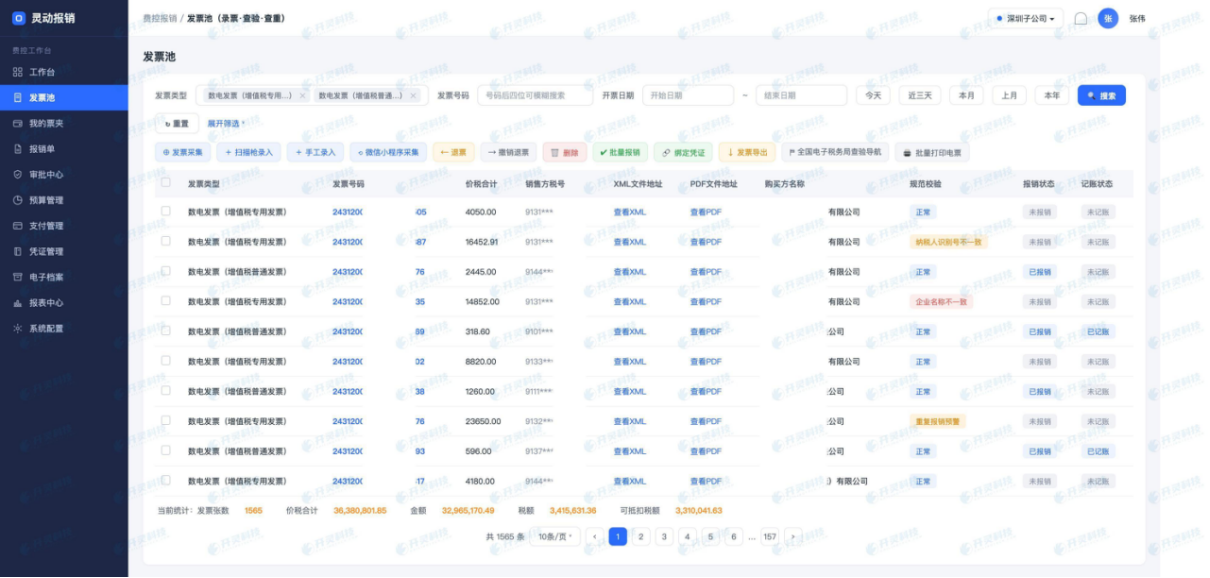
▍Whether to hard-block is left for the enterprise to decide
After a problem is found, should it just be a reminder, or should it simply not be allowed in? Different enterprises have different answers. Lingdong Reimbursement provides strong control settings at the invoice folder level: enterprises can choose to block non-compliant invoices directly outside the folder and not allow them to enter, meaning they have no chance to be selected into a reimbursement form. At the same level, there is also handling of duplicate collection - when the same invoice is collected again, a prompt is given and duplicate addition is not allowed.
Whether to enable strong control is a management choice, not a technical choice. Group headquarters with tighter risk control and shared service centers with concentrated invoice volumes usually tend to enable it; enterprises with complex business forms and frequent special invoices may first enable only prompts, with finance making judgments during the review stage. The prudent approach is to run in prompt mode for a period first, see how many flagged invoices are truly erroneous and how many are due to incomplete rule configuration, and tighten only after false positives converge.
▍Paper invoices compare numbers, electronic invoices verify signatures
Four-element comparison addresses "to whom it is issued," but whether the invoice itself is genuine is another matter, and these are two different paths.
The core of a paper invoice is the number: the system compares the number on the invoice face with information from the electronic tax bureau to confirm that the invoice actually exists and that its content is consistent with tax authority records. For invoice types without line items, such as fixed-amount invoices, sequential number recognition is also supported, and local verification entry points are embedded to prevent a stack of sequentially numbered fixed-amount invoices from being repeatedly used for reimbursement.
E-invoices rely on signatures: both e-invoices and fully digitalized e-invoices carry tamper-proof signature information, and verifying the signature can determine whether the file has been altered since issuance. This is especially important for reimbursement—if the amount field of a PDF has been tampered with, it is hard to spot with the naked eye, but the signature will not match. The scan-and-flash-entry action itself retrieves the source files (PDF, OFD, XML) from the Electronic Tax Bureau for employees, and what is obtained is the original tax-side file, completing verification and retrieval in the same step.
▍Back to that conversation at the beginning
After a certain manufacturing enterprise group went live with Lingdong Reimbursement, the location where that conversation happened changed. While waiting for an invoice at the front desk, the employee scanned the invoice into the mobile invoice folder, and the screen immediately marked "enterprise name inconsistent." He could look up and ask the other party to reissue one—only two minutes in total, without taking an invalid invoice back to the company, and without being returned by finance a month later.
For finance, the nature of the work content has also changed: previously half the time was spent on deterministic labor such as "finding errors"; now the system completes the deterministic parts, and people only handle exceptions that machines cannot judge—entity mix-ups within the group, legacy old names, and special invoice types. This is exactly what Kailing Technology emphasizes: the value of an expense control system is not in re-verifying invoices for finance, but in blocking problems that should be solved at the source.
Every rework in the reimbursement chain costs not the rework itself, but the fact that it often occupies the few days of month-end closing. Move checking whether the company name is correct, whether the tax number is wrong, and whether the address, phone, and bank account are the current set to the moment the invoice enters the door, and only then can the subsequent reimbursement, approval, accounting, and archiving proceed smoothly.
▍FAQ
Q: If the verification prompt is inconsistent, does that mean the invoice definitely cannot be reimbursed?
A: Not necessarily. Verification results are prompts, and the handling method is determined by enterprise policy. When strong control is not enabled, invoices marked as inconsistent can still be placed in the folder and submitted, and finance judges during review; when strong control is enabled, non-compliant invoices are not allowed into the folder and must first be exchanged or corrected. The system is responsible for pointing out problems; whether to release is a management action.
Q: Are the validation rules for special VAT invoices and ordinary invoices the same?
A: The verification action is the same, but the information items of concern differ. Ordinary invoices usually focus on the buyer's name and taxpayer identification number; special invoices also involve address and telephone and bank account number, and these two items are themselves part of the special invoice face. The system compares according to the information items actually contained on the invoice face, and invoice types missing items will not be misjudged because they lack that field.
Q: After enabling strict control, will normal invoices be mistakenly flagged?
A: False positives are mostly not a problem with the verification itself, but with the enterprise's invoicing information archive not being maintained properly, such as not updating the address after moving or not synchronizing after opening a new basic account. It is recommended to first use prompt mode for observation in the initial launch period, approve the archive, clarify common exceptions, and then switch to hard control.
Q: Is verification done at collection or when the reimbursement form is submitted?
A: It is executed when the invoice enters the invoice folder, that is, at the collection stage, and the status is carried over when the reimbursement form is submitted. The benefit of moving it earlier is that employees can see the result at the invoicing site or on the day they receive the invoice, when the cost of exchanging the invoice is lower, without waiting for the reimbursement form to be rejected.
Q: Can old invoices previously stored in the system still be re-screened?
A: The invoice pool can be filtered by invoice type, number, invoicing date, and other conditions for centralized processing. Compliance verification, reimbursement status, and bookkeeping status are all list fields, facilitating unified screening of existing invoices. For the handling standards of historical invoices, it is recommended to confirm with finance first to avoid disturbing documents that have long been booked.
Move invoice verification onto employees' phones and to the moment invoices enter the door. Learn about Kailing Technology Lingdong Reimbursement's multi-dimensional invoice verification and pre-blocking capabilities: https://www.kailingteck.com/feikong/ .
As a comprehensive business-finance-tax digitalization solution service provider, Kailing Technology provides business-finance-tax management digital transformation products and operational services for various government agencies, institutions, and large, medium, and small enterprises. The product line includes:
Solutions for businesses including sales contract management system, procurement contract management system, fully digitalized Leqi interface project, output automatic invoicing system, reverse invoicing system, invoice issuance for individuals system, employee expense control and reimbursement system, input VAT invoice management system, supply chain collaborative reconciliation system, image OCR recognition system, automatic financial bookkeeping system, and electronic accounting archives system, comprehensively driving the digitalization process across various fields.
If you have any business-finance-tax digital transformation needs, welcome to contact us. Beijing Kailing Technology will serve you wholeheartedly.
Keywords: invoice validation, incorrect invoice title and tax number, invoice standardization validation, inconsistent taxpayer identification number, non-compliant invoice interception, Kailing Technology, Lingdong Reimbursement, expense control and reimbursement system
As a comprehensive business-finance-tax digitalization solution service provider, Kailing Technology provides business-finance-tax management digital transformation products and operational services for various government agencies, institutions, and large, medium, and small enterprises. The product line includes: solutions for sales contract management system, procurement contract management system, fully digitalized Leqi interface project, automatic output invoicing system, reverse invoicing system, invoice issuance for individuals system, employee expense control and reimbursement system, input VAT invoice management system, supply chain collaborative reconciliation system, image AI OCR recognition system, automatic financial bookkeeping system, electronic accounting archives system, etc., comprehensively driving the digitalization process across various fields.
Consultation Hotline: 18513895936 / 010-60974119 Location: Beijing