
What needs to change in reimbursement after the full rollout of fully digitalized e-invoices? Kailing Technology sorts out three new actions: collection, verification, and locked booking
After the full rollout of fully digitalized e-invoices, a question enterprises ask frequently is: does the reimbursement process really need to change accordingly? The answer often lies in the details—the approval form is still the same approval form, the signatures are still the same levels of signatures; what has truly changed is the invoice itself: it is no longer a piece of paper you can touch and glue on, but a set of structured data with an electronic signature. When Kailing Technology implements expense control and reimbursement for enterprises, it finds that the process usually gets stuck not because some step was done wrong, but because the form of the invoice has changed while the actions did not follow suit. This article follows a fully digitalized e-invoice through the whole journey: from the seller clicking the invoice button, to its collection, verification, reimbursement, and being locked in the accounts, to see which three additional actions appear in between.
▍First see clearly: where the three differences between fully digitalized e-invoices and paper invoices lie
The first difference is that there are no paper copies. The action chain of "receive the invoice, paste it onto the reimbursement form, and hand it to finance" disappears at its starting point. What employees receive may be a push notification, a QR code, or a file forwarded by a colleague.
The second difference is that there is a source file. Fully digitalized e-invoices exist in three forms on the electronic tax bureau side: PDF, OFD, and XML. Among them, XML is structured data that can be directly read and verified by systems; screenshots and printouts are only its shadows, with neither a signature to verify nor fields to extract. According to the relevant requirements of the Ministry of Finance's accounting data standards for electronic vouchers, it is precisely this type of source file that must be retained for reimbursement, booking, and archiving.
The third difference is that the tax side can see the status. A fully digitalized e-invoice has an "identity" on the tax side: whether the recipient has confirmed its use, whether it has been booked, and whether it is booked as deductible or non-deductible before tax will all be recorded. This did not exist in the paper invoice era, and it is precisely why the process needs new actions—the invoice status is no longer determined only by the enterprise's internal ledger.

▍New action one · Collection: what you retrieve must be the source file
Once the invoice is issued, the first new action arrives: collection. In the past, collection meant "collecting paper"; now collection means "retrieving files." These two things are not at the same level of difficulty.
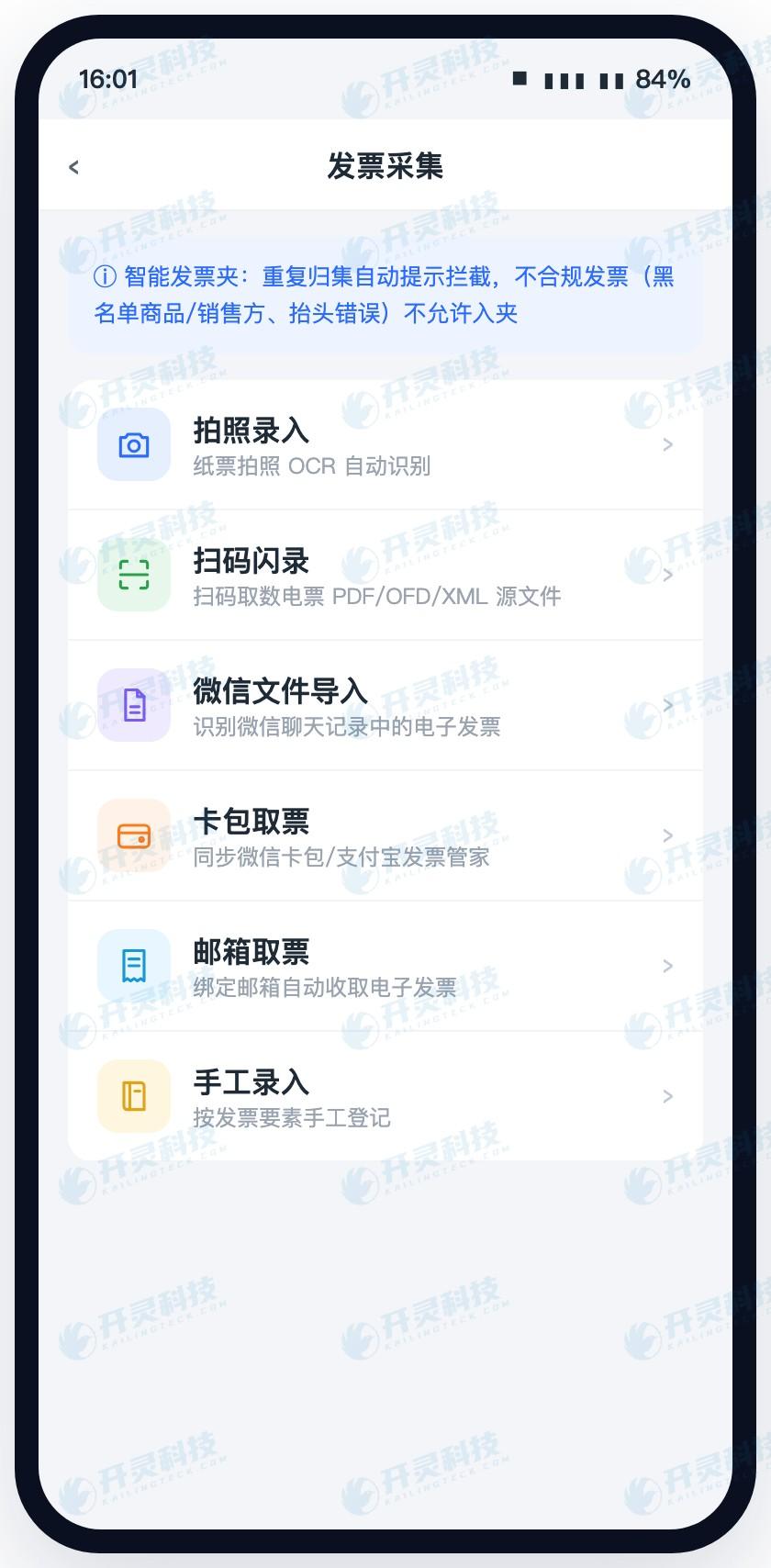
The difficulty lies in channels being too scattered. For the same employee, business trip air tickets are in the email, dining invoices are in the card wallet, conference fee invoices are sent by the client in a chat window, and there are still a few local fixed-amount invoices that can only be photographed. If collection only supports photo upload, then all subsequent steps receive only images, and source files cannot be recovered. The approach of LingDong Reimbursement is to expand the entry points: scan what can be scanned, directly sync what is sitting in WeChat card wallets, recognize and receive files sent by others in chat windows, let the system retrieve what is in email, support batch inclusion of fully digitalized e-invoices, and for what is left only on paper, take photos, while also keeping a manual supplementary entry channel. Each entry point operates independently, but all converge at the end into the same personal invoice pool.
More critically, scan-to-record in a flash. Employees scan the QR code on the invoice with their mobile phones, and the system directly connects to the Electronic Tax Bureau to retrieve the PDF, OFD, and XML source files of this invoice, completing collection and file retrieval in one step. At the moment it enters the pool, it is already an "invoice with original documents," rather than discovering only a blurry screenshot on hand when an audit requests files. When the same invoice is repeatedly collected, the invoice folder will prompt on the spot and not allow duplicate addition, narrowing the loophole for duplicate reimbursement first.
▍New action two · Verification: compare signatures, not just check authenticity
Next is verification. In the paper invoice era, the core question of verification was "is this invoice real?"; in the fully digitalized e-invoice era, the core question has become "has this invoice been altered, can it be used, and is it a duplicate?"
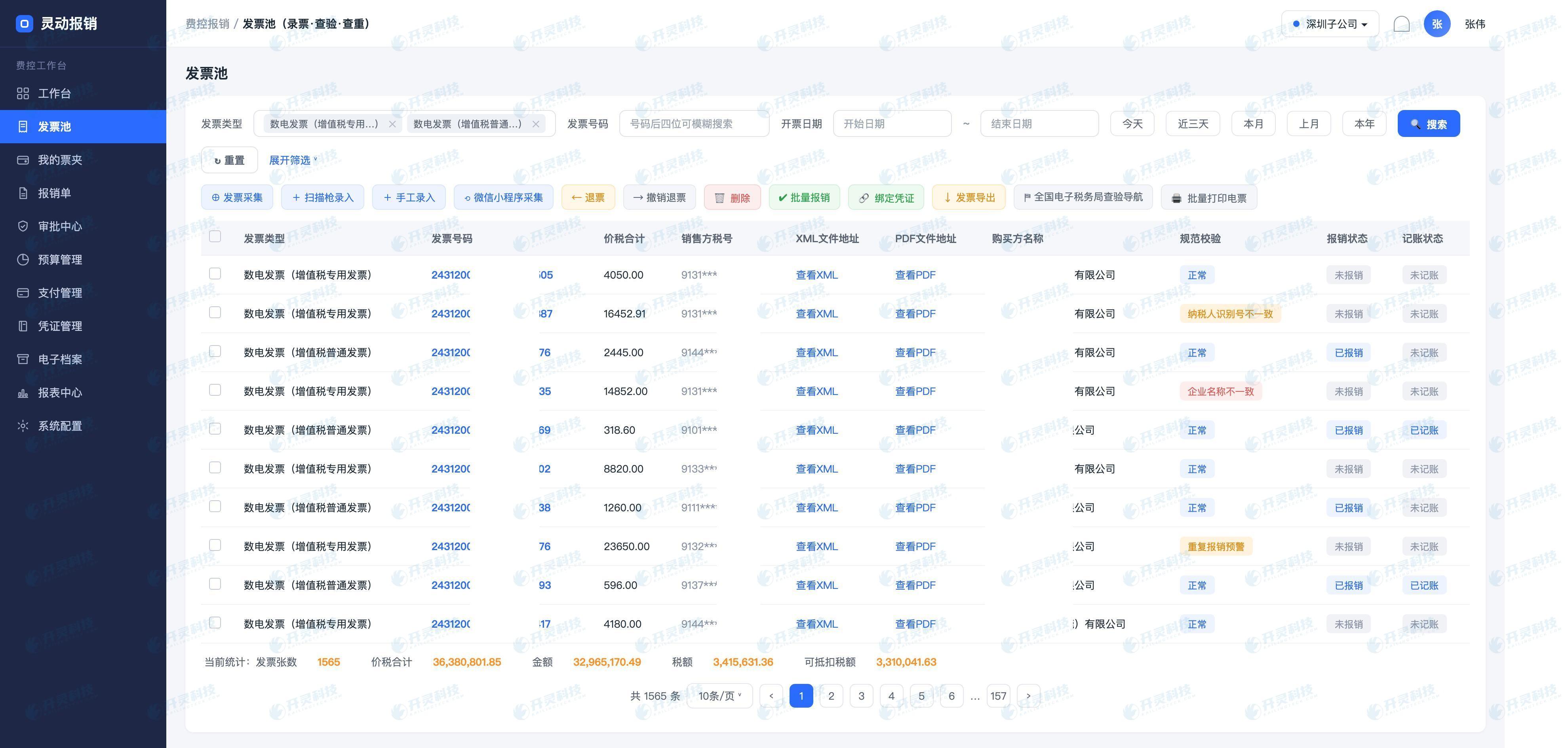
The root of the change is that a fully digitalized e-invoice is a file, and files can be edited. If the amount or header of a PDF is altered during circulation, it cannot be seen by the naked eye, but the electronic signature will become invalid. Thus verification has changed from a "true-or-false choice" to a set of simultaneous actions: whether the buyer's name on the invoice is fully written, whether the tax number matches, whether the address, telephone, and bank account match the enterprise records—these items are checked one by one; electronic invoices require checking the signature to see whether it has been tampered with during circulation; for paper ones, the invoice number is sent back to the tax authority side for verification; commodity names and sellers are each checked against blacklists; for fixed-amount invoices, it is also necessary to see whether the numbers are consecutive and connect to the local verification channel.
The verification result is not an ambiguous right or wrong, but writes the reason out in the open: those with no problems are marked as normal, and those with problems directly point out whether the tax number does not match or whether the company name in the header does not match the file. Finance does not need to open each one to guess what is wrong; looking at this column tells them which one to return and whom to ask. Enterprises with strict compliance requirements can also set verification as a hard control—non-compliant invoices are not allowed into the folder, and problems are intercepted before employees submit them, rather than being returned during finance review.
▍The middle step · order closing: let documents and invoices recognize each other
Once invoices enter the pool and pass verification, the next step is forming documents. On the surface there is nothing new in this step, but in fact it hides an easily overlooked requirement: documents and invoices must establish a traceable correspondence.
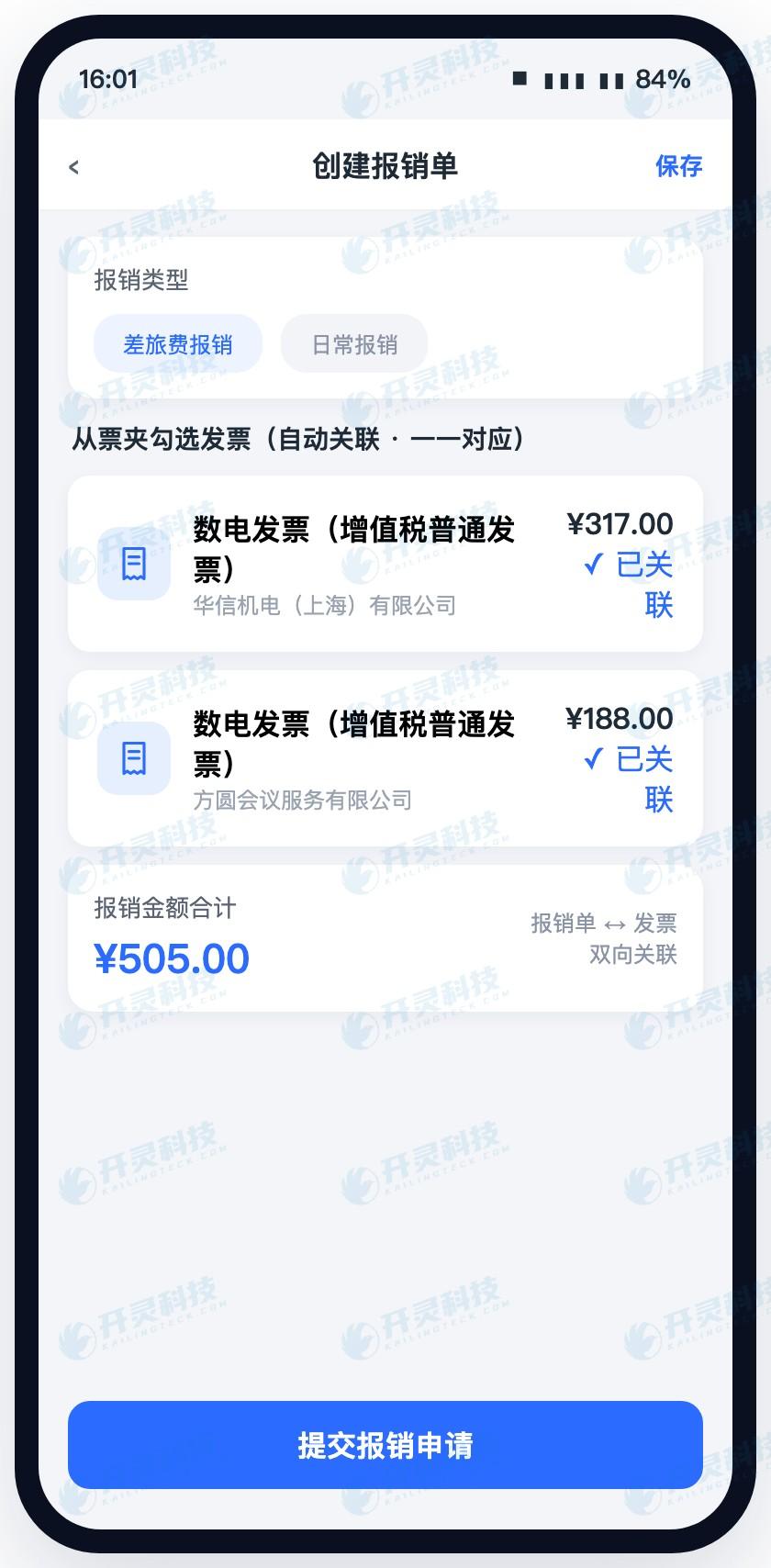
The traditional approach is for employees to fill out a reimbursement form and attach invoices behind it, with the relationship between the two relying entirely on the attachment sheet and a perforation seal. Fully digitalized e-invoices have no paper, so this physical association naturally breaks. Instead, a bidirectional association is made in the system: employees select several invoices in the invoice folder, and the system automatically generates reimbursement content based on invoice details (fields such as amount, item, and seller can be modified according to actual business circumstances), and the generated form is linked to each selected invoice. Later, whether checking invoices from a document or tracing back from an invoice to which document it entered, which approval step it reached, and whether payment was made, all can be clicked through.
This linkage may seem merely convenient now, but when spot-checked months later or accessed across years, it is the key to self-verification. The reimbursement progress and invoice status on the ledger are linked in real time, no longer requiring manual maintenance of comparison tables in Excel.
▍New action three · Lock-in: Kailing Technology locks this invoice in the books
The third new action, and one that is easily missed entirely: locking the tax accounting status.
In many enterprises, the reimbursement process ends once "approval is passed and money is paid out," but for fully digitalized e-invoices there is still one step missing. If this invoice's usage status on the tax side remains blank, in the seller's eyes it is still an "unused" invoice with room to be reversed. The enterprise has recorded the entry and generated the voucher, but the invoice on the other side gets reversed, and the cost of tracing it afterward is quite high.
Kailing Technology's approach is to embed this action into the reimbursement process itself, rather than having finance open another system afterward to make up for it: employees initiate reimbursement in Lingdong Reimbursement, and the system automatically marks the associated invoice as booked, distinguishing pre-tax deduction and non-deduction according to the nature of the business; when truly necessary, it also supports canceling the booking, with status written back and traces available for inquiry. Locking is therefore no longer an extra process added at month-end, but the natural result of the reimbursement action. Kailing Technology places it on the same chain as the preceding collection and verification because these three things are originally three segments of the same goal—making the source, content, and destination of each invoice verifiable.
▍After going through the whole journey: what each of the three new actions held up
Reviewing this trip, you find that the three new actions each target three types of risk:
- Collect source files— What it withstands is the archive risk of "being unable to retrieve the original." The original is filed at the moment of accounting entry, and the archive side is directly connected, synchronizing without secondary organization; when retrieval is needed later, the document, invoice original, and payment receipt are available as a complete set.
- Verification and signature comparison—— What it withstands is the compliance risk of "the invoice has a problem but has already been reported in." Element verification, signature authenticity verification, blacklist checks, and duplicate checks are all moved before submission, so erroneous invoices cannot enter the process.
- Lock booking status— What it withstands is the financial risk of "the invoice being recovered." The accounting entry status is synchronously written when reimbursement is initiated, making it difficult for the seller to arbitrarily reverse the invoice, and anomalies can also trigger reminders.
After a certain manufacturing enterprise group switched to fully digitalized e-invoices, it once encountered this situation: the invoice images submitted by employees were clear and approval passed smoothly, until the annual audit needed to retrieve the original electronic vouchers and it was discovered that most of what was kept in the system were screenshots, which had to be downloaded again one by one from the tax bureau side. After changing collection to scanning codes to directly obtain source files, this kind of rework decreased noticeably—not because more staff were added, but because the action was placed in the correct position.
For enterprises already running expense control systems, the amount of modification is not large; the key is not to treat fully digitalized e-invoices as "just another invoice type while continuing the old process." Once these three actions are completed, voucher generation, input VAT selection, and archive filing will follow naturally.
▍FAQ
Q: Do fully digitalized e-invoices still need to be printed for reimbursement?
A: From the perspective of reimbursement booking itself, what needs to be saved are the invoice source files (PDF, OFD, XML), not printouts. Printouts can serve as auxiliary materials during circulation, but cannot replace source file archiving. If internal management still requires paper copies for circulation or archiving, they can be printed directly in the system, and centralized batch printing after filtering by invoice type is also supported.
Q: If the same fully digitalized e-invoice is reimbursed by two people separately, how does the system detect it?
A: Blocking is distributed across several steps: when the same invoice is repeatedly aggregated into the invoice folder, it is immediately flagged and duplicate addition is not allowed; duplicate reimbursement verification is performed when submitting reimbursement; in the invoice pool and ledger, the reimbursement status and bookkeeping status of each invoice can also be seen, and the whereabouts of this invoice can be checked across departments and documents.
Q: After the invoice's tax posting status is locked, can it still be reversed?
A: Yes. The system supports reversing posting, for cases such as a reimbursement form being rejected, business cancellation, or a need to adjust the accounting treatment. The reversal writes back the status and leaves a record, making it easy to trace afterward who made the adjustment and when.
Q: For historical invoices previously reimbursed using screenshots, is there still a way to supplement the source files?
A: In most cases, they can be re-obtained from the tax side using information such as the invoice number, but supplementation is handled invoice by invoice and takes longer when volumes are large. A more reliable approach is to first switch newly occurring business to QR code source file capture, and fill in historical items in batches by priority according to audit and archive requirements.
Want to know which step your reimbursement process is still missing after the full rollout of fully digitalized e-invoices? Welcome to learn about Kailing Technology Lingdong Reimbursement expense control solution: https://www.kailingteck.com/feikong/ .
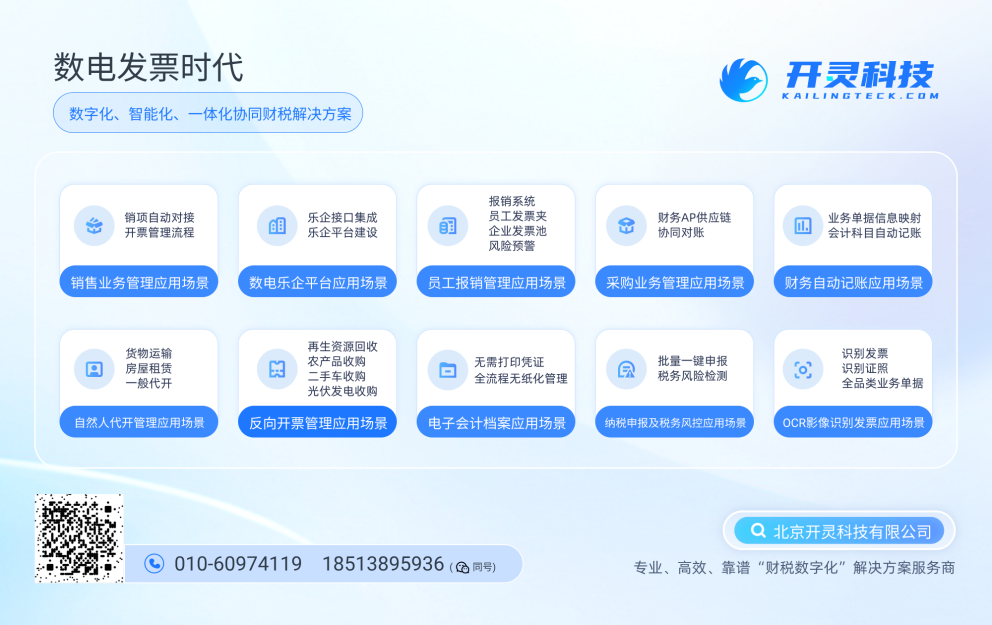
As a comprehensive business-finance-tax digitalization solution service provider, Kailing Technology provides business-finance-tax management digital transformation products and operational services for various government agencies, institutions, and large, medium, and small enterprises. The product line includes:
Solutions for businesses including sales contract management system, procurement contract management system, fully digitalized Leqi interface project, output automatic invoicing system, reverse invoicing system, invoice issuance for individuals system, employee expense control and reimbursement system, input VAT invoice management system, supply chain collaborative reconciliation system, image OCR recognition system, automatic financial bookkeeping system, and electronic accounting archives system, comprehensively driving the digitalization process across various fields.
If you have any business-finance-tax digital transformation needs, welcome to contact us. Beijing Kailing Technology will serve you wholeheartedly.
Keywords: Fully digitalized e-invoice reimbursement, fully digitalized e-invoice, Kailing Technology, Lingdong reimbursement, invoice source files, scan-and-flash entry, invoice verification and signature, tax recording status lock, expense control reimbursement system, electronic accounting archives
As a comprehensive business-finance-tax digitalization solution service provider, Kailing Technology provides business-finance-tax management digital transformation products and operational services for various government agencies, institutions, and large, medium, and small enterprises. The product line includes: solutions for sales contract management system, procurement contract management system, fully digitalized Leqi interface project, automatic output invoicing system, reverse invoicing system, invoice issuance for individuals system, employee expense control and reimbursement system, input VAT invoice management system, supply chain collaborative reconciliation system, image AI OCR recognition system, automatic financial bookkeeping system, electronic accounting archives system, etc., comprehensively driving the digitalization process across various fields.
Consultation Hotline: 18513895936 / 010-60974119 Location: Beijing