
Goods, orders, payments, and invoices in grain procurement never match? Kailing Technology's reverse invoicing system for agricultural product procurement provides five flows in one comparison and ledger retention
In the autumn grain peak season, grain trucks queue up outside the weighbridge one after another. Weighing, unloading, recording slips, counting cash, and invoicing — several steps run almost simultaneously. Once the peak season passes and finance sits down to reconcile, problems emerge: how many jin were weighed at the weighbridge, how many tons were received at the warehouse, how many entries were written on purchase slips, how much money the cashier paid, and finally how many purchase invoices were issued — the four ledgers of goods, slips, payments, and invoices never reconcile no matter how they are checked. Once the numbers do not match, the input VAT deducted based on purchase invoices cannot stand. When an audit asks for the self-verification chain, with a paper here and a notebook there, it cannot be assembled or explained clearly.
To twist this chain into a single rope, it does not rely on overtime and extra manpower during peak season to reconcile numbers, but on binding the goods, documents, payments, and invoices of each purchase together from the moment they arise and automatically comparing them.Kailing Technology Agricultural Product Procurement Reverse Invoicing System It is precisely designed around this matter: weighing means entry, purchasing means invoicing, payment goes through bank-enterprise direct connection, and the five flows are automatically verified and recorded as ledgers.
▍Why does peak-season reconciliation always "not add up"? Goods, orders, payments, and invoices each go their own way
Break down a grain purchase and you will see that four pieces of data are generated in four steps and four sets of records, with no one aligning them in real time in between:
- Cargo (weighed and warehoused): The weighbridge produces weighbridge tickets, while the warehouse records inbound receipts. Tare weight and gross weight, impurity deductions and moisture deductions are calculated separately. Weighbridge tickets are a stack of paper, and inbound quantities often do not match purchase orders.
- Document (purchase document): In peak season, handwritten purchase slips and after-the-fact supplementary entry make it easy to mix up variety, grade, and quantity, and it is impossible to tell which slip corresponds to which batch of goods.
- Payment (disbursement): Farmers want cash and on-the-spot settlement. Once payment goes through cash, the chain breaks — how much was paid and to whom cannot be reconciled with the procurement order amount.
- Invoice (purchase invoice): Invoicing is often delayed until after the peak season for centralized supplementary issuance, and the purchase price does not match the actual payment or the weight on the weighbridge ticket, so deductions are naturally questioned.
When the four run separately, a single transaction is split into four isolated records. During reconciliation, staff must dig out paper weighbridge tickets, handwritten purchase slips, bank statements, and invoicing records one by one to verify them; once volume grows, reconciliation becomes impossible, let alone matching books with reality. Agricultural product purchase invoices calculate input deductions based on the "purchase price," so once the goods payment, payment, and invoicing amounts fail to match, the reasonableness of the deduction loses its support.
▍From "four-way mismatch" to "five-flow unification": how Kailing's agricultural product procurement reverse invoicing system compares
Kailing Technology Agricultural Product Procurement Reverse Invoicing System's approach is: instead of waiting for post-event reconciliation, let an acquisition leave traces synchronously along five "flows" when it occurs, and the system automatically cross-checks. The integration of five flows refers to the self-certification flow, contract flow, business flow, tax flow, and fund flow.
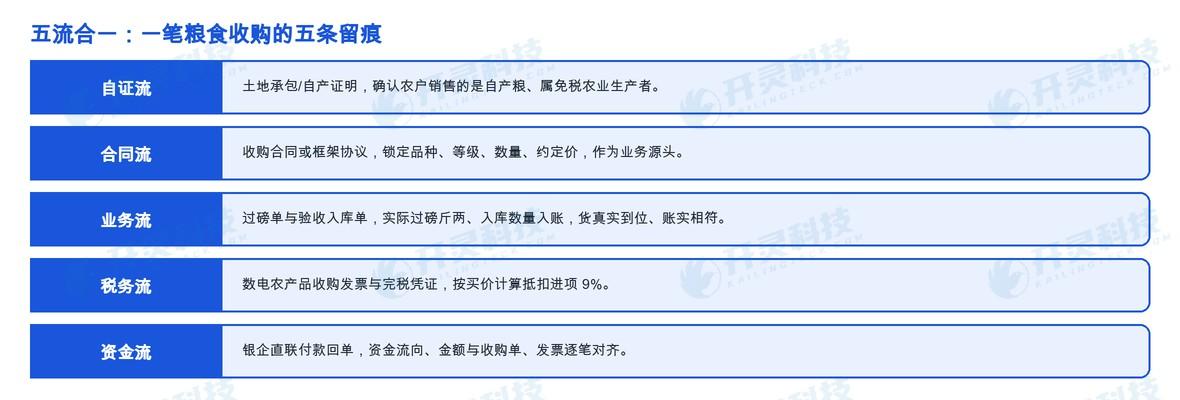
The five flows are not five separately kept accounts, but are linked around the same purchase: weighing data enters the business flow and automatically generates an electronic purchase order; purchase confirmation triggers the issuance of a fully digitalized purchase invoice and enters the tax flow; payment goes through bank-enterprise direct connection and the receipt enters the fund flow; the invoiced purchase price, the weighed goods payment, and the payment amount are consistent across all three parties, verified in real time by the system, with immediate warnings for mismatches. Farmer identity is backed by the self-produced certificate in the self-certification flow, clarifying the standards for tax exemption and deductibility.
In this way, reconciliation is no longer a “rummaging through everything” after peak season, but is completed in real time with each acquisition. Which transaction has a weight discrepancy between the weighbridge ticket and the purchase order, which transaction has been paid but not yet invoiced, and which transaction’s purchase price clearly deviates from the market are marked by the system at the entry stage, allowing sales staff to verify on the spot and correct promptly, rather than accumulating until month-end or quarter-end and only then discovering a pile of unreconcilable muddled accounts.
▍Traces become a ledger: withstand peak-season volume, and produce a self-verification chain during audits
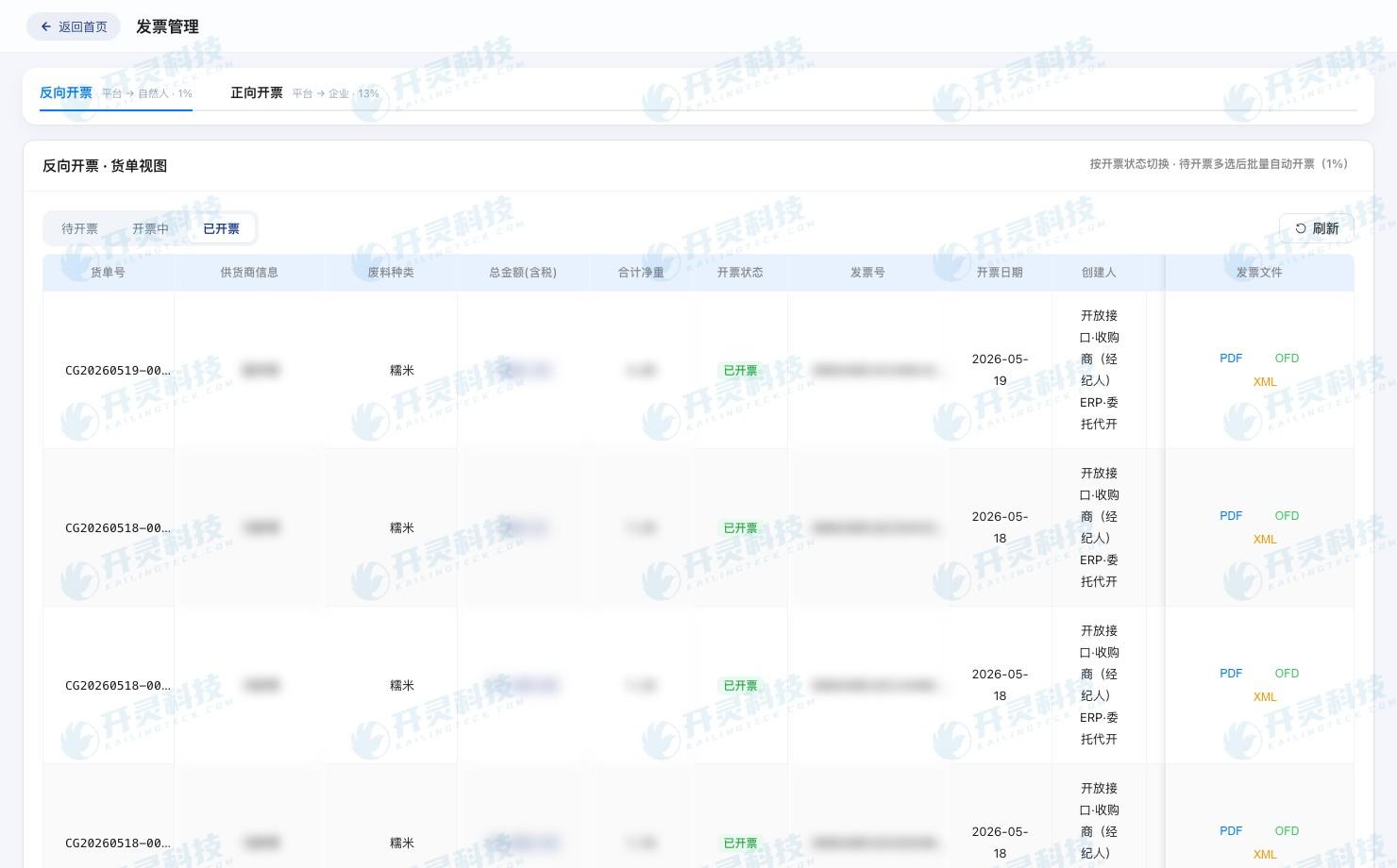
The real test of peak season is volume. Individual amounts are not large, but the number of transactions runs into the thousands or tens of thousands. Manual invoice issuance and payment transaction by transaction simply cannot keep up; the busier it gets, the more chaotic it becomes, and the more chaotic it becomes, the harder it is to reconcile. Kailing Technology's agricultural product purchase reverse invoicing system supports batch automatic invoicing and batch payments: invoicing is triggered upon weighing or purchase confirmation, and payments are uniformly routed through bank-enterprise direct connection, eliminating the need to manually enter each invoice and transfer each payment, fundamentally avoiding errors and omissions caused by manual supplementary entry.
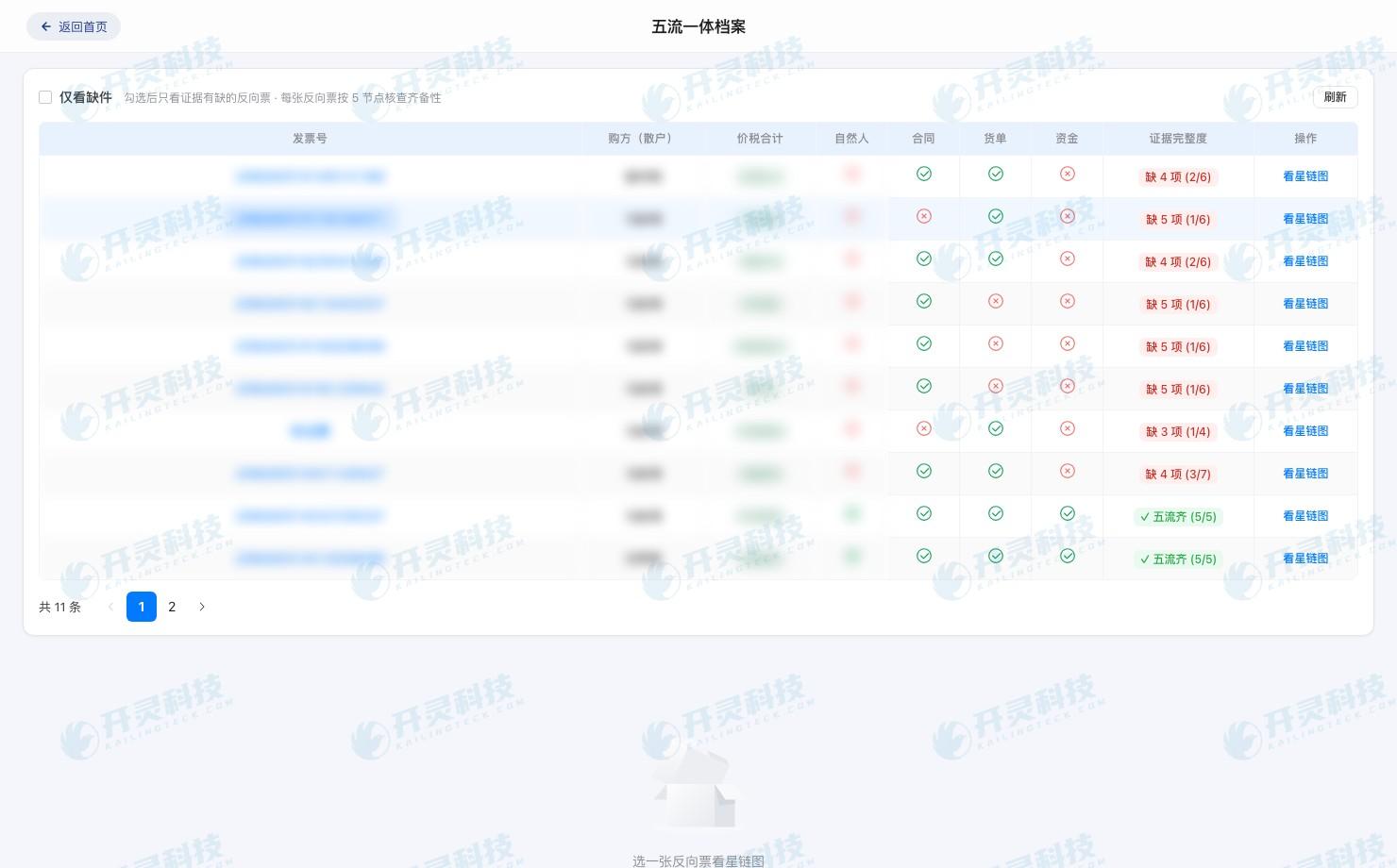
The five-flow trace of every purchase is automatically collected into an electronic ledger—which day, which farmer, what variety, how much weighed, how much warehoused, how much paid, which invoice issued, where the self-production certificate is—traceable transaction by transaction. When an audit asks about a particular transaction, there is no need to rummage for paper; the entire self-proof chain can be retrieved directly from the ledger, with goods notes, payments, and invoices matching and accounts consistent with reality, providing a basis for the 9% deduction.
▍FAQ
Q: During peak season, when goods, payments, and invoices do not match, which link is most likely to be questioned during an audit?
A: The most common issues are broken fund flow chains (cash payments with no receipt) and purchase prices not matching actual payments. Kailing uses bank-enterprise direct payment and invoicing upon acquisition, making payment, document, and invoice amounts consistent, with a complete self-proving chain that blocks doubts at the root.
Q: What exactly are the five flows in "five-flow integration"?
A: Self-certification flow (land/self-production proof), contract flow (purchase contract), business flow (weighing/inspection and warehousing), tax flow (fully digitalized purchase invoice/tax payment voucher), fund flow (bank receipt). The five flows leave traces synchronously around the same purchase and are automatically cross-compared.
Q: Can the system handle high-concurrency batch invoicing and payments during peak season?
A: The system supports batch automatic invoicing and batch payments during peak seasons. Weighing or purchase confirmation triggers invoicing, and payments uniformly go through bank-enterprise direct connection, replacing manual transaction-by-transaction operations. No matter how large the volume, it will not become chaotic or miss anything.
Q: What is the use of keeping a traceable ledger for audit response?
A: The five flows are integrated into electronic ledgers with one click. Goods, documents, payments, and invoices are traceable transaction by transaction, with accounts matching reality. During audits, the entire self-verification chain can be retrieved immediately, and deductions are supported by evidence.
No longer worry about reconciling goods, orders, payments, and invoices during peak grain procurement. Welcome to learn about Kailing Technology's reverse invoicing system for agricultural product procurement, enabling five flows in one, consistency between accounts and reality, and stable deduction: https://www.kailingteck.com/fxncp/ .
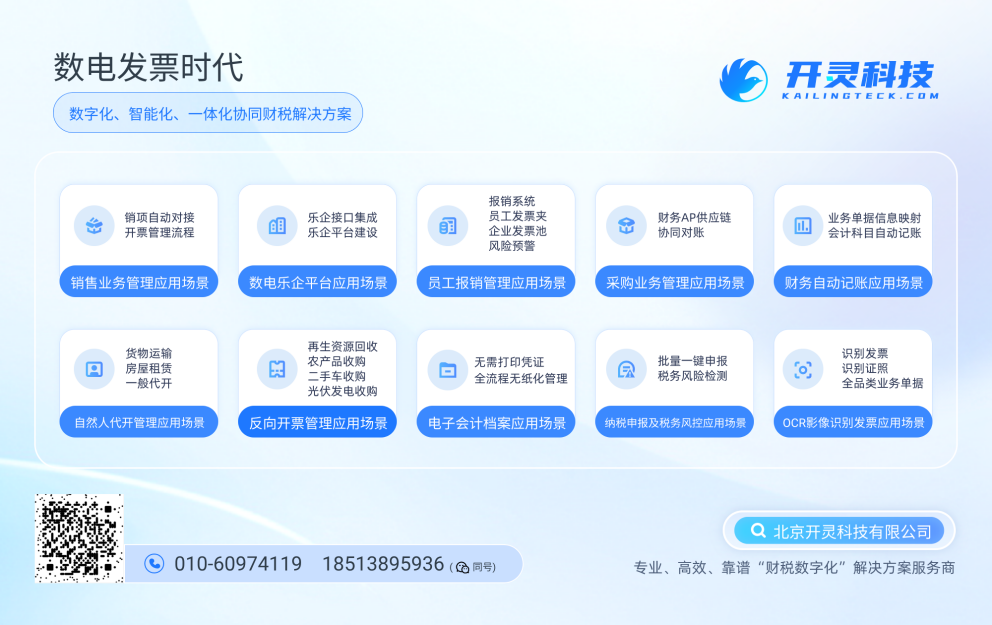
As a comprehensive business-finance-tax digitalization solution service provider, Kailing Technology provides business-finance-tax management digital transformation products and operational services for various government agencies, institutions, and large, medium, and small enterprises. The product line includes:
Solutions for businesses including sales contract management system, procurement contract management system, fully digitalized Leqi interface project, output automatic invoicing system, reverse invoicing system, invoice issuance for individuals system, employee expense control and reimbursement system, input VAT invoice management system, supply chain collaborative reconciliation system, image OCR recognition system, automatic financial bookkeeping system, and electronic accounting archives system, comprehensively driving the digitalization process across various fields.
If you have any business-finance-tax digital transformation needs, welcome to contact us. Beijing Kailing Technology will serve you wholeheartedly.
Keywords: Kailing Technology agricultural product procurement reverse invoicing system, grain procurement reverse invoicing, agricultural product procurement invoice, five-flow-in-one, goods-order-payment-invoice reconciliation, procurement ledger, input VAT deduction, accounts matching reality
As a comprehensive business-finance-tax digitalization solution service provider, Kailing Technology provides business-finance-tax management digital transformation products and operational services for various government agencies, institutions, and large, medium, and small enterprises. The product line includes: solutions for sales contract management system, procurement contract management system, fully digitalized Leqi interface project, automatic output invoicing system, reverse invoicing system, invoice issuance for individuals system, employee expense control and reimbursement system, input VAT invoice management system, supply chain collaborative reconciliation system, image AI OCR recognition system, automatic financial bookkeeping system, electronic accounting archives system, etc., comprehensively driving the digitalization process across various fields.
Consultation Hotline: 18513895936 / 010-60974119 Location: Beijing