
No need to read a thick stack of contracts word by word: Kailing Technology AI digital employee compares clauses one by one for legal affairs and highlights risks in red

On the legal office desk in the afternoon lies a stack of contracts awaiting review: procurement, outsourcing, leasing, bidding, each dozens of pages, and several together totaling over a hundred pages. Legal staff must read line by line, compare against standard templates to spot differences, and check compliance against regulations and internal policies. By the later pages, their eyes grow tired and attention slips, and a penalty clause quietly reduced by the counterparty or a reference to a long-repealed legal provision may slip past unnoticed. Must a thick stack of contracts really be chewed through word by word by people? The answer from Kailing Technology's AI digital employee is: no need — let the digital employee first compare every clause and mark all risks in red, and legal staff only need to judge the red-marked items.
▍With a stack of contracts on the desk, where does legal's time go?
Contract review looks like mental work, but what really drags out time is often the mechanical actions. After reviewing a contract, legal affairs' energy is roughly lost in four places:
- Reading word by word is too exhausting: Reading dozens of pages from beginning to end, payment, breach of contract, guarantee, confidentiality, and intellectual property ownership clauses cannot be missed. The longer you read, the more likely you are to become fatigued and distracted, and the more likely you are to overlook things later on.
- Templates, regulations, and systems aligned on three fronts: The standard template is in one place, current regulations are in another, and internal approval criteria are in yet another. When comparing, you have to flip back and forth, and versions are often misaligned, making it hard to see at a glance which clause has been tampered with.
- Multiple copies and multiple versions are hard to sort out: A contract goes back and forth through several revisions. Which draft did the business team send, what differs from the previous version, and whether agreed clauses have been secretly replaced—relying on manual visual comparison becomes chaotic once the volume grows.
- Judgments are scattered and hard to accumulate: Who reviewed it, why it was judged this way, and where the conclusion is recorded are often scattered across emails and chats; afterward, there is no basis for review, and newcomers cannot take over the experience of senior legal staff.
Stacked together, the result is slow review, exhausting review, and yet incomplete review—and the cost of a single missed high-risk clause may far exceed the contract itself.
▍Review-and-audit digital employee: hand off line-by-line comparison
Among the nine major digital employee job types sorted out by Kailing Technology from enterprise positions, contract review belongs to the typical "review and examination type" — characterized by being able to spot errors and check compliance: comparing item by item according to rules, regulations, and contract templates, and marking anomalies and risks in red one by one. It does not make decisions for people, but compares everything that should be compared and marks everything that should be marked, saving people the effort of reading contracts word by word. Under this job type, Kailing Technology AI digital employees cover the three most mentally exhausting legal tasks: contract clause risk review and red-marking, contract version comparison, and bidding compliance review.
Unlike Q&A AI that only chats with you for a couple of lines, Kailing Technology's AI digital employees are meant to "get things done": not vaguely telling you "this contract has some risk," but pinpointing a specific clause or sentence, pointing out which template it deviates from and which regulatory red line it touches, and grading it by high, medium, and low severity with item-by-item red marking. What Legal receives is no longer a contract that must be reread, but a review conclusion with risks already circled and graded.

▍From import to red highlighting, compared one by one for you
The core of this review examiner is to transform the legal team's experience of "finding faults against templates and regulations" into a process that AI can execute comprehensively and stably, with each step linked:
- Import contracts: Business is submitted with one click from an OA form or the WeCom or DingTalk workspace, and the digital employee automatically extracts contract elements, so legal no longer needs to manually enter them again.
- Compare policies and templates item by item: AI breaks contracts down to clause granularity and simultaneously compares them against the enterprise's standard template library, current regulations library, and internal approval policies, aligning them one by one—identifying which clause was modified, which is missing, and which conflicts with regulations.
- Risk clauses marked in red: Any clause that deviates from the template or touches a legal red line is highlighted in red item by item, stating which clause it deviates from, which rule it violates, and whether it is high, medium, or low level, so that people can see at a glance which must be changed, which are recommended to be changed, and which are acceptable.
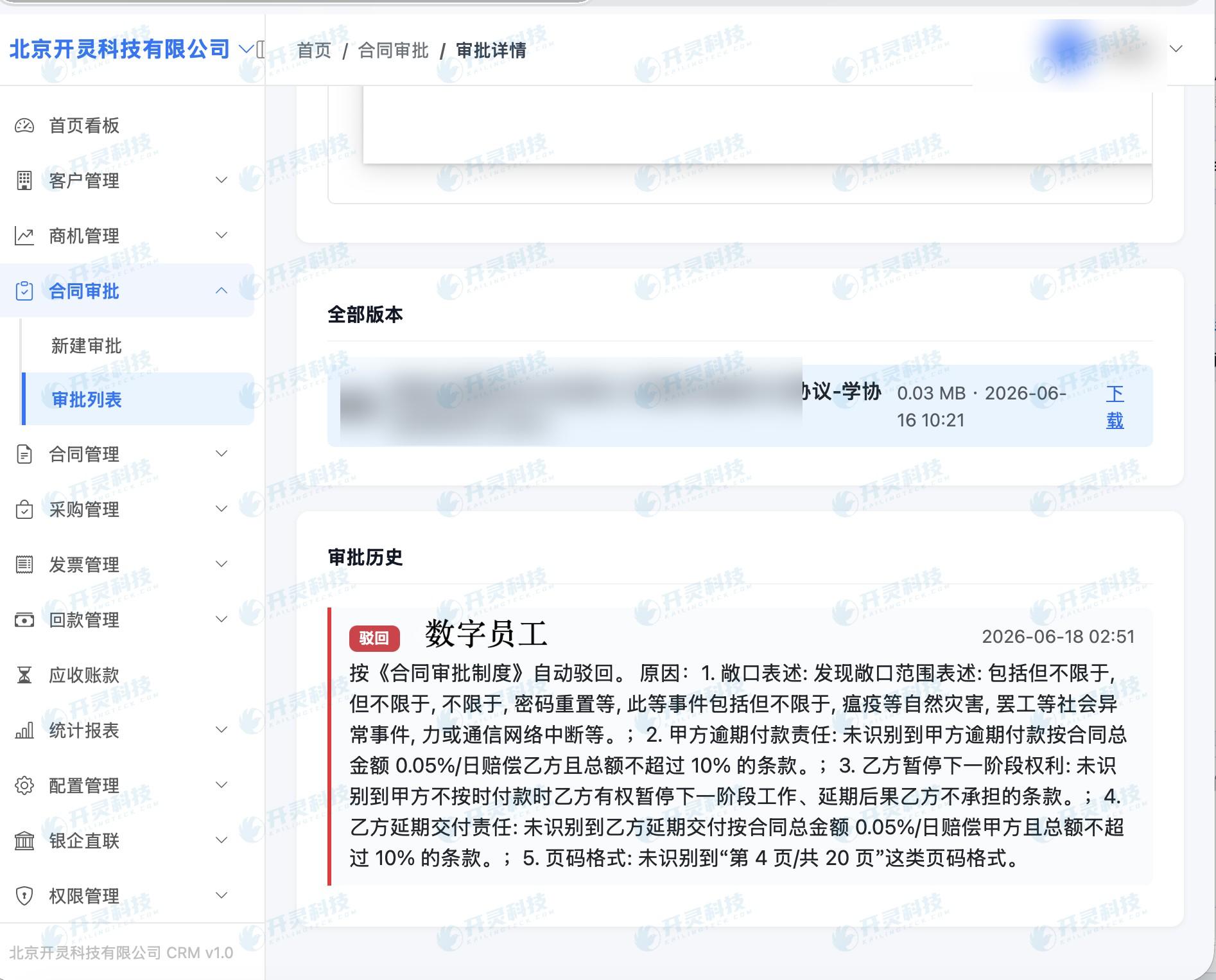
- High risk in manual review: People only focus on high-risk clauses marked in red by AI to make final judgments, approving, modifying, or rejecting with one click; according to the Contract Approval System, AI digital employees can also automatically reject and list the reasons item by item.
The key lies in the words "item by item": rather than giving a vague conclusion, it pinpoints the exact sentence and provides the basis. When templates are updated or regulations change, maintaining it once in the knowledge base takes effect immediately, with no need to change a single line of code—review standards automatically follow the latest version.
▍Not just reviewing one document: version comparison and bid compliance review
The trouble with contract review is often not just "whether this one is compliant or not." Kailing Technology AI digital employee pushes review-type capabilities two steps further, specifically addressing two other headaches for legal affairs:
- Contract version comparison: When the same contract is revised through several drafts, AI digital employees align old and new versions item by item and automatically highlight the changes—which amount was adjusted, which liability clause was deleted, which provision was replaced—all clear at a glance, with no need to compare two documents side by side by eye.
- Compliance review in bidding and tendering: Whether the bid documents respond to the substantive clauses of the tender documents, whether qualification and commercial requirements are omitted, and whether any bid-disqualification items are triggered—AI digital employees check compliance item by item according to tender requirements, marking non-responsive, missing, and conflicting points in advance, so you don't discover a missed item only when bids are opened.
The three things come from the same source: they all follow the gatekeeping logic of "comparing item by item and flagging anomalies in red", only the reference objects differ—one compares against template regulations, one against old and new versions, and one against tender requirements. Together, what legal faces is no longer a stack of paper to be read from scratch, but review checklists with key points already marked.

▍People only look at what is highlighted in red, and efficiency and risk control rise together
Once this is running, the changes are tangible. No matter how many contracts there are, they are reviewed 7×24 on arrival, without backlogs or queues caused by concentrated signing at month-end; review standards are uniformly embedded in the system, so a newcomer can produce comparison results at the same level as a senior legal counsel on day one; legal staff are freed from word-by-word reading and leave their energy for the few truly high-risk clauses highlighted in red that require judgment—reviewing faster and more comprehensively.
Fast, but safety cannot be traded away. Kailing Technology's AI digital employee uses private deployment: models run on the enterprise intranet, data does not leave the domain, sensitive fields are desensitized and encrypted, and core materials such as contracts are not transmitted externally; every comparison and judgment is encrypted and logged, searchable and auditable by contract or responsible person; high-risk nodes require mandatory manual confirmation, and anomalies can be quickly rolled back and handed over to manual takeover. Implementation also does not require overturning existing systems—non-intrusive access encapsulates the interfaces and forms of existing contract and approval systems into AI-callable tools, with zero-code modification and no touching of the underlying layer, protecting the enterprise's years of IT investment.
▍FAQ
Q: With a thick stack of contracts, does the AI digital employee review them one by one or all together?
A: Yes, batch review is possible. After multiple contracts are queued and imported, the AI digital employee compares all of them item by item, marks them red, and grades them. Legal does not need to wait one by one, but only prioritizes the red-marked high-risk items. No matter how large the volume, there will be no backlog.
Q: A contract has gone through several revisions; can the changes be automatically identified?
A: Yes. Contract version comparison aligns the old and new drafts item by item, automatically highlighting changes in amounts, responsibilities, agreements, and replaced clauses, so there is no need to place two documents side by side and look for differences with the naked eye.
Q: Can bid compliance also be reviewed?
A: Yes. Bid compliance review checks bid responses item by item against the substantive clauses, qualification, and commercial requirements of the tender documents, marking in advance non-responsive, missing, or potentially disqualified items, avoiding omissions discovered only at bid opening.
Q: Will AI also flag clauses that are fine, or make decisions directly on behalf of people?
A: It won't make decisions for people. Flagging in red does grading rather than a one-size-fits-all approach, clearly distinguishing high, medium, and low risks, with humans ultimately reviewing high-risk clauses and making judgments; even if misjudgment occurs, it can be quickly rolled back and routed to humans. AI is only responsible for providing the basis.
Q: Contracts are very sensitive; is it safe to hand them to AI for review? Do we need to change our existing system?
A: Secure, and almost no system changes are needed. It uses private deployment, data does not leave the domain, sensitive fields are masked and encrypted, and the full process is traceable and auditable; non-intrusive access to existing contract and approval systems requires zero-code modification and does not touch the underlying layer.
Want a thick stack of contracts to no longer rely on word-by-word reading and let legal affairs only look at highlighted high-risk clauses? Welcome to Kailing Technology to learn about the review-type AI digital employee: https://www.kailingteck.com/de/ .
As a comprehensive business-finance-tax digitalization solution service provider, Kailing Technology provides business-finance-tax management digital transformation products and operational services for various government agencies, institutions, and large, medium, and small enterprises. The product line includes:
Solutions for businesses including sales contract management system, procurement contract management system, fully digitalized Leqi interface project, output automatic invoicing system, reverse invoicing system, invoice issuance for individuals system, employee expense control and reimbursement system, input VAT invoice management system, supply chain collaborative reconciliation system, image OCR recognition system, automatic financial bookkeeping system, and electronic accounting archives system, comprehensively driving the digitalization process across various fields.
If you have any business-finance-tax digital transformation needs, welcome to contact us. Beijing Kailing Technology will serve you wholeheartedly.
Keywords: Kailing Technology's AI digital employee, review and audit digital employee, contract clause risk review, contract version comparison, bidding compliance review, item-by-item comparison and highlighting, private deployment, business-finance-tax digitalization
As a comprehensive business-finance-tax digitalization solution service provider, Kailing Technology provides business-finance-tax management digital transformation products and operational services for various government agencies, institutions, and large, medium, and small enterprises. The product line includes: solutions for sales contract management system, procurement contract management system, fully digitalized Leqi interface project, automatic output invoicing system, reverse invoicing system, invoice issuance for individuals system, employee expense control and reimbursement system, input VAT invoice management system, supply chain collaborative reconciliation system, image AI OCR recognition system, automatic financial bookkeeping system, electronic accounting archives system, etc., comprehensively driving the digitalization process across various fields.
Consultation Hotline: 18513895936 / 010-60974119 Location: Beijing