
What should delivery notes be reconciled against? Line-by-line reconciliation against orders and warehousing notes to produce a discrepancy list | Kailing Technology AI OCR delivery note solution
What should delivery notes be reconciled against? Simply put, on the buyer's side delivery notes are reconciled against purchase orders and warehousing notes, and on the seller's side against shipping notes and signed receipts, ultimately landing on statements and invoices. The hard part is not knowing what to reconcile against, but that a single note has dozens of detail lines, and when short deliveries, over-deliveries, exchanges, returns, and unit price adjustments are mixed together, manual line-by-line comparison is slow and error-prone. The Kailing Technology AI OCR delivery note solution recognizes paper delivery notes into data, then compares them line by line with orders and warehousing notes in the ERP, automatically generating a discrepancy list and listing unmatched items line by line for human handling. This article is organized around three questions: what to reconcile against, how to reconcile, and how to handle discrepancies.

▍A single delivery note: who should it be checked against
Delivery notes serve different purposes for the buyer and the seller, so the objects of reconciliation differ. For the buyer, the delivery note proves that the supplier delivered the goods; for the seller, the signed delivery note proves that the customer received the goods. The table below lists each party's reconciliation objects and purposes.
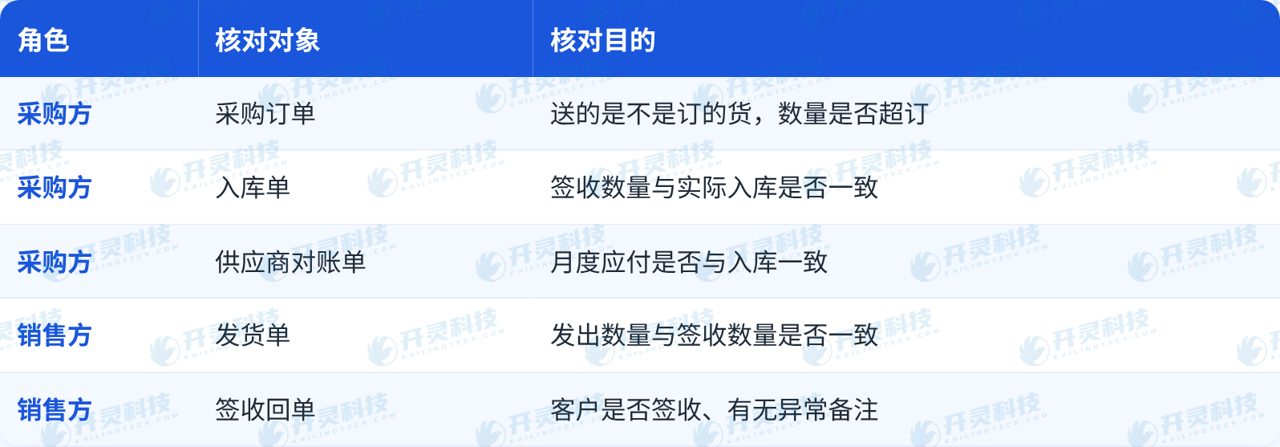
What delivery notes are reconciled against for the buyer and the seller
It can be seen that, from whichever party's perspective, the delivery note is not reconciled on its own; it is the intermediate document connecting "what was ordered", "what arrived" and "what was settled". Only by recognizing it as data is automatic line-by-line comparison possible.
▍Line-by-line verification: align by material, quantity and unit price
The basic method of line-by-line reconciliation is to use the material code as the primary key, align the corresponding lines of the delivery note, purchase order, and warehousing note, and then compare quantities and unit prices. Kailing Technology AI OCR first recognizes the delivery note number, pulls the associated purchase order and warehousing note from the ERP by that number, and then matches the delivery note detail lines against them line by line.
- Material alignment: The product name on a delivery note often differs from the order; the system aligns by material code, specification, and the alias library maintained by the enterprise, and lists unmatched lines separately.
- Quantity comparison: The delivery quantity is compared separately with the order's undelivered quantity and the warehousing quantity; for partial arrivals, deduct each time by order line, leaving the remaining quantity for next time.
- Unit price comparison: Compare unit price and amount again at the statement and invoice stage; small cent-level differences caused by reverse calculation in invoicing software are handled as tolerance.
Reconciliation rules can be set as exact matching or summary matching according to enterprise requirements: materials that must match line by line use exact matching, while auxiliary materials that only require the same total use summary matching. For many-to-many cases such as one delivery received in several warehousing entries or several warehousing entries combined on one invoice, merge by material first and then compare one by one.
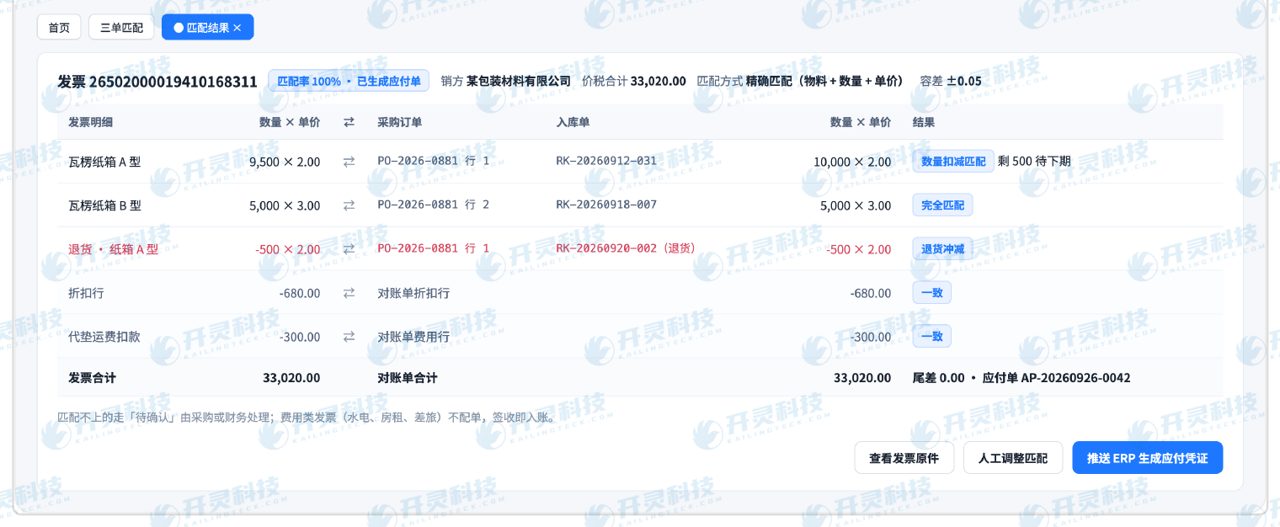
Kailing Technology three-way match: line-by-line alignment of invoices with orders and goods receipts (information desensitized)
▍Discrepancy list: list the unmatched items line by line
The result of reconciliation is not a simple "matched" or "not matched", but a discrepancy list. The Kailing Technology AI OCR delivery note solution lists the problems found during verification line by line, with each line stating the discrepancy type, the documents involved, the discrepancy quantity or amount, and attaching the original signed delivery note. Common discrepancy types are as follows.
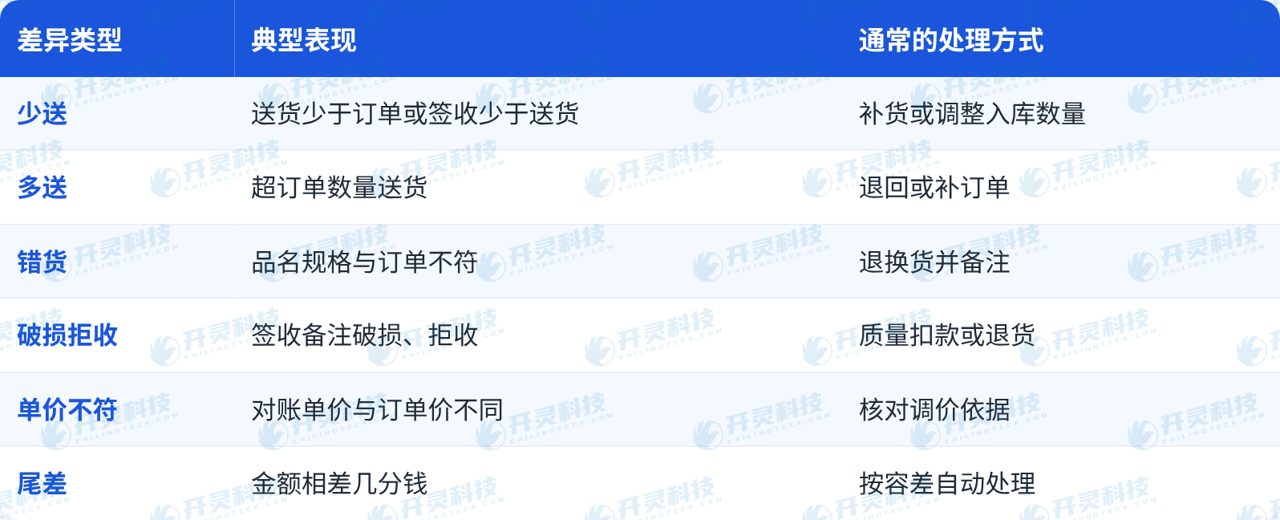
Common discrepancy types in delivery note reconciliation
The discrepancy list can be filtered by supplier, by salesperson and by discrepancy type, and handled rows record the handler and handling result. At month-end there is no need to go through all documents from the beginning; only the remaining rows on the list need to be handled.
▍Handwritten notes: the most easily missed source of discrepancies
Many discrepancies are not in the printed form but written next to the receipt column: "two boxes short," "outer box damaged," "one item rejected." If no one sees these handwritten notes and warehousing is done at the original quantity, the accounts will not match the actual goods at reconciliation.
Kailing Technology AI OCR has handwriting recognition capability and will recognize the signature, date and handwritten notes in the receipt column. When keywords such as shortage, damage or rejection are detected, the note is automatically flagged as an exception and pushed to the corresponding customer service or procurement staff for follow-up. One point to note: recognized handwritten content is used only as a prompt; where quantity adjustments are involved, staff confirm before modifying receipt or reconciliation data, and the system will not automatically rewrite the ERP.
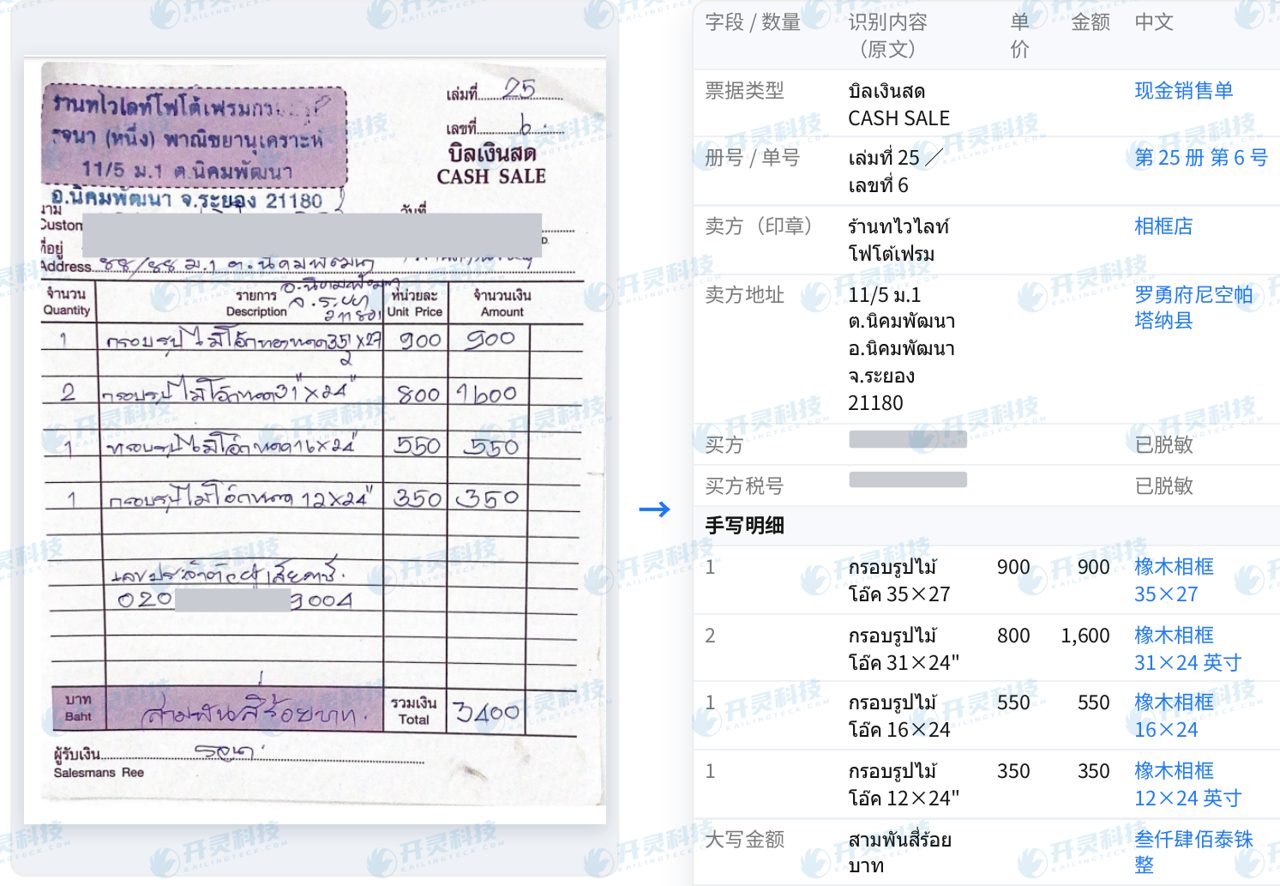
Kailing Technology AI OCR recognizes handwritten details and verifies amounts
▍From discrepancy list to booking: how reconciled data enters the ERP
Once discrepancies are handled, the statement is confirmed online by the supplier and then converted into a proforma invoice, on which the supplier issues the invoice. When the invoice arrives, the system performs a three-way match against the order and goods receipt note; once matched, an accounts payable voucher is generated and pushed to the ERP, with the voucher number written back to the invoice; after deducting returns, claims and discounts from the amount due, a payment proposal is formed, and each deduction can be traced back to the source document.
In this way, a paper delivery note is linked under the same business number from receipt, recognition, and comparison to booking and payment. During audits or verification, starting from any end—invoice, voucher, or delivery note—you can trace to the other documents.
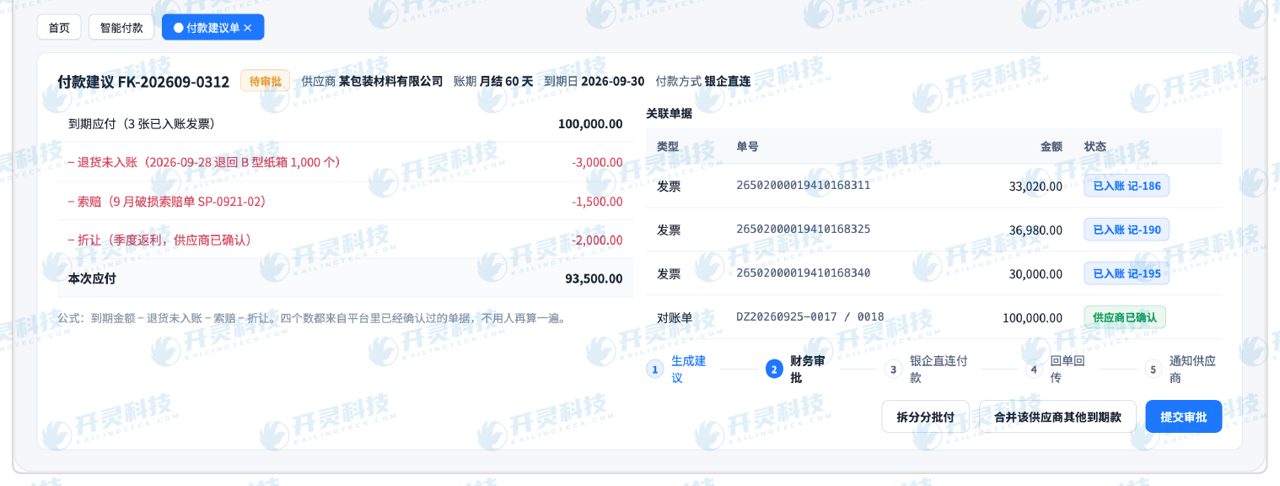
Kailing Technology payment proposal: item-by-item deduction of returns, claims and discounts (information desensitized)
▍Who reconciles: division of work among procurement, warehouse and finance
Once the discrepancy list is generated, handling responsibility must be assigned to individuals. The warehouse is responsible for the accuracy of signed and received quantities, noting shortages and damage on the delivery note on the spot; procurement is responsible for communicating with suppliers on replenishment, returns and price adjustments; finance is responsible for statement confirmation and accounts payable verification. The Kailing Technology solution sets to-dos by role, with handling progress updated in real time on the list, so at month-end it is clear at a glance who still has unhandled discrepancies.
▍Three common questions: set the rules before reconciliation
First, which quantity prevails. It is recommended to clearly use the warehousing quantity as the settlement basis, with the delivery quantity and receipt quantity used for reconciliation and traceability, avoiding three parties each insisting on their own version. Second, who handles discrepancies. Short deliveries and wrong goods are followed up by procurement, damage and rejection are determined by quality inspection, and unit price mismatches are confirmed jointly by procurement and finance, with the system automatically assigning by discrepancy type. Third, how often to reconcile. Materials supplied frequently are recommended for weekly rolling reconciliation, with discrepancies handled within the week; by monthly reconciliation only a small number of residual items remain.
| "Reconciliation is not about the number of documents, but about the goods and money behind each line. |
Once the rules are clearly defined, automated comparison in the system will make the discrepancy list shorter and shorter. Kailing Technology implementation consultants will review these criteria with procurement, warehouse, and finance before go-live and configure them in the system.
▍FAQ
Q: Should delivery notes be reconciled against purchase orders or goods receipt notes?
A: Both. Check against the purchase order whether the goods delivered are the goods ordered, and check against the goods receipt note whether the signed quantity was actually received into stock; settlement is usually based on the received quantity.
Q: Do delivery notes need to be checked directly against invoices?
A: Usually invoices are matched against purchase orders and goods receipt notes in a three-way match, with the delivery note serving as the prerequisite document for goods receipt, providing the original signed copy and notes when there is a dispute.
Q: Can the discrepancy list be automatically pushed to the person in charge?
A: Yes. The Kailing Technology AI OCR delivery note solution assigns discrepancies by type to procurement, quality inspection or finance, and records the handling results.
Q: How to match when the product name differs from the order?
A: The system aligns records by material code, specification and the alias library maintained by the enterprise; rows that cannot be matched are listed separately in the discrepancy list for manual confirmation.
To automatically reconcile delivery notes line by line with orders and warehousing notes, learn about the Kailing Technology AI OCR delivery note solution: https://www.kailingteck.com/ai-ocr/ .
As a national high-tech enterprise, Kailing Technology focuses on the digital and intelligent transformation of enterprise business-finance-tax and operations management, providing software products, system integration, implementation and delivery, and operational services for various government agencies, institutions, group enterprises, and SMEs.
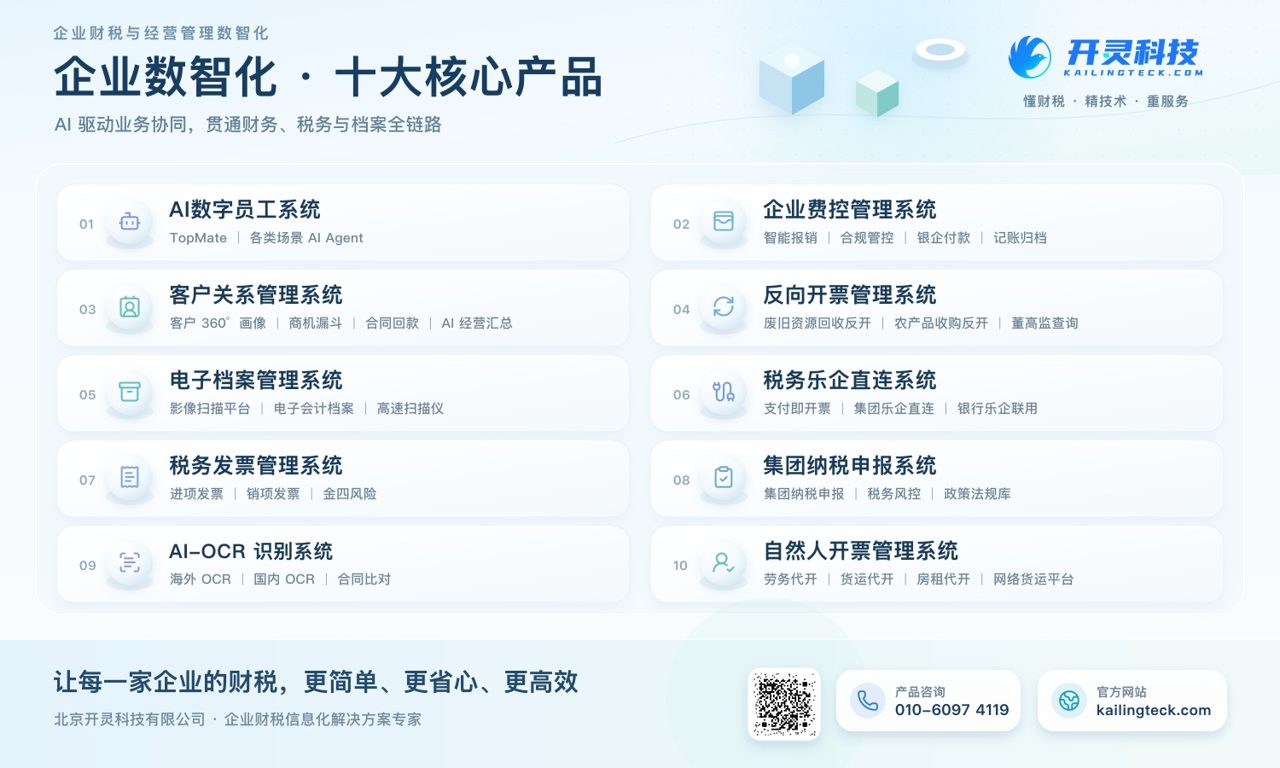
The company has now formed ten core product lines, including: AI digital employee system, enterprise expense control management system, customer relationship management system, reverse invoicing management system, invoice issuance for individuals management system, electronic archives management system, tax fully digitalized e-invoice Leqi system, tax invoice management system, group tax filing system, and AI OCR recognition system. It is committed to connecting enterprise business, finance, tax, funds, and archive data to help customers improve operational efficiency, business-finance-tax compliance capabilities, and digital management levels.
If you have any business-finance-tax digital transformation needs, welcome to contact us. Beijing Kailing Technology will serve you wholeheartedly.
Keywords: What should delivery notes be reconciled against, delivery note reconciliation, delivery note vs. purchase order reconciliation, delivery note vs. warehousing note reconciliation, reconciliation discrepancy list, Kailing Technology AI OCR, delivery note solution
As a comprehensive business-finance-tax digitalization solution service provider, Kailing Technology provides business-finance-tax management digital transformation products and operational services for various government agencies, institutions, and large, medium, and small enterprises. The product line includes: solutions for sales contract management system, procurement contract management system, fully digitalized Leqi interface project, automatic output invoicing system, reverse invoicing system, invoice issuance for individuals system, employee expense control and reimbursement system, input VAT invoice management system, supply chain collaborative reconciliation system, image AI OCR recognition system, automatic financial bookkeeping system, electronic accounting archives system, etc., comprehensively driving the digitalization process across various fields.
Consultation Hotline: 18513895936 / 010-60974119 Location: Beijing