
Is the parking fee invoicing tax rate 6% or 9%? Item name and code explained at once | Kailing Technology Leqi Integrated Solution
Is the parking fee invoicing tax rate 6% or 9%? "What major category does issuing a parking fee invoice belong to," "what item to issue," and "how to choose the code" are questions often searched by parking lot operators and property finance staff. Direct answer: vehicle parking service belongs to real estate operating lease services; the tax rate for general taxpayers is 9%, not 6%; eligible taxpayers may choose simplified taxation at 5%, and small-scale taxpayers apply a 5% levy rate. Fully digitalized e-invoices need to be issued under the specific business of real estate operating lease. This article explains the tax item, tax rate, item name, code, and specific business information at once, and introduces how the Kailing Technology Leqi Integrated Solution enables invoicing immediately after a car owner scans to pay.
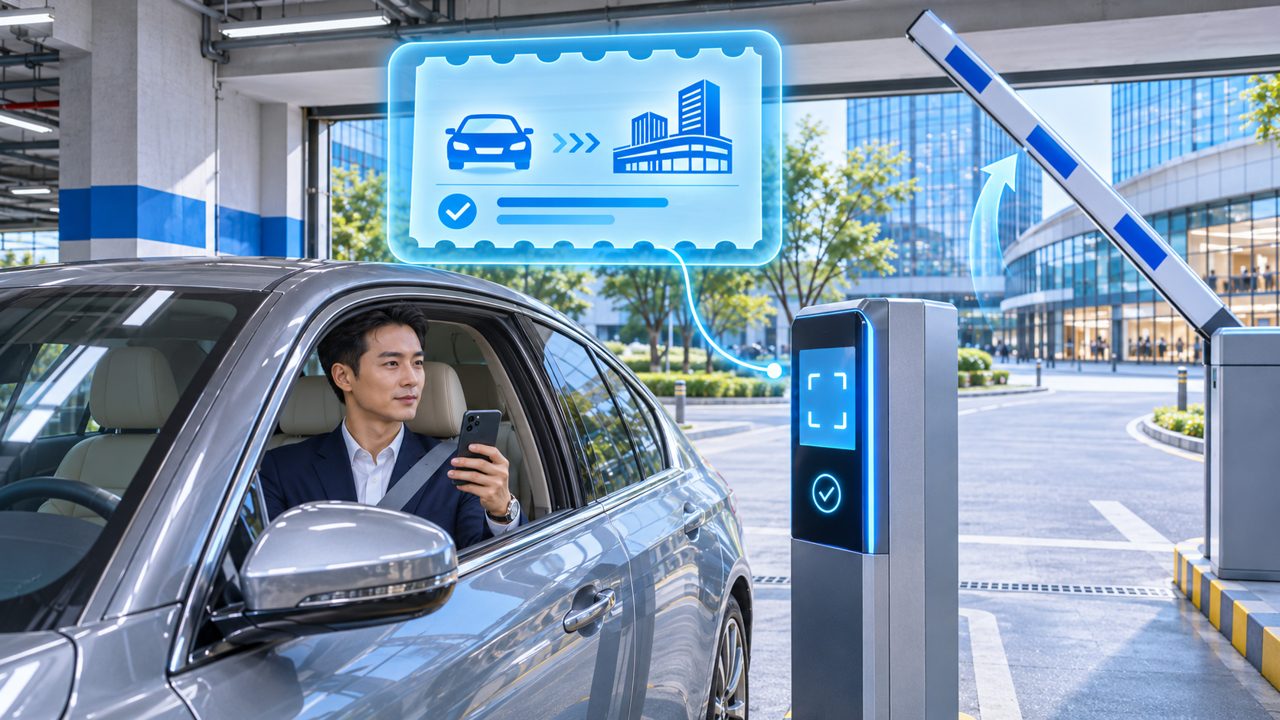
▍What major category it belongs to: real estate operating lease
According to the "Notes on Sales Services, Intangible Assets, and Real Estate" in Annex to Cai Shui [2016] No. 36, vehicle parking services are classified as real estate operating lease services. Many people assume parking fees are "service fees" and issue invoices at 6%, because they confuse them with property management services; in fact, parking lets vehicles occupy parking spaces, and its essence is an operating lease of real estate.
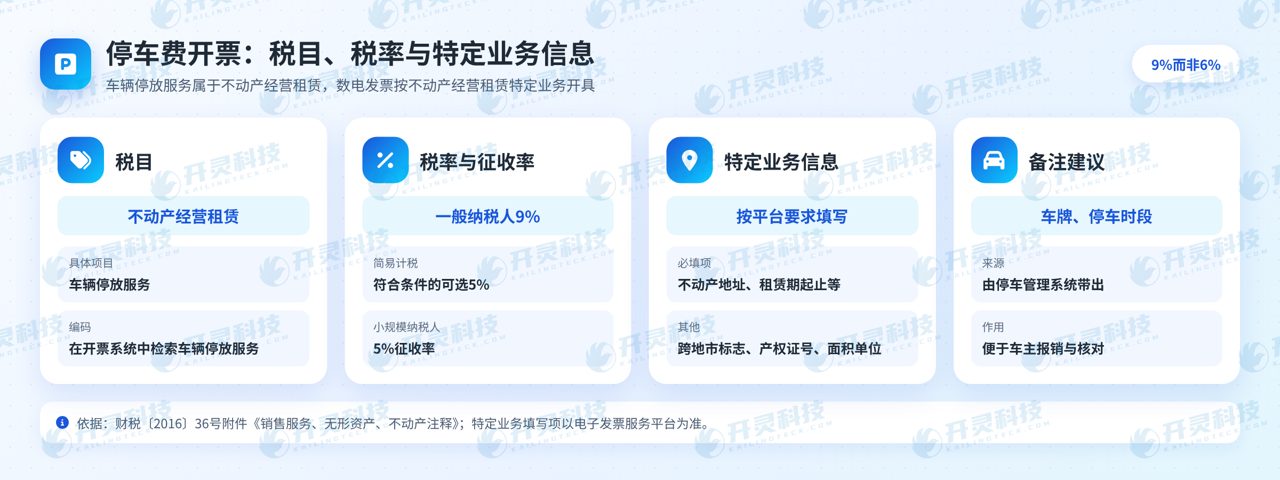
Tax items, tax rates, and specific business information for parking fee invoicing
▍How the tax rate is determined: distinguish 9% and 5%
For general taxpayers providing vehicle parking services, the tax rate under the general taxation method is 9%. General taxpayers leasing real estate acquired before April 30, 2016 may choose the simplified taxation method and calculate at a 5% levy rate. Small-scale taxpayers providing vehicle parking services apply a 5% levy rate, which is different from the preferential treatment of reducing the 3% levy rate to 1% and cannot be applied.
Therefore, for the same parking fee, the tax rate issued by a general taxpayer operating company of a commercial complex and a small-scale property company of an old residential community may differ. Parking lot operators should determine the applicable tax rate according to their own taxpayer status and the time the real estate was acquired.

Applicable tax rates and levy rates for parking fees
▍Item name and code: how to choose
The project name can be written as "parking fee" or "vehicle parking service". In the invoicing system, search for "vehicle parking service" for the tax classification code, and select the corresponding code under real estate operating lease, subject to the latest code table in the invoicing system. Do not select codes for property management services or other modern services, otherwise the tax rate and tax category will both be wrong.
For fixed parking space fees charged monthly or annually, state the parking space number and lease period in the remarks; for temporary parking, state the license plate number and parking period in the remarks to facilitate car owners' reimbursement verification.
| "Parking fees depend on the parking space, not on the word 'service': the tax item is real estate operating lease." |
▍Specific business information: what to fill in for fully digitalized e-invoices
When a fully digitalized e-invoice is issued under the specific business of real estate operating lease, information such as the real estate address, lease start and end dates, cross-region (city) flag, property ownership certificate or real estate ownership certificate number, and area unit must be filled in according to the requirements of the electronic invoice service platform. The license plate number is not a required field for this specific business and can be placed in the remarks.
For parking lots, most of this information is fixed: the address and property certificate number of the same parking lot do not change for every transaction. Configure this information in advance and have the system bring it out automatically during invoicing, so the front desk does not need to fill it in manually each time.
▍Car owners scan to pay and get an invoice immediately: process and integration
The vehicle owner scans the code or uses contactless payment before exiting. After payment is completed, the parking management platform confirms successful payment, and the system generates an invoice according to the preset tax item, tax rate, and specific business information and pushes it to the vehicle owner's mobile phone. Invoicing is based on real payment records, and the invoicing result is written back to the parking management platform to form a unified ledger.
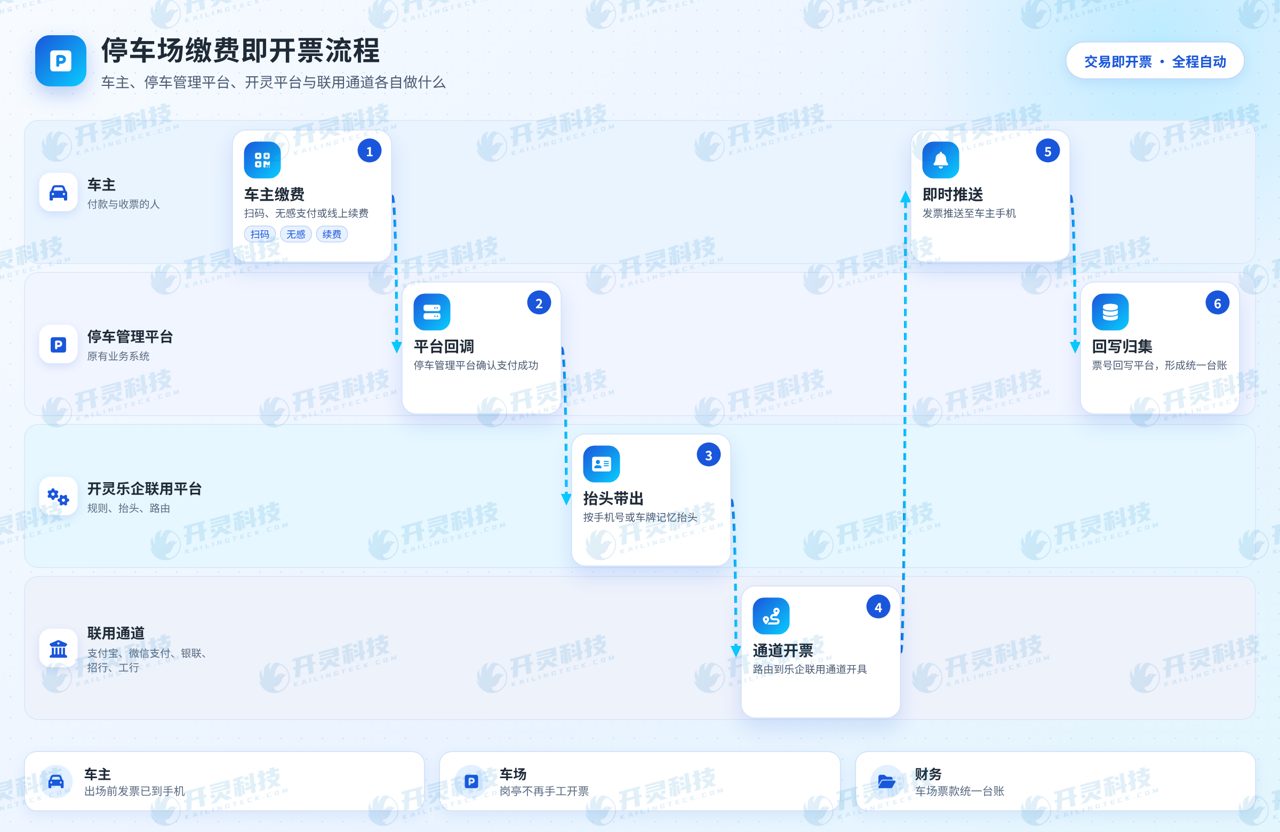
Diagram of division of responsibilities for invoicing upon payment at parking lots
The Kailing Technology Leqi integrated-use solution integrates the parking management platform with payment institutions and banks that hold integrated-use qualifications: the parking management platform integrates once and can then connect to multiple collection and invoicing channels; the parking lot's real estate information and tax rate rules are configured uniformly, and the license plate and parking period are brought out by the platform and written into the remarks. It should be noted that Kailing Technology is responsible for system integration, while the payment and invoicing channels come from payment institutions or banks that hold integrated-use qualifications.
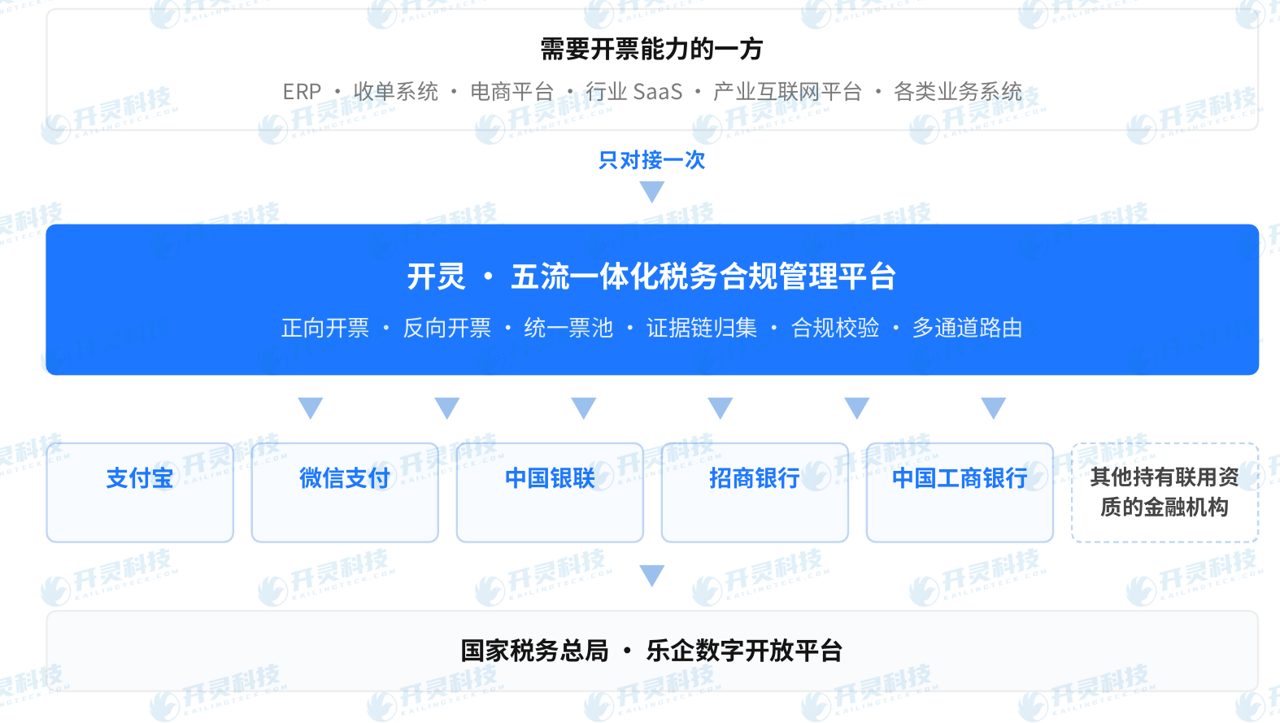
Kailing Technology Leqi integrated-use hub: the parking platform integrates once
▍Invoicing configurations for three types of parking lots
Commercial complex parking lots: mostly general taxpayers with many temporary vehicles; it is recommended to issue invoices upon exit payment, write the license plate and parking period in the remarks, and push the invoice to the car owner's mobile phone. Residential community parking lots: may be operated by property companies with many monthly rental spaces; it is recommended to issue invoices monthly or quarterly, write the parking space number and lease period in the remarks, and issue them as separate items from property fees. Roadside or public parking lots: operating entities and charging methods vary by location, and invoicing rules should be configured according to the operating entity's taxpayer status and local requirements.
What the three types of parking lots have in common is that the tax item is handled as real estate operating lease; the differences lie in taxpayer status, billing method, and remarks content. Configure these differences into the system, and neither the front desk nor the car owner needs to worry about them.
▍Three questions car owners often ask
First, can parking invoices be reimbursed? Parking invoices are compliant fully digitalized e-invoices, and unit reimbursement is subject to the unit's rules. Second, why is there no license plate on the invoice? The license plate is not a required field for the specific business, and the parking lot can write it into the remarks as needed. Third, how to invoice for a monthly parking space? Issue according to the lease period, and state the parking space number and start and end dates in the remarks.
▍Month-end reconciliation for parking lot finance
Parking fees are small in amount and large in number, and month-end reconciliation is often the most troublesome part for parking lot finance. After invoicing upon payment, reconciliation can be checked against three numbers: the number and amount of charges on the parking management platform, the number and amount of transactions on the integrated channel, and the number and amount of invoices issued. If the three match, it means there are no omissions in charging and invoicing; if they do not match, find the reason transaction by transaction by transaction number. Common causes are refunds not reversed by red invoice, duplicate payments, or failed invoicing without retry.
The Kailing Technology Leqi integrated-use solution provides daily and monthly reconciliation reports; transactions with failed invoicing are automatically retried and logged; refund transactions are linked to the original invoice for red-letter reversal as required; finance only needs to handle a small number of exceptions.
For operators with multiple parking lots, statistics can also be made separately by parking lot to compare charging and invoicing at each lot and promptly identify equipment or configuration problems.
▍Summary in one sentence
For parking fee invoicing, remember three things and you won't go wrong: the tax item is real estate operating lease; the tax rate is 9% for general taxpayers, and 5% for small-scale taxpayers and eligible simplified taxation; and fully digitalized e-invoices should be filled in under the specific business of real estate operating lease with information such as the real estate address and lease start and end dates. The remaining license plate and time period can be written in the remarks and automatically brought out by the system. For parking lot operators, configuring these rules once in place is more worry-free than manually judging each invoice and less prone to errors.
▍FAQ
Q: Is the parking fee invoicing tax rate 6% or 9%?
A: Vehicle parking service belongs to real estate operating lease. The tax rate is 9% for general taxpayers, and eligible taxpayers may choose simplified taxation at 5%; small-scale taxpayers apply a 5% levy rate.
Q: What major category does issuing a parking fee invoice belong to?
A: It belongs to real estate operating lease services within modern services, and the specific item is vehicle parking service.
Q: How do I choose the code for a parking fee invoice?
A: Search for "vehicle parking service" in the invoicing system and select the corresponding code under real estate operating lease, subject to the latest code table.
Q: Do fully digitalized e-invoices for parking fees require a license plate number?
A: The license plate number is not a required field for the specific business of real estate operating lease and can be written in the remarks; required information includes the real estate address and lease start and end dates, subject to platform requirements.
If a parking lot wants to achieve invoicing upon payment and avoid errors in tax rate and coding, you are welcome to learn about the Kailing Technology Leqi Integrated Solution: https://www.kailingteck.com/leqi-lianyong/ .
As a national high-tech enterprise, Kailing Technology focuses on the digital and intelligent transformation of enterprise business-finance-tax and operations management, providing software products, system integration, implementation and delivery, and operational services for various government agencies, institutions, group enterprises, and SMEs.
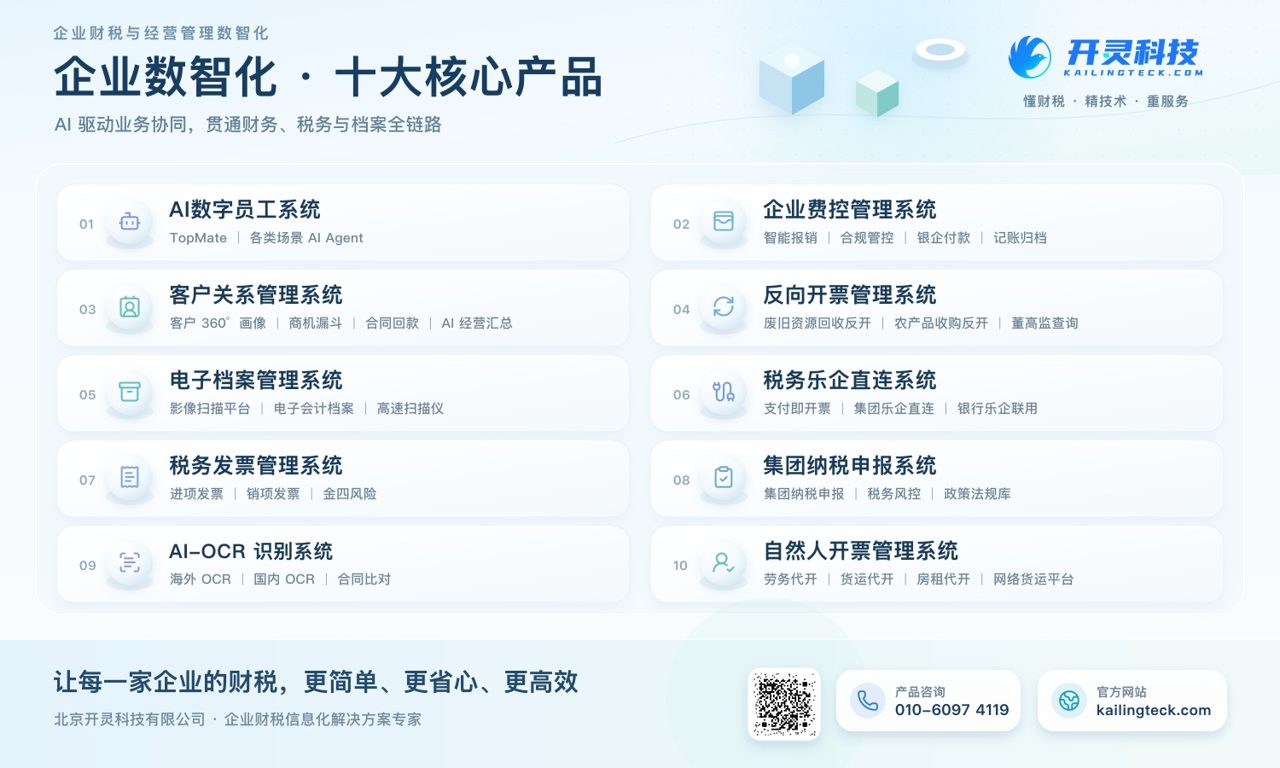
The company has now formed ten core product lines, including: AI digital employee system, enterprise expense control management system, customer relationship management system, reverse invoicing management system, invoice issuance for individuals management system, electronic archives management system, tax fully digitalized e-invoice Leqi system, tax invoice management system, group tax filing system, and AI OCR recognition system. It is committed to connecting enterprise business, finance, tax, funds, and archive data to help customers improve operational efficiency, business-finance-tax compliance capabilities, and digital management levels.
If you have any business-finance-tax digital transformation needs, welcome to contact us. Beijing Kailing Technology will serve you wholeheartedly.
Keywords: parking fee invoicing tax rate, parking fee invoicing 6% or 9%, what major category does issuing a parking fee invoice belong to, what item is on a parking fee invoice, parking fee invoicing code, Kailing Technology Leqi Integrated Solution, parking lot invoicing upon payment
As a comprehensive business-finance-tax digitalization solution service provider, Kailing Technology provides business-finance-tax management digital transformation products and operational services for various government agencies, institutions, and large, medium, and small enterprises. The product line includes: solutions for sales contract management system, procurement contract management system, fully digitalized Leqi interface project, automatic output invoicing system, reverse invoicing system, invoice issuance for individuals system, employee expense control and reimbursement system, input VAT invoice management system, supply chain collaborative reconciliation system, image AI OCR recognition system, automatic financial bookkeeping system, electronic accounting archives system, etc., comprehensively driving the digitalization process across various fields.
Consultation Hotline: 18513895936 / 010-60974119 Location: Beijing