
Scrap metal recycling collecting cash from small sellers with no input invoices? Kailing Technology reverse invoicing compliantly obtains input invoices with a five-flows-in-one ledger
In the scrap metal recycling business, almost all money is settled in cash. The receiving staff stand by the weighbridge with cash in hand, and scrap steel, scrap iron, and scrap copper are weighed cart after cart. The money is counted out on the spot to the small sellers who come to sell, and the goods are considered received. But within this old rule of "cash on one hand, goods on the other" lies a loophole that has troubled finance for years: the sellers are small individuals who cannot issue VAT invoices, while the enterprise has genuinely paid costs but never has that input invoice in hand. The larger the operation grows, the more output VAT is paid as usual, while the input side remains empty for a long time. Profits are nibbled away bit by bit by taxes, and once an audit occurs, it is hard to argue. To untie this knot, what is needed is precisely Kailing Technology reverse invoicing—by a qualified recycling enterprise, compliantly issuing VAT invoices in reverse to individual sellers, filling back the input that small sellers cannot issue, and then using a five-flows-in-one ledger to firmly nail down the cause and effect of every invoice. The following uses a certain scrap metal recycling enterprise as an example to break down and explain the implementation path for compliantly obtaining input invoices.
▍Goods bought with cash, books that don't match: the unavoidable hurdle in scrap metal recycling
What recycling enterprises lack least is supply; what they lack most is vouchers that can be booked, deducted, and withstand inspection. For cash purchases of scrap metal from individual sellers, the trouble is not receiving the goods but the broken chain of evidence after the money is paid.
The first layer is tax burden imbalance. Individual sellers are not tax entities and cannot issue invoices, so this portion of procurement cost cannot be deducted. The output side pays in full, while the input side is blank. The difference between input and output is entirely borne by profits, and the larger the scale, the greater the disadvantage.
The second layer is the disconnect between accounts and physical reality. Cash transactions have no invoices to thread them together: how many tons were weighed and received at the warehouse, how much was recorded in the cost accounts, and how much was paid out in cash or via bank — these three figures are calculated separately, lacking a thread to string them together, and at month-end the accounts simply won't reconcile.
The third layer is having no evidence for audits. If an inspection really occurs, who this batch of scrap steel came from, how much was weighed, and to whom the money was paid can only be pieced together from scattered receiving slips and transfer records; there is also no confidence about whether individual sellers can legally be sellers, and the risk of back taxes plus penalties always hangs overhead. Ultimately, what is missing is not scrap material, but a mechanism that can turn “real receipt of goods and real payment” into compliant input VAT vouchers and produce evidence at any time.
▍Reverse invoicing: the compliant channel policy leaves for scrap metal recycling enterprises
Reverse invoicing is not a gray operation; it has a clear policy basis. State Taxation Administration Announcement No. 5 of 2024 took effect on April 29, 2024, allowing eligible resource recycling enterprises to "reverse" issue VAT invoices to individuals selling scrapped products, turning that long-dangling input into compliant, deductible, and traceable invoices. This is also the policy foundation of Kailing Technology's reverse invoicing solution.
To make good use of this channel, two prerequisites cannot be avoided. The first is enterprise qualification: the company must hold one of the following three—a hazardous waste operating permit, an end-of-life vehicle recycling and dismantling qualification, or a renewable resource recycling operator filing. The second is the invoicing target: legal representatives, directors and senior managers, and registered individual businesses cannot serve as individual sellers. Invoicing the wrong target still requires back taxes and penalties, so "verify the entity before invoicing" must be locked in as a front-end gate.
Policies continue to reduce the burden on recycling enterprises: Announcement No. 12 of 2026 (effective July 1, 2026) lowers the individual income tax prepayment rate on business income for the portion of an individual's annual sales not exceeding 600,000 yuan excluding tax, and allows recycling enterprises to handle filing on their behalf, further loosening restrictions. These are favorable background conditions, but what enterprises truly need to hold in their hands are still input VAT invoices that can be issued, deducted, and verified.
▍Step one · Create profiles for individual suppliers: block "can it be invoiced" at the very front
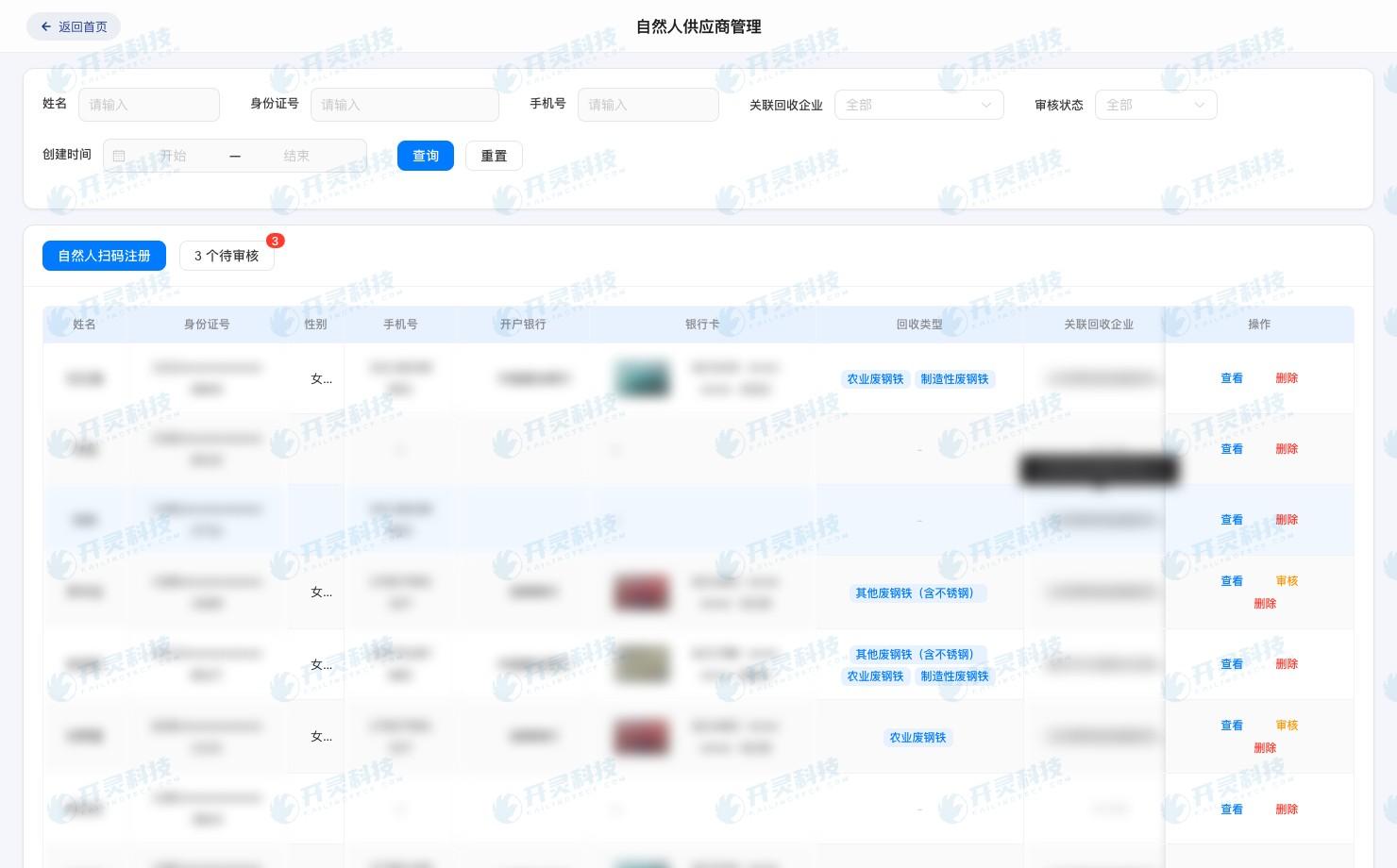
The starting point of this chain is not invoicing, but clearly identifying the person. When an individual seller arrives at the store, they can complete natural person supplier registration by scanning a code, entering their name, ID number, mobile number, bank and bank card, and selecting recycling types according to business scope—agricultural scrap steel, manufacturing scrap steel, other scrap steel containing stainless steel, and other labels are clear at a glance. After submission, it enters pending review, and only after enterprise approval does the person become a formal seller.
File creation also serves as a risk control gate: at this step, the system connects to subject qualification verification, directly identifying and blocking non-compliant targets such as legal representatives, directors and senior managers, and registered individual businesses, plugging the hidden risk of "invoicing the wrong person" at the source, so every subsequent reverse invoice can be issued with confidence.
▍Step two · Goods receipt by order: make that truckload of scrap bought with cash findable in the system
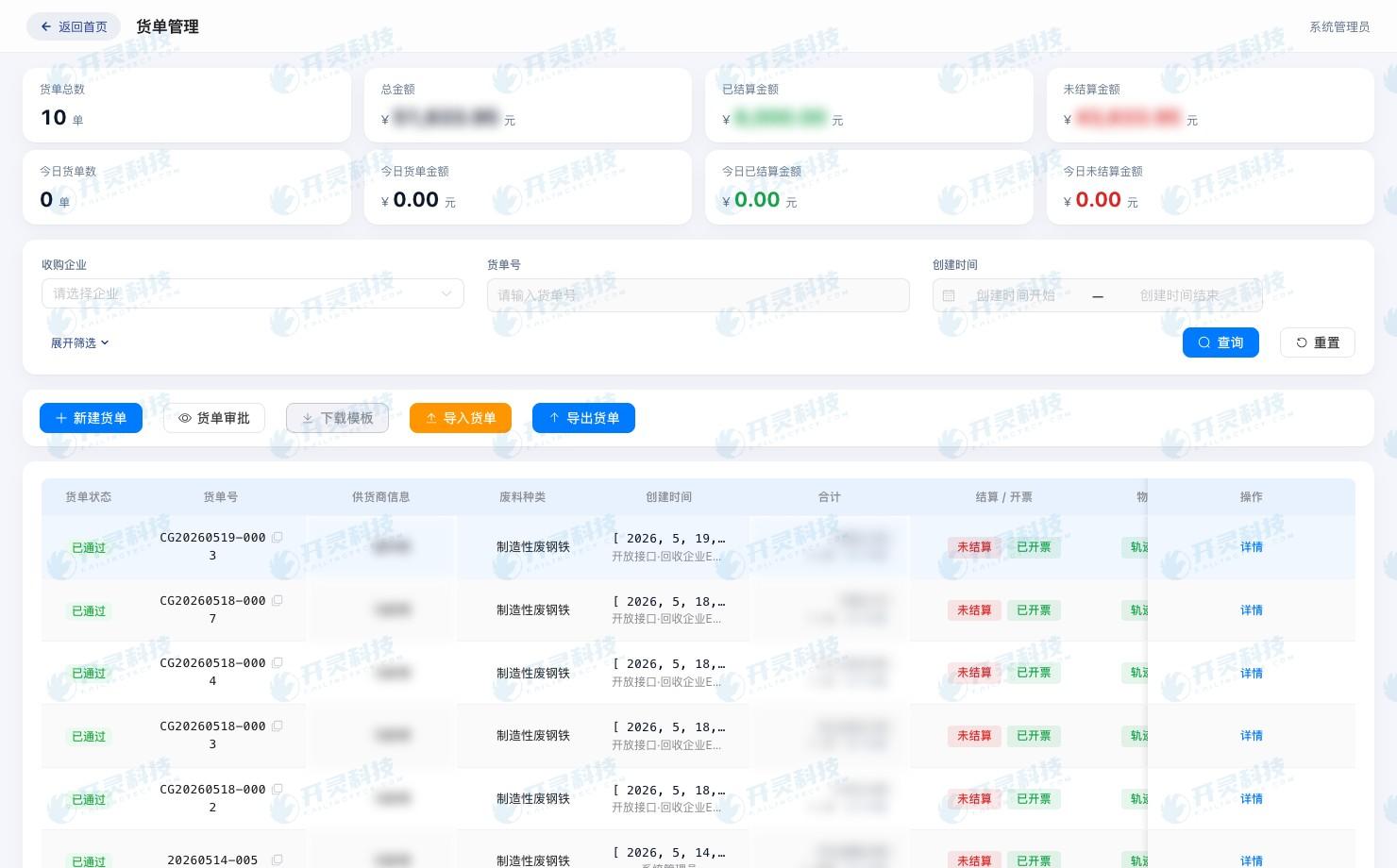
Once the person is confirmed, the goods are then recorded accurately. For each truckload of scrap metal received, a receipt record is generated in the goods order, with the goods order number, supplier, scrap type, net weight, total amount, and creation time entered item by item; it supports creation, import, export, and goes through approval and logistics tracking. The top of the homepage summarizes in real time the number of goods orders, total amount, settled and unsettled amounts, showing at a glance how much was received, how much was paid, and how much is still outstanding.
This step turns "the goods were indeed received" from a verbal confirmation by the weighbridge operator into a formal voucher in the system with time, tonnage, and status. It is the foundation of the "business flow" among the five flows, and also the prerequisite for subsequent invoices and ledgers to mesh one-to-one.
▍Step three · One-click reverse invoicing: instantly fill in the missing input VAT invoices
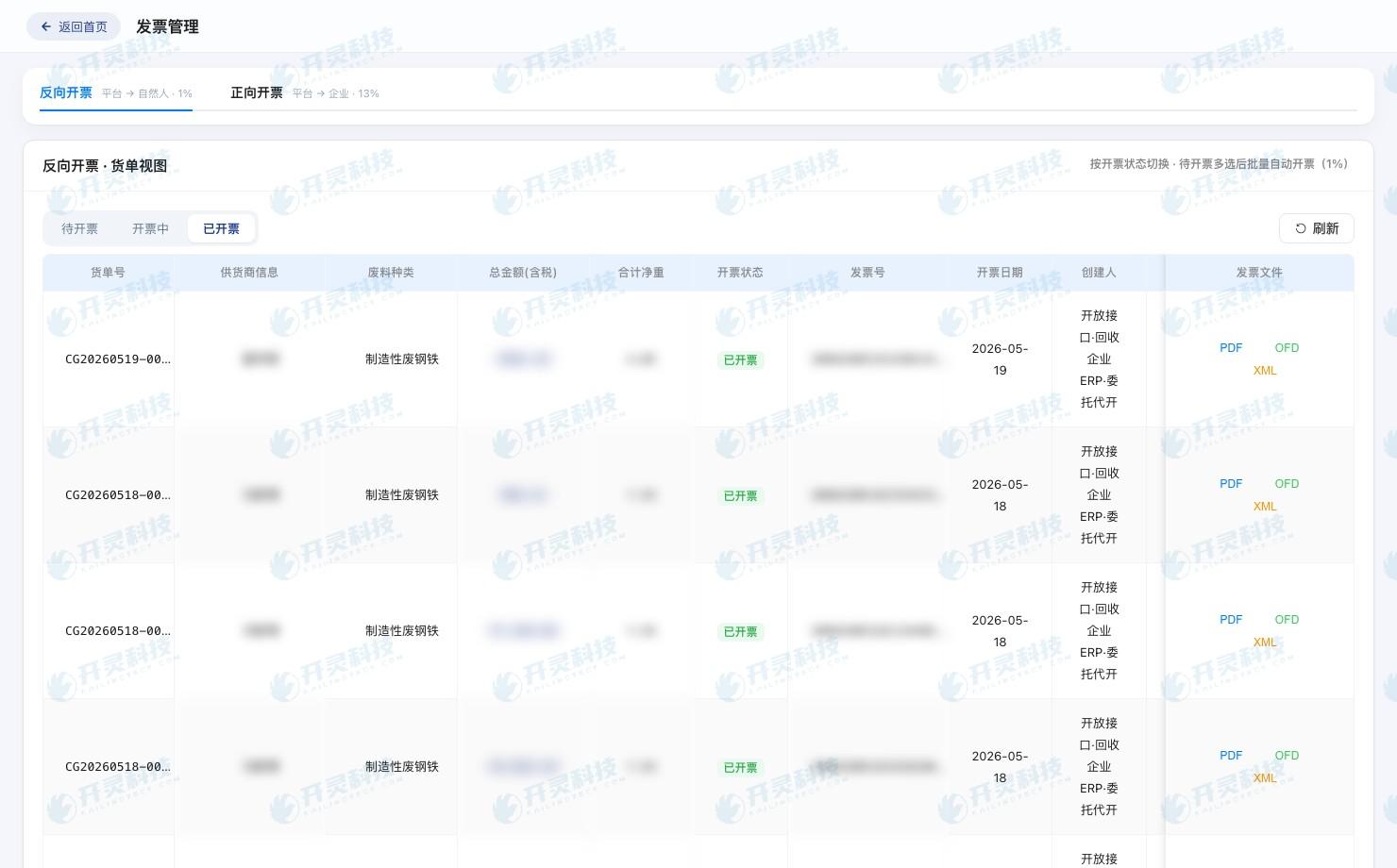
Once the cargo document is verified, it reaches the most critical invoice supplementation stage. In invoice management, switch to the Reverse Invoicing · Cargo Document View, select multiple pending cargo documents in batches, and issue them automatically with one click. The electronic tax bureau interface is called without login throughout the process, and invoice status flows in real time among pending, issuing, and issued. For each invoice issued, the PDF, OFD, and XML source files are retained synchronously, the invoicing source is clearly marked, and the full context is written on the invoice; if voiding is needed, one-click red reversal is also available.
For recycling enterprises, this means that the input that was always missing can now be filled in one transaction at a time, immediately and compliantly, according to the goods documents. Output invoices and input invoices are both available, and the two ends finally match, so profits are no longer unilaterally swallowed by the tax burden of "output without input."
▍Step four · Five-flow integrated ledger: make every input VAT invoice stand up
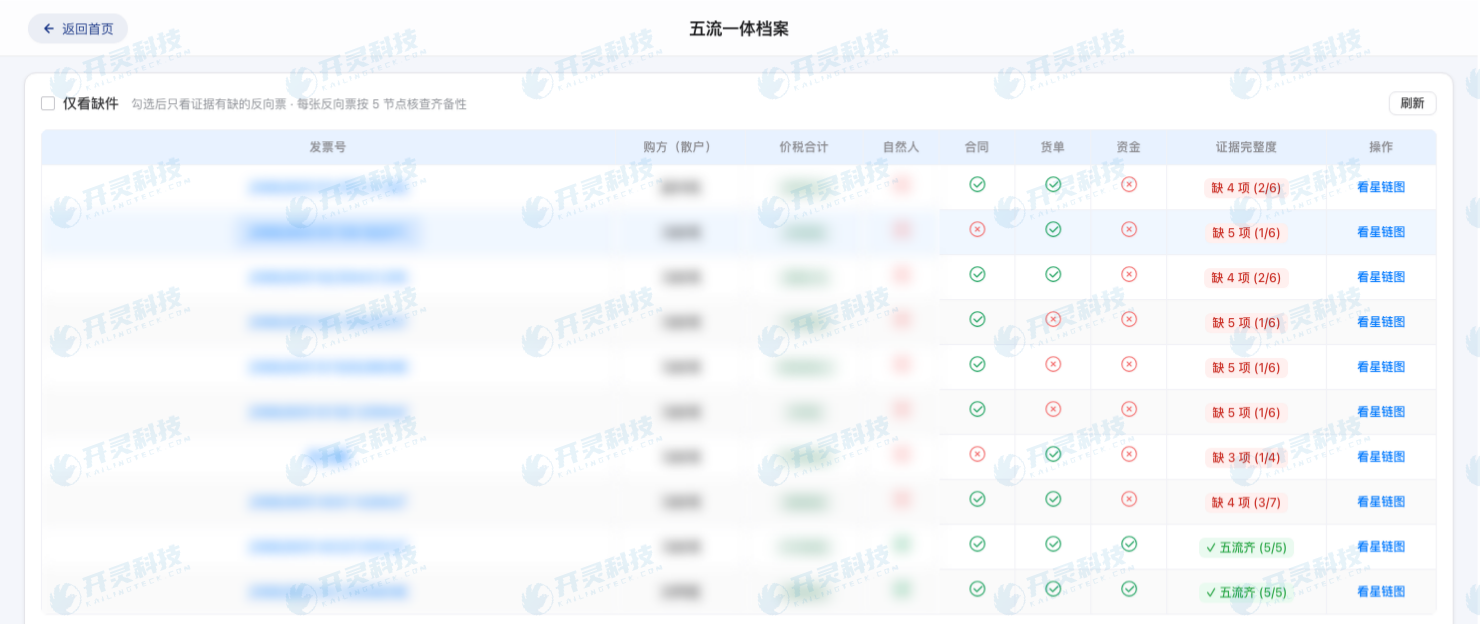
Having invoices alone is not enough. To make input items stand up to inspection and truly match accounts with reality, the key lies in the five-flow integrated ledger—automatically consolidating evidence scattered across each stage into one ledger built around each reverse invoice. Kailing has turned the policy-caliber "three-flow integration" into a more complete "five-flow integration": self-certification, contract, business, tax, and funds—not one is left out.

After the five flows are collected, the ledger automatically checks evidence completeness around each reverse invoice: the individual, contract, goods order, and funds are checked item by item, complete ones are marked "Five Flows Complete", gaps are marked in red to indicate which link is missing, and you can filter only missing items to prioritize completion, tracing back along the evidence chain. Which invoice has incomplete evidence and at which node it breaks can be seen at a glance and filled in on the spot.
| "Scrap metal recycling dares to collect, dare to operate, and dare to scale up, not because of luck, but because every cash receipt can be traced to invoices and matched to accounts through the five-flow ledger. |
|---|
Only at this point is the loop truly closed: a reverse invoice matches an acquisition agreement, a goods note, and a real weighed receipt going backward, and matches a bank-enterprise direct connection payment going forward, with input and business interlocking one by one, accounts matching reality, and the input loop closed. This is exactly the dead knot that Kailing Technology's reverse invoicing aims to untie for scrap metal recycling enterprises.
▍FAQ
Q: For scrap metal recycling, when paying cash to individual sellers for goods and no input VAT invoice can be obtained, how exactly should this be solved?
A: Use reverse invoicing, with qualified recycling enterprises compliantly issuing VAT invoices to natural-person sellers, filling back the input that individual sellers cannot issue; then combine with a five-flows-in-one ledger so that every input invoice corresponds to a real receipt, and input and output, books and reality naturally align.
Q: Can reverse invoicing be issued for all individual sellers of scrap materials?
A: No. Legal persons, directors and senior managers, and registered individual businesses cannot serve as individual sellers. The Kailing system performs entity qualification verification upfront during supplier onboarding, allowing what can be issued to be issued with confidence and intercepting what cannot be issued in advance, avoiding tax supplements and fines for issuing to the wrong target.
Q: To issue reverse invoices for scrap metal recycling, what qualifications must an enterprise have first?
A: Yes. One of the following three is required: a hazardous waste operating permit, an end-of-life motor vehicle recycling and dismantling qualification, or renewable resource recycling operator filing. Only with the qualification and with proper traceability in accordance with policy can reverse invoicing to individuals be done compliantly.
Q: Which five flows does the "five-flow integrated ledger" specifically manage?
A: Self-certification flow (natural person verification), contract flow (purchase agreement), business flow (goods note weighing and receipt), tax flow (reverse invoicing and source files), fund flow (bank-enterprise direct connection payment). The five lines are automatically aggregated into a ledger and the completeness of evidence is checked. Missing items are marked red, and when all five flows are complete it is traceable, making accounts match reality.
Q: What does the 2026 No. 12 new policy mean for scrap metal recycling enterprises?
A: It lowers the prepayment rate of individual income tax on business income for the portion of an individual's annual sales amount within 600,000 yuan excluding tax, with the recycling enterprise handling filing on their behalf. It takes effect on July 1, 2026, and is a favorable backdrop for continuously optimizing reverse invoicing. The enterprise's main line remains compliantly obtaining deductible input VAT invoices and making the five-flow ledger solid.
Scrap metal recycling receives goods in cash and lacks input invoices. Welcome to learn about Kailing Technology's reverse invoicing and five-flows-in-one ledger solution: www.kailingteck.com.
As a comprehensive business-finance-tax digitalization solution service provider, Kailing Technology provides business-finance-tax management digital transformation products and operational services for various government agencies, institutions, and large, medium, and small enterprises. The product line includes:
Solutions for businesses including sales contract management system, procurement contract management system, fully digitalized Leqi interface project, output automatic invoicing system, reverse invoicing system, invoice issuance for individuals system, employee expense control and reimbursement system, input VAT invoice management system, supply chain collaborative reconciliation system, image OCR recognition system, automatic financial bookkeeping system, and electronic accounting archives system, comprehensively driving the digitalization process across various fields.
If you have any business-finance-tax digital transformation needs, welcome to contact us. Beijing Kailing Technology will serve you wholeheartedly.
As a comprehensive business-finance-tax digitalization solution service provider, Kailing Technology provides business-finance-tax management digital transformation products and operational services for various government agencies, institutions, and large, medium, and small enterprises. The product line includes: solutions for sales contract management system, procurement contract management system, fully digitalized Leqi interface project, automatic output invoicing system, reverse invoicing system, invoice issuance for individuals system, employee expense control and reimbursement system, input VAT invoice management system, supply chain collaborative reconciliation system, image AI OCR recognition system, automatic financial bookkeeping system, electronic accounting archives system, etc., comprehensively driving the digitalization process across various fields.
Consultation Hotline: 18513895936 / 010-60974119 Location: Beijing