
How to solve the invoice problem when purchasing from fishermen? Two compliant invoicing methods | Kailing Technology Agricultural Product Procurement Compliance Solution
For aquatic product processing plants and seafood wholesalers receiving goods from fishermen, invoices are the biggest headache: fishermen cannot issue invoices, and without invoices there is no input VAT. How can the invoice problem be solved when purchasing from fishermen? There are two main compliant paths: first, fishermen, as natural persons, apply to the tax authority for issuance of tax-exempt ordinary invoices on their behalf; second, the purchasing enterprise, as the payer, issues agricultural product purchase invoices itself. Both methods share the same premise: what the fishermen sell must be aquatic products they themselves caught or farmed. This article compares the processes, applicable situations, and evidence to be retained under the two invoicing methods, and introduces the approach of Kailing Technology's agricultural product purchase compliance solution.
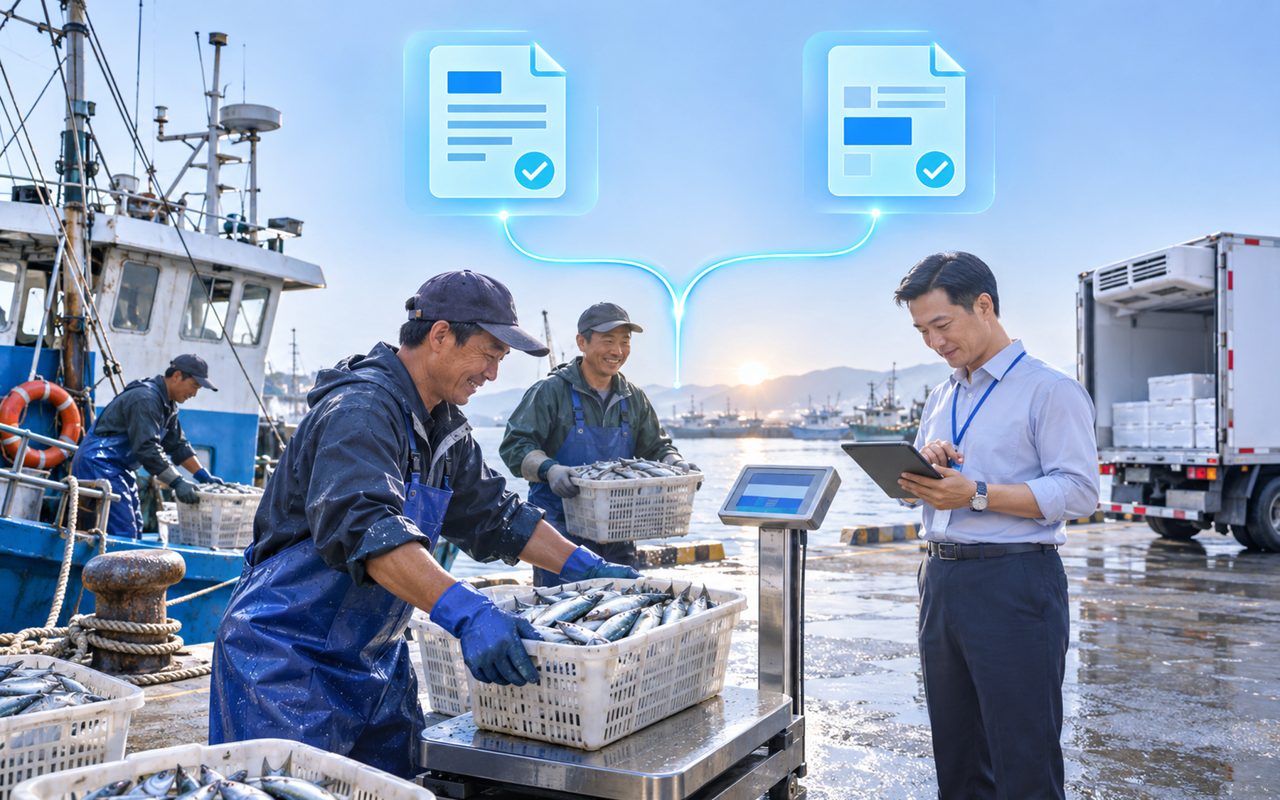
▍Prerequisite: what fishermen sell must be self-produced aquatic products
The "Notes on the Scope of Taxation of Agricultural Products" lists artificially stocked and artificially caught fish, shrimp, crabs, shellfish, etc. as aquatic products, and both marine fishing and aquaculture belong to agricultural production. Fishermen selling aquatic products they have caught or farmed themselves constitutes the sale of self-produced agricultural products by agricultural producers and is exempt from VAT.
It should be distinguished that middlemen at the dock and fishmongers who buy from fishermen and resell are not self-produced, cannot enjoy tax exemption, and cannot have purchase invoices issued for them by the purchasing enterprise. To prove self-production, commonly used materials include fishery fishing licenses, water area and mudflat aquaculture certificates, village committee certificates, etc., subject to the requirements of the competent tax authority.
▍Method one: fishermen apply to the tax authority to issue a tax-exempt ordinary invoice on their behalf
As a natural person, a fisherman may, with identity documents and proof of self-production, apply to the tax authority for issuance of a tax-exempt ordinary invoice on their behalf, issued to the purchasing enterprise. After the purchasing enterprise obtains this invoice, a general VAT taxpayer calculates the input VAT amount based on the purchase price stated on the invoice and the 9% deduction rate.
The characteristic of this method is that invoices are issued by the tax authority on behalf of the fisherman, who needs to handle it personally; it is suitable for situations with few transactions and large single amounts. The drawbacks are also obvious: fishermen's working hours at sea are irregular, a trip to the tax authority is costly, and when transactions are frequent it is difficult to apply for issuance on behalf of each transaction.
▍Method two: the purchasing enterprise issues an agricultural product purchase invoice
When a purchasing enterprise purchases self-produced aquatic products from individual fishermen, it may, as the payer, issue a self-issued agricultural product purchase invoice, and likewise calculate input VAT at the 9% deduction rate based on the purchase price. This method is completed by the enterprise side; fishermen only need to confirm the transaction and receive payment, making it suitable for aquatic product processing and wholesale enterprises with frequent dock receiving and a large number of fishermen.
Because the invoices are issued by the enterprise itself, the enterprise bears more responsibility for proving authenticity: fishermen's identity and self-production proof, weighing records, and payment records must all be retained. Kailing Technology's agricultural product purchase compliance solution is designed for this situation.
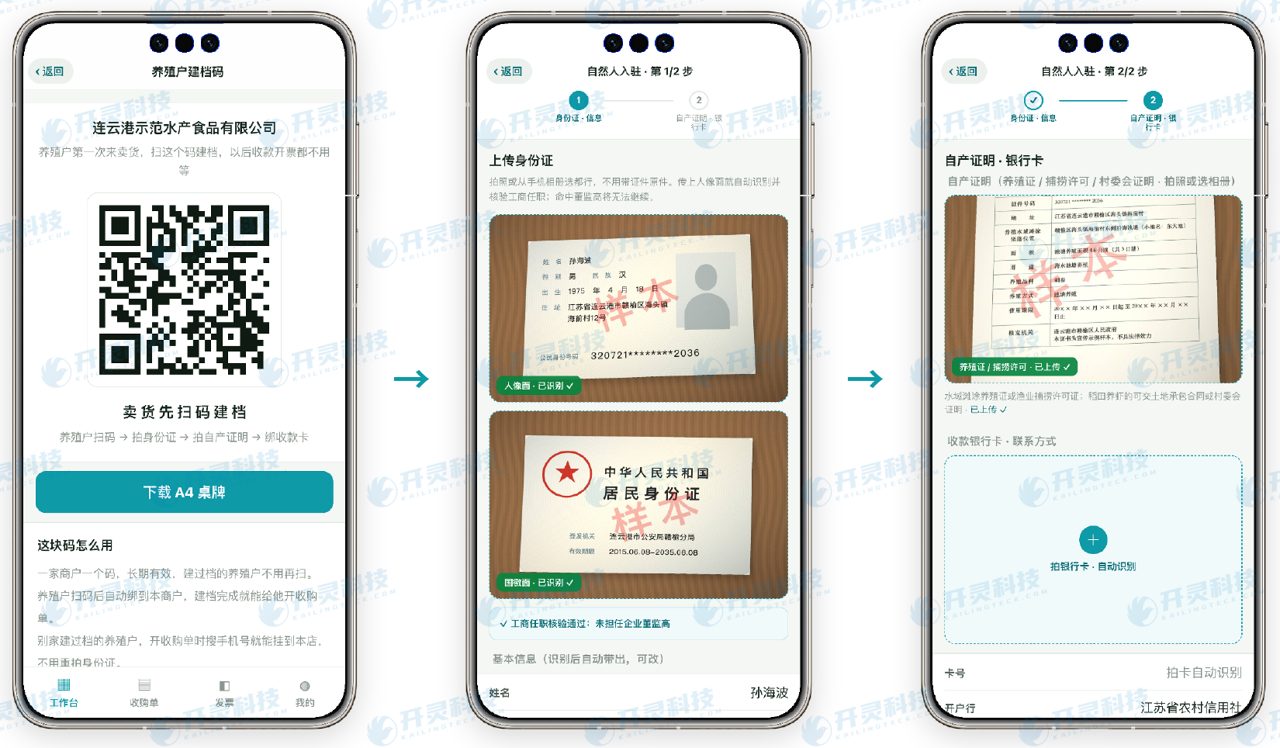
Kailing Technology fishing household file creation: upload farming certificate or fishing license (information desensitized)
▍Comparison of two invoicing methods: how to choose
The table below compares the two invoicing methods from three aspects: the entity handling the process, suitable scenarios, and the evidence the enterprise needs to retain.
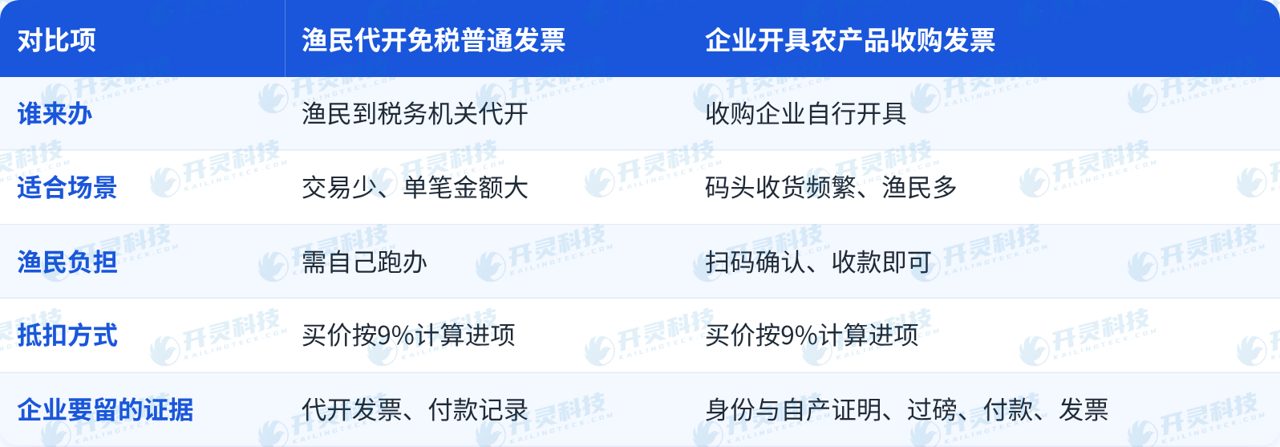
Comparison of two compliant invoicing methods for purchasing from fishermen
The two methods are not mutually exclusive. Enterprises can use purchase invoices for fishermen with long-term cooperation and frequent transactions, and ask fishermen with occasional transactions to have invoices issued on their behalf; the key is that every transaction has matching evidence.
▍How to achieve the integration of five flows in dock receiving
The process of Kailing Technology's agricultural product purchase compliance solution for receiving goods at the dock or pondside is: fishing households scan a code to create a file on their first delivery, upload their ID card, bank card, and fishing license or farming certificate, and complete real-name and facial verification; at receiving, select goods by category, weigh after draining water, enter the net weight, and attach the scale photo to the goods line; the fishing household confirms the purchase order with their own mobile phone, payment is made to their own bank card, and an agricultural product purchase invoice is issued synchronously upon successful payment.
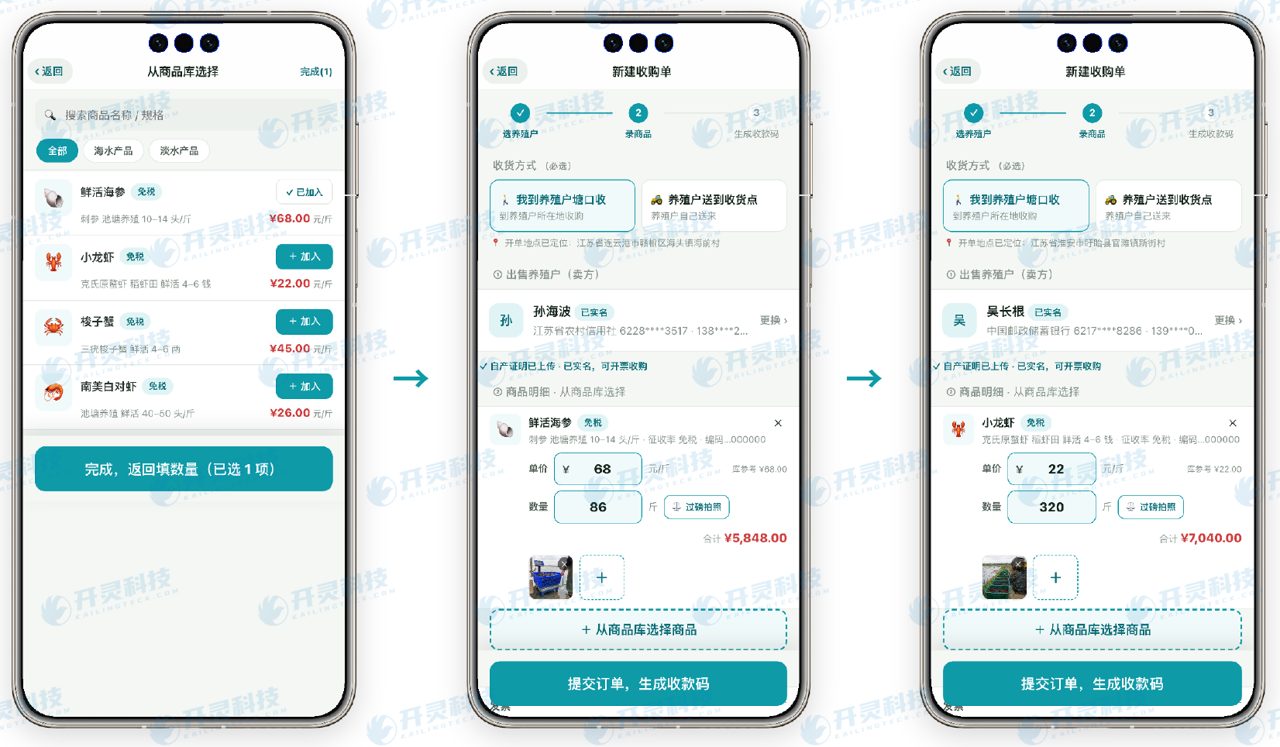
Kailing Technology pondside weighing: net weight and photos after draining water (information desensitized)
The five evidence chains—self-certification, contract, business, tax, and funds—are attached under the same purchase, one invoice one file. The system also flags abnormal delivery volumes: tax authorities in some regions have already, in practice, compared the amount of aquatic product purchase invoices with data such as fishing vessel capacity; where the delivery volume clearly exceeds the catching or farming scale, verification in advance is required.
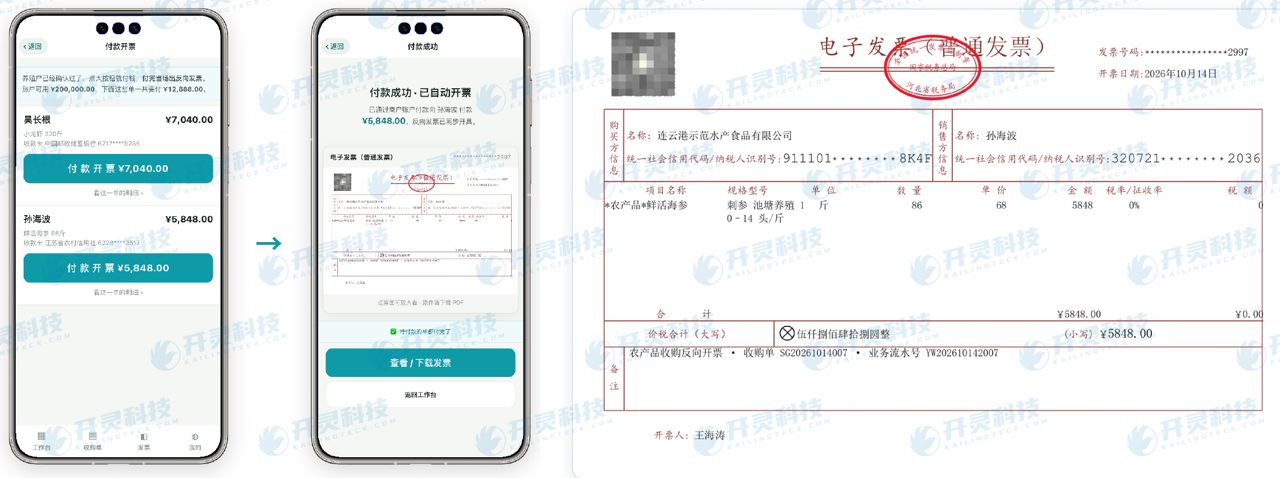
Kailing Technology aquatic product payment and invoicing (information desensitized)
| " The catch does not identify the person, but the invoice must: every transaction must be traceable back to that fisherman and that boatload of goods. |
▍Three details of dock receiving
First, draining and net weight. Aquatic products weighed with water will have inflated weight; they should be weighed after draining, the net weight recorded, and a photo of the scale retained. Second, category and specification. When the same fisherman delivers multiple varieties or specifications at one time, enter them by line, each corresponding to its unit price and photo, and generate details by line when invoicing. Third, cold chain and timeliness. Purchasing of fresh aquatic products is fast-paced; it is recommended that fishermen confirm by scanning the code on the boat or at the dock to reduce waiting time.
The mobile end of Kailing Technology's agricultural product purchase compliance solution supports offline photo taking at the dock and synchronization after connecting to the network, enabling normal operations even on shores with unstable networks.
▍A simple criterion for choosing an invoicing method
Enterprises can use two questions to determine which invoicing method to use: first, how many times this fisherman will come to sell in a year; second, whether the enterprise already has a system to support evidence retention for purchase invoices. If the number of sales is small and the enterprise has no system support yet, it is safer to have the fisherman issue invoices on their behalf; if sales are frequent, there are many fishermen, and the enterprise can already retain evidence across the five flows, self-issuing purchase invoices is more efficient. Both methods should be premised on self-production and based on real transactions.
▍Suggestions for internal division of labor within the enterprise
Receiving goods from fishermen involves three positions: dock receiver, quality inspector, and finance. The receiver is responsible for confirming that the deliverer matches the registered fishing household and for on-site weighing and photographing; quality inspection is responsible for determining category and specifications; finance is responsible for payment and invoicing, and monthly reviews whether each fishing household's delivery volume matches its fishing or farming scale. The three parties each complete their own steps in the system, and the data is linked under the same purchase order.
For enterprises using both invoicing methods at the same time, finance should also distinguish the booking and deduction of the two types of invoices: tax-exempt ordinary invoices issued on behalf are treated as obtained invoices, while purchase invoices are treated as self-issued; the two types of invoices are collected separately in the system, and quantities and amounts are reconciled at month-end to ensure no duplication and no omission.
▍Summary in one sentence
When purchasing from fishermen, there are only two paths to solving the invoice problem, and only one prerequisite: what the fishermen sell are aquatic products they have caught or farmed themselves. Choose the right path and retain complete evidence, and input tax deduction will be secure.
▍FAQ
Q: How do I obtain invoices when purchasing from fishermen?
A: There are mainly two methods: fishermen apply to the tax authority to issue a tax-exempt ordinary invoice on their behalf, or the purchasing enterprise issues an agricultural product purchase invoice itself when purchasing self-produced aquatic products from individual fishermen.
Q: Are fish from marine fishing considered self-produced and tax-exempt?
A: Aquatic products caught by fishermen themselves are self-produced agricultural products sold by agricultural producers and are exempt from VAT; products resold after transfer are not self-produced.
Q: How much can be deducted when purchasing aquatic products from fishermen?
A: General VAT taxpayers calculate the input tax amount based on the purchase price stated on the purchase invoice or the tax-exempt invoice issued on their behalf, using a 9% deduction rate.
Q: What proof needs to be retained when purchasing aquatic products from fishermen?
A: It is recommended to retain the fisherman's identity certificate, self-production proof such as a fishing license or aquaculture license, weighing records, payment receipts, and invoices.
If you want to solve the invoice problem in one go when purchasing from fishermen, you are welcome to learn about Kailing Technology's Agricultural Product Procurement Compliance Solution: https://www.kailingteck.com/fxncp/ .
As a national high-tech enterprise, Kailing Technology focuses on the digital and intelligent transformation of enterprise business-finance-tax and operations management, providing software products, system integration, implementation and delivery, and operational services for various government agencies, institutions, group enterprises, and SMEs.
The company has now formed ten core product lines, including: AI digital employee system, enterprise expense control management system, customer relationship management system, reverse invoicing management system, invoice issuance for individuals management system, electronic archives management system, tax fully digitalized e-invoice Leqi system, tax invoice management system, group tax filing system, and AI OCR recognition system. It is committed to connecting enterprise business, finance, tax, funds, and archive data to help customers improve operational efficiency, business-finance-tax compliance capabilities, and digital management levels.
If you have any business-finance-tax digital transformation needs, welcome to contact us. Beijing Kailing Technology will serve you wholeheartedly.
Keywords: How to solve the invoice problem when purchasing from fishermen, fishermen invoicing, aquatic product purchase invoice, fishermen tax-exempt invoice issued on their behalf, seafood purchase invoice, Kailing Technology Agricultural Product Procurement Compliance Solution, five-flow integration
As a comprehensive business-finance-tax digitalization solution service provider, Kailing Technology provides business-finance-tax management digital transformation products and operational services for various government agencies, institutions, and large, medium, and small enterprises. The product line includes: solutions for sales contract management system, procurement contract management system, fully digitalized Leqi interface project, automatic output invoicing system, reverse invoicing system, invoice issuance for individuals system, employee expense control and reimbursement system, input VAT invoice management system, supply chain collaborative reconciliation system, image AI OCR recognition system, automatic financial bookkeeping system, electronic accounting archives system, etc., comprehensively driving the digitalization process across various fields.
Consultation Hotline: 18513895936 / 010-60974119 Location: Beijing