
Is the property fee invoicing tax rate 6% or 9%? Choose the item name and tax category this way | Kailing Technology Leqi integrated-use solution
Is the property fee invoicing tax rate 6% or 9%? The answer is: the property fee itself is issued as property management service, with 6% applicable to general VAT taxpayers; while the parking fee collected at the same time by the property company is issued as real estate operating lease, with 9% applicable to general VAT taxpayers. Many property companies issue all items on one payment slip at the same tax rate, and that is where the problem lies. An owner's single payment often includes property fees, parking fees, collected water and electricity fees and even public area advertising income, and the tax categories and tax rates of different items are not the same. This article explains item by item how to choose the item name and tax category, and introduces how the Kailing Technology Leqi integrated-use solution achieves payment-triggered invoicing for owners and automatic itemization by item.

▍See at a glance in one table: tax categories and rates for common property charges
The figure below lists the four most common types of charges for property companies under the general taxpayer basis; small-scale taxpayers calculate by levy rate. The specific classification in the invoicing system and the determination of the competent tax authority shall prevail.
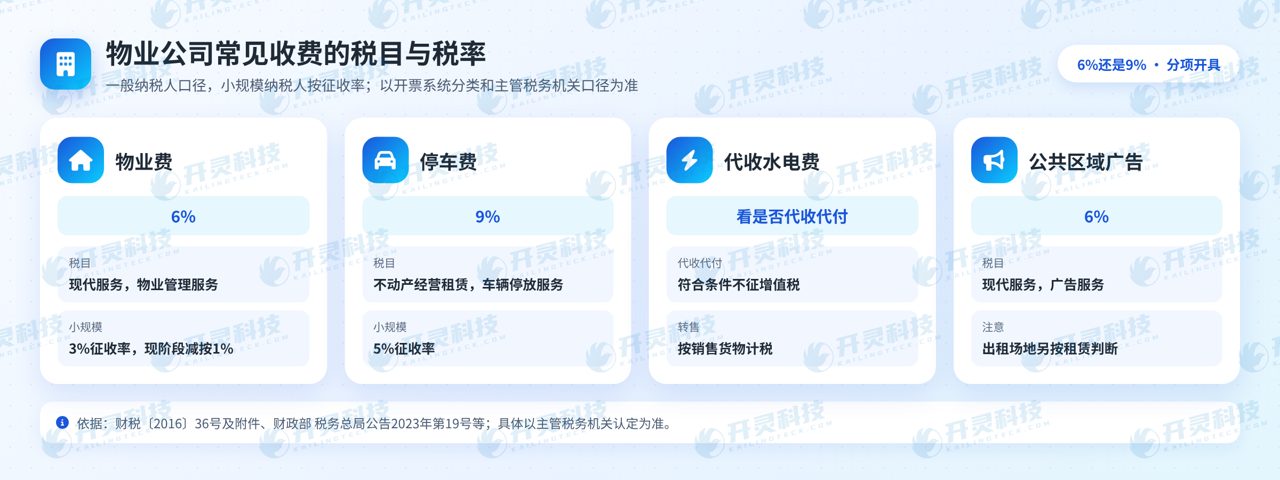
Tax categories and tax rates for common property management charging items
As can be seen from the figure, the difference between 6% and 9% does not lie in the entity "property company" but in what kind of service the fee item itself belongs to. Property fees are property management services under modern services, while parking fees are vehicle parking services under real estate operating lease; the two have different tax rates and should be invoiced separately.
▍Property fees: issue as property management service, with the item name clearly stated
When issuing property management fee invoices, the item name is generally written as "property management service" or "property service fee", and the corresponding property management service classification in the invoicing system is selected; the tax rate for general VAT taxpayers is 6%; small-scale taxpayers apply a 3% levy rate, currently reduced to 1% as required, with the policy in effect until December 31, 2027.
It is recommended that item names be consistent with the property service contract and payment notice, and that the room number and billing period be stated in the remarks, for example "Building X, Room X, Community X, Month X to Month X, Year X." This makes reimbursement for owners and reconciliation for the property company more convenient. If the property fee includes charges such as shared public energy consumption, whether they are part of the property service fee should be confirmed according to the contract.
▍Parking fees, utilities, advertising fees: judged separately
Parking fees
The vehicle parking fee for owners or visitors belongs to real estate operating lease services, with a 9% tax rate for general taxpayers; eligible taxpayers may choose simplified taxation at 5%, and small-scale taxpayers apply a 5% levy rate. Fully digitalized e-invoices are issued under the specific business of real estate operating lease and require information such as the real estate address.
Collected water and electricity fees
Where a property company collects water and electricity fees on behalf of water and power supply units and meets the conditions for collection and payment on behalf, it is not the property company's sales revenue; where the property company resells water and electricity in its own name, tax is calculated as sales of goods. In practice this part is most likely to cause disputes; it is recommended to confirm with the competent tax authority according to the actual business model.
Advertising income in common areas
Income from advertising in the community's common areas is generally issued as advertising services, with a 6% tax rate for general taxpayers; if the site is leased to others for operation, it is judged as real estate leasing. The attribution of advertising income also involves the distribution of income from owners' common areas, and property companies should handle it according to the contract.
| "One payment, multiple items, itemized invoicing, so the tax rate is never wrong." |
▍Invoicing upon owner payment: how the process works
The owner pays through the mini program, official account, or property fee collection system. After payment is completed, the system automatically splits the invoicing details by the fee items on the payment slip: the property fee line is issued as property management service, the parking fee line is issued as vehicle parking service, and different items correspond to different tax rates. The invoice is automatically pushed to the owner's mobile phone, the invoicing result is written back to the property fee collection system, and finance can reconcile by room number and period with one click.
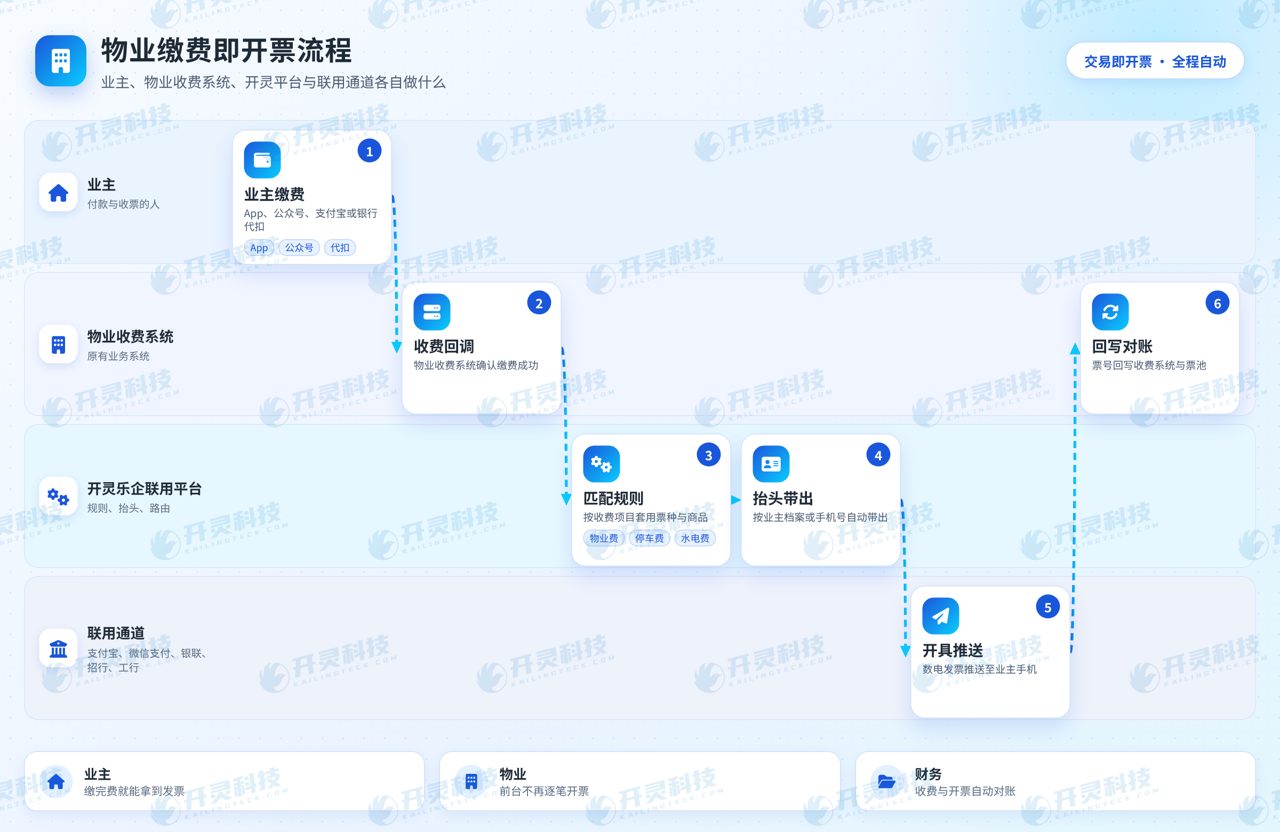
Diagram of division of responsibilities for payment-triggered invoicing in property management
Under the Leqi integrated model, payment and invoicing are completed by a payment institution or bank holding the integrated qualification, and the original transaction data is generated in its system; the property fee collection system needs to accurately pass information such as room number, fee item, and billing period so that the correct invoice can be issued.
▍Kailing Technology Leqi integrated solution: itemization rules and multiple channels configured at once
The difficulty for property companies lies in many charging items, many payment channels and many residential communities. The Kailing Technology Leqi integrated-use solution integrates between the property charging system and the integrated-use channel: tax classifications and tax rates are preset by charging item, parking fees automatically complete the required information under the specific business of real estate operating lease; whether owners pay by WeChat, Alipay or bank card, invoices are issued under the same set of rules; invoicing entities for multiple communities and multiple project companies are configured separately.
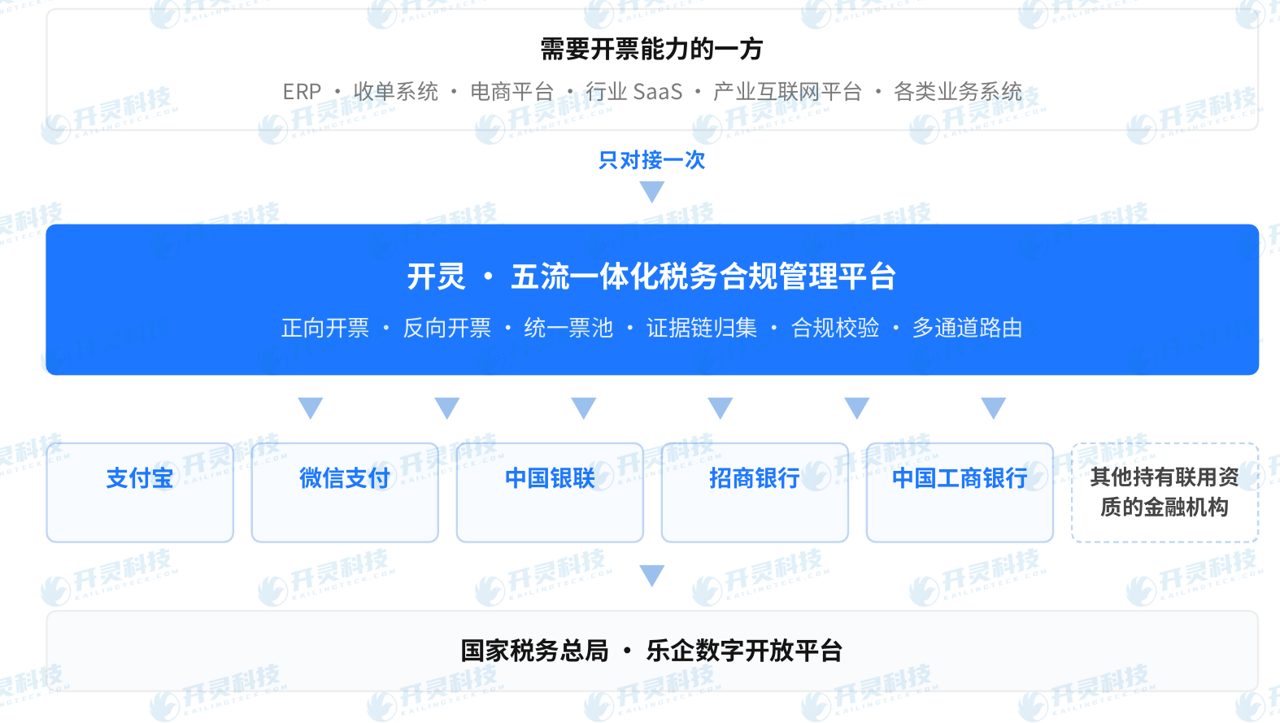
Kailing Technology Leqi integrated-use hub: property system integration in one step
The table below summarizes the items that property companies need to confirm when configuring invoicing rules.

Property company invoicing rule configuration checklist
▍An example: how one payment slip is split into invoice line items
Suppose the owner pays one quarter of property fees and parking fees at once, plus collected water fees. The system processes as follows: the property fee line, with the item name property management service, is issued at the tax rate applicable to the property company, with the room number and billing period in the remarks; the parking fee line is issued as vehicle parking service under the specific business of real estate operating lease, with the parking lot real estate information filled in and the parking space number or license plate in the remarks; collected water fees handled as collection and payment are not included in the property company's invoice and are issued by the water supply unit as agreed or handled separately.
After this split, the owner receives one or several invoices with clear line items, the property company's revenue is accounted for separately by tax category, and the data can be directly reconciled at month-end filing.
▍Three common invoicing questions for property companies
First, all items are invoiced under a single tax rate. The most common cases are merging parking fees into property fees and issuing at 6%, or conversely issuing everything at 9%, both of which cause tax category and tax rate errors. Second, the invoicing timing for prepaid property fees. Where an owner prepays property fees for multiple years at once, the invoicing timing should be determined based on the actual receipt of payment or provision of services, and the specifics should be confirmed with the competent tax authority. Third, owners request invoices made out to a company. Where a tenant or corporate owner requests a special VAT invoice, the name and taxpayer identification number must be provided, and the system issues the invoice under the entity's name.
Write the handling standards for these issues into the invoicing rules and configure them in the system, so the front desk does not have to judge each time.
▍FAQ
Q: Is the property fee invoicing tax rate 6% or 9%?
A: Property fees are issued as property management service, with a 6% tax rate for general taxpayers; parking fees are issued as real estate operating lease, with a 9% tax rate for general taxpayers.
Q: What item does property fee invoicing fall under?
A: Generally it is issued as property management service under modern services; the item name can be written as property management service or property service fee, subject to the classification in the invoicing system.
Q: What rate does a small-scale property company apply to property fees?
A: The 3% levy rate applies, currently reduced to 1% as required, with the policy in effect until December 31, 2027; real estate leasing such as parking fees applies a 5% levy rate.
Q: Can invoices be issued automatically after the owner pays?
A: Yes. Through the Leqi integrated approach, after the owner completes payment, invoices are automatically split by fee item and pushed to the mobile phone; the Kailing Technology Leqi integrated solution handles integration with the fee collection system.
To achieve itemized invoicing and error-free tax rates for property payments, welcome to learn about the Kailing Technology Leqi integrated-use solution: https://www.kailingteck.com/leqi-lianyong/ .
As a national high-tech enterprise, Kailing Technology focuses on the digital and intelligent transformation of enterprise business-finance-tax and operations management, providing software products, system integration, implementation and delivery, and operational services for various government agencies, institutions, group enterprises, and SMEs.
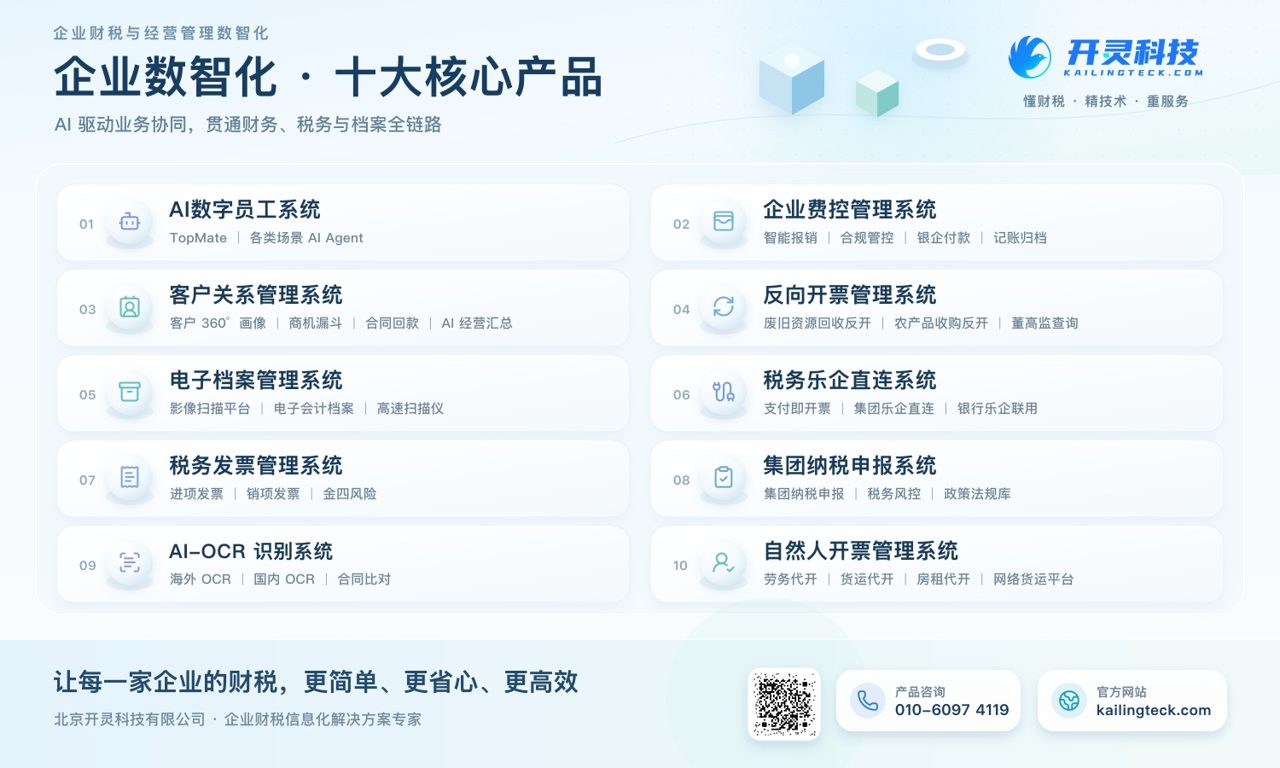
The company has now formed ten core product lines, including: AI digital employee system, enterprise expense control management system, customer relationship management system, reverse invoicing management system, invoice issuance for individuals management system, electronic archives management system, tax fully digitalized e-invoice Leqi system, tax invoice management system, group tax filing system, and AI OCR recognition system. It is committed to connecting enterprise business, finance, tax, funds, and archive data to help customers improve operational efficiency, business-finance-tax compliance capabilities, and digital management levels.
If you have any business-finance-tax digital transformation needs, welcome to contact us. Beijing Kailing Technology will serve you wholeheartedly.
Keywords: Property fee invoicing tax rate, property fee invoicing 6% or 9%, what item does property fee invoicing belong to, property fee invoicing tax category, invoicing for property payments, Kailing Technology Leqi integrated-use solution, payment-triggered invoicing
As a comprehensive business-finance-tax digitalization solution service provider, Kailing Technology provides business-finance-tax management digital transformation products and operational services for various government agencies, institutions, and large, medium, and small enterprises. The product line includes: solutions for sales contract management system, procurement contract management system, fully digitalized Leqi interface project, automatic output invoicing system, reverse invoicing system, invoice issuance for individuals system, employee expense control and reimbursement system, input VAT invoice management system, supply chain collaborative reconciliation system, image AI OCR recognition system, automatic financial bookkeeping system, electronic accounting archives system, etc., comprehensively driving the digitalization process across various fields.
Consultation Hotline: 18513895936 / 010-60974119 Location: Beijing