
Difficulties and risks of timber procurement invoices: logging permit and tally sheet are both indispensable | Kailing Technology agricultural product procurement compliance solution

Where are the difficulties and risks of timber procurement invoices? Enterprises that have done panel processing and timber operations mostly have this experience: it is unclear whether the forestry farmer's product is self-produced, the log volume cannot be measured accurately, there are many orders and invoicing is slow, and whenever a tax inspection comes, materials must be supplemented everywhere. At the national level, there is no single document listing item by item which proofs must be attached to timber procurement invoices, but from the three aspects of self-production attribute, transaction authenticity and measurement basis, logging proof and tally sheets are the two most critical links in the evidence chain; without either link, the procurement invoice is hard to sustain. This article sorts out the four difficulties of timber procurement invoicing and the corresponding risks, and introduces how the Kailing Technology agricultural product procurement compliance solution links logging permits, tally sheets and invoices.
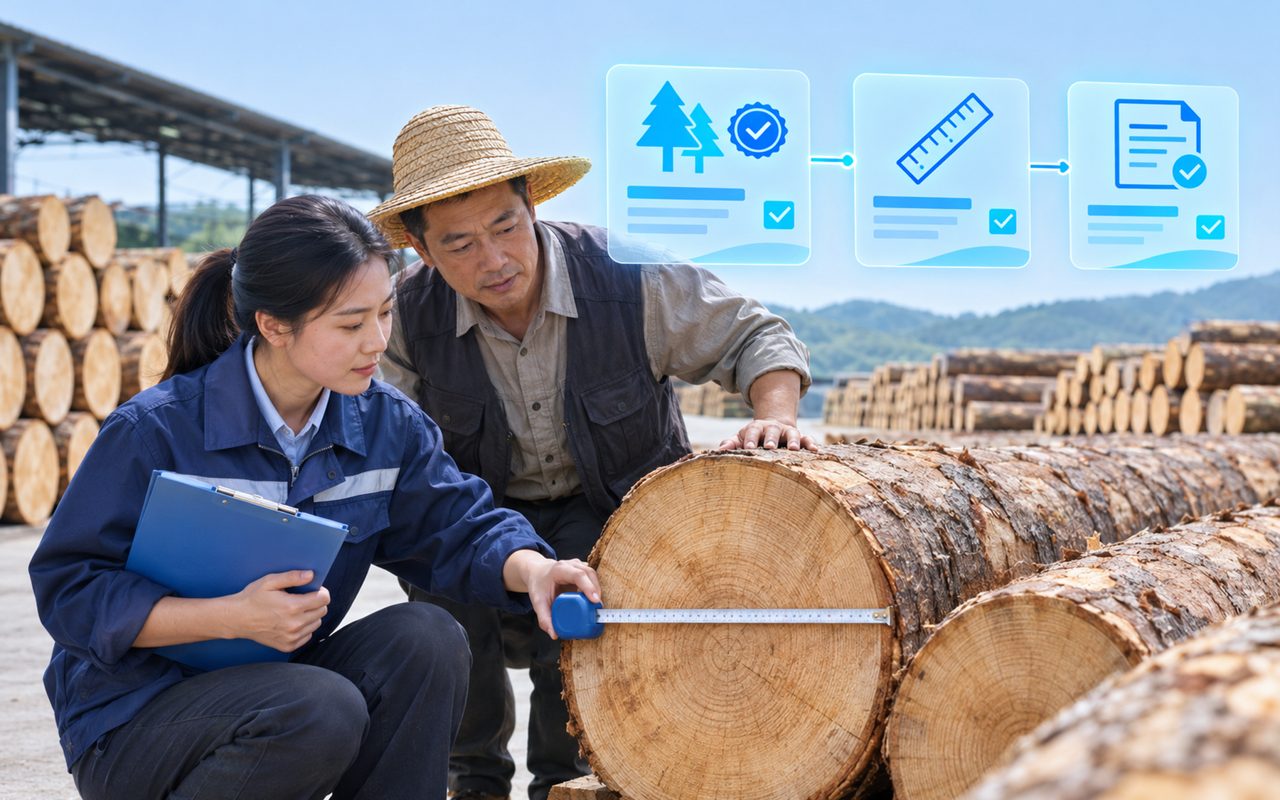
▍Challenge one: self-produced status is unclear
The sale of self-produced agricultural products by agricultural producers is exempt from VAT; forest farmers selling trees they planted and felled fall within this scope, and only then can the purchasing enterprise issue an agricultural product purchase invoice for them. The problem is that in the timber purchase chain, forest farmers, mountain-contract households, and timber traffickers are often mixed together, and who is the true forest owner is not always clear.
To prove self-production, common materials include forest rights certificates or forest land contracting and transfer contracts, as well as certificates issued by the village committee. If the seller cannot provide forest land ownership materials, or the delivery volume clearly exceeds the scale of their forest land, be alert to whether it is timber trafficking. Traffickers do not qualify as self-production, and the purchasing enterprise may not issue purchase invoices for them.
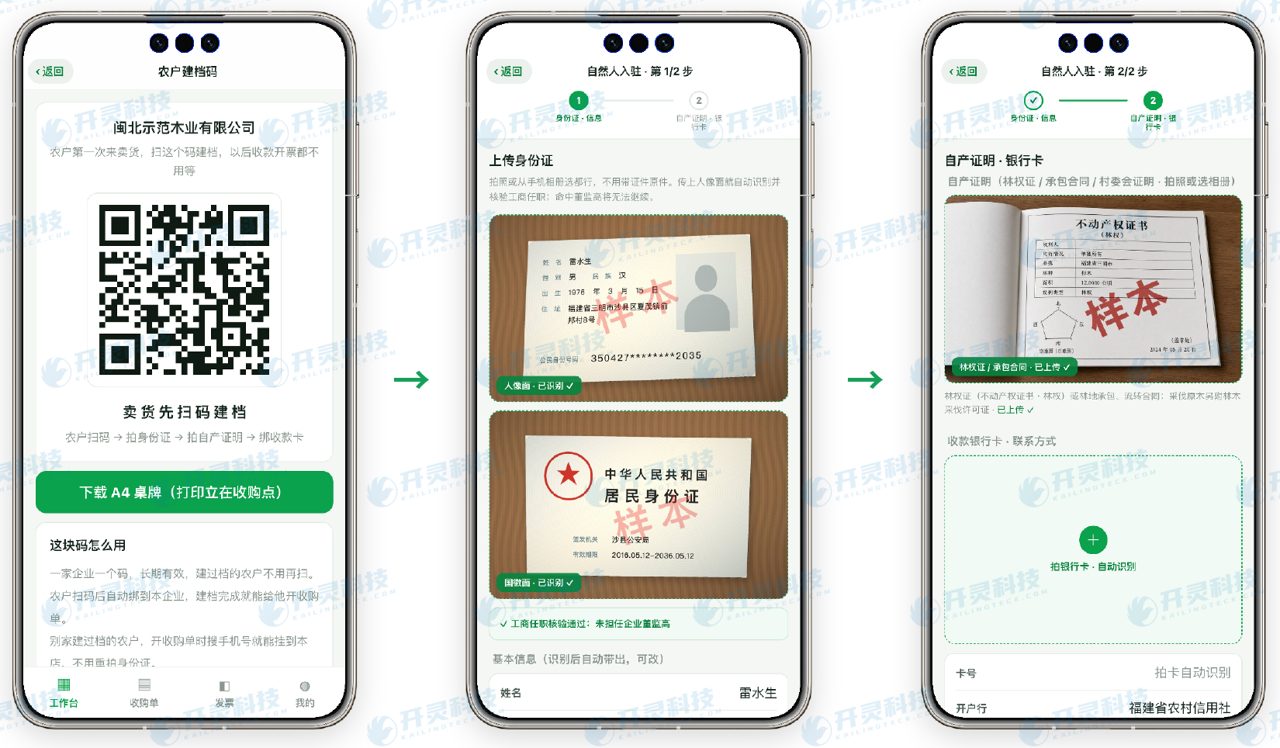
Kailing Technology forestry farmer filing: upload forestry rights and contracting materials (information desensitized)
▍Challenge two: the felling source must be legal
The Forest Law of the People's Republic of China (revised in 2019, effective July 1, 2020) provides that felling trees on forest land should in principle require a felling permit and be carried out in accordance with the permit, and also sets out exceptions where no application is required. For timber purchasing enterprises, the felling permit is both proof of legal felling and important evidence that the source of this batch of timber is traceable.
After the same law was revised, the timber transport permit was abolished from July 1, 2020, and the transport link no longer uses the transport permit as a voucher. Therefore, the past practice of relying on the transport permit to prove the source no longer applies, and the felling certificate is more important in the evidence chain. Some regions have also imposed supplementary evidence requirements for timber flowing in from other provinces and non-forest-land timber; for example, the Guangxi forestry department proposed in a 2026 reply to a proposal that felling permits, village committee filing certificates, and transportation system data may serve as the basis for timber purchase invoicing. Enterprises should pay attention to local specific requirements.
| "After the transport permit was abolished, the felling certificate became the most critical link in the timber source." |
▍Challenge three: the measurement basis must be verifiable
Timber procurement is settled by volume or number of pieces; logs must be tallied piece by piece, with volume calculated by diameter class and length, and moso bamboo counted by piece. The tally sheet or yard sheet records the measurement result of each piece of timber and is the direct basis for the settlement amount and invoice quantity. A mismatch between the tally result and the settlement or invoiced quantity is a common doubt in inspections.
Kailing Technology agricultural product procurement compliance solution supports entry of logs by cubic meter and moso bamboo by piece; photos of the tally sheet are attached directly to the procurement order, the settlement quantity is brought out from the tally result, and the invoiced quantity is kept consistent with it.
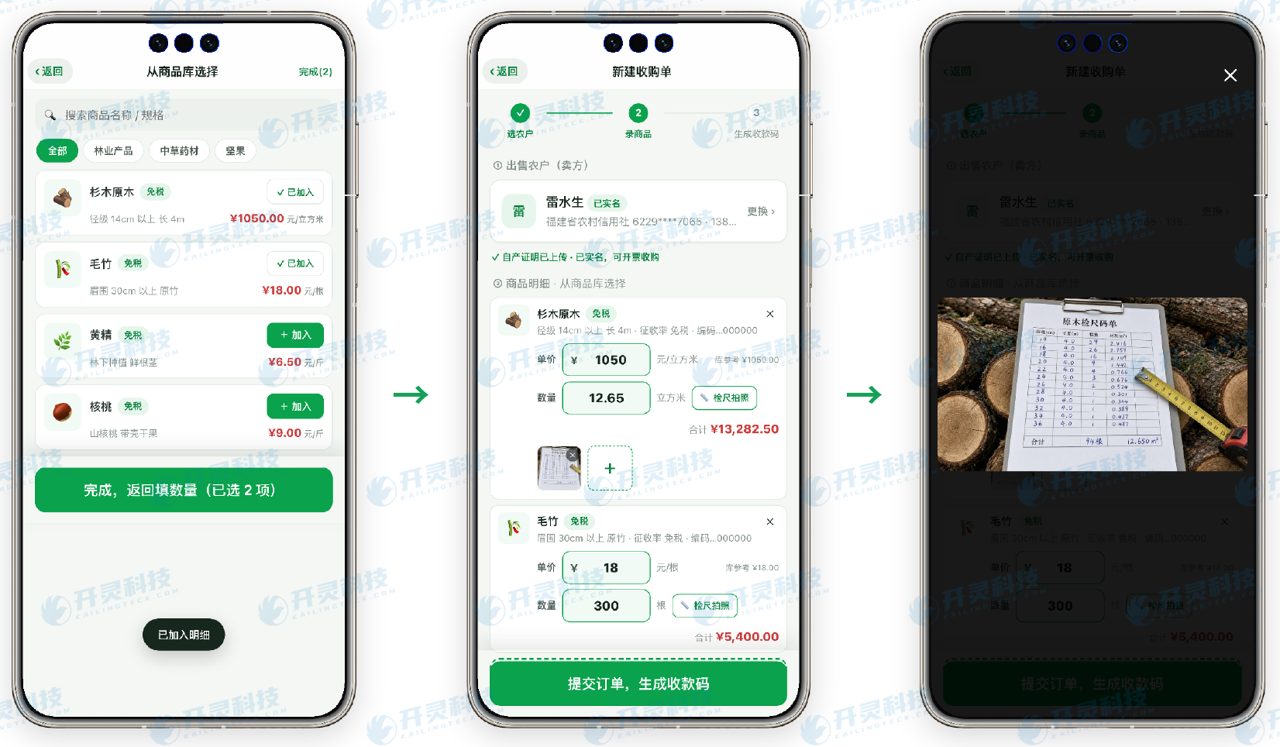
Kailing Technology tally entry: log tally sheets retained with the order (information desensitized)
▍Challenge four: many orders and large volume, slow invoicing
Timber procurement is often concentrated in the logging season, with dozens of truckloads a day at one yard; in the past, invoicing and payment were manual, and invoicing clerks could not keep up even with overtime. The Kailing Technology solution links tallying, settlement, payment and invoicing together: payment is made after the forestry farmer personally confirms the procurement order, and upon successful payment the procurement invoice is issued synchronously; batch invoicing is supported in peak season.
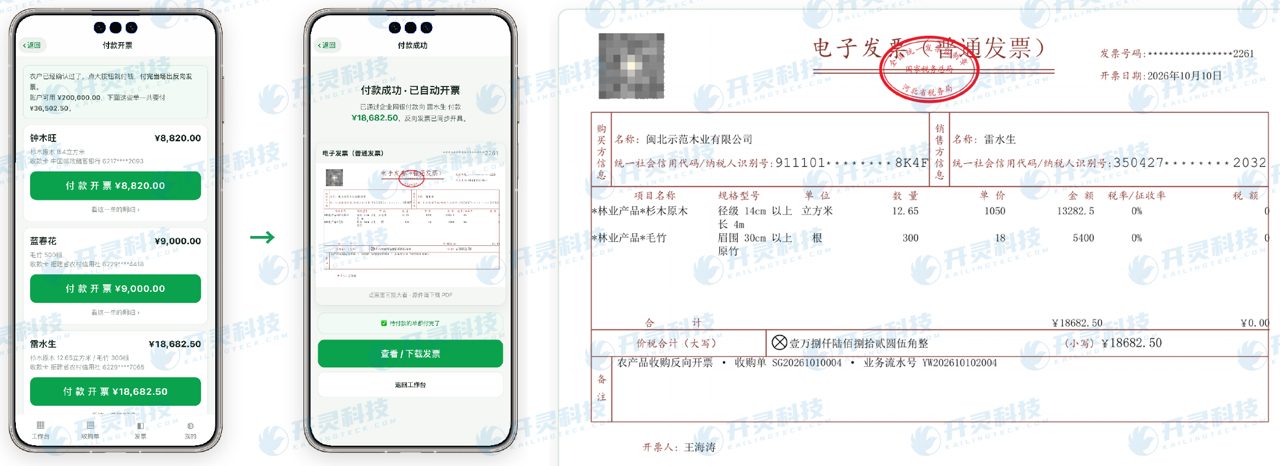
Kailing Technology forestry product payment-triggered invoicing (information desensitized)
▍Risk comparison: what happens if a link is missing
Looking at the above difficulties together, the risks of timber procurement invoices are mainly concentrated in the following categories.
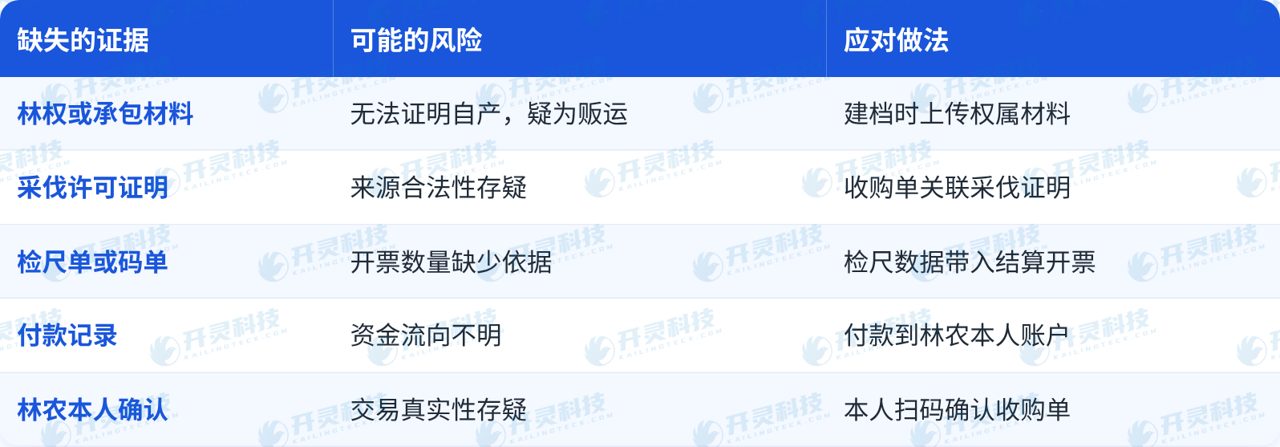
Comparison of evidence-missing risks for timber procurement invoices
These five items correspond to the five-flows-in-one approach of Kailing Technology's agricultural product procurement compliance solution: self-proof, contract, business, tax, and funds—five lines of evidence archived around the same procurement, with strong verification of the identity, contract, and goods flows before invoicing.
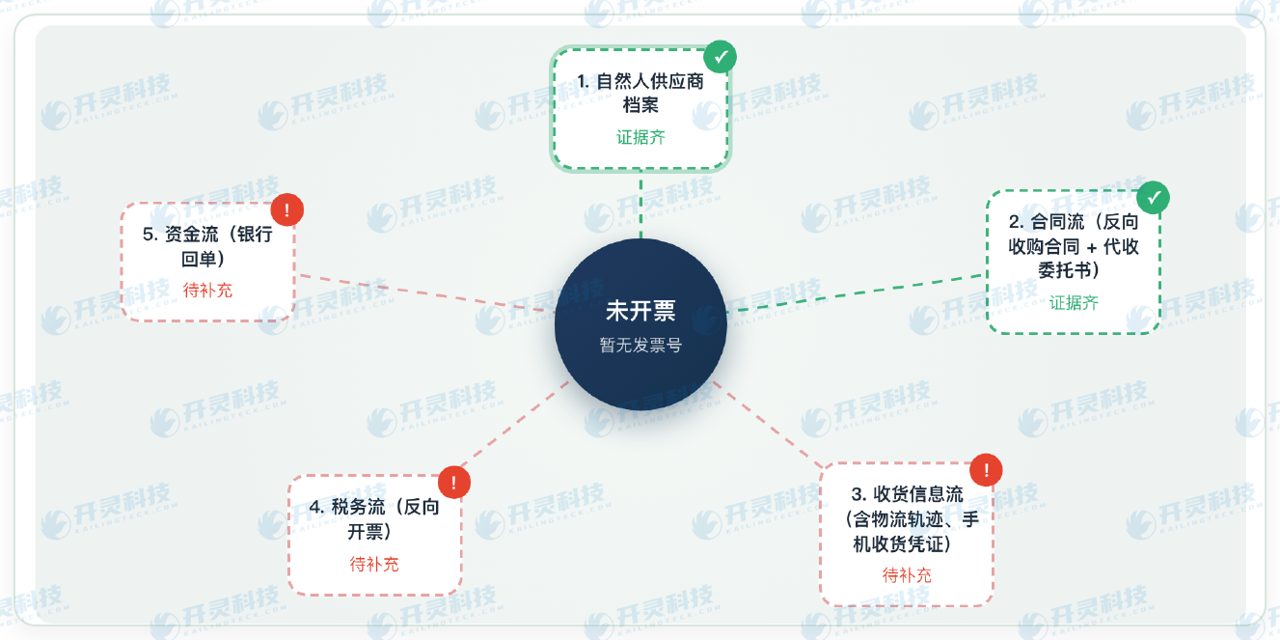
Kailing Technology five-streams star-chain diagram: invoice only when evidence is complete (information desensitized)
▍Recommended daily practices for timber purchasing enterprises
First, complete filing before the forest farmer's first delivery; ownership materials and logging permits are uploaded once, and subsequent logging on the same plot can be directly linked. Second, take photos simultaneously during log scaling at the yard, with the scale ticket corresponding to the log pile location, to avoid after-the-fact supplementary entry. Third, settlement is based on the scaling results; the product of unit price and volume is calculated by the system, with manual work limited to confirmation. Fourth, payment goes to the forest farmer's own account, not to an intermediary. Fifth, review monthly whether delivery volume matches forest land area, and verify anomalies promptly.
These five practices may seem trivial, but each corresponds to the questions most frequently asked during verification. Done routinely, there is no need to scramble to supplement materials during verification.
| "With a permit for felling, a slip for measurement, and evidence for payment, the timber purchase invoice holds up." |
▍Requirements may differ by region
The supporting evidence requirements for timber procurement invoices may be refined in various localities on the basis of national regulations. For example, in a 2026 reply to a CPPCC proposal, the Guangxi forestry department proposed the "four unifications" working approach, clarifying that logging permits, village committee filing certificates, transportation system data, etc. may be used as the basis for timber procurement invoicing, and put forward requirements for supporting evidence of timber flowing in from other provinces and timber logged on non-forest land; some places also allow small forestry farmers to replace part of the vouchers with a village committee self-production certificate plus a authenticity commitment.
These are local regulatory practices, not uniformly applicable nationwide. Enterprises purchasing timber across provinces should pay attention to both the requirements of the timber source location and those of the enterprise's location, communicate with the competent tax authority for confirmation when necessary, and configure the materials to be uploaded by region in the system.
▍Summary in one sentence
The difficulties of timber procurement invoices ultimately come down to one question: how to prove that this batch of timber comes from real forestry farmers, legal logging and accurate measurement. String together the five pieces of evidence - forestry rights, logging, tally, payment and invoice - and the difficulties become a checklist that can be checked item by item.
▍FAQ
Q: Is a felling permit required for timber purchase invoices?
A: There is no uniformly listed mandatory checklist at the national level, but a felling permit certificate is important supporting evidence of legal timber source and self-produced status; it is recommended to keep it linked with the purchase order and to pay attention to local specific requirements.
Q: Is a timber transport permit still required?
A: No. The revised Forest Law took effect on July 1, 2020, and the timber transport permit has been abolished.
Q: Can purchase invoices be issued for timber delivered by timber traffickers?
A: No. Timber trafficking is not the sale of self-produced agricultural products by agricultural producers, and the invoice should be issued by the seller in accordance with regulations.
Q: Why is the log scaling slip important?
A: The log scaling slip records the log volume or the number of bamboo poles and is the direct basis for the settlement amount and invoiced quantity; the invoiced quantity should be consistent with the scaling result.
To match logging permits, tally sheets and invoices in timber procurement, welcome to learn about the Kailing Technology agricultural product procurement compliance solution: https://www.kailingteck.com/fxncp/ .
As a national high-tech enterprise, Kailing Technology focuses on the digital and intelligent transformation of enterprise business-finance-tax and operations management, providing software products, system integration, implementation and delivery, and operational services for various government agencies, institutions, group enterprises, and SMEs.
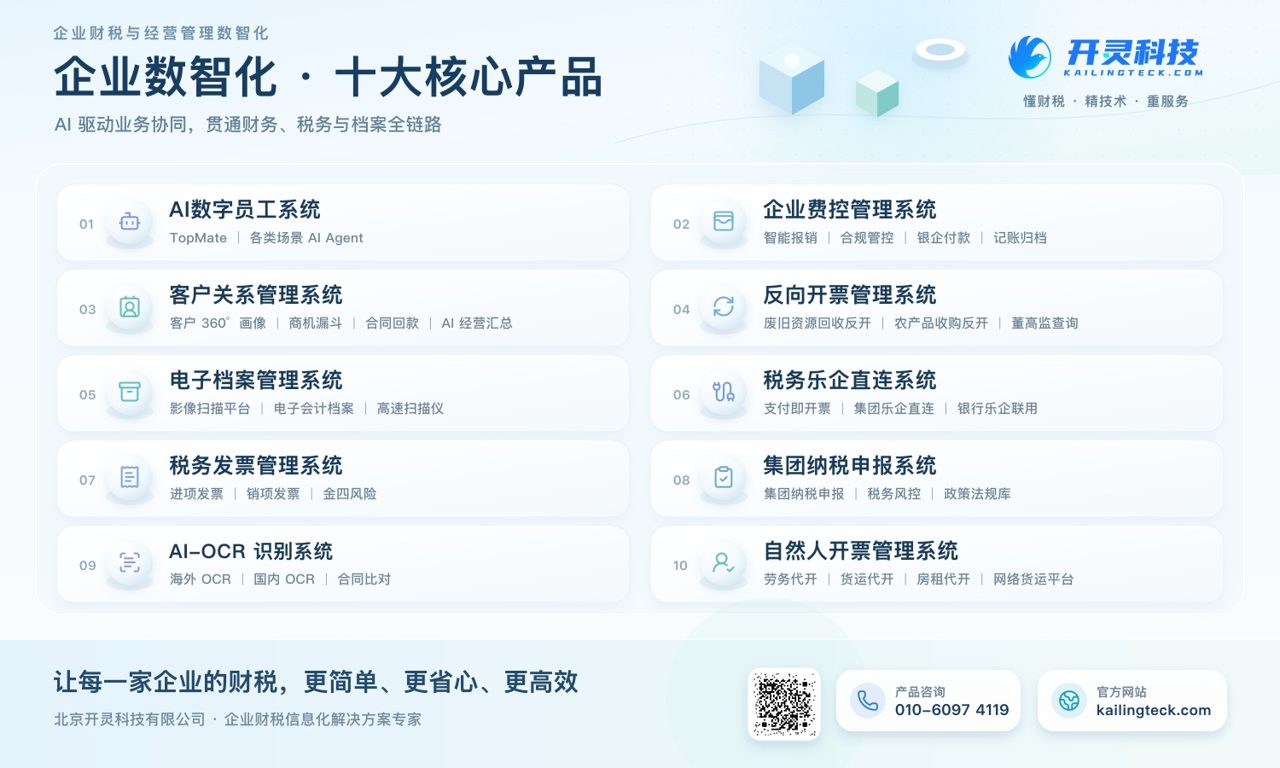
The company has now formed ten core product lines, including: AI digital employee system, enterprise expense control management system, customer relationship management system, reverse invoicing management system, invoice issuance for individuals management system, electronic archives management system, tax fully digitalized e-invoice Leqi system, tax invoice management system, group tax filing system, and AI OCR recognition system. It is committed to connecting enterprise business, finance, tax, funds, and archive data to help customers improve operational efficiency, business-finance-tax compliance capabilities, and digital management levels.
If you have any business-finance-tax digital transformation needs, welcome to contact us. Beijing Kailing Technology will serve you wholeheartedly.
Keywords: Timber procurement invoice difficulties, timber procurement invoice risks, how to issue timber procurement invoices, logging permit, tally sheet, Kailing Technology agricultural product procurement compliance solution, forestry product procurement invoice
As a comprehensive business-finance-tax digitalization solution service provider, Kailing Technology provides business-finance-tax management digital transformation products and operational services for various government agencies, institutions, and large, medium, and small enterprises. The product line includes: solutions for sales contract management system, procurement contract management system, fully digitalized Leqi interface project, automatic output invoicing system, reverse invoicing system, invoice issuance for individuals system, employee expense control and reimbursement system, input VAT invoice management system, supply chain collaborative reconciliation system, image AI OCR recognition system, automatic financial bookkeeping system, electronic accounting archives system, etc., comprehensively driving the digitalization process across various fields.
Consultation Hotline: 18513895936 / 010-60974119 Location: Beijing